From Potential to Performance

Posted by Hogan Assessments on Tue, Apr 03, 2012

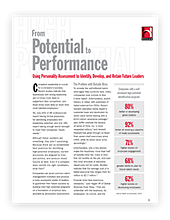
Competent leadPotential2ership is crucial for a company’s success. Recent studies indicate that businesses with strong leadership are 13 times more likely to outperform their competition, and three times more likely to retain their most talented employees.

Yet, only 44% of HR professionals report having formal processes for identifying employees with leadership potential, and only 18% report having enough bench strength to meet the future requirements of the company.

From Potential to Performance” examines how organizations can use personality assessment to identify, develop, and retain talented employees.

Topics: leadership, high potential

From Potential to Performance

Posted by Hogan Assessments on Mon, Apr 02, 2012

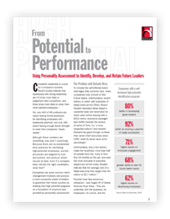
Competent leadPotential2ership is crucial for a company’s success. Recent studies indicate that businesses with strong leadership are 13 times more likely to outperform their competition, and three times more likely to retain their most talented employees.

Yet, only 44% of HR professionals report having formal processes for identifying employees with leadership potential, and only 18% report having enough bench strength to meet the future requirements of the company.

From Potential to Performance” examines how organizations can use personality assessment to identify, develop, and retain talented employees.

Topics: high potential

5 Essentials of Execution

Posted by Hogan Assessments on Wed, Mar 28, 2012

Companies invest countless man hours and billions of dollars every year in pursuit of one thing – the next big idea. However, what separates the most successful companies from their competitors often isn’t a better product, service, or business plan, but their ability to move quickly and efficiently from idea to implementation.

Although it seems fundamental, many companies struggle to execute their business strategies. “5 Essentials of Execution” outlines the necessary steps organizations can take to build a culture of getting things done.

ABCs of Derailment

Posted by Dustin Hunter on Fri, Mar 23, 2012

Over the course of several feedback sessions, I’ve noticed that the vast majority of individuals prefer the euphemism over-used strengths to derailers when speaking about results on the Hogan Development Survey. I hadn’t really put much thought to this phenomenon until I came across an article in Talent Management magazine by Anthony Gigliotti. He presents the literal analogy of over-used strengths to weight lifting; further, too much lifting or over-exercise can be detrimental to our muscles which are the mechanism to achieving performance. Gigliotti argues that a break-even point occurs when using strengths that, when exceeded, quickly become unfavorable. Achieving a balance between maximizing strengths while mitigating the harmful effects is the obvious challenge. This article continues with several coaching techniques for talent managers to support strong leaders, which I have adapted into a model closely resembling behavior analysis:

Focus on how a strength contributes to success

Focus on how a strength detracts from success

ANTECEDENTS
Identify the cues or breakeven point BEHAVIORS
Strategic self-awareness / modification COACHING

Gigliotti’s first set of techniques are largely situational. Tasking a leader to focus on contextual clues or others’ reactions to gauge positive or negative impact is asking a lot. This could add complexity to an already overwhelming feedback session. When interpreting the HDS, a light-bulb moment can occur if you draw the connection to various antecedents that trigger derailers such as specific groups of people (i.e. boss versus direct report), or simply provide examples of when, where, or what setting the leader has received feedback they have been excitable, diligent, etc. This modification also controls for perceptive ability.

The second technique is largely the same. In a Hogan example, the excitable scale starts out as energetic and intense means to an end; however, becomes over-used when yelling or volatile reactions emerge. Keep in mind there are situations that never quite cross the line into derailing behavior…think of the Wall Street trading floor or an effective prosecutor.

Finally, the last strategy of behavior modification through strategic self-awareness is hinged on accurate results, a willingness to change and a strategic coach who can tie all these pieces together. The reason a 1:1 model doesn’t completely shake out in this instance (consequence ? coaching) is due to: leaders failing to see the impact of their derailing behaviors on others, actor-observer bias, and/or negative reinforcement via their office ‘bulldozer’ reputation.

Gigliotti effectively states, “Regardless of the excuses, effective leadership requires constant reputation management. If over-exercised strengths are damaging productivity, effectiveness or working relationships with others, then it’s time to consider a modified approach.”

ABCs of Derailment

Posted by Hogan Assessments on Thu, Mar 22, 2012

Over the course of several feedback sessions, I’ve noticed that the vast majority of individuals prefer the euphemism over-used strengths to derailers when speaking about results on the Hogan Development Survey. I hadn’t really put much thought to this phenomenon until I came across an article in Talent Management magazine by Anthony Gigliotti. He presents the literal analogy of over-used strengths to weight lifting; further, too much lifting or over-exercise can be detrimental to our muscles which are the mechanism to achieving performance. Gigliotti argues that a break-even point occurs when using strengths that, when exceeded, quickly become unfavorable. Achieving a balance between maximizing strengths while mitigating the harmful effects is the obvious challenge. This article continues with several coaching techniques for talent managers to support strong leaders, which I have adapted into a model closely resembling behavior analysis:

Focus on how a strength contributes to success

Focus on how a strength detracts from success

ANTECEDENTS
Identify the cues or breakeven point BEHAVIORS
Strategic self-awareness / modification COACHING

Gigliotti’s first set of techniques are largely situational. Tasking a leader to focus on contextual clues or others’ reactions to gauge positive or negative impact is asking a lot. This could add complexity to an already overwhelming feedback session. When interpreting the HDS, a light-bulb moment can occur if you draw the connection to various antecedents that trigger derailers such as specific groups of people (i.e. boss versus direct report), or simply provide examples of when, where, or what setting the leader has received feedback they have been excitable, diligent, etc. This modification also controls for perceptive ability.

The second technique is largely the same. In a Hogan example, the excitable scale starts out as energetic and intense means to an end; however, becomes over-used when yelling or volatile reactions emerge. Keep in mind there are situations that never quite cross the line into derailing behavior…think of the Wall Street trading floor or an effective prosecutor.

Finally, the last strategy of behavior modification through strategic self-awareness is hinged on accurate results, a willingness to change and a strategic coach who can tie all these pieces together. The reason a 1:1 model doesn’t completely shake out in this instance (consequence ? coaching) is due to: leaders failing to see the impact of their derailing behaviors on others, actor-observer bias, and/or negative reinforcement via their office ‘bulldozer’ reputation.

Gigliotti effectively states, “Regardless of the excuses, effective leadership requires constant reputation management. If over-exercised strengths are damaging productivity, effectiveness or working relationships with others, then it’s time to consider a modified approach.”

Why Nations Fail

Posted by Robert Hogan on Wed, Mar 21, 2012

Hogan and Chamorro-Premuzic argue that all large scale social phenomena---wars, economic disasters, etc.—can be explained in terms of personality. For individual lives, character is fate, and the fate of nations (and other organizations) depends on the character of the leaders. Put more simply, who is in charge really matters. When competent people direct organizations, the organizations tend to prosper, and so do the individual incumbents. When incompetent people are in charge, bad things happen to organizations and to the incumbents. 

This is a gloomy generalization because so many leaders are incompetent—we estimate that the base rate of managerial incompetence in corporate American is at least 50%. For politicians, the figure seems much higher, but we have no systematic data. 

Acermoglu and & Robinson have recently provided extensive historical documentation for the view that the fate of organizations depends on the character of the leaders. With apologies to the authors, I can summarize their argument as follows. First, all people are selfish and opportunistic, and some people are more skilled at gaining status in organizations than others. As a result, the tops of organizational hierarchies contain a large percentage of people who are politically talented but largely motivated by greed and selfishness. Second, power corrupts, and, of course, absolute power corrupts absolutely. Third, in organizations where the rules (and mechanisms of enforcement) against corruption and self-dealing are weak, leaders will loot. Fourth, kleptocratic organizations funnel economic output toward parasitic elites, and this misdirection of financial resources discourages innovation and investment. Fifth, these systems are self-perpetuating; the plunder empowers the corrupt elite, and following generations of leaders have strong incentives to keep the system going. Finally, then, reform from within rarely happens which makes the long term failure of these organizations inevitable. 

Three examples illustrate these points. First, consider the histories of Spain and England in the 17th and 18th centuries. Both started as medieval monarchies (tyrannies), but the English monarchs had slightly less control. When the great European overseas explorations began in the 17th century, the Spanish monarchs controlled trade, whereas in England, trade was controlled by “privateers”. Riches from the Americas solidified Spanish tyranny but created an elite merchant class in England. The English revolution of 1688 secured the rights of the merchant class, counterbalanced the landed aristocracy (the kleptocrats), and set the conditions for further world class economic growth—in contrast with Spain, where the aristocracy remained in control. 

Second, Central and South America contained dense populations ripe for plundering, and the Spanish put governments in place to make it happen—“it” means funneling wealth to the Spanish aristocracy. Unfortunately for the British, the populations of their North American colonies were dispersed, which made them hard to enslave. As a result, colonial governors created market incentives for the early settlers in Virginia and Massachusetts, and the subsequent pluralism created American industry and wealth—in contrast with the lingering poverty of the Spanish Americas.  

Third, in Venice, during the early stages of its economic development, there was a partnership between the rich Venetians who built the merchant fleet and the sailors who manned the fleet; the profits from the voyages were shared, creating upward mobility for the sailors. Starting in the late 1400s, greed got the best of the ruling class, trade was nationalized (and profits were no longer shared), so that, by 1500, the decline of Venice as a great power was well underway. 

I would like to highlight three lessons from the forgoing discussion. The first is the obvious point that power corrupts and leaders will steal when they can. The second lesson is that robust regulatory institutions (the bête noire of conservatives) are needed to keep the power elite in check; corruption will always be with us, at every level of government, but corruption is worse in Nairobi than in Chicago—because there are more controls on the greed of powerful people. But finally, consider the individual psychological dynamic underlying these themes. It is “engagement”. To the degree that the citizens of a country or members of an organization feel that they can in some way participate in and share the fortunes of their collective, they will work toward and support the goals of the enterprise. Engagement is not merely a contemporary HR fad, it is a potent dynamic underlying the fate of nations. Successful organizations depend on competent leadership, which creates subordinate engagement; conversely, bad leadership alienates the subordinates and ruins organizations.  

Why Nations Fail

Posted by RHogan on Tue, Mar 20, 2012

Hogan and Chamorro-Premuzic argue that all large scale social phenomena—wars, economic disasters, etc.—can be explained in terms of personality. For individual lives, character is fate, and the fate of nations (and other organizations) depends on the character of the leaders. Put more simply, who is in charge really matters. When competent people direct organizations, the organizations tend to prosper, and so do the individual incumbents. When incompetent people are in charge, bad things happen to organizations and to the incumbents. 

This is a gloomy generalization because so many leaders are incompetent—we estimate that the base rate of managerial incompetence in corporate American is at least 50%. For politicians, the figure seems much higher, but we have no systematic data. 

Acermoglu and & Robinson have recently provided extensive historical documentation for the view that the fate of organizations depends on the character of the leaders. With apologies to the authors, I can summarize their argument as follows. First, all people are selfish and opportunistic, and some people are more skilled at gaining status in organizations than others. As a result, the tops of organizational hierarchies contain a large percentage of people who are politically talented but largely motivated by greed and selfishness. Second, power corrupts, and, of course, absolute power corrupts absolutely. Third, in organizations where the rules (and mechanisms of enforcement) against corruption and self-dealing are weak, leaders will loot. Fourth, kleptocratic organizations funnel economic output toward parasitic elites, and this misdirection of financial resources discourages innovation and investment. Fifth, these systems are self-perpetuating; the plunder empowers the corrupt elite, and following generations of leaders have strong incentives to keep the system going. Finally, then, reform from within rarely happens which makes the long term failure of these organizations inevitable. 

Three examples illustrate these points. First, consider the histories of Spain and England in the 17th and 18th centuries. Both started as medieval monarchies (tyrannies), but the English monarchs had slightly less control. When the great European overseas explorations began in the 17th century, the Spanish monarchs controlled trade, whereas in England, trade was controlled by “privateers”. Riches from the Americas solidified Spanish tyranny but created an elite merchant class in England. The English revolution of 1688 secured the rights of the merchant class, counterbalanced the landed aristocracy (the kleptocrats), and set the conditions for further world class economic growth—in contrast with Spain, where the aristocracy remained in control. 

Second, Central and South America contained dense populations ripe for plundering, and the Spanish put governments in place to make it happen—“it” means funneling wealth to the Spanish aristocracy. Unfortunately for the British, the populations of their North American colonies were dispersed, which made them hard to enslave. As a result, colonial governors created market incentives for the early settlers in Virginia and Massachusetts, and the subsequent pluralism created American industry and wealth—in contrast with the lingering poverty of the Spanish Americas.  

Third, in Venice, during the early stages of its economic development, there was a partnership between the rich Venetians who built the merchant fleet and the sailors who manned the fleet; the profits from the voyages were shared, creating upward mobility for the sailors. Starting in the late 1400s, greed got the best of the ruling class, trade was nationalized (and profits were no longer shared), so that, by 1500, the decline of Venice as a great power was well underway. 

I would like to highlight three lessons from the forgoing discussion. The first is the obvious point that power corrupts and leaders will steal when they can. The second lesson is that robust regulatory institutions (the bête noire of conservatives) are needed to keep the power elite in check; corruption will always be with us, at every level of government, but corruption is worse in Nairobi than in Chicago—because there are more controls on the greed of powerful people. But finally, consider the individual psychological dynamic underlying these themes. It is “engagement”. To the degree that the citizens of a country or members of an organization feel that they can in some way participate in and share the fortunes of their collective, they will work toward and support the goals of the enterprise. Engagement is not merely a contemporary HR fad, it is a potent dynamic underlying the fate of nations. Successful organizations depend on competent leadership, which creates subordinate engagement; conversely, bad leadership alienates the subordinates and ruins organizations.  

Developing a Global Mindset

Posted by Jarrett Shalhoop on Mon, Mar 19, 2012

Last week I attended the Developing Leaders for Global Roles Summit at the Thunderbird Najafi Global Mindset Institute in Glendale, Arizona. The summit brought together academics and practitioners from around the world to discuss the concept and issues surrounding global leadership, and approaches to closing the talent gaps that virtually every organization experiences. The stories and insights from the other attendees were enlightening, so I thought I’d summarize a few of the takeaways here in our blog.

First, this will come as no surprise, but nobody is defining their problem in terms of a surplus of global leadership talent. Talent in this area is particularly scarce and extremely valuable. This is a prime battle in the broader war for talent.

Second, gooGlobed leadership skills do not necessarily generalize to a global setting. Leadership skills are distinct from having a global perspective, and successful global leadership requires both. The folks at Thunderbird have a robust body of research on the concept of global mindset, complete with a measurement tool (the Global Mindset Inventory, or GMI) and taxonomy of skills and attributes. The good news is that global mindset can be developed. The bad news is that not nearly enough organizations are actively developing global mindsets in their leadership talent pools or organizations. 

Third, success in a global environment requires not just leaders that think globally, but an entire organization that sees itself as global and thinks in those terms. Making this transition is difficult. For example, moving from being a U.S.-based business that works in China to an organization that does business in both the U.S. and China is a big adjustment, and requires commitment from the entire workforce. From this perspective, global mindset is an organizational development issue, not just a leadership development issue.

So what are people doing to move towards a global organization? I heard a few things from a fantastic lineup of speakers, including:

  • Building cross-cultural work teams. These might be traditional or virtual work teams, but getting some exposure to different people, different business cultures, and different ways of thinking is key.
  • Spending time in-country. Most of the speakers agreed that there is no substitute for spending time in another culture. If you want to do business in Japan, for example, you need to get over there and really get a first-hand feel for the way things work. This is difficult and expensive, but also provides tremendous development.
  • Debriefing past experiences. After projects are implemented, the project teams sit down and replay the scenario, debriefing what decisions were made, and how things could have been done differently. This is probably good practice for any significant project, but hearing the story from others with a different cultural perspective can provide valuable insight that might not have been acquired through the process of just getting the work done.
  • Targeting global mindset specifically through development programs. This is relatively new, but seems like a great idea. The GMI and other assessments are being integrated into development programs to help people recognize their own tendencies (individual and cultural), and how to think outside of those constraints.

It’s a cliché – but no less true – to say it’s a global business environment. Those who can adapt to this playing field will be more successful. Those who impose their ways of doing things onto other culture will struggle. Developing leaders who can be successful in the global business environment will be critical, and the Global Najafi Global Mindset Institute is doing a lot of great work to help organizations meet this challenge.

Topics: leadership development, global leadership, developing leaders, leadership skills

Developing a Global Mindset

Posted by Hogan Assessments on Sun, Mar 18, 2012

Last week I attended the Developing Leaders for Global Roles Summit at the Thunderbird Najafi Global Mindset Institute in Glendale, Arizona. The summit brought together academics and practitioners from around the world to discuss the concept and issues surrounding global leadership, and approaches to closing the talent gaps that virtually every organization experiences. The stories and insights from the other attendees were enlightening, so I thought I’d summarize a few of the takeaways here in our blog.

First, this will come as no surprise, but nobody is defining their problem in terms of a surplus of global leadership talent. Talent in this area is particularly scarce and extremely valuable. This is a prime battle in the broader war for talent.

Second, gooGlobed leadership skills do not necessarily generalize to a global setting. Leadership skills are distinct from having a global perspective, and successful global leadership requires both. The folks at Thunderbird have a robust body of research on the concept of global mindset, complete with a measurement tool (the Global Mindset Inventory, or GMI) and taxonomy of skills and attributes. The good news is that global mindset can be developed. The bad news is that not nearly enough organizations are actively developing global mindsets in their leadership talent pools or organizations. 
Third, success in a global environment requires not just leaders that think globally, but an entire organization that sees itself as global and thinks in those terms. Making this transition is difficult. For example, moving from being a U.S.-based business that works in China to an organization that does business in both the U.S. and China is a big adjustment, and requires commitment from the entire workforce. From this perspective, global mindset is an organizational development issue, not just a leadership development issue.

So what are people doing to move towards a global organization? I heard a few things from a fantastic lineup of speakers, including:

  • Building cross-cultural work teams. These might be traditional or virtual work teams, but getting some exposure to different people, different business cultures, and different ways of thinking is key.
  • Spending time in-country. Most of the speakers agreed that there is no substitute for spending time in another culture. If you want to do business in Japan, for example, you need to get over there and really get a first-hand feel for the way things work. This is difficult and expensive, but also provides tremendous development.
  • Debriefing past experiences. After projects are implemented, the project teams sit down and replay the scenario, debriefing what decisions were made, and how things could have been done differently. This is probably good practice for any significant project, but hearing the story from others with a different cultural perspective can provide valuable insight that might not have been acquired through the process of just getting the work done.
  • Targeting global mindset specifically through development programs. This is relatively new, but seems like a great idea. The GMI and other assessments are being integrated into development programs to help people recognize their own tendencies (individual and cultural), and how to think outside of those constraints.

It’s a cliché – but no less true – to say it’s a global business environment. Those who can adapt to this playing field will be more successful. Those who impose their ways of doing things onto other culture will struggle. Developing leaders who can be successful in the global business environment will be critical, and the Global Najafi Global Mindset Institute is doing a lot of great work to help organizations meet this challenge.

Topics: global leadership, developing leaders

SIOP 2012 Session: Do Values Really Differ by Generation? A Multi-Assessment Review

Posted by Info Hogan on Fri, Mar 16, 2012

SIOPDrs. Kevin Meyer and Jeff Foster will participate in a group forum discussing one of the most popular topics in management training and development – managing workers from different generations. Results will be presented that represent a unique and comprehensive examination of generational differences in individual workplace values and interests to test the popular assumption that differences exist between generations. The session will be held Friday, April 27 at the 27thAnnual SIOP Conference in San Diego.

Topics: values, SIOP

Subscribe to our Blog

Most Popular Posts

Connect