Maximizing Team Potential

Posted by Hogan Assessments on Tue, Jul 26, 2022

The logo for the Science of Personality podcast, which covers maximizing team potential in episode 55.

Corporate team building done right can make productivity skyrocket. Maximizing team potential starts with understanding how personality influences our behavior at work.

Recently on The Science of Personality, cohosts Ryne Sherman, PhD, chief science officer, and Blake Loepp, PR manager, spoke with Jennifer Lowe, MA, director of professional services at Hogan, about how to build a successful team and maximize team potential.

High-performing teams play a critical role in overall organizational performance. Personality sits at the core of team success.

Let’s dive into what makes corporate teams successful, how to build trust in a team, how personality influences teams, and more.

Characteristics of Successful Teams

Successful teams—the high-performing ones full of camaraderie—have these foundational qualities in common:

  • a high level of trust
  • transparent communication
  • clear goals
  • a focus on psychological safety

Members of effective teams trust each other and communicate well with each other. “When I get in the room with many leadership teams, I pretty immediately know how the session is going to go,” Jennifer said. The level of team trust is apparent in team members’ interactions. To fulfill team potential, team members need alignment on what matters and clarity about what the objectives are.

In successful teams, team members can offer constructive criticism about an idea without worrying that they’re putting their careers at risk. This characteristic of successful teams is part candid communication and part psychological safety.

It all circles back to trust. “We’re a team together and a team apart,” Jennifer said. “We can support the vision and mission of both the team and the broader organization.”

Challenges to Fulfilling Team Potential

Understanding team challenges is important for fulfilling team potential. According to Jennifer, teams that struggle often have a lack of clarity about the mission. Nothing derails a team faster than mismatched objectives. This could be caused by individuals having different objectives or by team objectives that have increased or changed.

Another common team challenge is when the team acts with too much aspiration and sets unreachable goals. A highly innovative or ambitious team can aim for big results at the risk of overlooking the tactical details of their ideas or failing to communicate their vision to others. Overambitious teams benefit from pragmatic members who will ensure the team’s ideas are actionable.

Teams get derailed when they fail to acknowledge the natural evolution or dissolution of a team. For instance, a team might meet on Tuesdays at 3:00 p.m. because they always have. However, they may not be the right task force to accomplish a new objective—and nobody wants to be the person to say so.

“It’s so interesting how powerful something like auditing the communications of the team and action planning can be,” Jennifer added.

How Personality Influences Team Performance

The Hogan personality tests measure reputation: how we communicate with others, how we make decisions, our sense of urgency, and much more. “When we leverage a personality assessment within teams, it tells us collectively how the team shows up, the way they communicate, and what they’re known for within their organization,” Jennifer said. 

A reputational awareness exercise can help team members understand how they are seen by other business units. It also allows the team to build trust and define their operating norms, overall trends, and themes within the team. Team development reveals individual strengths and potential performance challenges, as well as how those impact team performance.

Personality can also influence division of labor within a team. Teams maximize performance when all members capitalize on their strengths to support the whole. Personality data allows team members to unpack how each other operates and how they will engage day to day.

“Understanding how personality can impact team performance helps people understand each other better,” Jennifer said.

Best Practices for Team Development

Every team development initiative requires a customized approach based on team dynamics. When an organization asks Hogan for help maximizing team potential, the Hogan team begins with discovery. Who’s on the team, and what are the goals of team development? Are there new team members, or is there a new team leader? Is the goal to encourage team connection, or is it to refine team strategy?

Before the team session, individual team members should understand their personal strengths, challenges, and values. Well-validated personality tests are useful to communicate this information objectively. This can help set the stage for team development.

“Maximizing team potential starts with individual self-awareness,” Jennifer said. “We want to know what a successful outcome looks like—what the team is trying to achieve—but we also want the individuals within the team to focus on self-awareness.”

Effective team development sessions end with action planning. Understanding how individual strengths fit within the team culture won’t cause any change unless the team commits to actions that drive them toward higher performance.

Team Building Tips for Leaders

If you’re building a team from scratch, start with selecting the right members for the team. A strong selection process is one that is based on data-driven talent insights and behavioral characteristics that will best support the team’s key goals.

Another point to consider when building a brand-new team is whether it’s needed at all. A team is not a solution to every problem, so be sure you are clear on why the team is necessary and what its objectives are. Ask whether you are building a team for the right reasons.

If you, the leader, are the new element in the team, don’t underestimate the impact of your predecessor and yourself on the team’s culture. Culture is set by the values of leaders, so a new leader changes the dynamic of the team even more than new team members do.

If you fear your team is dysfunctional, identify likely causes for derailment. Jennifer explained, “If a team is operating in derailer mode, it may be that they have change fatigue, have reorganized too many times, or are uncertain about objectives.” To improve performance, go back to the basics: the team’s objective, its communication, its culture, and individual self-awareness.

“Teams that make the biggest improvements towards their full potential make these changes part of their day-to-day interactions within the team,” Jennifer said.

Listen to this conversation in full on episode 55 of The Science of Personality. Never miss an episode by following us anywhere you get podcasts. Cheers, everybody!


Topics: teams

Getting the Most Out of Your Job Interviews

Posted by Hogan Assessments on Tue, Jul 26, 2022

Two people, whose faces are not visible in the frame, exchange a clipboard over a wooden conference table. The people are preparing for structured job interviews. The conference table also holds a couple of notebooks, a binder, and some envelopes. There are large windows visible on the side of the table opposite the camera.

Perhaps one of the most common tools to inform hiring decisions is the job interview. There are a few likely reasons for this. To start, job interviews have been around since the 1920s. Second, people typically want to meet the person that they could be working with to determine whether they might be right for the job. In interviews, you get a sense for someone’s social style, likelihood of aligning with the culture, ability to communicate, experiences, and ability to do the job. Lastly, interviews have strong face validity, which means people tend to perceive them as being fair and accurate.

When job interviews are at their best, they can be used to assess whether someone’s skills, experiences, and other key characteristics are aligned with the job, which allows for better hiring decisions. This makes the interview a powerful tool for selection. However, the problem is that all interviews are not created equal.

Bias and Error in Job Interviews

When interviews aren’t designed well, bias and error can impact judgments made in the interview.1,2 An interviewer who has a more favorable impression of the candidate, for example, will likely ask fewer questions compared to applicants for whom they have less favorable impressions.3 In addition, an interviewer’s opinion of an applicant can show through nonverbal communication, affecting the candidate’s responses.4 These errors, among others, can provide some candidates with an advantage or disadvantage over others. For example, the candidate who is asked more questions has more opportunities to show strengths or potential weaknesses.

One way to mitigate some of the potential for error in interviews is to consider the structure of the interview.5 Interviews fall on a spectrum between being unstructured and structured. Those that are unstructured typically follow a more organic or conversational approach. Using this approach, the interviewer asks questions they believe fit the requirements of the job. The interviewer may or may not provide a rating of the candidate’s responses to the questions. Interviewers adopting an unstructured approach likely don’t ask every candidate the same questions and think of questions as the interview progresses.

Unstructured Interviews

This unstructured way of interviewing is common in organizations. One reason for this is that an interviewer gets to ask the questions they think are relevant to the job. If you provide an interviewer with a set of questions beforehand and ask them to “stick to the script,” they might think the list of questions is missing important components of the job. Another reason interviewers might favor the unstructured approach is because they can ask candidates questions they believe are relevant to each person.

These reasons might seem to justify unstructured interviews, but they can create problems. While interviewers might want to ask questions relevant to the job, some of their perceptions about what is required could be erroneous. For example, interviewers might assume a candidate should have a certain skill prior to being hired for a job. But it is also possible someone who learns that skill on the job will perform equally as well as an incumbent employee who entered the job with that skill.

Another example could be an interviewer who has a preconceived notion about psychology majors lacking business savvy. This might lead the interviewer to hold an overall negative impression of an applicant with a psychology degree. The interviewer might be inclined to ask that candidate more questions about business yet ask fewer business questions of a candidate with a business degree. This is unfair. Worse, this overall negative impression could be communicated indirectly or even nonverbally, causing a negative reaction from the candidate.

These are just a couple of examples of how bias and errored thinking can influence the unstructured interview process and why it could be helpful to consider a more structured interview.

Structured Interviews

In contrast to unstructured interviews, highly structured interviews are typically guided by questions planned beforehand. The questions themselves are based on the knowledge, skills, abilities, and other characteristics (KSAOs) that have been proven to be related to the job. The questions are typically asked in the same order for every candidate, and the rating options for each question are anchored with behaviors the ratings represent. Structuring the interview in these ways helps to mitigate some of the biased decision-making and other problems associated with the more conversational approach of unstructured interviews.6 When each candidate gets the same opportunity to respond to the same questions, the outcome of the interview is less associated with the structure of the interview itself and more with what you are trying to measure in the interview.

So, using structured interviews can be an effective way to assess whether someone will meet the requirements for the job. Each interview question is directly related to the job, each candidate has the same opportunity to answer the questions, and the interviewer has a clear and unambiguous way to rate each applicant. Using this type of interview gives our psychology major and our business major the same chance to be rated fairly.

Making the Most Out of Your Selection Process

While structured interviews are a great tool to use in hiring decisions, the interview is not the only tool you should use in your selection process. Valid, reliable personality tests are another tool that can add value to talent acquisition. Numerous studies have shown that personality is a key component for determining if someone will be a strong performer.7 Other research has demonstrated that gauging personality in interviews is challenging and can result in inaccurate assessment of someone’s personality.8 Hogan provides quality personality tests, which can be combined with an interview to better assess whether someone will be a good fit for the job.

If you have any questions about how personality tests can be used in conjunction with your job interview, feel free to reach out to our team.

This blog post was authored by Hogan Consultant Mark Shoemaker, MA.

References

  1. Kutcher, E. J., & Bragger, J. D. (2004). Selection Interviews of Overweight Job Applicants: Can Structure Reduce the Bias? Journal of Applied Social Psychology, 34(10), 1993-2022. https://doi.org/10.1111/j.1559-1816.2004.tb02688.x
  2. Bohnet, I. (2016, July 18). How to Take the Bias out of Interviews. Harvard Business Review. https://hbr.org/2016/04/how-to-take-the-bias-out-of-interviews
  3. Dipboye, R. L. (1994). Structured and Unstructured Selection Interviews: Beyond the Job-Fit Model. Research in Personnel and Human Resources Management, 12, 79-123.
  4. Dougherty, T. W., Turban, D. B., & Callender, J. C. (1994). Confirming First Impressions in the Employment Interview: A Field Study of Interviewer Behavior. Journal of Applied Psychology, 79(5), 659. https://doi.org/10.1037/0021-9010.79.5.659
  5. McCarthy, J. M., Van Iddekinge, C. H., & Campion, M. A. (2010). Are Highly Structured Job Interviews Resistant to Demographic Similarity Effects? Personnel Psychology, 63(2), 325-359. https://doi.org/10.1111/j.1744-6570.2010.01172.x
  6. Levashina, J., Hartwell, C. J., Morgeson, F. P., & Campion, M. A. (2014). The Structured Employment Interview: Narrative and Quantitative Review of the Research Literature. Personnel Psychology, 67(1), 241-293. https://doi.org/10.1111/peps.12052
  7. Hogan, J., & Holland, B. (2003). Using Theory to Evaluate Personality and Job-Performance Relations: A Socioanalytic Perspective. Journal of Applied Psychology, 88(1), 100. https://doi.org/10.1037/0021-9010.88.1.100
  8. Barrick, M. R., Patton, G. K., & Haugland, S. N. (2000). Accuracy of Interviewer Judgments of Job Applicant Personality Traits. Personnel Psychology, 53(4), 925-951. https://doi.org/10.1111/j.1744-6570.2000.tb02424.x

Topics: talent acquisition

What’s the Difference Between Groups and Teams?

Posted by Hogan Assessments on Tue, Jul 19, 2022

The photograph shows five people, who comprise a group or a team, working around a conference table in a brightly lit room. The room has a large window and several posterboards. The people are clad in business casual attire. Two of the people are taking notes or drawing, one is using a tablet, and two are looking on at the others’ work. They appear to be collaborating. However, because the difference between groups and teams involves whether their goals are individual or collective, the photo does not make it clear if the collaboration is groupwork or teamwork.

We may use the words “groups” and “teams” interchangeably, but they are not synonymous terms.

Groups and teams are functionally and psychologically different from each other, just as group members and team members have different needs and goals. In fact, differentiating between groups and teams is an essential first step in leading and developing each one successfully.

Here’s how to know whether you’ve got a group or a team—and what to do about it.

Group or Team: Know the Difference

Groups and teams differ in how they achieve goals. One is driven by multiple individual goals and the other by a single collective goal.

What Is a Group?

A group is a collection of individuals who have separate goals, do independent work, and succeed or fail based on their individual efforts.

An example of a group is a regional sales function in which each rep’s goal depends entirely on individual effort, not collaboration with other sales reps. The sales function’s success in the region is measured by the sum of the reps’ independent achievements; requiring reps to work more collaboratively would be unlikely to affect financial performance.

Group development calls for leaders to ensure that members have access to the same information and resources, stay engaged, possess the necessary skills, and achieve individual goals.

What Is a Team?

A team is three or more people who have a common goal. A team’s ability to achieve that goal is dependent on its members who share common leadership and success or failure. The members also see themselves as belonging to the team; this mental model identifies them as team members and frames their interpretation of events.

An example of a team is a collective of people with cross-functional expertise working toward a shared goal, such as a team of technical experts asked to solve a problem collaboratively.

In addition to similar requirements for group development, team development requires leaders to ensure that team members identify with the team, hold their goals and the criteria for their success in common, and cooperate.

Team Roles

Building a healthy, high-functioning team is not easy. It requires balance between people’s actual jobs and their strengths within the group. These two qualities are differentiated as functional roles and psychological roles.

Functional roles are dictated by people’s titles and reflect their professional expertise, such as front-end web developer, graphic designer, social media manager, or user experience strategist.

Psychological roles, on the other hand, are influenced by the individual strengths of the team members. One person is good at fostering collaboration, for example, while another excels at overseeing processes. Strengths in anticipating problems or in promoting realistic solutions are linked more closely to personality than to job training.

A team performs best when a team’s members are balanced among five areas of strengths:

  • Innovation – anticipates problems, identifies trends and patterns, recognizes the need for adaptation, and generates creative solutions
  • Pragmatism – promotes realistic, practical approaches and offers counterarguments to refine ideas
  • Process – oversees the rules of implementation, the details of execution, and the use of organized systems to complete tasks
  • Relationships – takes responsibility for collaboration within the team and understands how outside stakeholders may perceive the team
  • Results – takes responsibility for the team’s outcomes by communicating ideas, processes, progress, and problems to the team

Without harmony among a team’s strengths, the team is unlikely to operate at its highest efficiency and may become imbalanced or even dysfunctional. Leaders of high-functioning teams understand how to manage and develop team members based on how their strengths interact.

The Characteristics of High-Performing Teams

Personality affects the success of teams in terms of team balance, team derailers, and team leadership.

Team Balance

Achieving the right mix of skills, experience, and personality is the key to creating a productive team and satisfied workforce.

A high-performing team is a balanced team. Starting a game of baseball with just eight pitchers and four center fielders would be difficult. Likewise, a team with eight people encouraging team cooperation and four people focused on team outcomes is unlikely to function smoothly.

Team leaders who can assess team balance in terms of strengths can forestall unnecessary struggle and conflict. When team strengths are even and adequate, this is the foundation for a high-performing team.

Team Derailers

Besides the need to keep a balance of personalities on a team, teams face other derailers that stem from personality tendencies and from low employee engagement.

Performance challenges arise when individuals are under stress. Every personality has dark-side tendencies, or derailers, that may express themselves if team members become dysregulated. For instance, people who score high on the Cautious scale on the Hogan Development Survey (HDS), which measures characteristics under stress, can be resistant to change and reluctant to take chances. They can derail a team subtly by avoiding making decisions, rejecting innovation because of the perceived likelihood of failure, or altogether abandoning challenging tasks.

Potential team derailers are also associated with employees who are not engaged. According to Hogan Founder Robert Hogan, PhD, “When employees are engaged, they like their jobs, they work hard at their jobs, they take initiative, and they show loyalty.” Actively disengaged team members can seriously fracture the team dynamic because they may allow their psychological or functional role within the team to lapse.

Team Leadership

Another component of personality that affects team success or failure is team leadership. An effective team leader is one who can manage the team to deliver results, an accomplishment that cannot be achieved without trust.

Trustworthy team leaders are predictable, empathetic, resilient, and humble. They do not behave erratically, they understand people’s emotions, they remain calm under stress, and they forego charisma and arrogance to share credit for collective effort. All these tendencies, which are tied to personality, can be enhanced by deliberate, habitual practice, yet it is also true that well-validated personality data can predict the perceived trustworthiness of leaders and thus their likelihood to lead teams well.

Merely knowing the difference between groups and teams isn’t enough to keep leaders and team members engaged. To grow high-performing teams, organizations need to offer talent development opportunities that are proven to improve engagement and productivity.

Topics: teams

Who Becomes a Private Equity Leader?

Posted by Hogan Assessments on Tue, Jul 19, 2022

Two women wearing black blazers shake hands in front of a projector displaying business information. One of the women, who is Asian with long, straight hair, faces the camera and is smiling. The other woman, who is Black with a shaved head, has her back to the camera.

We examined the personalities of more than 900 private equity executives to see how they compare to other employees around the world. What follows is a summary of what we found.

For many of us, the world of finance is a mystery, filled with names like Warren Buffett, Michael Bloomberg, and Lloyd Blankfein, who are distinguished from the average working adult by billions of dollars.

We may find ourselves glued to our TV screens and caught up in a love-hate relationship with fictional characters in series such as Billions and Succession. We admire (and sometimes cringe at) the tenacity of the incredibly intelligent and shrewd investor, Bobby Axelrod (Billions). Or watch with a dropped jaw as Logan Roy (Succession) displays bullish and ruthless behavior, even toward the ones he loves.

The finance industry has a reputation for being competitive, focused on getting ahead and winning at all costs. Our pop culture reinforces this reputation. But what do we know about qualities finance executives truly embody—specifically those who work in private equity?

Leadership Skills in Private Equity

Private equity is more than just raising capital. The skills required for success in this industry go beyond achieving high returns. These include driving organic growth, building high-performing teams, creating organizational systems, and having a change-oriented mindset.1

We know that the success or failure of any organization largely depends on its leaders. In finance, and more specifically private equity, leaders make decisions that directly impact the financial health of the organization. These decisions are driven by personality.

To examine the personalities of leaders in private equity, we searched our archives of Hogan personality assessment data for people who work in private equity. Specifically, we looked for people with the following job titles: board member, chief executive officer, chief financial officer, chief operating officer, chief human resources officer, chief actuary officer, chief compliance officer, chief information officer, chief marketing officer, chief revenue officer, chief strategy officer, chief technology officer, partner or cofounder, president, executive vice president, senior vice president, vice president, and director or managing director.

We compiled and analyzed the personality assessment results of more than 900 private equity executives. To determine how the personalities of private equity executives differ from other members of the global working population, we compared these results with our global normative data. Our research identified differences in day-to-day behaviors, behaviors that may get in the way when under stress (aka potential derailers), and motivation.

Everyday Personality Characteristics of Private Equity Leaders

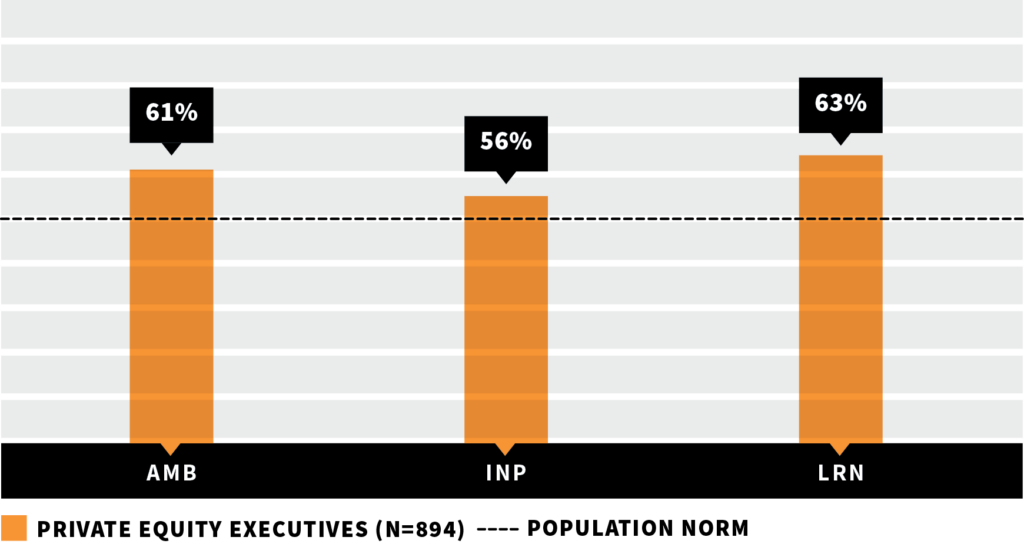
In day-to-day behaviors, which Hogan assesses using the Hogan Personality Inventory (HPI), we found several key differences. First, private equity executives are above average on the Ambition scale, which concerns the tendency to take initiative, compete with others, and drive results. Private equity executives also score above average on Learning Approach, which concerns the tendency to stay up-to-date on business matters and proactively seek out and engage with information or insight. Finally, they also score slightly above average on Interpersonal Sensitivity, which regards the tendency to be skilled at maintaining relationships, considerate toward others, and agreeable.

In practice, we may experience private equity executives as being results oriented and focused on quick yet informed decision-making—capitalizing on the opportunity before it is too late! This is balanced with the need to leverage relationships for the “social capital” they offer.

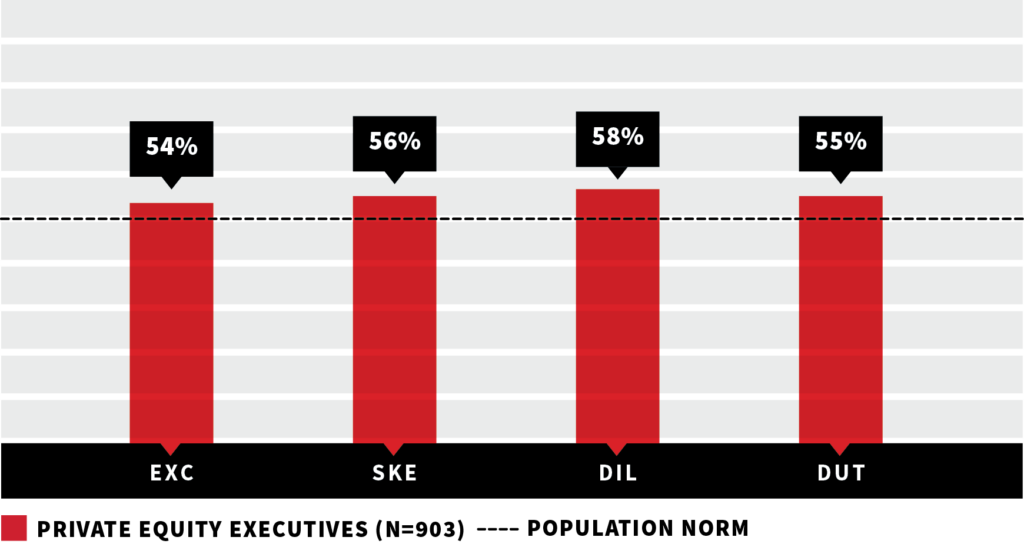
Figure 1: HPI Profile for Private Equity Executives vs. Population Norm

Hogan_Blog_PE_Graphs_HPI

Potential Derailers of Private Equity Leaders

Hogan examines potential derailers, or behaviors that may inhibit success, using the Hogan Development Survey (HDS). Looking at the personality results of private equity executives, we discovered that they tend to score above average on Excitable. This concerns the tendency to be overly energetic and active but become easily disappointed and lack perseverance with projects or people. They also tend to score above average on Skeptical, which is the tendency to be socially insightful but cynical or argumentative.

Additionally, we found that private equity executives may score above average on Diligent, which is the tendency to be conscientious and hardworking, yet perfectionistic and difficult to please. They also tend to score above average on Dutiful, which is the tendency to work hard to please others.

Thus, private equity executives may be perceived by others as acting quickly, challenging the motives of others, and moving on to the next challenge when the likelihood of success decreases. Because of their high standards of performance and expectations for success, they may be difficult to please and defer to key stakeholders rather than standing up for what they believe in.

Figure 2: HDS Profile for Private Equity Executives vs. Population Norm

Hogan_Blog_PE_Graphs_HDS

Values and Motivations of Private Equity Leaders

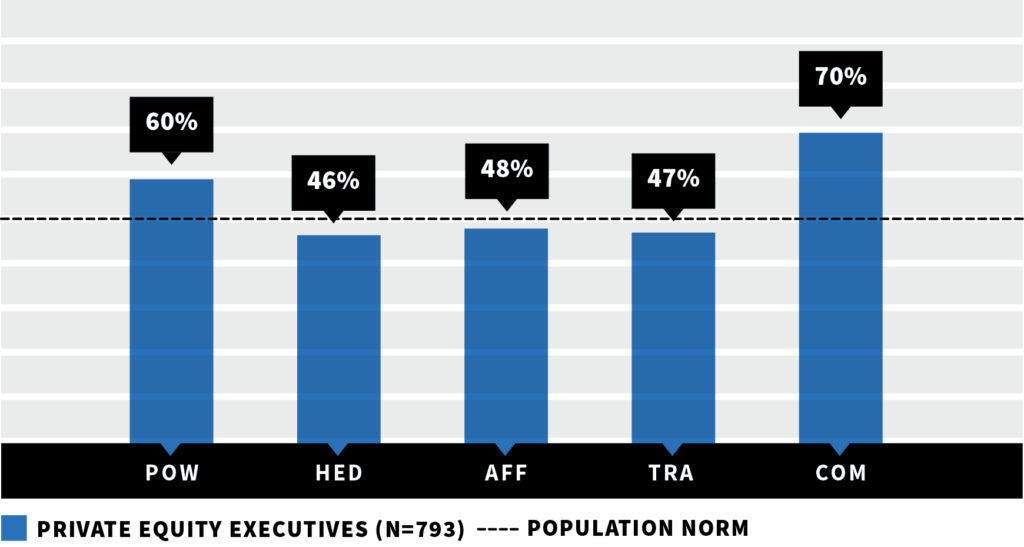
Finally, we looked at results from the Hogan Motives, Values, Preferences Inventory (MVPI) to understand the motivation of private equity executives. We found that private equity executives score above average on the Power scale, which indicates desire for challenge, competition, achievement, and success. They also score above average on Commerce, which indicates interest in financials, realizing profits, and finding business opportunities. Additionally, they tend to score below average on Hedonism (desire for no-nonsense environments), Recognition (preference for a culture where work speaks for itself), Tradition (preference for challenging the status quo), and Affiliation (desire for independence).

These results may indicate that private equity executives value success and financial data and may use metrics for keeping scores. Additionally, they appreciate the opportunity to be focused and disciplined, and they may take their work very seriously: “We are here to do a job!” They may have tolerance for ambiguity and believe that process impedes speed. Finally, they may be intentional about engaging with others, preferring to divide and conquer in service of a quick result.

Figure 3: MVPI Profile for Private Equity Executives vs. Population Norm

Hogan_Blog_PE_Graphs_MVPI

Overall, these results paint a portrait of the typical private equity executive as someone who is focused on results, hard to please, financially driven, informed, disciplined, fast-paced, intentional, and comfortable questioning the status quo.

What Does This All Mean?

Successful organizations must make good decisions about money and people. Though financial organizations have always recognized the importance of being smart about money, there may be an opportunity to explore the people side of the business and its impact on success.

A key insight is that private equity executives may not be proactively engaging with others (i.e., key stakeholders, peers, direct reports). They may be seen as hard to please with high expectations and a temper when those expectations are not met.

As we mentioned at the beginning, private equity is more than just raising capital. It requires the ability to build high-performing teams and create organizational systems—both of which require time, engagement, and collaboration with others. Finding that balance between getting ahead and getting along may differentiate private equity firms that are financially stable from those that are financially successful.

See how Hogan helps private equity firms manage their biggest investment: talent.

Reference

  1. Richman, S. (2021, May 14). 6 CEO Skills Prized by Private Equity Firms. Battery. https://www.battery.com/6-ceo-skills-prized-by-private-equity-firms/

Hogan Announces Talent Consulting Global as New Distributor

Posted by Hogan Assessments on Tue, Jul 12, 2022

Talent Consulting Global logo.

Hogan is excited to announce Talent Consulting Global as the newest member of the Hogan International Distributors Network, covering the market in Thailand.

“Adding Talent Consulting Global to our network of distributors was a natural fit for Hogan for several reasons,” said Krista Pederson, Hogan’s managing director of Asia Pacific. “First, they share the same commitment to science and research that we highly value at Hogan. Second, they have an extremely talented and friendly team that delivers excellent results with a great attitude for the organizations they serve. And finally, this addition furthers expands our footprint across Asia Pacific, a region with tremendous growth potential.”

Headquartered in Bangkok, Talent Consulting Global (TCG) specializes in career transition, change management, talent development, and organizational development. Founded in February of 2021, the firm assembled a talented team with extensive experience in consulting, training, and facilitation. Today, TCG boasts a diverse client list that features some of the major brands in Thailand.

“Although our firm is relatively new to the market, our experience and ability to understand the needs of each of our clients and offer uniquely suitable solutions have driven significant business growth,” said Chaowat Tantivivathanaphand, CEO of Talent Consulting Global. “We are especially excited to start offering Hogan as a tool in the Thai market. Our goal is to help local clients more effectively select and develop their talent, and the Hogan assessments will help us achieve that goal.”

As Hogan’s authorized distributor in Thailand, Talent Consulting Global aims to become a one-stop HR solutions provider for recruitment and selection, training and development, and outplacement services.

Attachment Styles in the Workplace

Posted by Hogan Assessments on Tue, Jul 05, 2022

The logo for The Science of Personality podcast, which covers attachment styles in the workplace in episode 54.

What do crying babies, airport goodbyes, and leadership development have in common? Plenty, according to attachment theory.

Recently on The Science of Personality, cohosts Ryne Sherman, PhD, chief science officer, and Blake Loepp, PR manager, talked with Peter Harms, PhD, professor of management at the University of Alabama, about attachment styles in the workplace.

Often overlooked by organizational psychologists, attachment styles arguably influence every relationship that humans build—leading to significant impact on major organizational outcomes.

Let’s dive into this discussion about how attachment affects leaders and employees.

The Basics of Attachment Theory

“Attachment theory is considered a grand theory in personality psychology because it’s supposed to explain everything,” said Peter. The theory developed about a hundred years ago from an evolutionary perspective on infant and childhood vulnerability. As humans, we want proximity to other people who will nurture us, and when we are separated from that care, we become distressed; a baby cries when a caregiver leaves and is comforted at the caregiver’s return.

Our social nature affects everything about us: our childhood development, our interpersonal relationships, and our worldview. In short, attachment theory gets to the very roots of personality. (Speaking of roots, listen to our conversation about personality and genetics in episode 47 with Kathryn Paige Harden, PhD.)

Quick caveat: Attachment theory by no means suggests that anyone who has experienced childhood trauma is fated to have a certain personality. Rather, it describes a lens through which people tend to interpret and react to experiences.

3 Attachment Styles

The three common attachment styles can be described in terms of behavior when dropping off a loved one at the airport.

  • Secure attachment – A securely attached person might hug or kiss their loved one and gaze after them for a few moments before leaving.
  • Anxious attachment – A person with anxious attachment might embrace many times, talk of future reconnection, and not leave until necessary.
  • Avoidant attachment – A person with avoidant attachment might say, “Have fun,” and leave immediately.

Attachment styles are best understood as dimensions on a continuum. People don’t have one exclusive attachment style but rather a pattern of behavior that we generally default to. “Attachment styles are just like personality,” Peter explained. “They tend to be fairly stable, but they’re not immutable.”

In terms of the Hogan Development Survey (HDS), which measures derailers or overused strengths under stress, the two insecure attachment types loosely correspond to two scales: anxious to Colorful and avoidant to Reserved.

Attachment at Work

“Relationships are really important, and attachment is the personality psychologist’s best tool for understanding relationships,” Peter said, including relationships at work.

Secure workers tend to be more satisfied at work and have higher levels of performance in most jobs, while those who are more anxious or avoidant express less satisfaction with work and may be more likely to engage in counterproductive workplace behaviors. The anxious people might seem disruptive and clingy, and the avoidant people might seem antisocial and uncooperative.

Attachment theory holds that all people want love and security—even on some level from our leaders and coworkers. If, for example,anxious people are paired with secure leaders who are willing to give them the attention and connection they desire, they don’t feel triggered because their fears of abandonment or betrayal are assuaged.

Secure attachment in the workplace is connected to structure and consideration. Most workers want to know what will happen, what they are expected to do every day, and that somebody at the organization cares about them. Particularly given the Great Resignation, attachment theory speaks to our need to feel connected and engaged at work. Peter suggested that, after alienating workers through relationship-destroying remote work since 2020, it is not too surprising that employees are seeking to fill a psychological need by finding workplaces where they receive appreciation.

Attachment and Leadership

Strategic self-awareness is a key component of leadership development and organizational success. Leaders who understand attachment styles can build secure workplace relationships.

Secure and avoidant leaders tend to be more readily promoted, especially avoidant leaders who may conform to highly masculine “bro company” workplace cultures that value toughness and independence. Avoidant leaders are less likely to be aware of or able to foster the connection and security that employees desire.

Anxious leaders, in contrast, might be able to create employee satisfaction and positive team dynamics, but they often struggle with discipline and direction. They may worry about harming the relationship they have with their workers or driving their employees away, or worry about betrayal from their employees and peers.

To the far more numerous avoidant leaders, Peter advised, “Make sure there’s someone in your organization that people can go to. If you can’t necessarily be there for people emotionally, you can create the context where the organization is caring.”

The Rise of the Avoidant Dimension

The organizational implications of attachment style are critical. Originally, attachment data showed that about 60% of people were securely attached, 20% anxious, and 20% avoidant. But more recent surveys have shown that millennials and Gen Z have different dimensions of attachment, with only 40% secure, 20% anxious, and 40% avoidant.

“As humans, we desire a level of intimacy and relatedness that’s been stripped from the workplace,” Peter said, referring to employees of fully remote organizations who have never met a leader or coworker in person. “We often talk about what has happened in the changes in the workplace through technical, transactional terms, but we have ignored the implications in human terms. That’s why it’s important to pay attention to things like attachment styles.”

Listen to this conversation in full on episode 54  of The Science of Personality. Never miss an episode by following us anywhere you get podcasts. Cheers, everybody!



Topics: attachment styles

Too Legit to Quit: Addressing Employee Turnover

Posted by Hogan Assessments on Tue, Jun 28, 2022

Employee turnover is on the rise with the Great Resignation, and many employers find they need to improve employee retention. This photo shows a person who has just quit his job. He is holding a box containing a plant and other assorted objects that might be found at an office desk. The former employee is wearing a patterned short-sleeved button-down shirt and is otherwise out of focus in the photo.

At Hogan, we have recently seen an uptick in client concerns regarding employee turnover. This developing concern parallels a general increase throughout the workforce in employees’ desires to quit their jobs after experiencing organizational changes sparked by the pandemic.1 According to the US Bureau of Labor Statistics,2 an average of 4.3 million employees per month quit their jobs between March 2021 and March 2022. This trend, termed the Great Resignation, can harm organizational effectiveness due to replacement costs, reduced efficiency, loss of clients, lower customer satisfaction, overburdened HR, and a decrease in workforce morale.3–5

Involuntary Versus Voluntary Turnover

Turnover can occur involuntarily or voluntarily. Involuntary turnover refers to employer-initiated termination of employment, typically because an employee has fallen below performance standards. Organizations may view involuntary turnover as somewhat desirable because it removes poor performers from the workplace; however, organizations likely prefer implementing well-designed developmental interventions to correct poor performers or using accurate hiring practices to avoid hiring them in the first place. Because involuntary turnover is the employer’s choice, Hogan can assist employers with solutions to accurately hire or develop high-performing employees and thus avoid involuntary turnover.

Although addressing involuntary turnover is always important, the current rise in voluntary turnover requires special attention. Voluntary turnover is when the employee chooses to end their relationship with the organization. Compared to involuntary turnover, voluntary turnover compounds the problems associated with needing to replace and retrain new employees because the organization is also losing otherwise good talent. Thus, the primary focus of our post is to highlight science-based tools for addressing voluntary turnover.

What Are the Signs an Employee Might Quit?

Research provides various indicators that can help identify employees who are more likely to quit. Many of these are directly relevant to the solutions Hogan offers.

Personality Characteristics

In a previous blog post, another Hogan expert highlighted personality characteristics and work values associated with burnout and empowerment, both of which are linked to voluntary turnover. In addition, researchers have documented a few general trends linking personality and voluntary turnover across several jobs and organizations. Specifically, higher openness (e.g., HPI Inquisitive and Learning Approach), lower conscientiousness (e.g., HPI Prudence), lower agreeableness (e.g., HPI Interpersonal Sensitivity), and lower emotional stability (e.g., HPI Adjustment) predicted turnover across multiple studies.6,7 Personality characteristics even provide unique insight into turnover beyond other factors, such as job complexity, job satisfaction, intent to quit, and job performance.6

While a few general trends have been established across jobs and organizations, it can be meaningful to take a more nuanced look at specific organizations or situations.  In an electronics manufacturing firm, for instance, outside researchers showed that higher scores on HPI Inquisitive and Learning Approach predicted turnover regardless of individuals’ work satisfaction and commitment.8 Higher Learning Approach scores also increased the risk of turnover over time. Furthermore, the HDS Moving Against scales (i.e., Bold, Mischievous, Colorful, and Imaginative) predicted quicker turnover, and the Moving Toward scales (i.e., Diligent and Dutiful) indicated slower turnover. As the label would imply, the Moving Away scales (i.e., Excitable, Skeptical, Cautious, Reserved, and Leisurely) most strongly predicted turnover in cases where the employee disappeared without notice.

Readers should interpret these findings while keeping in mind that they were observed in a single organization, and effects of personality characteristics can vary by job or organization.  Even the most recent analysis across multiple studies showed that higher emotional stability predicted turnover in some situations, but lower emotional stability predicted turnover in others.6 Although to a lesser degree, the turnover relationships with agreeableness, conscientiousness, and openness also varied notably depending on the situation. This finding underscores the need to understand how the dynamics of personality characteristics operate within the specific job and organization. One way to approach such specificity is to focus on job alignment.

Job Alignment

The alignment of individual characteristics, such as personality and work values, with the job requirements and work environment can provide insight into employee turnover. Generally speaking, turnover is more likely when an employee’s personality characteristics or work values do not align with the given job or organization, whether based on perception or objective measurement.6,9–11

For example, turnover is decreased when congruence exists between the employees’ social values and those of their supervisors and workgroups.10 These social values (i.e., service, family fun, and inclusion) conceptually map onto Hogan’s Motives, Values, Preferences Inventory (MVPI) scales (i.e., Altruism, Hedonism, and Affiliation/Altruism, respectively). Organizations should focus on fostering congruence between supervisor, workgroup, and employee social values. Other values (e.g., compensation and flexibility) are less relevant. In addition, value misalignment predicts decreased employee engagement, which then predicts increased turnover.1 This suggests that drops in engagement could serve as an early warning sign of future turnover. Tools such as the MVPI can help decrease the likelihood of both turnover and declining engagement.

How to Reduce Turnover and Improve Employee Retention

Hogan provides many solutions to help reduce voluntary turnover and improve retention of employees who are “too legit to quit,” as MC Hammer would say. An earlier blog shared some ideas on leader-focused interventions, with which Hogan can help. Based on the research discussed here, we highlight additional ways Hogan can help address voluntary employee turnover across all job levels. But don’t just take our word for it! Even external talent scientists argue that organizations can use personality assessments in their hiring processes to reduce the likelihood of voluntary turnover.7 Specifically, Hogan can help (1) improve job fit and (2) identify specific characteristics that predict turnover in particular work contexts.

Virtually all of Hogan’s solutions provide personality or work value configurations that our own research indicates will align best with the focal job and work environment. We thoroughly and systematically examine the specific work context for which a solution is designed. We then leverage our massive data archives and, at times, collect new local data to identify Hogan scales that are especially relevant to that job and work context.

Consequently, proper implementation of our tools increases the desired alignment between employees’ individual characteristics and their work. As the research shows, this alignment is what will forecast reduced turnover. Hogan’s talent acquisition tools can help reduce turnover by identifying better-fitting applicants from the beginning, and our talent development recommendations can help by improving the fit of current employees.

In situations where turnover is a heightened concern, Hogan’s talent analytics team can construct custom solutions that include scales predictive of turnover in a specific job and organization. If an organization has enough previous employees who have taken Hogan’s assessments and have since quit, Hogan can identify specific personality and value scales that distinguish such employees from those who have not quit. When Hogan data on employees who have quit is not available, Hogan can collect new data to identify scales that characterize individuals who show warning signs of impending turnover. Specifically, we have a pool of survey questions that have been developed by outside researchers to identify employees who are about to quit. In response to said questions, supervisors rate their direct reports’ behaviors that tend to precede turnover. Their employees also respond to Hogan’s assessments, allowing our talent analytics team to recommend profiles of individuals less likely to engage in pre-quitting behaviors.

Indeed, Hogan has a track record of successfully improving employee retention for clients. For example, a global financial services provider saw approximately 300 fewer sales representatives quit per year after implementing a custom talent acquisition profile built by Hogan. This helped save the company an estimated $4.5 million in replacement costs. Another business services company found that health assistants who scored high on their custom Hogan profile were nearly 13 times more likely to stay with the company than those who did not. Likewise, a custom-built Hogan profile helped a global telecommunications company reduce 90-day turnover rates by 50%, saving the company more than $70,000 in employee replacement costs.

Other Factors to Consider

We know that, although personality characteristics explain a substantial chunk of voluntary turnover, they do not tell the full story. Fortunately, research points to additional things to look for that, in conjunction with personality, can help you paint the full turnover picture. Decades of research suggests that thoughts, withdrawal states, attitudes, job characteristics, behaviors, and wellness are all factors associated with voluntary turnover. Of these, job characteristics and behaviors are typically easier to identify. A recent analysis of multiple studies found that less pay predicted more turnover.6 In addition, fewer opportunities for promotion, less role clarity, more role conflict, more role overload, and more overall stress predicted more turnover.12Some work behaviors that predicted turnover include decreased job performance, increased absenteeism, and increased misconduct.6,11,12 Employers will typically have more success in improving employee retention if they pair consideration of these additional factors with a focus on personality and work values. If your organization needs to improve employee retention, consider the personality-based solutions Hogan provides.

This blog post was authored by Lauren Murphy, Chase Winterberg, and Linda Muller.

References

1. Coley, S., & Gallagher, P. (2022, April 27-30). The Buffering Effects of Purpose Alignment Against Turnover Intentions at Work [Conference presentation]. Society for Industrial and Organizational Psychology Annual Conference, Seattle, WA, United States.

2. US Bureau of Labor Statistics. (2022, May 3). Quits Levels and Rates by Industry and Region, Seasonally Adjusted. US Department of Labor. https://www.bls.gov/news.release/jolts.t04.htm

3. Heavy, A. L., Holwerda, J. A., & Hausknecht, J. P. (2013). Causes and consequences of collective turnover: A meta-analytic review. Journal of Applied Psychology, 98, 412-453.

4. Judge, T. A., & Kammeyer-Mueller, J. (2022). Staffing Organizations (10th ed.). McGraw-Hill Irwin.

5. Tyler, K. (2021). How Can HR Professionals Prepare for the Wave of Voluntary Employee Departures That Experts Are Predicting? HR Magazine, 66, 26-31.

6. Rubenstein, A. L., Eberly, M. B., Lee, T. W., & Mitchell, T. R. (2018). Surveying the Forest: A Meta-Analysis, Moderator Investigation, And Future-Oriented Discussion of Antecedents of Voluntary Employee Turnover. Personnel Psychology, 71, 23-65.

7. Zimmerman, R. D. (2008). Understanding the Impact of Personality Traits on Individuals’ Turnover Decisions: A Meta-Analytic Path Model. Personnel Psychology, 61, 309-348.

8. Woo, S. E., Chae, M., Jebb, A. T., & Kim, Y. (2016). A Closer Look at the Personality-Turnover Relationship: Criterion Expansion, Dark Traits, and Time. Journal of Management, 42, 357-385.

9. Crossley, C. D., Bennett, R. J., Jex, S. M., & Burnfield, J. L. (2007). Development of a Global Measure of Job Embeddedness and Integration into a Traditional Model of Voluntary Turnover. Journal of Applied Psychology, 92, 1031-1042.

10. McFarland, L. A., Ray, C., Shepherd, W., & Harold, C. M. (2022, April 27-30). The Consequences of Value Congruence: It Depends on Value Type [Poster presentation]. Society for Industrial and Organizational Psychology Annual Conference, Seattle, WA.

11. Moon, Y., & O’Brien, K. E. (2022, April 27-30). “I Put in My Two Weeks Notice!” Employee Behavior and Wellness Prior to Exit [Poster presentation]. Society for Industrial and Organizational Psychology Annual Conference, Seattle, WA.

12. Griffeth, R., Hom, P., & Gaertner, S. (2000). A Meta-Analysis of Antecedents and Correlations of Employee Turnover: Update, Moderator Tests, and Research Implications for the Next Millennium. Journal of Management, 26, 463-488.

Manage and Retain Creative Talent with These 5 Strategies

Posted by Hogan Assessments on Tue, Jun 21, 2022

An employee with creative talent draws on a tablet at a pale wooden desk. She wears an olive-green sweater vest with brown buttons. She has short dark hair, tattooed arms, numerous rings on her hands, and dark nail polish. Next to her tablet is an open notebook with drawings in it. A pen lies on the desktop. Multiple drawings are posted on the wall behind her, and the desk is flanked by large houseplants.

Talent shortage in creative roles is real and pressing, bringing employee retention to the forefront of effective managerial strategy. Because disrespect, lack of flexibility, and underwhelming benefits are major reasons workers quit their jobs in 2021,1 leaders must give even greater attention to the management of employees in creative teams—the innovators and creatives whose ideas drive organizational growth.

According to a 2012 Adobe study, more than 80% of people believe creativity is critical to economic growth.2 A Forbes panel about hiring for creative roles indicates that creativity is perceived as a desirable personality characteristic.3 In fact, people find creativity so desirable that it’s often subject to what psychologists call the better-than-average effect, which occurs when individuals consistently rate themselves better than average along desirable qualities. Despite the importance of innovation in business, few organizations and fewer managers seem to understand what it takes to keep their creative people happy and productive.

What Is a Creative Personality?

The creativity crisis, which was predicted in 2004,4 has come to fruition. Between high unemployment and a labor shortage, attracting and retaining talent is a challenge for many organizations.5 Creative employees are essential to company innovation, so it’s important to understand their personalities.

Psychologists from the Hogan data science team compared 360-degree feedback data with personality data measured using three personality assessments:

  1. The Hogan Personality Inventory (HPI) measures people’s everyday strengths and weaknesses.
  2. The Hogan Development Survey (HDS) measures strengths that people overuse under increased stress or pressure.
  3. The Motives, Values, Preferences Inventory (MVPI) measures the core drivers that determine what people desire and what they are willing to work for.

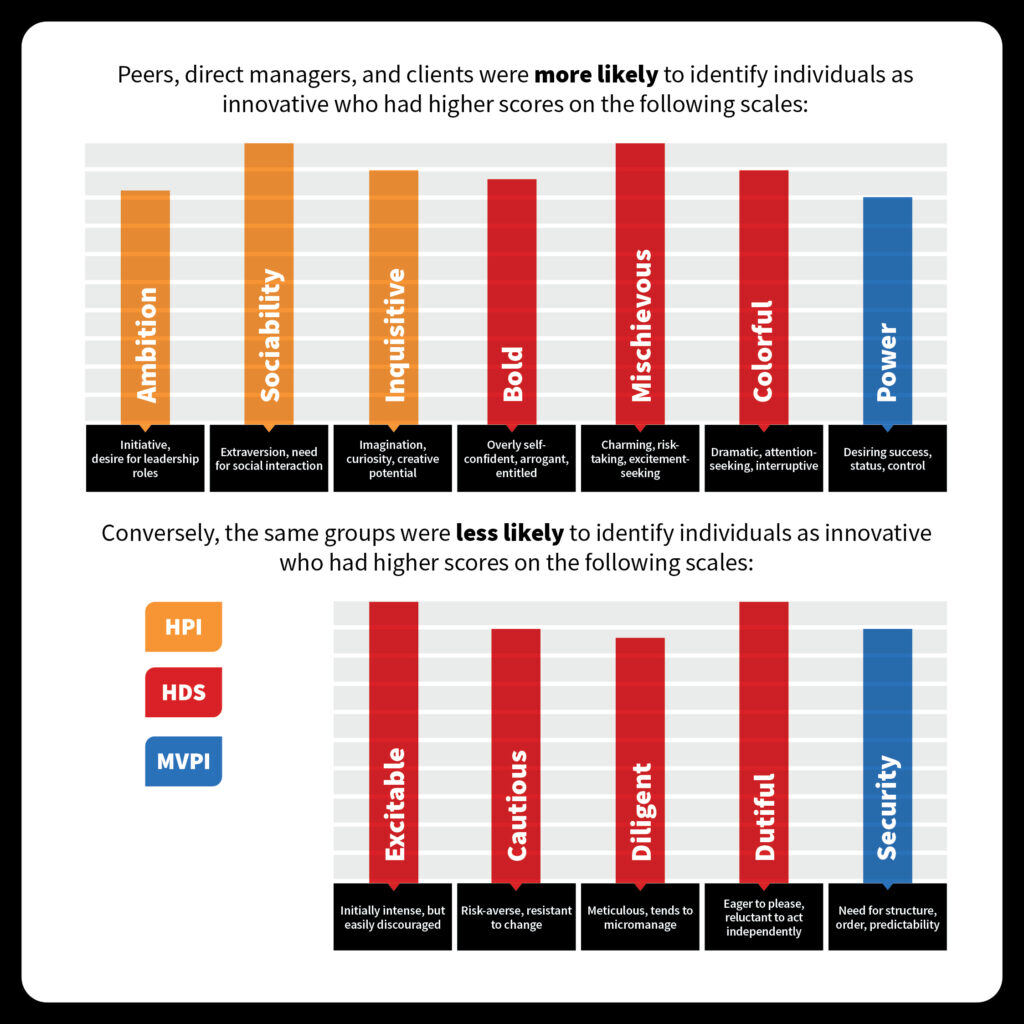
Individuals who scored higher in Ambition, Sociability, and Inquisitive (HPI); Bold, Mischievous, and Colorful (HDS); and Power (MVPI) were more likely to be identified by peers, direct managers, and clients as innovative. Conversely, those who scored higher in Excitable, Cautious, Diligent, and Dutiful (HDS); and Security (MVPI) were less likely to be identified as having an innovative reputation at work.

Innovation_Scales_Graphic_20220621-1

A Profile of the Creative Employee

Drs. Robert Hogan and John Morrison described the creative personality in practical terms in their chapter “Managing Creativity.”6

Creative, innovative people tend to be

  • open to new experiences,
  • skilled at organizing and evaluating information gleaned from a variety of sources,
  • able to easily produce an abundance of ideas,
  • concerned with their performative adequacy, and
  • motivated to prove themselves.

These qualities may make creatives sound like ideal employees—but here’s the rub. Hogan research shows that creative people tend to be idealistic, nonconforming, and unconcerned about money, which can make them the bane of managers, who tend to be stable, practical, and concerned with maintaining order and controlling costs.

From a psychological perspective, creative and managerial personalities can seem predisposed not to understand one another. Organizational priorities about positive creativity and innovation mean that managers and creative people need each other to succeed.

5 Keys to Managing Creatives

Here are five imperatives for leaders to provide to ensure they are properly managing their creative teams and driving innovation.

1.    Freedom and Flexibility

Creative employees need time, space, and resources to innovate.

The bottom line here is not to constrain your creative employees by forcing them to follow processes or conform to structures. Social psychologist Teresa Amabile interviewed 46 managers of North American corporate R&D groups, asking them about examples of high and low creativity in their laboratories.7 The most frequently cited obstacles to creativity included employees’ lack of control over their own work and lack of freedom in deciding what to do or how to do it. Also mentioned were lack of time, lack of resources, and poor project management.

On the other hand, creativity is enhanced by more freedom and flexibility at work. According to The Wall Street Journal, today’s talent may value flexible work arrangements and other perks even more than compensation.8 Consequently, managers can encourage innovation among creative employees by letting them work remotely and outside of normal business hours.

Managers should also refrain from demanding an account of their employees’ creative methods because those are likely to rely on unstructured, irreplicable spontaneity. Rather, creatives should be evaluated by the quality of their innovative work products.

2.    Conventional Colleagues

Innovators work best alongside colleagues who are just the right quality of “boring”—too conventional to challenge ideas yet unconventional enough to collaborate with.

Creative employees flourish with independence, not required group work with other creatives. Data from Hogan psychologists affirm that innovative individuals are driven by the desire for success and control. They can display above-average drive and competitiveness. Thus, when two or more creatives are forced to collaborate, they tend to compete for ideas or keep them to themselves.

Independence, however, is not the same as isolation. Creative people also need stimulation from coworkers who appreciate and nurture their ideas without competition. The key to supporting creative individuals at work is by building a diverse team in which they can thrive. Creative teams that perform the most effectively have a mix of creative members and those who pay more attention to details and processes.

3.    Meaningful Motivation

Rather than offer only monetary rewards, motivate creatives with meaningful work.

Monetary reward systems are poor drivers of performance among creative individuals. Studies from Edward Deci and Richard Ryan show that offering “controlled motivation,” such as money, decreases intrinsic motivation and self-determination.9 People who received money to read magazines or solve puzzles did so for a shorter time than people who acted for enjoyment, for instance.

Hogan research shows that innovators tend to have more vision than less creative personalities do. Because creatives see the bigger picture and consider why things matter, they can be reluctant to engage in meaningless work. Managers who demonstrate a link between work, meaning, and values can build intrinsic motivation in creative employees.

4.    Concrete Goals

Collaborate with your creative employees to set reasonable goals and deadlines.

In their chapter, Hogan and Morrison discuss the need for good goal setting. One of their interview subjects, a vice president for research and development at a computer manufacturing firm, recommended this approach: ask researchers what they thought they could accomplish in a certain timeframe, then support their efforts and keep them on track.

Given that creatives are motivated by adequacy, goals should be tied to performance and supported with clear, credible feedback. Likewise, since creatives prefer to control the means by which they accomplish tasks, deadlines should be largely determined by the innovator and approved by the manager.

5.    Good Management

In the end, the factors that negatively impact creativity are the result of poor management. Organizations need to recognize the importance of personality in leaders too. Personality assessments can inform hires and promotions into management roles, and leadership development opportunities help managers become more aware of how their reports might perceive them so they can lead more effectively.

Managers who are unable to build and maintain productive relationships with creative individuals, set clear performance expectations, or give clear or credible feedback, for example, could cause innovators to simply walk away. Leaders who cannot create the nonevaluative atmosphere described by Amabile as fostering the freedom to fail will stifle or alienate creatives to the detriment of the entire organization. In a climate where 84% of CEOs view innovation as critical to growth but only 6% are satisfied with their innovation performance, maximizing the creative potential of innovators is an essential managerial skill.10

If you are interested in more information about using personality assessments to identify and develop leaders who understand how to manage and retain creative talent, get in touch with us today.

References

1. Parker, K., & Horowitz, J. M. (2022, March 9). Majority of Workers Who Quit a Job in 2021 Cite Low Pay, No Opportunities for Advancement, Feeling Disrespected. Pew Research Center. https://www.pewresearch.org/fact-tank/2022/03/09/majority-of-workers-who-quit-a-job-in-2021-cite-low-pay-no-opportunities-for-advancement-feeling-disrespected

2. Adobe Systems Incorporated. (2012, April 23). Study Reveals Global Creativity Gap [Press release]. https://news.adobe.com/news/news-details/2012/Study-Reveals-Global-Creativity-Gap/default.aspx

3. Forbes Agency Council Expert Panel. (2021, January 8). How to Hire for Creative Roles: 12 Unique Traits of the Best Candidates. Forbes. https://www.forbes.com/sites/forbesagencycouncil/2021/01/08/how-to-hire-for-creative-roles-12-unique-traits-of-the-best-candidates/?sh=270ef66558c9

4. Florida, R. (2004, October). America’s Looming Creativity Crisis. Harvard Business Review. https://hbr.org/2004/10/americas-looming-creativity-crisis

5. Sanandaji, T., Monte, F., Ham, A., & Tarki A. (2021, June 14). Attracting Talent During a Worker Shortage. Harvard Business Review. https://hbr.org/2021/06/attracting-talent-during-a-worker-shortage

6.Hogan, R., & Morrison, J. (1996). Managing Creativity. In A. Montouri (Ed.), Unusual Associates (pp. 344-351). Hampton Press.

7. Amabile, T. M. (1983). The Social Psychology of Creativity: A Componential Conceptualization. Journal of Personality and Social Psychology, 45(2), 357-376. https://doi.org/10.1037/0022-3514.45.2.357

8. Broughton, K. (2022, March 1). Companies Try to Limit Salary Bumps and Focus on Perks Instead. The Wall Street Journal. https://www.wsj.com/articles/companies-try-to-limit-salary-bumps-and-focus-on-perks-instead-11646130600

9. O’Hara, D. (2017, December 18). The Intrinsic Motivation of Richard Ryan and Edward Deci. American Psychological Association. https://www.apa.org/members/content/intrinsic-motivation

10. Growth and Innovation. (n.d.). McKinsey & Company. https://www.mckinsey.com/business-functions/strategy-and-corporate-finance/how-we-help-clients/growth-and-innovation

Entrepreneur or Organized Criminal?

Posted by Hogan Assessments on Tue, Jun 21, 2022

The logo for The Science of Personality podcast, which covers personality among entrepreneurs and organized criminals in episode 53.

From a personality standpoint, entrepreneurs and organized criminals are not that different. Does that surprise you?

On The Science of Personality, cohosts Ryne Sherman, chief science officer, and Blake Loepp, PR manager, discuss what separates entrepreneur Jeff Bezos from notorious mob boss Al Capone.

Not only have hundreds of entrepreneurs taken the Hogan personality assessments, but about 60 members of organized crime groups have too. Unlike most criminals whose personalities have been studied, the people in the sample group were not incarcerated when they took the assessment, which was administered by one of Hogan’s partners, A&D Resources in Denmark.

Let’s dive into Ryne’s evaluation of how the personality assessment results compare.

Decoding the Assessments

Hogan offers three core personality assessments, the Hogan Personality Inventory (HPI), the Hogan Development Survey (HDS), and the Motives, Values, Preferences Inventory (MVPI) to measure people’s everyday characteristics, characteristics under stress, and drivers and motivators, respectively. We’ll discuss each in turn, then share some analysis and anecdotes about the overlap between entrepreneurs and organized crime members.

MVPI

When we examine the core drivers that motivate both entrepreneurs and organized crime members, both groups are driven to get ahead and maximize profit. “That’s the key when we look at entrepreneurship and when we look at criminal behavior,” Ryne observed. “Neither is trying to be innovative. Their goal is to be successful, and in many cases that success is identified by how profitable they are.”

The MVPI sample sets strongly resemble each other. Driven to get ahead, entrepreneurs and organized crime members have high Recognition, high Power, high Hedonism, and low Security, which accords with their desire to compete to succeed and willingness to take risks to accomplish goals.

Where entrepreneurs and organized crime members differ on the MVPI is in Aesthetics and Science. While entrepreneurs tend to value the artistic nature of their work, the use of technology, and decision-making based on data, organized crime members score lower on these two scales. “They’re really, really motivated to succeed and win and to do whatever it takes to get there,” Ryne said.

HPI

The overall shape of the HPI profile, which shows higher scores on Ambition, Inquisitive, and Sociability and lower scores on Prudence, remains about the same for entrepreneurs and organized crime members. This is concurrent with the MVPI results, which show a strong drive to succeed.

Where they differ, however, is that the overall scores are somewhat lower for the organized crime members than for the entrepreneurs. Even Sociability and Inquisitive, which are highest among the organized crime members, are still lower than those of the entrepreneurial sample. “The typical mode of behavior is a little more deflated in terms of the HPI dimensions for the organized crime group versus the entrepreneurs,” Ryne explained.

HDS

Entrepreneurs and organized crime members also look fundamentally the same in HDS terms. “The striking thing is how remarkably similar the profiles are for these two groups,” said Ryne. “They’re very high elevations across the board except Diligent and Dutiful, which tend to be around the average range.”

Both show high levels in all these scores: Excitable, Skeptical, Cautious, Reserved, and Leisurely. They also score high in Mischievous, Colorful, Imaginative, and Bold. Like a criminal, the typical entrepreneur is willing to take risks and chances to succeed.

Organized crime members score somewhat lower than entrepreneurs in Colorful, which means they may avoid attention-seeking behavior while engaged in criminal activity. Yet the rule-breaking element is a strong similarity between the two groups, suggesting that both could be comfortable operating in a legally gray area.

The Dark Side of Entrepreneurship

The dark side to being an entrepreneur can be expressed in terms of getting ahead by eliminating competition. Ryne referenced a situation in California in which a community that profited from the recreational marijuana trade worked to secure a vote against a bill to legalize recreational marijuana use because legalization would damage profits.

Many entrepreneurs both past and present would be (or have been) successful in a criminal organization because the criteria for success look very similar: rule-shirking, risk-taking, innovation, and motivation to profit. Likewise, many mafia bosses would make excellent modern entrepreneurs.

Here are a few fictional and nonfictional personas that match this personality profile:

  • Al Capone
  • Bill Gates
  • Elizabeth Holmes
  • Elon Musk
  • Jeff Bezos
  • John Gotti
  • Steve Jobs
  • Tony Stark (Iron Man)

Society as a body is made up of about 10% of people who are creative, innovative, and motivated by profit. Whether some of them break the rules to succeed comes down to how willing they are to bypass legal roadblocks.

Advice for Entrepreneurs

The entrepreneurial mindset is to run with a great idea and pay it off later. It isn’t helpful to tell an entrepreneur to “just be more careful” because that doesn’t align with their personality and values.

Instead, entrepreneurs need to select an advisor with a profile different from and complementary to theirs whose role is to keep them out of trouble—not to say no all the time but to point out any gray areas that may arise.

“Modern day organized criminals are not that dissimilar from modern day entrepreneurs,” Ryne said. “The similarity there goes unrecognized and underappreciated.”

Listen to this conversation in full on Episode 53 of The Science of Personality Podcast. Never miss an episode by following us anywhere you get podcasts. Cheers, everybody!
Why Leadership Development Is Broken

Posted by Hogan Assessments on Tue, Jun 14, 2022

pexels-sora-shimazaki-5668825

Leadership development is big business. The programs and practices used to grow top-level talent are prolific and diverse, and 95% of organizations plan to maintain or increase their current leadership development investment.1 Paradoxically, only 10% of CEOs say their leadership development programs have clear business impact, and more than 50% of CEOs say that developing next-generation leaders is the biggest challenge they face today.2,3 Employees paint a similarly bleak picture. Employee engagement is at just 32%, down from 36% in 2020, while active disengagement is on the rise, up one percentage point from 2021.4 Their relationships with leaders are a contributing factor.4,5 A startling 84% of US workers attribute their stress to their managers, and half say their performance would improve if their managers were to receive development opportunities.5

The evidence is clear: Organizations are investing a lot to develop leaders but realizing little return on investment. That leads us to two critical questions: (1) Why is leadership development broken, and (2) what can we do to fix it?

Those of us who have spent years working with Hogan clients’ leadership development programs can help to answer the first question. We have seen a lot, and some problems are quite common! The second question is tougher to answer, but we have some ideas and would love to hear from others in the field as well. To that end, we have described seven common problems in this article, and we look forward to discussing seven possible solutions during our next webinar.

Challenge 1: Incorrect Definition of Leadership

In most organizations, when you ask someone to tell you who the leaders are, they will identify people in certain types of roles—from first-line managers to C-suite executives. In doing so, they are (perhaps inadvertently) linking leadership with position, pay, or title, and not with impact, effectiveness, or results.

Challenge 2: Irrelevant Outcomes

Leadership development programs are often judged by affective measures (e.g., how much participants reported enjoying the program) and career outcomes (e.g., promotion). We don’t judge! It is quite difficult to measure program effectiveness. Leaders are human beings operating in complex contexts, after all—they’re not microchips built on an assembly line. But a leader liking a program is not indicative of the leader improving via the program. Not to mention, if the leadership development program had never happened, would the same promotions still have occurred? In many cases, the answer is yes.

Challenge 3: Leadership Competency Models

The competency modelsi we have seen in leadership development programs are nearly always (1) created based on expert or executive judgment rather than research and validation, (2) aspirational rather than achievable, and (3) ineffective in guiding leaders to meaningful, long-term change.  

Challenge 4: The Peanut Butter Approach

Leadership development programs are often designed as though any given cohort of leaders is a monolith. We tend to forget that not all leaders begin development programs at the same starting line. Some individuals might be ahead based on tenure, expertise, or experience, while others might be behind due to lack of visible, emergent behaviors, or—worse, but perhaps as common—due to bias and lack of previous opportunity.

Challenge 5: Ignoring Context

In the world of leadership, context is king, and that king has many characteristics. Leaders need to be keenly aware of and adaptive to their teams, bosses, and responsibilities, as well as the culture, strategy, mission, and values of their organizations. Too frequently, the contextual elements that ultimately impact a leader’s effectiveness are ignored in development programs.

Challenge 6: Overlooking Psychology

Behavioral change is hard. This is well established, yet we seem to forget in leadership development programs. When designing these programs, many organizations fail to consider key factors, like leaders’ lack of resources (time and energy), their potential ambivalence to development, the difficulty of self-awareness, and the importance of the good old SMART goal.

Challenge 7: Disconnected Processes

Although individual assessment is frequently a component of leadership development programs, the results of those assessments (e.g., personality, 360-degree feedback) are rarely used to guide specific coaching and curriculum-based experiences. Instead, assessment is treated as a one-and-done event after which every leader goes through the same program steps often focused on the same organizationally specific competencies.

But enough of the bad news! Check out this webinar to delve further into the challenges of leadership development and, more importantly, find out what can be done to address them. 

This blog post was authored by Jackie VanBroekhoven Sahm, MA, director of global learning, and Jocelyn Hays, MS, learning solutions manager.

Note

  1. They are not always called “competency models,” but as the saying goes, “If it looks like a duck . . .”

References

  1. Westfall, C. (2019, June 20). Leadership Development Is A $366 Billion Industry: Here’s Why Most Programs Don’t Work. Forbes. https://www.forbes.com/sites/chriswestfall/2019/06/20/leadership-development-why-most-programs-dont-work/?sh=207dc7a661de
  2. Segal, E. (2021, May 19). Latest Corporate Crisis: Only 11% Of Surveyed Companies Have A Strong Leadership Bench. Forbes. https://www.forbes.com/sites/edwardsegal/2021/05/19/only-11-of-companies-have-a-strong-leadership-bench-according-to-new-study/?sh=65cc8eda2b62
  3. Feser C., Nielsen, N., & Rennie, M. (2017, August 1). What’s Missing in Leadership Development? McKinsey Quarterly. https://www.mckinsey.com/featured-insights/leadership/whats-missing-in-leadership-development
  4. Harter, J. (2022, April 25). US Employee Engagement Slump Continues. Gallup. https://www.gallup.com/workplace/391922/employee-engagement-slump-continues.aspx
  5. SHRM. (2020, August 12). Survey: 84 Percent of U.S. Workers Blame Bad Managers for Creating Unnecessary Stress [Press release]. https://www.shrm.org/about-shrm/press-room/press-releases/pages/survey-84-percent-of-us-workers-blame-bad-managers-for-creating-unnecessary-stress-.aspx

Subscribe to our Blog

Most Popular Posts

Connect