
Don’t Try to Be the “Fun Boss” — and Other Lessons in Ethical Leadership

Posted by Hogan Assessments on Fri, Oct 12, 2018

fun boss*This article was written by Kimberly Nei and Darin Nei, and was originally published by Harvard Business Review on September 10, 2018.

Just becoming a leader is enough to exacerbate some people’s unethical tendencies. But power does not corrupt everyone. Our research suggests that key personality characteristics predict unethical leadership behavior.

We collected personality data and supervisor ratings of ethical behavior (e.g., integrity, accountability) on 3,500 leaders across 30 organizations we had worked with. The organizations included in our study were largely multinational, represented several industries, and varied in size from medium to large. We combined data across these 30 independent studies to examine the relationship between personality and ethical leadership across a range of different settings and situations. We found that characteristics related to certain traits have stronger relationships with unethical behavior.

So, what should today’s leaders do to build trust with their teams and the public? Here are a few tips, based on our findings:

Be humble; not charismatic. It is natural that we are attracted to people whom we perceive to be inspiring, fun, and engaging. It makes sense that you need a little charisma or pizzazz to stand out from others and get noticed. Charisma can also be useful for engaging and inspiring others towards the organizational mission. However, too much of this may be a bad thing in the eyes of your team members. Unchecked charisma will lead to a reputation of self-absorption and self-promotion. When team members get the sense that you are focused on your own concerns and ideas, they feel unsupported. The team may start to worry that you will no longer do what is best for the team or organization, and that you will instead do what is best for your own agenda.

Be steady and dependable; it will get you further. While you may have been noticed and promoted based on your charisma, being reliable, rule-following, and responsible is more important for your team. As a leader, you have a tremendous amount of autonomy and decision-making power. If we are to entrust our leaders with such power, we need to be confident in their ability to remain true to their word and to do what’s right for the organization. Showing your team that you exercise caution, take calculated risks, and will adhere to organizational principles will go a long way toward gaining their trust.

Remember that modesty is the best policy. At times, we may all enjoy working in an environment that is less formal, or working for a boss who knows how to keep things light-hearted. However, there is still a degree of responsibility and professionalism that people come to expect from those in charge. Trying to be liked and known as “the fun boss” can tarnish your reputation in the long run. It’s OK to stay out of the limelight and keep some space between you and your team. It sends signals that you are there for their professional benefit and that they can rely on you when needed.

Balance analysis with action. Although people appreciate a degree of logic and rationality in the decision-making process, be careful to not get so focused on data and analysis that you forget the larger context or the impact of your decisions. Spending too much time analyzing data can hold you back from making important decisions, especially in high-pressure situations that call for quick action. The data may indicate the best course of action for the bottom line, but this may not be the best decision for the broader team or relevant stakeholders. Leadership must be able to make a decision and take corrective action quickly, even if it initially hurts the bottom line.

Be vigilant; vulnerability increases over time. Learning and adjusting to a new role, especially a high-visibility leadership role, can take some time. It’s during the first few months in a new role that we usually spend more time observing what’s going on around us. We also tend to be more mindful of our interactions with others and may spend more time managing the impressions we make on others. Over time, we become more comfortable in our surroundings and we stop paying attention to our reputations. It’s usually after the six-month mark where we see an increased risk of our dark-side tendencies impeding our success or derailing our careers. Keep your guard up, stay vigilant, and continually seek feedback.

The personality characteristics that will get you chosen as a leader are not always the same as the ones that will make you effective in that role. Spending too much time trying to get noticed or having a “win at all costs” mentality to get ahead can put you (and your team) at a higher risk of engaging in unethical behavior. Having awareness of your surroundings and an understanding of the ways you influence your team will help to keep yourself (and your team) on track.

*Kimberly Nei is a manager of client research at Hogan Assessments where she manages the design and implementation of legally defensible assessment-based selection and development solutions.

*Darin Nei is a senior consultant with Hogan Assessments’ Global Alliances team where he works closely with international consulting partners to deliver science-based solutions and ensure assessment quality across a variety of cultures and languages.


Topics: Harvard Business Review, Hogan, bosses, fun bosses, Kimberly Nei, Hogan Assessment Systems, Darin Nei, ethical leadership, ethical leaders

IAssessment to Host Event on Safety Featuring Ryan Ross and Zsolt Feher

Posted by Hogan Assessments on Tue, Oct 09, 2018

Untitled-1

Every year, accidents at work cause unnecessary human tragedies and have serious financial consequences for companies. For decades, organizations have been investing, with good results, in three of the pillars of safety: laws, regulations and procedures; equipment, and training. However, these accidents still happen.

Why is that? What more can companies do to determine and minimize the possibility of these accidents? The answer is the fourth pillar: personality.

Regardless of the industry in which you work – factories, mining, oil, gas, transportation, telecommunications, systems, or banking – there are several security risks that you should consider within your organization, from the simplest drops to security breaches, problems with energy sources, or the hauling of goods.

On October 25 in Madrid, Hogan’s Ryan Ross, Zsolt Feher, and IAssessment Managing Director Juan Antonio Calles will be presenting on the topic of safety to help the audience gain useful and reliable knowledge on how determine safety-related behaviors within organizations.

Here’s a brief preview of the event:

Click here to register or email eventos@iassessment.es.

Topics: Hogan, Hogan Assessment Systems, Juan Antonio Calles, Madrid

PCL to Host Dysfunctional Leadership Conference on November 14 in London

Posted by Hogan Assessments on Tue, Oct 02, 2018

Untitled-1*This post was authored by Gillian Hyde, Director at Psychological Consultancy Ltd.
Destructive leadership can take many forms, from the specific counterproductive tendencies associated with an individual’s dark side profile to a simple failure to take on the responsibilities of a leader.

Register for the Dysfunctional Leadership Conference to hear these themes explored by experts in assessment, psychology and executive coaching.  

Introduction

Leadership effectiveness is often seen as an elusive, undefinable quality – something only a few will ever achieve. Dysfunctional leadership, on the other hand, is pervasive and a routine part of many people’s everyday working lives.

Social interaction exposes our vulnerabilities – and particularly social interaction at work where performance is key and the stakes are high. To succeed at work we have to perform, and for some of us this performance is much more of a challenge than it is for others.

These insecurities will impact on our ability to lead and manage others at work and cause many leaders to operate in a destructive fashion – maybe because of the negative impact of specific counterproductive behaviours such as arrogance or mistrust, maybe because of a particular state they are in (e.g. bereavement) but also sometimes because the leader is simply not capable of taking on the mantel of responsibility that comes with the territory.

PCL is delighted to announce the Dysfunctional Leadership Conference being held in London on November 14 where these themes will be discussed. 

Speakers

Gillian Hyde, Director of PCL, will be introducing the day’s events, setting the scene and facilitating the afternoon workshop with Darin Nei and Trish Kellett.


Scott Gregory, CEO of Hogan Assessment Systems, will be speaking at the conference on the topic of absentee leadership  – having a leadership position while avoiding engaging in any leadership behaviours – and how this can have even further reaching effects than dark side leadership, for example, resulting in persistently lower levels of job satisfaction in subordinates.

Adrian Furnham, Professor of Psychology at University College London, will be discussing why leaders fail and derail, focusing on the dark side of personality.

Anne Scoular, Founding Director of Meyler Campbell, will be speaking about the impact of bereavement on a leader’s performance with specific reference to Queen Victoria.

Register

To register for the conference please click here.

About PCL

As Hogan Assessment Systems’ first international distributor, PCL has been working with organisations and individuals using the Hogan tools for 25 years, providing assessment solutions for selection, personal development, team development, leadership development and employee engagement. Using the most robust and valid psychometric assessments, we help companies make the best decisions for their business and staff and we help individuals reach their full potential.

Topics: Hogan, dysfunctional leadership, London, Gillian Hyde

Robert Hogan and Ryne Sherman to Speak in Mexico City on October 16

Posted by Hogan Assessments on Tue, Oct 02, 2018

HRToolsHRTools, Hogan’s premier distributor in Mexico, is hosting a breakfast event on October 16 in Mexico City featuring Dr. Robert Hogan and Dr. Ryne Sherman as speakers.

Dr. Hogan’s presentation will cover the topic of humility and effective leadership. When organizations search for new leaders, they consciously or unconsciously look for candidates with charisma. However, a robust new line of research on leadership shows that charisma degrades leadership and often creates long-term chaos and ruin within organizations. In contrast with charismatic leaders, humble leaders admit their mistakes, listen to feedback, and solicit input from knowledgeable subordinates, and this creates an environment of continuous improvement.

Here is a brief preview of the presentation from Dr. Hogan:

Dr. Sherman’s presentation will focus on ROI and employee selection. People are an organization’s most important asset, and creating a competitive advantage begins by assessing and hiring the right candidates and developing them. Organizations that don’t use valid and accurate assessments in the selection process have to rely on intuition instead of data. This results in a lot of wasted time, energy and, most importantly, money.

Here is a brief preview of the Dr. Sherman’s presentation, as well as a message from HRTools founder, Victoria Zapata:

Dr. Hogan and Dr. Sherman will speak at 9 am at the Presidente InterContinental Hotel at Campos Eliseos 218, Polanco, Polanco IV Secc, 11550 Ciudad de Mexico. Registration for the event is currently full, but you can reserve a spot on the waiting list here.

Topics: employee selection, Hogan, Bob Hogan

WEBINAR: Leaders Are People, Too (*GULP*)

Posted by Hogan Assessments on Mon, Sep 24, 2018

Untitled-1*Hogan Senior Strategist, Michael Sanger, facilitated a webinar hosted by Workforce on Tuesday, September 18. This post offers you a summary of the talk and the presentation in its entirety. 
Personality determines the way we lead. The way we lead determines our teams’ performance. And a successful organization is a collection of high performing teams that act in concert. Seems simple enough. So what’s the problem? In a word…humans.

Effective leaders, just like other working adults, are a bunch of grown-up children, only one or two DNA percentage points apart from Chimpanzees. So what differentiates these hominids from the rest of the pack? How are they able to navigate our complex matrices more adeptly than the rest, whilst consistently delivering results? Believe it or not, the prerequisites for advancement in a hierarchy haven’t changed all that much over the last million years (give or take a couple of hundred thousand).

Learning Objectives:

  • The tenets for effective leadership (from an evolutionary perspective)
  • How “emergence factors” emerged in the modern day
  • Getting along vs. getting ahead

Topics: Hogan

Relevant Management Consulting Partners with ICF Germany for Inaugural German Prism Award

Posted by Hogan Assessments on Wed, Sep 19, 2018

Untitled-1Hogan distributor, RELEVANT Management Consulting, has partnered with the International Coach Federation Germany chapter to present the inaugural German Prism Award, awarded to companies making a difference in the coaching community through professionalism, quality, and data.

The selection process and criteria were modeled after ICF’s International Prism Award, which has been granted annually since 2005 to companies that stand out through the establishment of a coaching culture with extraordinary results in difficult change processes. Past winners of this prestigious award include Coca Cola, SAP, Airbus, and several other prominent companies.

“Partnering with the ICF to present the first German Prism Award was a perfect opportunity for us,” says RELEVANT owner, Dr. René Kusch. “At RELEVANT, we are fully committed to advancing the coaching profession, and this award is symbolic of that commitment.”

Those nominated are coaching programs that have innovative concepts and/or have made a significant contribution to achieving important corporate goals. The award will be presented on November 16 during ICF Germany’s Coaching Day in Munich, and applications will be accepted through October 14.

“We look forward to a long and prosperous relationship with ICF Germany for many years to come,” says Kusch. “The ICF is the world’s premier coaching organization, and it is an honor to be involved in the early stages of something we believe will be a high-profile distinction for German coaching programs in the future.”

Topics: coaching, Hogan, RELEVANT, ICF, International Coach Federation

Hogan Personality Inventory Receives Stellar Review from The British Psychological Society

Posted by Hogan Assessments on Mon, Sep 17, 2018

BPS logoThis press release was originally published on Business Wire on Monday, September 17.

The British Psychological Society (BPS) has completed a test review of the Hogan Personality Inventory (HPI), Hogan Assessments’ flagship assessment that describes normal personality. The 15-month process concluded with the HPI receiving perfect four-star ratings in the Documentation, Reports and User Experience categories.

“The Hogan Personality Inventory is a well-established personality measure, being one of the most well-known personality assessments globally,” according to the official report issued by the BPS. “There is a large amount of information provided by the developer/publisher, which is comprehensive and identifies the majority of the necessary information needed for a test user to evaluate the utility of the inventory.”

The HPI, originally authored and published in 1980 by Hogan Assessments’ founders,Drs. Robert and Joyce Hogan, was the first personality assessment specifically designed to predict business success. Today, the 206-item assessment is used by 70 percent of the Fortune 500 and is available in 56 countries and 47 languages. The favorable review completed by the BPS lends significant credibility to the accuracy, reliability and validity of the assessment.

“Having the British Psychological Society’s stamp of approval speaks to the quality of the Hogan Personality Inventory, further validating the decades of work we have put into this assessment,” Robert Hogan said. “We faced a lot of criticism from the scientific community when we first developed it, but we knew that our perseverance would pay off.”

In addition, the HPI received three-star ratings in the Validity, Norms, and Reliability categories, and was deemed by the BPS to be “a useful tool for use with working adult samples within the UK.”

“The standards by which the BPS measures assessment quality are world class,” Hogan said. “Quality has always been of the utmost importance to us, which is why we adhere to the ‘Kaizen’ approach of constantly improving our psychometrics.”

Topics: Hogan, Hogan Assessment Systems, BPS, British Psychological Society

The Value of the Myers-Briggs Type Indicator

Posted by rtrost@hoganassessments.com on Tue, Sep 11, 2018

Pros and cons of the Myers-Briggs Type Indicator. By Robert Hogan.

The Personality Brokers, Merve Emre’s interesting new book, is a kind of feminist treatise focusing on the lives and work of the two amazing women, Katharine Briggs and her daughter Isabel Myers, who developed and promoted the Myers-Briggs Type Indicator (MBTI). The MBTI is the best known and most widely used personality “instrument” in the world. I never met the authors, but I knew pretty much everyone responsible for the development of the MBTI in the 1960s—both the critics and the proponents. It might be informative to reflect briefly on the pros and cons of this remarkably successful assessment product. In my view, there are five aspects of the MBTI that are positive and worth remembering.

First, the original goal of the Myers-Briggs Type Indicator is both worthy and honorable: It was intended to be used to improve the lives of working people by providing a rational basis for aligning people with jobs. It was designed to be used as a placement tool, a convenient and easy-to-use method for sorting employees in ways that maximized their happiness and the productivity of organizations. Who would not be in favor of maximizing individual happiness and corporate productivity?

Second, the MBTI is rooted in Jungian psychology. Carl Jung was a brilliant and highly eccentric psychiatrist, and a brave early supporter of Freud and psychoanalysis. After the famous 1913 break between Freud and Jung, Freud’s supporters engaged in a long and successful campaign to discredit Jung’s ideas, even though Freud adopted many of them as his own. Freud had a profound and, in many ways, negative impact on personality psychology for over 60 years; his influence began to decline in the 1970s, although for the wrong reasons. Freud argued that everyone is neurotic, that the big problem in life concerns dealing with one’s neurosis, and the goal of assessment is to identify the source of peoples’ neuroses. In contrast, the MBTI is all about people’s strengths; as such, it is deeply anti-Freudian and one of the first contributions to what is known today as “positive psychology.”

Third, a major reason for the MBTI’s popular appeal is that it describes people in terms of types, and I believe this is how we naturally think about other people. Academic psychologists, for reasons that only they understand, are devoted to trait theory. It is not a question of using trait theory to get beyond the conventional wisdom of types (the goal of most academic psychology), it is a question of carving nature at its joints—as recommended by Aristotle. For that reason, the MBTI with its focus on types is still ahead of the game.

Fourth, the MBTI can in fact be used to tailor marketing arguments for specific groups of people. The sort of argument that would appeal to an INTJ (a scientist) is, in principle, quite different from the sort of argument that would appeal to an ESFP (a new-age hipster). It is a relatively easy task to use peoples’ social media data to assign them to an MBTI type and then shape messaging accordingly.

Finally, using Myers-Briggs Type Indicator scores to align people with jobs is vastly preferable to using unguided intuition to align people with jobs. Talent management decisions should be based on assessment data not the reasoned judgment of HR professionals, no matter how experienced they are.

I believe that the MBTI also presents four problems that should be considered by potential users. First, the MBTI is often used to make personnel decisions without first gathering validity data to support the decisions. This is, of course, a problem attributable to the users and not the instrument. However, the MBTI’s simplicity and ease of use facilitates these kinds of deplorable abuses.

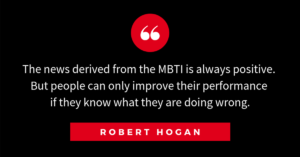
Second, the news derived from the MBTI is always positive and upbeat. But people can only improve their performance if they know what they are doing wrong.  MBTI results have nothing to say about the dark side, about behavioral tendencies that annoy and alienate other people and destroy the trust and confidence on which relationships depend and which support positive career development. Consequently, the MBTI has limited utility for career coaching purposes.

Third, the MBTI, along with the Five-Factor Model (FFM) that is the universally accepted paradigm for trait psychologists, has nothing to say about the up-down or status dimension in life. Every human group has a status hierarchy, with people at the top, people in the middle, and people at the bottom; in addition, the principal dynamic in every human group is the individual search for power. On issues of ambition and power seeking, the MBTI and the FFM are equally uninformative.

And finally, like most other major commercially available assessments (the Minnesota Multiphasic Personality Inventory, the California Psychological Inventory, the Strong Vocational Interest Inventory), there have been no significant updates or changes to the Myers-Briggs Type Indicator since its original publication. It is expensive and troublesome to upgrade a major assessment with a large archival base, but imagine how hard it is for BMW to come out with a new product line every three years. Upgrading a psychological assessment is trivial by comparison.

Want to learn more about personality tests? Check out The Ultimate Guide to Personality Tests

Topics: personality

Leadership and Organizational Effectiveness: The Case of Florida Atlantic University Football

Posted by Ryne Sherman on Wed, Aug 29, 2018

93293_h

Sports are an excellent laboratory for understanding how leadership impacts organizational effectiveness. The criteria for success are clear and easily quantified (i.e., winning vs. losing). Moreover, frequent changes in personnel and leadership provide quasi-experimental evidence of how these factors play a role in success. In this essay, I consider the case of the Florida Atlantic University football program.

In the fall of 2011 there was a great deal of excitement in Boca Raton as it was the opening season for a brand new football stadium. The $70 million stadium seats around 30,000 people and is located in the heart of the campus. The season, however, was disappointing for FAU fans. The team finished 1-11 (1 win, 11 losses), dead last in the conference, and had an average attendance of 17,565 (ranking 103rd among its FBS competitors). The legendary Howard Schnellenberger, who had announced his intention to retire prior to the beginning of the season, stepped down as head coach.

The team did not fare much better over the next five seasons. Carl Pelini was hired to begin the 2012 season, but subsequently resigned midway through the 2013 season for alleged illegal drug use. Charlie Partridge took over for the 2014 season and recorded three consecutive 3-9 records before being fired in November of the 2016 season. One month later, FAU hired Lane Kiffin as the head coach of the 2017 season.

Without a full season to recruit, Kiffin was faced with coaching the same players that had previously produced back-to-back-to-back 3-9 records. For this reason, what happened in 2017 is remarkable. Here are the highlights:

-An 11-3 win-loss record, their all-time best record as an FBS competitor

-Scored a team record 58 points in a game against Old Dominion

-Broke that record by 69 points in a game against North Texas the next week

-Scored 73 offensive touchdowns, tied for 3rd most in the FBS

-Undefeated (8-0) in conference play

-Won the conference championship in a 41-17 rout of North Texas

-Boca Raton Bowl Champions in a 50-3 victory over a good Akron team

Same roster. Different leadership. Vastly different results. How was this possible? I watched the team play in 2016. Despite having the same players, the 2017 team looked entirely different.  In 2016, when a critical 4th down came up, the team looked lost and panicked: “Should we punt?” “Should we go for it?” No one seemed to know. Watch the clip below to see how the 2017 team reacted to a 4th and goal situation in the first quarter of the Boca Raton Bowl:


When the 3rd and goal try fails, without panic and without a huddle, the team returns to the line of scrimmage, snaps the ball within 7 seconds, and has a wide-open touchdown in the end zone. They knew exactly what play to run and how to execute it in that situation. That’s preparation. Preparation that can only come from leadership.

In the 1970s and 1980s, the consensus among leadership researchers was that leadership is situationally-driven. That is, leadership and organizational outcomes were entirely based on circumstances outside individual control. In the decades since, we’ve proven over and over again that who is in charge has dramatic consequences for performance in sports, business, and political organizations. Lane Kiffin was placed in exactly the same situation as his predecessors. The results of this natural experiment once again confirm the hypothesis that leadership matters.

As for 2018, the Owls lost their first game 63-14 to the University of Oklahoma. Although they lost badly in the opener, I wouldn’t bet against Lane Kiffin and FAU long-term.

Topics: Hogan, college football, Florida Atlantic University, Florida Atlantic, FAU

Humility: The Antidote for Bad Leadership

Posted by Hogan Assessments on Tue, Aug 21, 2018

leadership-styles-1024×682Popular wisdom will have you believe that a leader is someone who exudes confidence and charisma because they appear smart, interesting, and engaging. However, more often than not, these types of leaders wreak havoc on the workplace. A growing body of research suggests that humility is a far more important quality in a leader than charisma.

Organizations tend to favor people who “seem” leader-like. Individuals who are self-promoting, interesting, and politically savvy tend to get earmarked for promotion. These leaders know what it takes to get ahead and get noticed, and they strategically cater to audiences who can offer them power, influence, status, or access to resources.

Charisma is the elusive quality of being charming, captivating, and pleasant to be around. We are naturally drawn to charismatic people because we feel good in their presence. However, charismatic people also tend to have inflated views of themselves and their skills. They also tend to be more self-promoting than others. Too much charisma can make for ineffective leaders as their tendency to be narcissistic can alienate those working under them.

In essence, charisma is a double-edged sword. Too little and it’s difficult to persuade team members to support your vision. Too much and team members feel unsupported and disengaged. The strong overlap between charisma and narcissism means that it’s easy for charm to turn into arrogance and entitlement.

Humility, on the other hand, is vitally important to creating stability and engagement within teams. One of the most famous studies on the topic analyzes the success of 11 high-performing companies. The leaders in the highest performing firms had two things in common: they were fiercely competitive, yet personally humble.

Humility is a relatively new subject in the context of leadership and organizational effectiveness, primarily because humble leaders typically don’t stand out from the crowd. Preliminary research on the topic shows that a humble leader inspires collaboration and earns the respect of their team members. They also create working environments with higher degrees of satisfaction and productivity. Although the subject is relatively new, there are valid claims for making it measurable. Initial research shows that these skills indicate humility: modesty, sincerity, openness to feedback, recognizing others, low levels of arrogance, and low levels of narcissism.

Mark Carney, governor of the Bank of England, emphasized the importance of humility as an essential attribute of leadership recently. “Good leaders combine personal humility, self-knowledge, and the ability to learn,” says Carney. “That means admitting mistakes, seeking and accepting feedback,and sharing the lessons you have learned.”

There is good news for those who are not naturally humble: research suggests that just by showing signs of humility, overly charismatic leaders can offset the qualities that make them unlikeable. A dose of humility can make a narcissistic boss seem more approachable, supportive, and open to feedback.

“Humility has the ability to counteract the potentially harmful effects of narcissism, which can lead to positive outcomes for the organization,” says Dena Rhodes, Research Consultant for Hogan Assessments. “This suggests that individuals can still have a narcissistic identity and be effective as a leader, as long as they have a humble reputation.”

The good news is that even the most arrogant of leaders can increase their effectiveness by showing humility, even if it’s not entirely genuine. Here are a few tips for avoiding the pitfalls of charisma:

  1. Put the spotlight on others: make a concerted effort to recognize the achievements of team members and subordinates
  2. Increase self-awareness: actively try to understand your limitations and show a willingness to acknowledge your mistakes
  3. Be open to feedback: a trademark of humility is being coachable, which means opening yourself up to criticism and accepting that your way is not the only way
  4. Check your sense of entitlement: work to earn the respect of your colleagues, don’t automatically assume you are entitled to it
  5. Monitor your self-promoting behaviors: focus on trying to get along rather than getting ahead

Topics: engagement, Hogan, charisma

Subscribe to our Blog

Most Popular Posts

Connect