Typewriter Bites Girl

Posted by Hogan Assessments on Wed, May 22, 2013


We got a kick out of this U.S. Navy office safety video from the 1940s.

Although the office environment (and the tone of the safety videos) has changed a bit since then, the underlying point of the video remains relevant – some personalities make an individual more prone to carelessness and, even in the most mundane of environments, that carelessness can cause accidents.

For more information about how people’s personalities influence office safety, check out Hogan SafeSystem.


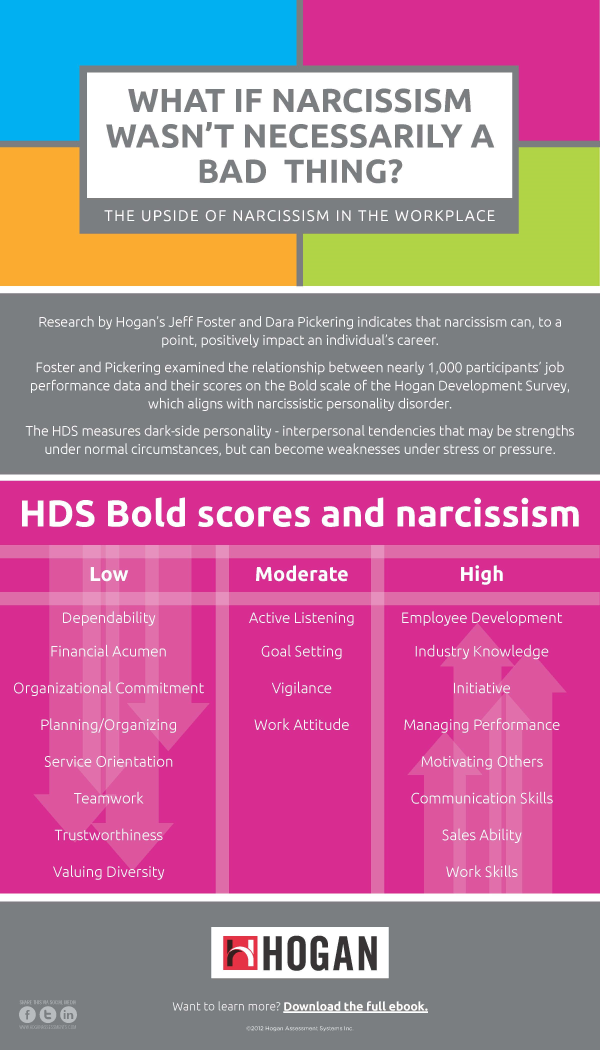
What If Narcissism Wasn't a Bad Thing?

Posted by Hogan News on Wed, May 22, 2013

The Upside of Narcissism in the Workplace

Narcissism


Topics: HDS, narcissism

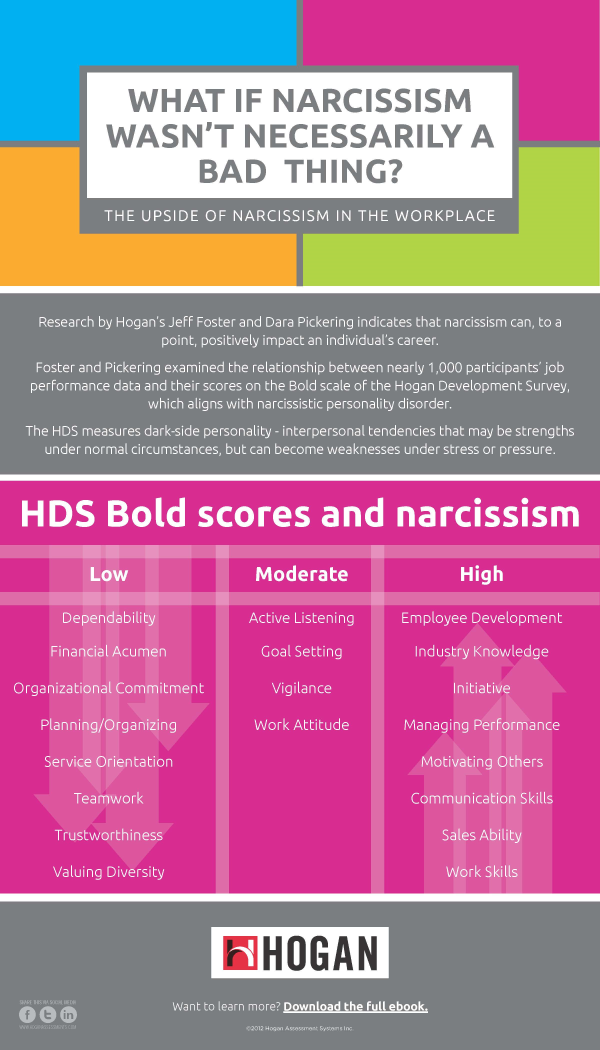
What If Narcissism Wasn’t a Bad Thing?

Posted by HNews on Tue, May 21, 2013


The Upside of Narcissism in the Workplace

Narcissism


Q1 Research Review I - Drivers of Performance

Posted by Hogan News on Mon, May 20, 2013

No one has time to read every new piece of research that could impact our field. As a result, it is hard to know what important new findings might pass us by. Luckily, the Hogan Research Division is here to help (and we welcome your contributions in return).

Below is a quick rundown of several articles from Q1 that examined a variety of individual and organizational characteristics that drive performance. This is not an all-inclusive list. So, if you’ve read any new publications or reports from the last three months we failed to include, feel free to write a comment telling us about them.

  • In a review of customer service-related variables, Hong et al. provide a nice outline of how leadership impacts a company’s bottom line. First, leadership practices shape an organization’s service climate, which influences employee behaviors. Behaviors impact customer satisfaction, which then drives financial performance. This research provides an excellent demonstration of the Leadership Value Chain at work.
  • In reviewing safety-related variables, Hogan & Foster presents research demonstrating how individual employee personality characteristics predict important work outcomes. Using data from multiple samples representing a variety of jobs, organizations, and industries, we show that personality influences safety-related behaviors, which in turn predict major workplace accidents and injuries. In other words, personality doesn’t influence work outcomes by itself, but does so because of its influence in important work-related behaviors.
  • We have all heard that self efficacy and performance are correlated with one another, but does one actually cause the other? Research by Sitzmann and Yeo suggests that performance drives self-efficacy, but not necessarily the other way around. Instead, individuals who are confident in their abilities likely do better on many tasks simply because they’ve done well on similar tasks in the past.  
  • Is conflict within teams good or bad? According to research by Bradley et al., it all depends on the personality characteristics of your team. When team members are generally high in Emotional Stability or Openness, conflict can drive good performance, but the opposite is true when either characteristic is generally low. So, when dealing with conflict within teams, it helps to know your team members.  
  • Abusive supervision continues to be a hot topic these days. In examining the impact of abusive supervision, Shoss et al. found that when employees identify an abusive supervisor with their company, they are more likely to retaliate against the company itself through both counterproductive behaviors and lower job performance.  
And stay tuned, Parts 2 and 3 of our review will cover articles relating to coaching, statistics, and a potpourri selection of articles we thought were worth sharing.

Topics: psychology, research

Q1 Research Review I – Drivers of Performance

Posted by HNews on Sun, May 19, 2013

No one has time to read every new piece of research that could impact our field. As a result, it is hard to know what important new findings might pass us by. Luckily, the Hogan Research Division is here to help (and we welcome your contributions in return).

Below is a quick rundown of several articles from Q1 that examined a variety of individual and organizational characteristics that drive performance. This is not an all-inclusive list. So, if you’ve read any new publications or reports from the last three months we failed to include, feel free to write a comment telling us about them.

  • In a review of customer service-related variables, Hong et al. provide a nice outline of how leadership impacts a company’s bottom line. First, leadership practices shape an organization’s service climate, which influences employee behaviors. Behaviors impact customer satisfaction, which then drives financial performance. This research provides an excellent demonstration of the Leadership Value Chain at work.
  • In reviewing safety-related variables, Hogan & Foster presents research demonstrating how individual employee personality characteristics predict important work outcomes. Using data from multiple samples representing a variety of jobs, organizations, and industries, we show that personality influences safety-related behaviors, which in turn predict major workplace accidents and injuries. In other words, personality doesn’t influence work outcomes by itself, but does so because of its influence in important work-related behaviors.
  • We have all heard that self efficacy and performance are correlated with one another, but does one actually cause the other? Research by Sitzmann and Yeo suggests that performance drives self-efficacy, but not necessarily the other way around. Instead, individuals who are confident in their abilities likely do better on many tasks simply because they’ve done well on similar tasks in the past.
  • Is conflict within teams good or bad? According to research by Bradley et al., it all depends on the personality characteristics of your team. When team members are generally high in Emotional Stability or Openness, conflict can drive good performance, but the opposite is true when either characteristic is generally low. So, when dealing with conflict within teams, it helps to know your team members.
  • Abusive supervision continues to be a hot topic these days. In examining the impact of abusive supervision, Shoss et al. found that when employees identify an abusive supervisor with their company, they are more likely to retaliate against the company itself through both counterproductive behaviors and lower job performance.

And stay tuned, Parts 2 and 3 of our review will cover articles relating to coaching, statistics, and a potpourri selection of articles we thought were worth sharing.

Way Outside the Box

Posted by Hogan News on Thu, May 16, 2013

Outside the boxIs there such a thing as being too creative? Although creativity is largely associated with positive work outcomes, our research shows that, in excess, creativity can be a powerful roadblock to career success.

To understand how creativity can harm an individual’s career, we must look at personality from two perspectives: bright-side personality and dark-side personality.

Bright-side personality describes the strengths and weaknesses people display when they are at their best. Dark-side personality describes personality characteristics that are strengths under normal circumstances. Under the increased stress, pressure, or boredom of most work environments, people tend to overuse those strengths, and they can become powerful career derailers.

Creative people often have parents who emphasize their uniqueness and favor creative expression over convention. As adults, their ability to comfortably work outside of societal norms makes creative individuals valuable sources of potentially important ideas. However, highly creative individuals also tend to focus too much on thinking outside the box, often at the cost of their ability to clearly explain their ideas or follow through.

For more on performance implications and recommendations for coaching highly creative individuals, download our white paper, Way Outside the Box.

Topics: HPI, Hogan Personality Inventory, Hogan Development Survey, assessments, HDS, coaching

Way Outside the Box

Posted by HNews on Wed, May 15, 2013

Outside the boxIs there such a thing as being too creative? Although creativity is largely associated with positive work outcomes, our research shows that, in excess, creativity can be a powerful roadblock to career success.

To understand how creativity can harm an individual’s career, we must look at personality from two perspectives: bright-side personality and dark-side personality.

Bright-side personality describes the strengths and weaknesses people display when they are at their best. Dark-side personality describes personality characteristics that are strengths under normal circumstances. Under the increased stress, pressure, or boredom of most work environments, people tend to overuse those strengths, and they can become powerful career derailers.

Creative people often have parents who emphasize their uniqueness and favor creative expression over convention. As adults, their ability to comfortably work outside of societal norms makes creative individuals valuable sources of potentially important ideas. However, highly creative individuals also tend to focus too much on thinking outside the box, often at the cost of their ability to clearly explain their ideas or follow through.

For more on performance implications and recommendations for coaching highly creative individuals, download our white paper, Way Outside the Box.

Topics: assessments, coaching

"Innovate or die." – Dr. Robert Hogan

Posted by Hogan News on Tue, May 14, 2013

InnovateordieThis axiom is all too relevant for entrepreneurs today. Companies like Google and Pixar embrace a collaborative and innovative culture with unconventional work hours and offices. Why do they go through such great lengths to foster their employees’ creativity? Because that’s what a creative employee’s personality demands.

A creative employee’s personality profile indicates that they’re idealistic, nonconforming, and tend to be unconcerned about money. Conversely, good managers tend to be stable, practical, and concerned with maintaining order and controlling costs.

Although they are psychological opposites, managers and creative people badly need one another.
Find out what 5 steps organizations can take to ensure they are properly managing their creative employees and driving innovation by downloading our complimentary ebook.

Topics: HPI, MVPI, Hogan Personality Inventory, Hogan Development Survey, assessments, HDS

Innovate or die. – Dr. Robert Hogan

Posted by HNews on Mon, May 13, 2013

InnovateordieThis axiom is all too relevant for entrepreneurs today. Companies like Google and Pixar embrace a collaborative and innovative culture with unconventional work hours and offices. Why do they go through such great lengths to foster their employees’ creativity? Because that’s what a creative employee’s personality demands.

A creative employee’s personality profile indicates that they’re idealistic, nonconforming, and tend to be unconcerned about money. Conversely, good managers tend to be stable, practical, and concerned with maintaining order and controlling costs.

Although they are psychological opposites, managers and creative people badly need one another.
Find out what 5 steps organizations can take to ensure they are properly managing their creative employees and driving innovation by downloading our complimentary ebook.

Topics: assessments

The Science of Attraction

Posted by Hogan News on Thu, May 09, 2013

Survey results revealed that 82.1% of respondents feel personality
is most important in a romantic partner.

Science of attraction

Topics: personality, science

Subscribe to our Blog

Most Popular Posts

Connect