
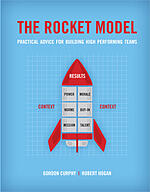
Teams are the Building Blocks of Human Achievement

Posted by Hogan Assessments on Wed, May 30, 2012

RM Twitter 3Western societies tend to attribute success to individuals – Hannibal is often seen as the leader who conquered much of the land surrounding the Mediterranean and it was Steve Jobs who transformed Apple into one of the world’s most valued companies. But these individuals would have failed had they worked alone. Hannibal’s success can be rightly attributed to assembling a highly effective army; Steve Jobs’ success depended on highly talented product developers and software engineers. Hannibal and Jobs not only had a knack for gathering the right cast of characters, they were also very adept at putting the right people in the right positions and getting everyone to work together effectively. More often than not, less talented individuals who work well together often accomplish more than talented individuals who play dysfunctional family feud. Despite the fact that all major human accomplishments have been the result of collective rather than individual efforts, systematic research on groups and teams is a relatively recent phenomenon.

Most of the research on teams from the late 1940s through the early 1980s was focused on the processes and dynamics associated with leaderless groups. Tuckman’s famous forming, storming, norming, and performing stages of group development was one of the more robust findings from this research and can readily be observed anytime groups of volunteers get together. Yet these four stages rarely occur in the world of work, since competitive threats, authority hierarchies, pre-assigned goals and roles, and time and task pressures profoundly affect group dynamics. Research on work teams over the past 30 years has resulted in these six major findings:

  1. There are important distinctions between groups and teams. Teams have overarching goals; members do interdependent work and share common fates. Groups are collections of individuals who have individual goals, do independent work, and are rewarded or fail based on their individual efforts.

  2. Teams are not always more effective than groups. The relative effectiveness of teams versus groups depends on the nature of work to be accomplished; sometimes teams are the best option and other times groups are a better way to go.

  3. Highly effective groups and teams are relatively rare. People work on many groups and teams over the course of their careers, yet most fail to perform at their potential.

  4. There is no widely accepted model for building high performing groups and teams. Several models for building teams have been offered but none have been widely adopted.

  5. Effective leaders are the exception rather than the rule. Somewhere between 65-75 percent of people in positions of authority are unable to build teams or get results.

  6. Leadership matters. It is true that leaders cannot do it alone and may get a disproportionate amount of credit or blame for team outcomes, but who is in charge does matter. Dysfunctional leaders beget dysfunctional teams.

By Gordon Curphy
Curphy Consulting Corporation
Guest blogger and author of The Rocket Model

Topics: leadership, teams, employee engagement, The Rocket Model, team performance, Curphy Consulting

There is no “I” in TALENT?

Posted by JVanBroekhoven on Wed, Jul 13, 2011

A virtual debate in the business blogosphere has been growing more and more heated over the past several weeks and months.  It appears the debate began with a May 17th New York Times article that quoted Mark Zuckerberg, Facebook’s illustrious CEO, as saying, “Someone who is exceptional in their role is not just a little better than someone who is pretty good. They are 100 times better.”  Although difficult to follow at first, Zuckerberg’s argument is that a brilliant individual is 100 times more valuable than a mediocre team.  His statement reflects a new strategy in the War on Talent that many have also begun to adopt.  According to the Times article, many of the giants in Silicon Valley are so desperate for fresh talent they have resorted to purchasing entire companies simply to acquire the gifted entrepreneurs, engineers, and programmers that created and comprise them.  This new practice has been dubbed “acqhiring,” and is becoming more common in industries where the competition for talent is fierce and requires more benefits, dazzling incentives, and creative ways to attract the best and brightest.

Zuckerberg’s thoughts are not shared by all, however.  In a rebuttal of sorts, HBR blogger Bill Taylor posted a piece of his mind called Great People Are Overrated on June 20th, in which he questions the practice of placing all of the eggs in a single, metaphorical basket.  Taylor warns his readers about the dangers of putting too much emphasis on “star players” and underestimating the power of an effective team.  In simpler terms, the quarterback cannot win the game alone, but the entire second string playing as a team may have a fighting chance; or at least they would in a heartwarming Hollywood blockbuster.  In our desperation to retain top talent, are those of us in talent management becoming overly focused on star-power and losing sight of what actually drives performance?  Taylor also points out that most talent decisions would not realistically involve a choice between one exceptional person and 100 mediocre people.  However, if forced to make the choice what would you decide?

Adding to the web debate is fellow HBR blogger Jeff Stibel, CEO of Dun & Bradstreet Credibility Corp.  Stibel responded directly to Taylor on June 27th with his blog, Why a Great Individual Is Better Than a Good Team.  He not only agrees with Zuckerberg, but takes it one step further by saying that a great individual is worth an infinite number of average people.  Why?  Stibel claims that our cognitive functioning breaks down in group settings, and that the value of an individual contributor declines with each additional team member working on a single idea or project.  He likens his argument to the economic law of diminishing returns, or – more simply put – too many cooks in the kitchen will spoil the broth.

Evaluating both sides of this argument from a psychologist’s perspective, I propose another point of view.  As with all matters involving human beings, we cannot place too much or too little emphasis on the importance of individual differences in our talent management philosophy.  The dynamics of human interaction, team performance, and individual effectiveness are far too complex to be reduced to sports metaphors or culinary idioms.  It is very easy to cull up images of the brilliant artist, boy genius, or start-up entrepreneur who works best as a “lone wolf,” locked up in an office or studio with nothing more than their ideas and their IQ points.  For these individuals, perhaps it is possible to claim that an individual is better than a team.  These salient examples, however intriguing they are, do not define the global workforce or talent pool that we are currently facing.  Today’s effective organizations need dreamers and doers, leaders and team players, and generally rely on the cooperation and coordination of many. 

Jeff Stibel’s argument is somewhat lost on me for a few reasons.  First, individual differences matter.  For every person who works better alone, there is at least one person who thrives on social interaction, gains energy from working in teams, and feels motivated by opportunities to collaborate.  Behind every brilliant program or idea developed by a software genius is a person or team who knows how to actually market the product, balance the books, manage the necessary resources, etc.  Second, organizational performance cannot be determined by calculating the arithmetic sum of each individual contributor’s brilliance, ability, or creativity.  Rather, organizational performance is determined by the extent to which individuals can effectively perform together as a team.  Finally, taking into account individual differences and team dynamics, success will also depend on the quality of leadership, which ideally provides a compelling vision, adequate resources, and the strategic direction necessary to maximize the talent within an organization.

The debate rages on – see Taylor’s Great People Are Overrated (Part II).  However, it seems that all parties agree that the War on Talent is a reality, and that continued organizational success depends on the ability to attract, retain, and perhaps even “acqhire” top talent.  My opinion diverges from the debate based on a belief that neither the individual nor the team is sufficient to guarantee organizational success.  A much more complex formula governs the outcomes we care about in today’s talent landscape and informs where we decide to funnel our resources.  The final statement in Stibel’s blog is one I absolutely agree with: “One decision is easy: find the best people and empower them to do great things.” 

Topics: teams

Subscribe to our Blog

Most Popular Posts

Connect