
The Real Challenge at Yahoo

Posted by Hogan Assessments on Mon, Jul 30, 2012

Yahoo CupcakesYahoo recently announced the hiring of Marissa Mayer – employee number 20 at Google – as its new CEO. Her appointment is noteworthy for a few reasons; she has been appointed CEO in a notoriously male‑dominated industry, she is the youngest CEO of a Fortune 500 company, and as has been widely reported, Ms. Mayer is pregnant and expecting her first child in October. The vast majority of press concerning her appointment to date has centered on this last bit of news, inciting discussion and debates about balancing careers and personal lives, and how she will manage through late-term pregnancy and her maternity leave. While this will certainly be an adjustment, Ms. Mayer will enjoy an army of help and plethora of resources that most new parents have never dreamed of. She will be able to manage this transition just fine.

In all the excitement concerning her pregnancy, few are writing about the real challenges that await Ms. Mayer as the new chief of Yahoo. For 13 years she has been with Google, leading the charge as the company grew from the tech nerd’s search engine of choice with a funny name, to the dominant search, cloud, mobile, and advertising giant we know today. Fortune has named Google the top company to work for in 3 of the past 6 years, allowing them to attract top talent in the industry. Google has developed a culture of success.

On the other hand, Yahoo has been a steady state of decline during the same period. An early internet darling in the late 20th century, Yahoo has gradually ceded ground to others in areas such as search, content, mail, and advertising, all areas where they were formally leaders. Ms. Mayer is Yahoo’s 4th CEO in as many years (not including interim CEOs), and former leadership has been criticized for failing to provide any direction or strategic leadership. Yahoo’s sales peaked at over $7 billion in 2008, and have steadily fallen to less than $5 billion in 2011.

All of this points to the biggest challenge; changing the culture at Yahoo. Where Google was a confident culture that expected to succeed, Yahoo’s culture is one that has been continually losing ground and lacks confidence in leadership. Yahoo has been losing out in the talent war to organizations like Google, Facebook, or promising start-ups in Silicon Valley. Ms. Mayer will need to convince Yahooers that they can be successful, and that they can trust her vision. She will need to put in place a strategy to recruit, develop, and retain the highly-prized talent that helped Google be so successful.

We know that leadership is not about the individual, and Ms. Mayer cannot expect to single-handedly rescue Yahoo from its recent woes simply by decreeing a new strategy or direction. Leadership is about facilitating the performance of others, about building and maintaining high-performing teams, and about winning and beating the competition. The biggest challenge that Ms. Mayer will face is building a company culture that, after years of losing ground and churning through leadership, believes it can compete and win against the Googles of the world.

Topics: corporate culture, company culture

The Rocket Model: Followership, Team Killers and Team Performance

Posted by Hogan Assessments on Mon, Jul 30, 2012

describe the image


Bad followership can destroy team performance. Followership concerns the level of engagement and critical thinking skills demonstrated by team and group members. A group member may have all the right skills and be in the right role, yet sit in the corner and pout rather than perform. Other members may have fewer skills but work hard and offer good ideas for improving processes which, ultimately, improves team functioning. 


curphy

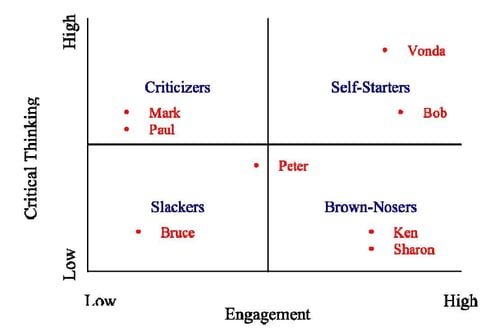
As seen in the diagram, engagement and critical thinking are independent dimensions of followership. These two dimensions can be divided into four followership types: Self-Starters, Brown-Nosers, Slackers, and Criticizers. The power of the model becomes obvious when leaders use it to assess the follower types on their team or group. Knowing members’ types will provide leaders with insights on how best to manage them since each type should be approached differently. . 

Self-Starters, such as Bob and Vonda, are individuals who are passionate about working on the team and will try to make it successful. They constantly think of ways to improve team performance by raising issues, developing solutions, and showing enthusiasm. When they encounter problems, they resolve issues and then tell their leaders what they have done rather than waiting to be told what to do. This follower type will improve their leaders’ performance by offering opinions before, and providing constructive feedback after, bad decisions. Self-Starters are critical to the performance of teams and are the most effective follower type.

Brown-Nosers such as Ken and Sharon have a strong work ethic but lack critical thinking skills. Brown-Nosers are dutiful and conscientious, rarely point out problems, raise objections, or make waves, and do whatever they can to please their boss. Brown-Nosers constantly check with their leaders and operate by seeking permission rather than forgiveness. Leaders who feel entitled, think they are hot, or think they are the only ones capable of developing solutions, often surround themselves with Brown-Nosers because suck-ups constantly flatter their great bosses. Brown-Nosers often go far in organizations, particularly in those that lack objective performance metrics. Organizations lacking clear measures of performance often make personnel decisions based on politics, and Brown-Nosers play politics very well.

Slackers don’t work very hard, think they deserve a paycheck for just showing up, and believe it is the leader’s job to solve problems. Slackers are clever at avoiding work, often disappear for hours, look busy but get little done, have good excuses for not completing projects, and spend more effort finding ways to avoid finishing tasks than they would by just doing them. Slackers are “stealth employees” who are happy to spend their time surfing the Internet, shopping online, gossiping with co-workers, and taking breaks with no concern for their jobs.

Criticizers are followers with strong thinking skills who are disengaged. Rather than directing their analytical skills to productive outcomes, they find fault in anything their leaders and organizations do. Criticizers educate co-workers about their leaders’ shortcomings, how change efforts will fail, how poorly their organizations compare to the competition, and how management ignores their suggestions. In terms of their impact on team and organizational performance, they are the most dangerous of the four types because their personal mission is to create dissent. If not managed properly, these team killers can take over teams and entire departments!

Leaders can use the followership model to understand group dynamics and what they need to do to improve team talent within any team or group. These four follower types are dynamic—they can and do change over time. Members who were once Self-Starters can become Criticizers and vice-versa. Because follower types are dynamic, leaders should periodically assess their own behavior and use the followership model to evaluate the impact it is having on the people in their groups.

By Gordon Curphy
Curphy Consulting Corporation
Guest blogger and co-author of The Rocket Model

Topics: leadership, teams, employee engagement, The Rocket Model, team performance, Groups, Curphy Consulting Corporation

The Rocket Model: Followership, Team Killers and Team Performance

Posted by Hogan Assessments on Sun, Jul 29, 2012


describe the image

Bad followership can destroy team performance. Followership concerns the level of engagement and critical thinking skills demonstrated by team and group members. A group member may have all the right skills and be in the right role, yet sit in the corner and pout rather than perform. Other members may have fewer skills but work hard and offer good ideas for improving processes which, ultimately, improves team functioning.

curphy

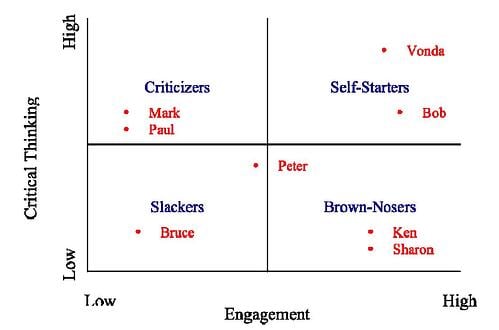
As seen in the diagram, engagement and critical thinking are independent dimensions of followership. These two dimensions can be divided into four followership types: Self-Starters, Brown-Nosers, Slackers, and Criticizers. The power of the model becomes obvious when leaders use it to assess the follower types on their team or group. Knowing members’ types will provide leaders with insights on how best to manage them since each type should be approached differently. .

Self-Starters, such as Bob and Vonda, are individuals who are passionate about working on the team and will try to make it successful. They constantly think of ways to improve team performance by raising issues, developing solutions, and showing enthusiasm. When they encounter problems, they resolve issues and then tell their leaders what they have done rather than waiting to be told what to do. This follower type will improve their leaders’ performance by offering opinions before, and providing constructive feedback after, bad decisions. Self-Starters are critical to the performance of teams and are the most effective follower type.

Brown-Nosers such as Ken and Sharon have a strong work ethic but lack critical thinking skills. Brown-Nosers are dutiful and conscientious, rarely point out problems, raise objections, or make waves, and do whatever they can to please their boss. Brown-Nosers constantly check with their leaders and operate by seeking permission rather than forgiveness. Leaders who feel entitled, think they are hot, or think they are the only ones capable of developing solutions, often surround themselves with Brown-Nosers because suck-ups constantly flatter their great bosses. Brown-Nosers often go far in organizations, particularly in those that lack objective performance metrics. Organizations lacking clear measures of performance often make personnel decisions based on politics, and Brown-Nosers play politics very well.

Slackers don’t work very hard, think they deserve a paycheck for just showing up, and believe it is the leader’s job to solve problems. Slackers are clever at avoiding work, often disappear for hours, look busy but get little done, have good excuses for not completing projects, and spend more effort finding ways to avoid finishing tasks than they would by just doing them. Slackers are “stealth employees” who are happy to spend their time surfing the Internet, shopping online, gossiping with co-workers, and taking breaks with no concern for their jobs.

Criticizers are followers with strong thinking skills who are disengaged. Rather than directing their analytical skills to productive outcomes, they find fault in anything their leaders and organizations do. Criticizers educate co-workers about their leaders’ shortcomings, how change efforts will fail, how poorly their organizations compare to the competition, and how management ignores their suggestions. In terms of their impact on team and organizational performance, they are the most dangerous of the four types because their personal mission is to create dissent. If not managed properly, these team killers can take over teams and entire departments!

Leaders can use the followership model to understand group dynamics and what they need to do to improve team talent within any team or group. These four follower types are dynamic—they can and do change over time. Members who were once Self-Starters can become Criticizers and vice-versa. Because follower types are dynamic, leaders should periodically assess their own behavior and use the followership model to evaluate the impact it is having on the people in their groups.

By Gordon Curphy
Curphy Consulting Corporation
Guest blogger and co-author of The Rocket Model


Leaders and Followers

Posted by Steve Nichols on Fri, Jul 27, 2012

leaders versus followers

At my house, I am a leader. More accurately, I am one half of a leadership team. I have 3 children, and I like to think they need my advice, direction, and all of the other things that go along with being a parent.  As I wrote that last sentence though, I realized this is why it’s a good thing I’m only one member of the leadership team in my house. Absent from my stream of consciousness right then were terms like tenderness, cuddling, and kissing boo-boos to make them better. It’s not that I don’t do those things (or enjoy doing them); it’s just that those are not what initially come to my mind when I think of how I lead the kids at home. Conversely, I’d wager that those terms would be at the top of their mom’s list. 

It is interesting to think of how differently our followers act depending on who seems to be in charge at the moment. With me, things are more pragmatic; if we have a task to do (whether it is putting together a race car track, picking up toys, or finishing homework), we focus on the task. When things need to be done, I prefer to just get them done. No need to talk about how much you like the task, or if you feel it’s fair – the task needs to be done, so let’s just do it.     

Conversely, when mom is in charge I hear a lot more back-and-forth about the tasks – “well my teacher said you can only get the answer if you do it this way” (it’s math – 2+2 is always 4), “I don’t want to pick up my toys” (they’re your toys), “why?” “Why?” “Whaa?” But when I am in charge, those types of behaviors don’t often occur.

Whether my kids have a preference for either of our leadership styles, I’m not sure. One is 13 and doesn’t seem to look too favorably on anything her parents say. The second is 2 and half, so our communication is not particularly deep or feedback rich and is sometimes limited to talks about the merits of Hot Wheels vs Matchbox, whether we like brown or yellow dogs better, and Dora the Explorer.  And last is our 1 year old; he doesn’t really talk, so unfortunately he just has to deal with things. I help him put together Mega Blocks, mom soothes the devastation brought on by literally spilled milk.

The point being, when something just needs to get done, I’m the man they go to. But when feelings get hurt, knees get skinned, or emotions are running high, everyone seems to clamor for mom’s attention.   

I think this may be analogous to why finding good leaders can be difficult. I fulfill one part of our followers needs – mom fulfils another. But our followers need both. 

In a work setting, discovering an individual who excels in all areas is rare; that is why good leaders can be hard to come by. As Dr. Robert Hogan pointed out in his blog Leadership is a Hygiene Factor, although a good leader may not be the most important aspect of unit performance, a bad one can certainly ruin things. I suppose that is why things at my house have not imploded yet – we have the benefit of spreading the needs of our followers across two people. My advice? Try not to alienate the kids too much – unit performance will suffer.

Topics: leadership

Leaders and Followers

Posted by SNichols on Thu, Jul 26, 2012

leaders versus followers

At my house, I am a leader. More accurately, I am one half of a leadership team. I have 3 children, and I like to think they need my advice, direction, and all of the other things that go along with being a parent.  As I wrote that last sentence though, I realized this is why it’s a good thing I’m only one member of the leadership team in my house. Absent from my stream of consciousness right then were terms like tenderness, cuddling, and kissing boo-boos to make them better. It’s not that I don’t do those things (or enjoy doing them); it’s just that those are not what initially come to my mind when I think of how I lead the kids at home. Conversely, I’d wager that those terms would be at the top of their mom’s list.

It is interesting to think of how differently our followers act depending on who seems to be in charge at the moment. With me, things are more pragmatic; if we have a task to do (whether it is putting together a race car track, picking up toys, or finishing homework), we focus on the task. When things need to be done, I prefer to just get them done. No need to talk about how much you like the task, or if you feel it’s fair – the task needs to be done, so let’s just do it.

Conversely, when mom is in charge I hear a lot more back-and-forth about the tasks – “well my teacher said you can only get the answer if you do it this way” (it’s math – 2+2 is always 4), “I don’t want to pick up my toys” (they’re your toys), “why?” “Why?” “Whaa?” But when I am in charge, those types of behaviors don’t often occur.

Whether my kids have a preference for either of our leadership styles, I’m not sure. One is 13 and doesn’t seem to look too favorably on anything her parents say. The second is 2 and half, so our communication is not particularly deep or feedback rich and is sometimes limited to talks about the merits of Hot Wheels vs Matchbox, whether we like brown or yellow dogs better, and Dora the Explorer.  And last is our 1 year old; he doesn’t really talk, so unfortunately he just has to deal with things. I help him put together Mega Blocks, mom soothes the devastation brought on by literally spilled milk.

The point being, when something just needs to get done, I’m the man they go to. But when feelings get hurt, knees get skinned, or emotions are running high, everyone seems to clamor for mom’s attention.

I think this may be analogous to why finding good leaders can be difficult. I fulfill one part of our followers needs – mom fulfils another. But our followers need both.

In a work setting, discovering an individual who excels in all areas is rare; that is why good leaders can be hard to come by. As Dr. Robert Hogan pointed out in his blog Leadership is a Hygiene Factor, although a good leader may not be the most important aspect of unit performance, a bad one can certainly ruin things. I suppose that is why things at my house have not imploded yet – we have the benefit of spreading the needs of our followers across two people. My advice? Try not to alienate the kids too much – unit performance will suffer.

Are You Aware of Awareness Coaching?

Posted by Hogan Assessments on Wed, Jul 25, 2012

Awareness coachingIn the face of ever-shrinking budgets and less resources to devote to employee development, many companies face a similar problem: providing current and potential leadership with critical professional development opportunities.
Executive coaching programs often span more than a year, in which a coach helps the participant develop skills and augment behaviors necessary for future success. These engagements are known as skills coaching and are designed to enhance the skillset of the participants.

Yet, skills coaching fails to heighten one’s strategic self-awareness – the understanding of one’s strengths, weaknesses, and behavioral tendencies and how these characteristics compare to those of others.

Awareness coaching, on the other hand, uses assessment results and a series of short coaching sessions that put the ownership of development on the participant. In such engagements, the employees receive a series of short coaching sessions supported by personality data, where they receive suggestions for behavior changes geared toward increasing workplace performance.

Finding cost-effective and impactful methods for leadership development is crucial to success. Using the power of assessments to make leaders aware of their own strengths and weaknesses, rather than teaching them new skills, or ways to improve their existing behaviors, employers can ensure they have a bench full of high-potential employees ready to step in to key leadership positions.

To learn more about awareness coaching and to see a case study of how one company experienced positive results through this method, review our white paper, Awareness Coaching.

Topics: leadership development, coaching

Are You Aware of Awareness Coaching?

Posted by Hogan Assessments on Tue, Jul 24, 2012

Awareness coachingIn the face of ever-shrinking budgets and less resources to devote to employee development, many companies face a similar problem: providing current and potential leadership with critical professional development opportunities.



Executive coaching programs often span more than a year, in which a coach helps the participant develop skills and augment behaviors necessary for future success. These engagements are known as skills coaching and are designed to enhance the skillset of the participants.

Yet, skills coaching fails to heighten one’s strategic self-awareness – the understanding of one’s strengths, weaknesses, and behavioral tendencies and how these characteristics compare to those of others.

Awareness coaching, on the other hand, uses assessment results and a series of short coaching sessions that put the ownership of development on the participant. In such engagements, the employees receive a series of short coaching sessions supported by personality data, where they receive suggestions for behavior changes geared toward increasing workplace performance.

Finding cost-effective and impactful methods for leadership development is crucial to success. Using the power of assessments to make leaders aware of their own strengths and weaknesses, rather than teaching them new skills, or ways to improve their existing behaviors, employers can ensure they have a bench full of high-potential employees ready to step in to key leadership positions.

To learn more about awareness coaching and to see a case study of how one company experienced positive results through this method, review our white paper, Awareness Coaching.

Topics: coaching

The Rocket Model: The Five Right Questions for Team Talent

Posted by Robert Hogan on Mon, Jul 23, 2012

Rocket Model


Armies with the best soldiers usually win wars, and sports teams with the best athletes usually win championships. Everyone knows how important it is to pick the right people for a team, yet this is an area where leaders woefully fall short. Far too often team members are selected because of empire building and politics rather than skills and experience. A simple way to determine whether a team or group is staffed properly is for leaders to ask themselves these five right questions:


  • Does the team have the right number of people?
  • Does the team have the right structure?
  • Do team members have the right skills?
  • Are team members in the right roles?
  • Are people on the team for the right reasons?

Overly inclusive or empire building leaders often make the mistake of having too many people on a team, which has a negative impact on team efficiency and effectiveness. Many leaders also make the mistake of organizing their teams around their favorites rather than letting the nature of the work drive team structure. Sometimes, members do not have the right skills or are not in the right roles, which also has a negative impact on the team’s ability to win. Team performance usually suffers whenever anyone is on the team solely because of favoritism or political expedience. 

Although leaders can ask themselves the five right questions at any time, it is best to do this after team context and goals have been determined, as these are critical determinants of team talent. Leaders who answer these questions before team context and goals are set are usually just making rationalizations for their favorites.

By Gordon Curphy
Curphy Consulting Corporation
Guest blogger and co-author of The Rocket Model

Topics: leadership, teams, employee engagement, The Rocket Model, team performance, Groups, Curphy Consulting Corporation

The Rocket Model: The Five Right Questions for Team Talent

Posted by RHogan on Sun, Jul 22, 2012


Rocket Model

Armies with the best soldiers usually win wars, and sports teams with the best athletes usually win championships. Everyone knows how important it is to pick the right people for a team, yet this is an area where leaders woefully fall short. Far too often team members are selected because of empire building and politics rather than skills and experience. A simple way to determine whether a team or group is staffed properly is for leaders to ask themselves these five right questions:

  • Does the team have the right number of people?
  • Does the team have the right structure?
  • Do team members have the right skills?
  • Are team members in the right roles?
  • Are people on the team for the right reasons?

Overly inclusive or empire building leaders often make the mistake of having too many people on a team, which has a negative impact on team efficiency and effectiveness. Many leaders also make the mistake of organizing their teams around their favorites rather than letting the nature of the work drive team structure. Sometimes, members do not have the right skills or are not in the right roles, which also has a negative impact on the team’s ability to win. Team performance usually suffers whenever anyone is on the team solely because of favoritism or political expedience.

Although leaders can ask themselves the five right questions at any time, it is best to do this after team context and goals have been determined, as these are critical determinants of team talent. Leaders who answer these questions before team context and goals are set are usually just making rationalizations for their favorites.

By Gordon Curphy
Curphy Consulting Corporation
Guest blogger and co-author of The Rocket Model


Welcome to the Hogan Team

Posted by Hogan Assessments on Fri, Jul 20, 2012

We're excited to welcome new members to the Hogan family!

As our new senior accountant, Adrienne Horner is responsible for contract management, maintaining pricing set-up, tax support, and taking care of business.

Jenni Weldon is our new HR Generalist. She is responsible for the administration of HR programs and policies, recruiting and staffing logistics, employee relations, and everything that makes our company culture what it is.

Jocelyn Hays, our newest Corporate Solutions consultant, works with Hogan’s direct clients to design and implement solutions for employee selection, leadership development, and team development. 

As Brand Manager, Lindsey Morehead, the newest addition to our marketing team, is responsible for establishing, maintaining, and monitoring Hogan brand standards internally and through partner relationships.

Our new receptionist, Autumn Rigsbee, is keeping the lines of communication open and assisting with office management. We love it when she brings her English mastiff, Kuma (Japanese for “bear”), around for a visit!

Tony Dinelli has joined our IT team as Project Manager. You might talk to him if you’re working on integrating Hogan into your company and looking for technical support. He acts as the liaison between clients, Hogan consultants, and customer service.

Holly Lee joined our customer service team in June. She works to provide excellent service to our clients and their candidates.

To our Florida office, we welcome Megan Ludwick. Megan is the new Project Associate in the training division and she assists with project management, development, and launches.

Leigha Carter is our new Training Coordinator. Leigha is responsible for supporting administrative functions, certification workshops, web courses, and maintaining all training records.

Welcome to the Hogan Team!New Hogan hires

Topics: Hogan Team

Subscribe to our Blog

Most Popular Posts

Connect