
It’s not what you say; it’s how you say it

Posted by Adam Vassar on Fri, Feb 24, 2012

ShutMouthI worked with an organization several years ago to develop a leadership coaching program. When I asked my client what the problem was, he said, “It is okay to be a jerk as long as you’re hitting your numbers.”

The organization’s sales leaders were operating in an alienating manner, but this behavior was excused because they were meeting their goals. When those sales dipped, they didn’t have trusted confidants to point out industry and competitive shifts that led to the decrease.

I liken this to the feedback some people receive regarding the things they say and the way they say them. It’s one thing to be right, and quite another to be rude about it. For a leader, being right is driving successful business results. Saying those things in the right way demonstrates the humility necessary to build relationships. Both factors must be present for individuals to attain leadership excellence.

Now consider NBA basketball star LeBron James. In the 2010 offseason, James signed as a free agent with the Miami Heat and faced a storm of criticism as the result. Why was he vilified when so many players in the sports world today opt to go the free agent route? It all goes back to what you say, and how you say it.

LeBron could have chosen a team to sign with and demonstrated professional courtesy to the other teams under consideration by informing them of this move in advance of holding a press conference. Instead, he strung teams along, including Cleveland, and announced his decision in a highly publicized and criticized ESPN live special entitled “The Decision.” LeBron and his Miami Heat teammates then hosted what appeared to be a post-championship celebration in their home arena before the season had even begun. Rather than a confident showman focused on the new goal ahead, many fans and media members saw arrogance and over-the-top flamboyance. The most notorious moment came when LeBron discussed his new team winning multiple championships as if it was a foregone conclusion.

LeBron was now firmly cast as a bad guy, yet even in this new role and on a new team he came up short yet again in the NBA championship series. The sports media criticized LeBron for not performing up to the level expected during crunch time moments of the 4th quarter. Unlike the last time he lost the big game, he was not given a pass.

This is the essence of leadership derailment. Derailing behaviors tend to emerge as coping mechanisms when we face stress or adversity. Over time these behaviors erode relationships. In the grand scheme of things, our positive achievements may outweigh our derailing moments in terms of sheer number. Regardless, the magnitude and weight of those derailing actions when we are at our worst tend to overshadow much of the good work we have done. 
LeBron was likely coping with stress and adversity. He had always lived and played basketball in Ohio up to that point, and last season was clearly a time of stressful decisions and transitions. His charisma, showmanship, and confidence allowed him to harness his talents and become an MVP. These same characteristics became strengths overused and the negative moments are quickly becoming the first thing that comes to mind when thinking of LeBron. The 2012 season appeared to be the year of a humble King James until a recent altercation with a fan during a game has further perpetuated his bad guy image.

On my way to the airport this week, I heard a sports talk radio personality characterize LeBron as a good guy who tends to say or do things in big moments that rub people the wrong way or bring into question his ability to deliver in the clutch. These derailing moments will likely permeate his legacy and overshadow his multitude of great on-the-court achievements unless he is able to win multiple championships. Like those sales leaders I worked with years ago, it’s okay to be a jerk as long as you are hitting your numbers; however, true greatness is likely achieved through equal doses of driving results and demonstrating humility. 

Topics: leadership, coaching, leadership derailment

It’s not what you say; it’s how you say it

Posted by Hogan Assessments on Thu, Feb 23, 2012

ShutMouthI worked with an organization several years ago to develop a leadership coaching program. When I asked my client what the problem was, he said, “It is okay to be a jerk as long as you’re hitting your numbers.”


The organization’s sales leaders were operating in an alienating manner, but this behavior was excused because they were meeting their goals. When those sales dipped, they didn’t have trusted confidants to point out industry and competitive shifts that led to the decrease.

I liken this to the feedback some people receive regarding the things they say and the way they say them. It’s one thing to be right, and quite another to be rude about it. For a leader, being right is driving successful business results. Saying those things in the right way demonstrates the humility necessary to build relationships. Both factors must be present for individuals to attain leadership excellence.

Now consider NBA basketball star LeBron James. In the 2010 offseason, James signed as a free agent with the Miami Heat and faced a storm of criticism as the result. Why was he vilified when so many players in the sports world today opt to go the free agent route? It all goes back to what you say, and how you say it.

LeBron could have chosen a team to sign with and demonstrated professional courtesy to the other teams under consideration by informing them of this move in advance of holding a press conference. Instead, he strung teams along, including Cleveland, and announced his decision in a highly publicized and criticized ESPN live special entitled “The Decision.” LeBron and his Miami Heat teammates then hosted what appeared to be a post-championship celebration in their home arena before the season had even begun. Rather than a confident showman focused on the new goal ahead, many fans and media members saw arrogance and over-the-top flamboyance. The most notorious moment came when LeBron discussed his new team winning multiple championships as if it was a foregone conclusion.

LeBron was now firmly cast as a bad guy, yet even in this new role and on a new team he came up short yet again in the NBA championship series. The sports media criticized LeBron for not performing up to the level expected during crunch time moments of the 4th quarter. Unlike the last time he lost the big game, he was not given a pass.

This is the essence of leadership derailment. Derailing behaviors tend to emerge as coping mechanisms when we face stress or adversity. Over time these behaviors erode relationships. In the grand scheme of things, our positive achievements may outweigh our derailing moments in terms of sheer number. Regardless, the magnitude and weight of those derailing actions when we are at our worst tend to overshadow much of the good work we have done. 
LeBron was likely coping with stress and adversity. He had always lived and played basketball in Ohio up to that point, and last season was clearly a time of stressful decisions and transitions. His charisma, showmanship, and confidence allowed him to harness his talents and become an MVP. These same characteristics became strengths overused and the negative moments are quickly becoming the first thing that comes to mind when thinking of LeBron. The 2012 season appeared to be the year of a humble King James until a recent altercation with a fan during a game has further perpetuated his bad guy image.

On my way to the airport this week, I heard a sports talk radio personality characterize LeBron as a good guy who tends to say or do things in big moments that rub people the wrong way or bring into question his ability to deliver in the clutch. These derailing moments will likely permeate his legacy and overshadow his multitude of great on-the-court achievements unless he is able to win multiple championships. Like those sales leaders I worked with years ago, it’s okay to be a jerk as long as you are hitting your numbers; however, true greatness is likely achieved through equal doses of driving results and demonstrating humility. 

Topics: coaching

Why Organizations Behave Irrationally

Posted by Robert Hogan on Thu, Feb 23, 2012

Organizations


There is an important source of irrationality in organizational life that seems largely to have been overlooked, but is worth considering more carefully. Consider the following examples.


  1. I-O psychologists know how to select personnel – they know how to distinguish between people with talent for certain jobs and people who are sure to fail. Hugo Munsterberg first outlined the principles of selection in studies of Boston street car conductors and ferry boat captains at Harvard before WWI. These selection principles are valid for predicting performance in every job we have studied, from janitor to CEO. Moreover, the financial consequences of good selection are both significant and well understood – these consequences are nicely described in Dave Jones’ marvelous book, Million Dollar Hire. Nonetheless, those of us in the selection business know that it is hard, even impossible, to persuade organizations to accept our recommendations regarding hiring decisions. As a friend who consults with major professional athletic teams noted, “They won’t listen to us because there is so much money and ego involved.”
  2. Since WWII, the United States has built up a huge intelligence capability. The actual size, staffing, and cost of this intelligence apparatus are unknown but almost certainly beyond comprehension. Vast antennae scoop up the world’s internet traffic; satellites circle the earth, photographing secret locations in the most remote locations; real human spies prowl the major cites of the world and report their clandestine discoveries constantly. Nonetheless, to the consternation of intelligence professionals, no significant foreign policy decision or intervention has ever been made on the basis of verified intelligence. The invasion of Iraq in 2003 had nothing to do with intelligence; a former chief counter terrorism advisor to the National Security Council believes that when George Bush came into office in 2000, he had already decided to invade Iraq. His administration selectively used intelligence data to support their already formed decision. This is not an unusual example.
  3. Herman Kahn invented modern, scenario-based strategic planning for the military while he was at the Rand Corporation in the 1950s. Pierre Wack, an imaginative French oil industrialist, introduced scenario planning at Royal Dutch Shell in London in the 1970s. Shell is widely regarded as having invented strategic planning for business, and believed to have had the most sophisticated strategic planning department in business for years. However, external reviewers conclude that senior management at Shell never used the input from this group to make a significant business decision. Senior managers at Shell from that period report that the planning group was “too academic.” Other business analysts suggest that the suggestions from the planning group were indeed state of the art, but the senior leadership team at Shell refused to implement them.
  4. Among well regarded economists at the best universities in the world, there is virtually unanimous consensus regarding the measures needed to revive a modern industrial economy that has fallen into a recession. Economists know how to fix broken economies. Nonetheless, across North America and Europe today, we see politicians making economic policy based primarily on their needs for re-election. North American and European politicians refuse to pay attention to the hard earned lessons of serious researchers.

Here we have four examples of an important theme in organizational life. It concerns the fact that the people who run organizations refuse to attend to the knowledge of competent researchers. I can think of many more examples of this trend, but the point should be clear. The next question concerns how to interpret the trend. In principle, this topic belongs to organizational researchers. Organizational theory is largely derived from structural sociology, where the most important causal or explanatory variables exist “out there” in the environment – variables like culture, climate, social class, etc. – and these unseen forces somehow determine the behavior of organizational actors.

I have long proposed a reductionist view which maintains that every important generalization one can make about organizational life – for example, silos are inevitable – can be reduced to, or explained in terms of, personality psychology or “human nature.” And the trends I described above are another example.

John Holland developed a theory of vocational types – the so-called RIASEC model – which he used to study vocational choice. It is a theory of personality types, and it maintains that there are a finite number of types of people (6 really) who think about and solve problems in characteristic and distinctive ways. They also have characteristic interests and values, such that opposite types don’t understand or much like one another. And therein lays the explanation for the theme described above. Enterprising (E) types are politicians – aggressive, action oriented, extraverted, impulsive, risk-seeking, and blame avoiding. These are the people found at the tops of organizations. Investigative (I) types are researchers – reflective, ruminative, risk averse, slow acting, and analytical. These are the people who are attracted to careers in research. E types need I types for ideas; I types need E types for funding. Successful organizations need E types for political leadership, they need I types for leadership in matters of innovation and intellectual property leadership. 

The two types don’t like one another, don’t understand one another, and communicate poorly. The result is that I types are usually unable to sell their research to the E types, and E types prefer to make intuitive rather than data-based decisions. Unless organizations recognize this problem and self-consciously try to deal with it, anti-intellectual decision making will continue to dominate public and business life. Organizations that recognize the problem are usually organizations founded by scientists and engineers (Google) and it becomes a source of competitive advantage.

Topics: organization, organizational psychology, organizational success

Why Organizations Behave Irrationally

Posted by RHogan on Wed, Feb 22, 2012

Organizations


There is an important source of irrationality in organizational life that seems largely to have been overlooked, but is worth considering more carefully. Consider the following examples.


  1. I-O psychologists know how to select personnel – they know how to distinguish between people with talent for certain jobs and people who are sure to fail. Hugo Munsterberg first outlined the principles of selection in studies of Boston street car conductors and ferry boat captains at Harvard before WWI. These selection principles are valid for predicting performance in every job we have studied, from janitor to CEO. Moreover, the financial consequences of good selection are both significant and well understood – these consequences are nicely described in Dave Jones’ marvelous book, Million Dollar Hire. Nonetheless, those of us in the selection business know that it is hard, even impossible, to persuade organizations to accept our recommendations regarding hiring decisions. As a friend who consults with major professional athletic teams noted, “They won’t listen to us because there is so much money and ego involved.”
  2. Since WWII, the United States has built up a huge intelligence capability. The actual size, staffing, and cost of this intelligence apparatus are unknown but almost certainly beyond comprehension. Vast antennae scoop up the world’s internet traffic; satellites circle the earth, photographing secret locations in the most remote locations; real human spies prowl the major cites of the world and report their clandestine discoveries constantly. Nonetheless, to the consternation of intelligence professionals, no significant foreign policy decision or intervention has ever been made on the basis of verified intelligence. The invasion of Iraq in 2003 had nothing to do with intelligence; a former chief counter terrorism advisor to the National Security Council believes that when George Bush came into office in 2000, he had already decided to invade Iraq. His administration selectively used intelligence data to support their already formed decision. This is not an unusual example.
  3. Herman Kahn invented modern, scenario-based strategic planning for the military while he was at the Rand Corporation in the 1950s. Pierre Wack, an imaginative French oil industrialist, introduced scenario planning at Royal Dutch Shell in London in the 1970s. Shell is widely regarded as having invented strategic planning for business, and believed to have had the most sophisticated strategic planning department in business for years. However, external reviewers conclude that senior management at Shell never used the input from this group to make a significant business decision. Senior managers at Shell from that period report that the planning group was “too academic.” Other business analysts suggest that the suggestions from the planning group were indeed state of the art, but the senior leadership team at Shell refused to implement them.
  4. Among well regarded economists at the best universities in the world, there is virtually unanimous consensus regarding the measures needed to revive a modern industrial economy that has fallen into a recession. Economists know how to fix broken economies. Nonetheless, across North America and Europe today, we see politicians making economic policy based primarily on their needs for re-election. North American and European politicians refuse to pay attention to the hard earned lessons of serious researchers.

Here we have four examples of an important theme in organizational life. It concerns the fact that the people who run organizations refuse to attend to the knowledge of competent researchers. I can think of many more examples of this trend, but the point should be clear. The next question concerns how to interpret the trend. In principle, this topic belongs to organizational researchers. Organizational theory is largely derived from structural sociology, where the most important causal or explanatory variables exist “out there” in the environment – variables like culture, climate, social class, etc. – and these unseen forces somehow determine the behavior of organizational actors.

I have long proposed a reductionist view which maintains that every important generalization one can make about organizational life – for example, silos are inevitable – can be reduced to, or explained in terms of, personality psychology or “human nature.” And the trends I described above are another example.

John Holland developed a theory of vocational types – the so-called RIASEC model – which he used to study vocational choice. It is a theory of personality types, and it maintains that there are a finite number of types of people (6 really) who think about and solve problems in characteristic and distinctive ways. They also have characteristic interests and values, such that opposite types don’t understand or much like one another. And therein lays the explanation for the theme described above. Enterprising (E) types are politicians – aggressive, action oriented, extraverted, impulsive, risk-seeking, and blame avoiding. These are the people found at the tops of organizations. Investigative (I) types are researchers – reflective, ruminative, risk averse, slow acting, and analytical. These are the people who are attracted to careers in research. E types need I types for ideas; I types need E types for funding. Successful organizations need E types for political leadership, they need I types for leadership in matters of innovation and intellectual property leadership. 

The two types don’t like one another, don’t understand one another, and communicate poorly. The result is that I types are usually unable to sell their research to the E types, and E types prefer to make intuitive rather than data-based decisions. Unless organizations recognize this problem and self-consciously try to deal with it, anti-intellectual decision making will continue to dominate public and business life. Organizations that recognize the problem are usually organizations founded by scientists and engineers (Google) and it becomes a source of competitive advantage.

Meet the Skeptic

Posted by Info Hogan on Thu, Feb 16, 2012

Meet the skeptic. You’ve probably seen him lurking around the office – the cynic, the conspiracy theorist, the one with the locked desk drawers and 26-character computer password. To him, everyone is suspect – his employees working to undermine him, his colleagues whispering behind his back, his boss is surely a member of some secret society.

In the climb to the top of the ladder, the line between strength and weakness isn’t always clear. The same shrewd business sense and understanding of company politics that help the skeptic early in his career can turn into paranoia when that person is stressed, bored, tired, or otherwise distracted.

Watch this video to see the skeptic at work, or visit www.howdoyouderail.com to view the entire HDS video series. Follow on Twitter @imhiskeptical#howdoyouderail

Skeptical

Topics: HDS, HDS scales, Skeptical

Meet the Skeptic

Posted by Hogan Assessments on Wed, Feb 15, 2012

Meet the skeptic. You’ve probably seen him lurking around the office – the cynic, the conspiracy theorist, the one with the locked desk drawers and 26-character computer password. To him, everyone is suspect – his employees working to undermine him, his colleagues whispering behind his back, his boss is surely a member of some secret society.

In the climb to the top of the ladder, the line between strength and weakness isn’t always clear. The same shrewd business sense and understanding of company politics that help the skeptic early in his career can turn into paranoia when that person is stressed, bored, tired, or otherwise distracted.

Watch this video to see the skeptic at work, or visit www.howdoyouderail.com to view the entire HDS video series. Follow on Twitter @imhiskeptical#howdoyouderail

Skeptical

The Science of Career Success

Posted by Info Hogan on Wed, Feb 15, 2012

TomasThe current class of college graduates is one of the most educated, technologically advanced, and technically skilled to ever enter the workforce. According to the New York Times, however, 22% are working in jobs that do not require a college degree, and 22.4% aren’t working at all.

Although the economy can be blamed for some of this problem, the widespread and persistent nature of under- and unemployment beg the question: What is keeping this otherwise talented young generation from succeeding in the workforce?

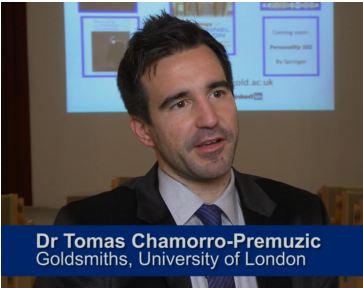
In a recent talk for the Cambridge Assessment Network, Dr. Tomas Chamorro-Premuzic discussed the underlying psychology of employability and career success.

Watch the video

For more about employability, read our recently-released whitepaper: “Are You Employable?

Topics: employment, employability

Q&A with Dr. Hogan: Psychopaths in the C-Suite

Posted by Robert Hogan on Wed, Feb 15, 2012

Q&APsychopathy is a personality disorder characterized by disregard for the rights of others, lack of empathy or remorse, and grandiosity. Although the world’s prisons are full of people who fit this description, not all psychopaths are in jail. In fact, a surprising number can be found in the corner office.
Q: For most people, the word psychopath brings to mind criminals like Charles Manson. How does this term apply in the business world?
A: In the business world, a better term for psychopath is swindler or confidence man – a person who is bright, charming, flirtatious, and fun, but utterly ruthless and with no capacity for guilt.

Q: How have changes in the typical career, specifically the frequency with which people change jobs, affected the rate of occurrence of psychopaths in leadership positions?
A: Psychopaths are very clever, and usually get caught when former victims begin to compare notes. In high mobility careers, it is hard to catch them because there is almost never a critical mass of former victims who can compare notes.

Q: When people describe the characteristics of a great leader, charisma often makes the list. Why do we find charismatic people so alluring?
A: What’s one person’s charisma is another person’s poison. Many liberals find Obama charismatic; conservatives tend to find him incompetent. The French thought Napoleon was charismatic; the English thought he was a worm. The Germans thought Hitler was charismatic; others had different opinions.

Q: Are women charismatic in different ways than men? Do they carry equal risk?
A: I don’t like to get involved in discussions of sex differences because they usually result in trouble. But my sense is that men equate female charisma with sex appeal. You would have to ask women what they think charisma is in other women. My sense is that women don’t find other women charismatic. Women are more competitive than men.

Q: What is the dark side of charisma?
A: Selfishness and betrayal – when the charismatic person works his or her magic for personal and selfish reasons.

Q: What kind of impact can these leaders have on business?
A: The data suggest that, in business, charisma is equal to narcissism, and that narcissistic CEOs are almost always bad for business.

Q: What can companies do to prevent putting a psychopath in charge?
A: Ask the people who used to work for the person to evaluate him or her. Subordinates always see through these people; senior people are always charmed by them.

Topics: leadership

The Science of Career Success

Posted by Hogan Assessments on Tue, Feb 14, 2012

TomasThe current class of college graduates is one of the most educated, technologically advanced, and technically skilled to ever enter the workforce. According to the New York Times, however, 22% are working in jobs that do not require a college degree, and 22.4% aren’t working at all.

Although the economy can be blamed for some of this problem, the widespread and persistent nature of under- and unemployment beg the question: What is keeping this otherwise talented young generation from succeeding in the workforce?

In a recent talk for the Cambridge Assessment Network, Dr. Tomas Chamorro-Premuzic discussed the underlying psychology of employability and career success.

Watch the video

For more about employability, read our recently-released whitepaper: “Are You Employable?”

Topics: employment, employability

Q&A with Dr. Hogan: Psychopaths in the C-Suite

Posted by RHogan on Tue, Feb 14, 2012

Q&APsychopathy is a personality disorder characterized by disregard for the rights of others, lack of empathy or remorse, and grandiosity. Although the world’s prisons are full of people who fit this description, not all psychopaths are in jail. In fact, a surprising number can be found in the corner office.

Q: For most people, the word psychopath brings to mind criminals like Charles Manson. How does this term apply in the business world?
A: In the business world, a better term for psychopath is swindler or confidence man – a person who is bright, charming, flirtatious, and fun, but utterly ruthless and with no capacity for guilt.

Q: How have changes in the typical career, specifically the frequency with which people change jobs, affected the rate of occurrence of psychopaths in leadership positions?
A: Psychopaths are very clever, and usually get caught when former victims begin to compare notes. In high mobility careers, it is hard to catch them because there is almost never a critical mass of former victims who can compare notes.

Q: When people describe the characteristics of a great leader, charisma often makes the list. Why do we find charismatic people so alluring?
A: What’s one person’s charisma is another person’s poison. Many liberals find Obama charismatic; conservatives tend to find him incompetent. The French thought Napoleon was charismatic; the English thought he was a worm. The Germans thought Hitler was charismatic; others had different opinions.

Q: Are women charismatic in different ways than men? Do they carry equal risk?
A: I don’t like to get involved in discussions of sex differences because they usually result in trouble. But my sense is that men equate female charisma with sex appeal. You would have to ask women what they think charisma is in other women. My sense is that women don’t find other women charismatic. Women are more competitive than men.

Q: What is the dark side of charisma?
A: Selfishness and betrayal – when the charismatic person works his or her magic for personal and selfish reasons.

Q: What kind of impact can these leaders have on business?
A: The data suggest that, in business, charisma is equal to narcissism, and that narcissistic CEOs are almost always bad for business.

Q: What can companies do to prevent putting a psychopath in charge?
A: Ask the people who used to work for the person to evaluate him or her. Subordinates always see through these people; senior people are always charmed by them.

Subscribe to our Blog

Most Popular Posts

Connect