
Too Rude to Fly?

Posted by Hogan Assessments on Tue, Jun 28, 2011

Last week, I was lucky enough to travel to Paris for a short vacation. I’ve traveled to Paris before, and I’m familiar with what to expect on the 10+ hour flight. With three DVDs, two books, and snacks in tow, I thought I knew what I was getting myself into. Unfortunately, I failed to prepare for one thing… poor customer service at 30,000 feet.

In my experience, the flight attendants on this particular carrier are never particularly high on what we call “service orientation” here at Hogan, but the treatment was so poor that I’m considering a personal boycott against the company. What made it so bad weren’t necessarily the grumbles when I asked her about her day or the condescending tone when she asked if I was able to sit in the exit row, but rather the judgment and questioning of my age when I ordered an adult beverage. That’s right… alcohol. Granted, I will give her this – I look considerably young for my age. I was recently carded for a rated-R movie, but that’s neither here nor there. The usual jest that ensues after people realize I’m really older than 18 was absent. Several passive-aggressive jabs were extended my way, even after producing my passport demonstrating my age. The flight continued along with same theme, and I fully expected Candid Camera to show up upon landing.

I want to give the flight attendant the benefit of the doubt. A delayed flight likely prompted my rude flight attendant’s stress. Her Bold (HDS) and Colorful (HDS) antics likely contribute to her charismatic charm on a day-to-day basis. However, this charm is intensified into derailing or moving-against behavior under stress. Perhaps she is simply more prone to stress and pressure. She surely wasn’t perceptive of the increasing frustration among the passengers with her quality of service.

Perhaps she simply isn’t cut out for the flight attendant role, as one of Hogan’s Industry Case Studies suggests. Findings indicate that more successful Flight Attendants are calm under pressure, perceptive and tactful, rule-abiding, and concerned with building job-related knowledge. If I were a betting woman, my flight attendant missed on several of these behaviors. In my opinion, Hogan scales aside, she was simply too rude to fly.
 

Topics: Hogan scales

Goodbye Michael Scott, Hello New Office Culture

Posted by Ashley Palmer on Thu, Jun 16, 2011

After seven seasons playing the wacky, yet lovable Michael Scott on NBC’s hit series, “The Office,” Steve Carell left the show this spring to focus on his film career. With his crazy antics and hilarious one-liners, Carell’s character enticed more than 7 million viewers to “The Office” every Thursday night. From off-the-wall impersonations to “that’s what she said” jokes, Michael Scott was a staple (no pun intended) of Dunder Mifflin, and his resignation will certainly lead to changes for the fictional company.
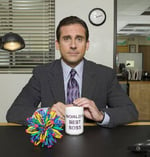

Like all managers, Michael’s personal values shaped the culture of the Scranton branch. One of his most fundamental beliefs was that his employees weren’t just staff – they were family, with perhaps the exception of Toby. Michael clarified during one episode that “Toby is in HR. Which, technically, means he works for corporate. So he's really not a part of our family. Also he's divorced. So he's really not a part of his family.”


Because he placed great value on relationships, Michael created an office environment that revolved around social interaction, frequent unscheduled meetings, constant communication, and spontaneous special work teams. For example, Michael held impromptu meetings on hot workplace topics including diversity, sexual harassment, and fire safety. He also assembled the Party Planning Committee to organize office events, such as birthday parties and holiday celebrations.


Another one of Michael’s drivers was the need for recognition. He sought visibility and admiration and cared deeply about having his and others’ accomplishments publically acknowledged. Michael carefully selected job titles such as “Assistant to the Regional Manager” to properly acknowledge his employees for their work roles. Also, Michael hosted “The Dundies,” an annual award show that publically recognized the Scranton staff by bestowing prestigious awards such as Whitest Sneakers, Longest Engagement, and Busiest Beaver.


After his nearly 20 year tenure (9,986,000 minutes to be exact) at Dunder Mifflin, Michael hosted his last Dundies and a new manager will take his place as the leader of the Scranton branch. Although “The Office” season finale left viewers in the dark about who the next regional manager will be, one thing is certain – a new leader will create a new office culture.


Will it be Dwight Schrute with his traditional values of reporting hierarchies, respect for authority, rules, and formality? Or will it be Kelly Kapoor with her attention to appearance and style? Perhaps it will be an external applicant with a completely different set of values and beliefs.


Regardless of the new boss’s identity, the culture of Dunder Mifflin will surely change with Michael Scott’s departure. Despite his quirks, Michael’s unique personality and value set created a one-of-a-kind office that we won’t soon forget. At least, that’s what she said.

Topics: values, corporate culture, engagement

Goodbye Michael Scott, Hello New Office Culture

Posted by Hogan Assessments on Wed, Jun 15, 2011

After seven seasons playing the wacky, yet lovable Michael Scott on NBC’s hit series, “The Office,” Steve Carell left the show this spring to focus on his film career. With his crazy antics and hilarious one-liners, Carell’s character enticed more than 7 million viewers to “The Office” every Thursday night. From off-the-wall impersonations to “that’s what she said” jokes, Michael Scott was a staple (no pun intended) of Dunder Mifflin, and his resignation will certainly lead to changes for the fictional company.

Like all managers, Michael’s personal values shaped the culture of the Scranton branch. One of his most fundamental beliefs was that his employees weren’t just staff – they were family, with perhaps the exception of Toby. Michael clarified during one episode that “Toby is in HR. Which, technically, means he works for corporate. So he’s really not a part of our family. Also he’s divorced. So he’s really not a part of his family.”

Because he placed great value on relationships, Michael created an office environment that revolved around social interaction, frequent unscheduled meetings, constant communication, and spontaneous special work teams. For example, Michael held impromptu meetings on hot workplace topics including diversity, sexual harassment, and fire safety. He also assembled the Party Planning Committee to organize office events, such as birthday parties and holiday celebrations.

Another one of Michael’s drivers was the need for recognition. He sought visibility and admiration and cared deeply about having his and others’ accomplishments publically acknowledged. Michael carefully selected job titles such as “Assistant to the Regional Manager” to properly acknowledge his employees for their work roles. Also, Michael hosted “The Dundies,” an annual award show that publically recognized the Scranton staff by bestowing prestigious awards such as Whitest Sneakers, Longest Engagement, and Busiest Beaver.

After his nearly 20 year tenure (9,986,000 minutes to be exact) at Dunder Mifflin, Michael hosted his last Dundies and a new manager will take his place as the leader of the Scranton branch. Although “The Office” season finale left viewers in the dark about who the next regional manager will be, one thing is certain – a new leader will create a new office culture.

Will it be Dwight Schrute with his traditional values of reporting hierarchies, respect for authority, rules, and formality? Or will it be Kelly Kapoor with her attention to appearance and style? Perhaps it will be an external applicant with a completely different set of values and beliefs.

Regardless of the new boss’s identity, the culture of Dunder Mifflin will surely change with Michael Scott’s departure. Despite his quirks, Michael’s unique personality and value set created a one-of-a-kind office that we won’t soon forget. At least, that’s what she said.

Topics: corporate culture, engagement

HOGAN GAME DAY 2011: RECAP

Posted by Dustin Hunter on Wed, Jun 08, 2011

Last month, Hogan celebrated its annual Hogan Game Day competition, a team-based version of the popular game show “Minute to Win It” that is a much-anticipated event at our Tulsa office.


In the week leading up to Game Day, and the week that followed, the halls were alive with spirited banter (and sometimes outright trash-talk). Our elite marketing team, which planned the event, kept the list of games close to its vest, and for good reason. There are those competitively spirited individuals at Hogan who would have mastered each challenge before Game Day actually took place! Needless to say, Game Day is a big deal around here. And even though my team took last place, my experience far outweighed earning a trophy.


To kick off the event, each employee was randomly assigned teams and tasked with generating a team name (we were Hogan’s Heathens) and deciding who would participate in each event:


Game 1: Stick To It – Two team members, a thrower and catcher, bounce ping pong balls across a table and catch them with a pair of lint rollers. Three balls per roller, one minute to win it.
Game 2: Hanky Panky – One team member pulls out an entire box of tissues, one at a time, in one minute.
Game 3: Breakfast Scramble – One team member solves a puzzle consisting of the front of a box of cereal cut into perfect squares in less than one minute.
Game 4: Dizzy Mummy – Two team members, a holder and turner, wrap a roll of toilet paper around the turner in under one minute.
Game 5: Triple Pong Plop – One team member bounces ping pong balls on a plate and into a fish bowl.
Game 6: Face the Cookie – One team member places an Oreo on their forehead and, without using his/her hands, moves the cookie into his/her mouth.
RELAY: Five team members push a lemon across a 10-yard section of the parking lot with chopsticks. The first team with all members down and back won.


Some would suggest such team-building activities are wasteful, but consider the employee whose only workplace social incentive or team-building event is a break room birthday party or casual Friday. Now consider workers at Apple, Google, Facebook, or other unconventional workplace where a shift in corporate culture – the addition of office game rooms, flex time, office pets, happy hours, or casual dress codes - makes their work lives more enjoyable.


And these initiatives aren’t just to attract quality employees – though applicants are beating the door down to work there – they are examples of low-cost agendas that seriously drive engagement and pride through higher employee satisfaction.


It wouldn’t be appropriate for every business to install a basketball court in its offices, but that doesn’t mean it can’t do something for its people. Creating creature comforts at work not only increases satisfaction, but it also motivates employees to work harder. It’s common to see workers at many of these workplaces voluntarily burning the midnight oil. What motivates your staff?
 

Topics: employee engagement, corporate culture

HOGAN GAME DAY 2011: RECAP

Posted by Hogan Assessments on Tue, Jun 07, 2011

Last month, Hogan celebrated its annual Hogan Game Day competition, a team-based version of the popular game show “Minute to Win It” that is a much-anticipated event at our Tulsa office.

In the week leading up to Game Day, and the week that followed, the halls were alive with spirited banter (and sometimes outright trash-talk). Our elite marketing team, which planned the event, kept the list of games close to its vest, and for good reason. There are those competitively spirited individuals at Hogan who would have mastered each challenge before Game Day actually took place! Needless to say, Game Day is a big deal around here. And even though my team took last place, my experience far outweighed earning a trophy.

To kick off the event, each employee was randomly assigned teams and tasked with generating a team name (we were Hogan’s Heathens) and deciding who would participate in each event:

Game 1: Stick To It – Two team members, a thrower and catcher, bounce ping pong balls across a table and catch them with a pair of lint rollers. Three balls per roller, one minute to win it.
Game 2: Hanky Panky – One team member pulls out an entire box of tissues, one at a time, in one minute.
Game 3: Breakfast Scramble – One team member solves a puzzle consisting of the front of a box of cereal cut into perfect squares in less than one minute.
Game 4: Dizzy Mummy – Two team members, a holder and turner, wrap a roll of toilet paper around the turner in under one minute.
Game 5: Triple Pong Plop – One team member bounces ping pong balls on a plate and into a fish bowl.
Game 6: Face the Cookie – One team member places an Oreo on their forehead and, without using his/her hands, moves the cookie into his/her mouth.
RELAY: Five team members push a lemon across a 10-yard section of the parking lot with chopsticks. The first team with all members down and back won.

Some would suggest such team-building activities are wasteful, but consider the employee whose only workplace social incentive or team-building event is a break room birthday party or casual Friday. Now consider workers at Apple, Google, Facebook, or other unconventional workplace where a shift in corporate culture – the addition of office game rooms, flex time, office pets, happy hours, or casual dress codes – makes their work lives more enjoyable.

And these initiatives aren’t just to attract quality employees – though applicants are beating the door down to work there – they are examples of low-cost agendas that seriously drive engagement and pride through higher employee satisfaction.

It wouldn’t be appropriate for every business to install a basketball court in its offices, but that doesn’t mean it can’t do something for its people. Creating creature comforts at work not only increases satisfaction, but it also motivates employees to work harder. It’s common to see workers at many of these workplaces voluntarily burning the midnight oil. What motivates your staff?
 

Topics: employee engagement, corporate culture

X-Factors of Executive Success

Posted by Greg Barnett on Fri, Jun 03, 2011

It was only a month ago that President Obama announced the death of America’s biggest villain and proudly proclaimed victory in the name of justice.

For most, the events that unfolded and the success of the mission were symbols of American power. But to those of us who have a passion for leadership, the more subtle story revolved around President Obama and the potential impact this success would have on perceptions of his effectiveness as a leader.

April 24, just days before he announced Bin Laden’s death, Real Clear Politics, a site that averages political polls, showed President Obama’s job approval ratings at just 45%, with 50% disapproving. Experts owed those negative poll numbers to public dissatisfaction with the economy – high gas prices, debt, and signs of inflation. Less than a month later, those perceptions had changed for the better.

The ultimate measure of senior executive selection and succession planning is how well we can identify future high performers. Even with decades of research and industry leading tools, the best we can predict is somewhere around 30% to 40% of leadership potential, and this is better than most of our competitors.

So what's going on with the other 60% to 70%? The following factors are just some of the complexities of executive performance:

Success often relies on a few key decisions.
The base rate of those critical decisions is low, making them difficult to reliably measure. How many times does a leader have the opportunity to take out Public Enemy No.1 and change his/her foreign policy reputation overnight? If you are Google, is it a good choice to buy You Tube? Skype if you are Microsoft? How much do you invest in your new product, the iPod? It only takes one decision to make or break a reputation, or a company's value.

Real impact is only visible in the long-term.
It can take years before the value of some executive decisions can be measured. Experts argue decisions made more than 40 years ago to provide covert assistance to Afghan rebels’ fight against the USSR – hailed as a US victory in the Cold War – lead to the creation of modern-day Al-Qaeda. Short-term brilliance can actually have very bad effects, and, likewise, your "dud" of a leader may just have a long-term plan in mind.

Success often means having good timing.
The US economy recently took a plunge unlike anything we could have expected. Sure, there were some leaders who were responsible for the decline (yes, I'm looking at you, Wall Street), and there were policy decisions in Washington that were equally critical (Barney Frank). There were also executives who had no control over the market’s movement. If you would have measured executive performance using a “snapshot” method during that time, you would have seen some ugly metrics: sinking revenue, poor profits, negative stock value, and low employee engagement. Now, as companies rebound, those in power reap the benefits of economic recovery without necessarily doing anything.

Success sometimes comes down to luck.
Social scientists are trained early and often on the importance of statistical significance – identifying relationships that are not due to chance alone. And whatever you call it – luck, chance, or good fortune – there is an element to executive performance which is not entirely within a leader's control. President Bush took a big hit to his reputation as an effective leader due to his response to Hurricane Katrina, even though so much of what happened – an intense hurricane hitting exactly where it did – was beyond his control.

Politics makes leadership a visible sport, but it is easy to forget some of the lessons it teaches us about measuring executive performance. You may be able to identify who has the right stuff, but judging whether someone will be truly successful is no easy task.

Finally, ask yourself about your own leaders: Do they really make good decisions? Or are they riding the coat tails of someone else's decisions, reaping the benefits of good timing, and enjoying a little luck?
 

Topics: leadership, selection, succession planning, Obama, US economy

X-Factors of Executive Success

Posted by Hogan Assessments on Thu, Jun 02, 2011

It was only a month ago that President Obama announced the death of America’s biggest villain and proudly proclaimed victory in the name of justice.

For most, the events that unfolded and the success of the mission were symbols of American power. But to those of us who have a passion for leadership, the more subtle story revolved around President Obama and the potential impact this success would have on perceptions of his effectiveness as a leader.

April 24, just days before he announced Bin Laden’s death, Real Clear Politics, a site that averages political polls, showed President Obama’s job approval ratings at just 45%, with 50% disapproving. Experts owed those negative poll numbers to public dissatisfaction with the economy – high gas prices, debt, and signs of inflation. Less than a month later, those perceptions had changed for the better.

The ultimate measure of senior executive selection and succession planning is how well we can identify future high performers. Even with decades of research and industry leading tools, the best we can predict is somewhere around 30% to 40% of leadership potential, and this is better than most of our competitors.

So what’s going on with the other 60% to 70%? The following factors are just some of the complexities of executive performance:

Success often relies on a few key decisions.
The base rate of those critical decisions is low, making them difficult to reliably measure. How many times does a leader have the opportunity to take out Public Enemy No.1 and change his/her foreign policy reputation overnight? If you are Google, is it a good choice to buy You Tube? Skype if you are Microsoft? How much do you invest in your new product, the iPod? It only takes one decision to make or break a reputation, or a company’s value.

Real impact is only visible in the long-term.
It can take years before the value of some executive decisions can be measured. Experts argue decisions made more than 40 years ago to provide covert assistance to Afghan rebels’ fight against the USSR – hailed as a US victory in the Cold War – lead to the creation of modern-day Al-Qaeda. Short-term brilliance can actually have very bad effects, and, likewise, your “dud” of a leader may just have a long-term plan in mind.

Success often means having good timing.
The US economy recently took a plunge unlike anything we could have expected. Sure, there were some leaders who were responsible for the decline (yes, I’m looking at you, Wall Street), and there were policy decisions in Washington that were equally critical (Barney Frank). There were also executives who had no control over the market’s movement. If you would have measured executive performance using a “snapshot” method during that time, you would have seen some ugly metrics: sinking revenue, poor profits, negative stock value, and low employee engagement. Now, as companies rebound, those in power reap the benefits of economic recovery without necessarily doing anything.

Success sometimes comes down to luck.
Social scientists are trained early and often on the importance of statistical significance – identifying relationships that are not due to chance alone. And whatever you call it – luck, chance, or good fortune – there is an element to executive performance which is not entirely within a leader’s control. President Bush took a big hit to his reputation as an effective leader due to his response to Hurricane Katrina, even though so much of what happened – an intense hurricane hitting exactly where it did – was beyond his control.

Politics makes leadership a visible sport, but it is easy to forget some of the lessons it teaches us about measuring executive performance. You may be able to identify who has the right stuff, but judging whether someone will be truly successful is no easy task.

Finally, ask yourself about your own leaders: Do they really make good decisions? Or are they riding the coat tails of someone else’s decisions, reaping the benefits of good timing, and enjoying a little luck?
 

Is your blogging personality affecting your reputation?

Posted by Bill Monrose on Thu, Jun 02, 2011

Blogging is another means of communication that reflects a person’s attitudes, ideas, interests, and values. Many of these characteristics gel with a few others to ultimately make up an individual’s personality or as we refer to it here at Hogan – “reputation.”


Companies and employees spend quite a bit of time and money on employee development programs. These engagements are designed to make an employee aware of behaviors that impede their performance, future opportunities, and relationships with other employees.  Let’s face it, changing reputation takes a lot of effort. To be successful, an employee must target specific, non-desirable behaviors time and time again until their natural derailing tendencies are curtailed and replaced with new desirable ones. If they are successful, other people’s perceptions of them change and so does their reputation.


However, it only takes a few oversights to erode their progress of change. One such oversight, that can undo all of their hard work, is not managing their online personality. With the pervasiveness of social media, such as LinkedIn, Facebook and Twitter, often an employee forgets these sites are an extension of themselves. Like it or not, blogging creates reputation. In many instances, an employee can have more than 1,000 connections, friends or followers on these websites. Trying to keep track of which people are outside the corporate circle, not somehow otherwise connected to co-workers or even future employers, is just not manageable.


When creating your development plan to change negative components of your reputation, don’t forget to consider and include your personality found in social media. It just may make the extra difference in changing your behaviors and ultimately your reputation, getting you that promotion at work, and strengthening your relationships with your co-workers.  
 

Topics: personality, reputation, employee development, social media

Is your blogging personality affecting your reputation?

Posted by Hogan Assessments on Wed, Jun 01, 2011

Blogging is another means of communication that reflects a person’s attitudes, ideas, interests, and values. Many of these characteristics gel with a few others to ultimately make up an individual’s personality or as we refer to it here at Hogan – “reputation.”

Companies and employees spend quite a bit of time and money on employee development programs. These engagements are designed to make an employee aware of behaviors that impede their performance, future opportunities, and relationships with other employees.  Let’s face it, changing reputation takes a lot of effort. To be successful, an employee must target specific, non-desirable behaviors time and time again until their natural derailing tendencies are curtailed and replaced with new desirable ones. If they are successful, other people’s perceptions of them change and so does their reputation.

However, it only takes a few oversights to erode their progress of change. One such oversight, that can undo all of their hard work, is not managing their online personality. With the pervasiveness of social media, such as LinkedIn, Facebook and Twitter, often an employee forgets these sites are an extension of themselves. Like it or not, blogging creates reputation. In many instances, an employee can have more than 1,000 connections, friends or followers on these websites. Trying to keep track of which people are outside the corporate circle, not somehow otherwise connected to co-workers or even future employers, is just not manageable.

When creating your development plan to change negative components of your reputation, don’t forget to consider and include your personality found in social media. It just may make the extra difference in changing your behaviors and ultimately your reputation, getting you that promotion at work, and strengthening your relationships with your co-workers.  
 

Topics: employee development

First Class Leadership: #35

Posted by Kristin Switzer on Tue, May 31, 2011

It can be hard to remember all the great moments of the Oklahoma City Thunder’s season when sports announcers and writers have been more focused this week on the Thunder’s “collapse” after losing to the Dallas Mavericks in the Western Conference. Although many fans faced disappointment after Games 4 and 5 (especially those of us in Oklahoma), the Thunder’s hard fought third season should not go overlooked. At the forefront of the adolescent Thunder team is Kevin Durant, who sums up the season nicely in a tweet he released last night: “It's been a fun ride for us. We had 15 guys on this team and a whole city behind us. Everybody was great. We'll keep working hard."


Durant’s achievements make him nothing short of a superstar. In his short NBA career since his college stint as a Texas Longhorn, Durant has won such awards as NBA Rookie of the Year, 2-time NBA All-Star, and the youngest scoring leader in NBA history at 21 years of age, among many others. He is undoubtedly one of the most talented players in the league, yet also one of the most humble, genuine, and respectful. As I’ve started paying more attention to Durant’s performance on the court these past few years, what I’ve found most impressive is how he leads his team off the court -- by example.


In an article written by Daniel Locke on Durant’s leadership style, Locke states, “The best thing to occur during the ‘Summer of LeBron’ for the Thunder was Kevin Durant signing a five-year contract extension worth about $86 million.” His signing not only ensured that we can watch Durant carry the Thunder for several seasons to come, it also served as a great example of Durant’s character. There were no major press releases, countdowns, or TV specials; just a simple tweet to share his gratitude: @KDthunderup: “Extension for 5 more years wit the #thunder….God Is Great, me and my family came a long way…I love yall man for real, this a blessing!” Durant could’ve taken the route of LeBron and milked it for all it was worth, but that’s not his style. He’s been unafraid to remain true to himself, his upbringing and his values, all qualities that make him an admirable basketball player, individual, and leader.


After the devastating loss to the Mavs this past Monday night, Durant took full responsibility as the team leader. He stated he felt upset for letting his team and city down. We don’t often see this level of ownership from high-level sports figures, not to mention from leaders. Many leaders are not introspective; it’s easier to point a finger and make excuses for the team’s failure, but not for Kevin Durant. He remains committed to his team, the city for which he plays, and most importantly, to himself. His leadership should serve as a strong example for the leaders of the world, whether they lead on the basketball court, on the field, or in the boardroom. His leadership style is one of commitment and respect, while pushing himself and his teammates to perform to the best of their abilities.


By Hogan standards, Durant has proven himself a successful leader—you simply have to take a look at the success of the team he leads. Team success can be measured in a number of ways, and it’s safe to say that the Thunder have seen success, even without winning a NBA title… yet.

Topics: leadership, OKC Thunder

Subscribe to our Blog

Most Popular Posts

Connect