
Every significant piece of public policy, every important generalization in history, economics, political science, and sociology depends on (largely unevaluated) assumptions about human nature. Personality psychology concerns the nature of human nature; it is, therefore, concerned with one of the most powerful and dangerous forces on earth. Developing adequate methods for conceptualizing human nature and forecasting significant components of social behavior—for example, integrity, creativity, leadership—would seem to be a matter of real urgency. Nonetheless, personality psychology has a minor and marginal status in academic psychology. I have spent my career trying to understand the origins of human behavior, trying to develop measurement models for capturing key elements of social performance, and trying to defend the study of personality against the complaints of a seemingly endless supply of academic critics.
Every significant piece of public policy, every important generalization in history, economics, political science, and sociology depends on (largely unevaluated) assumptions about human nature. Personality psychology concerns the nature of human nature; it is, therefore, concerned with one of the most powerful and dangerous forces on earth. Developing adequate methods for conceptualizing human nature and forecasting significant components of social behavior—for example, integrity, creativity, leadership—would seem to be a matter of real urgency. Nonetheless, personality psychology has a minor and marginal status in academic psychology. I have spent my career trying to understand the origins of human behavior, trying to develop measurement models for capturing key elements of social performance, and trying to defend the study of personality against the complaints of a seemingly endless supply of academic critics.
Robert S. McNamara (1916-2009) was the most powerful American Secretary of Defense in history and in many ways the architect of the modern war on terror. He was an immensely talented and successful man, whose career went up like a rocket from the beginning. Born in San Francisco, he was an Eagle Scout and President of the Rigma Lions boys club in 1933. He attended the University of California, Berkeley, where he studied economics, mathematics, and philosophy, was elected to Phi Beta Kappa in his sophomore year, and earned a varsity letter in crew. After receiving a master’s degree from the Harvard Graduate School of Business Administration in 1939, he worked for Price Waterhouse for a year. He then joined the Harvard faculty as the youngest and highest paid Assistant Professor at the university. He joined the Army Air Force in 1943 and worked in the Office of Statistical Control, where he analyzed the accuracy and effectiveness of US bombing missions, and made powerful connections.
In 1946, McNamara and 9 other former officers joined Ford Motor Company with a mandate to stop its financial and administrative chaos using modern planning and management control systems. He again advanced rapidly, and in November, 1960 became the first president of the company who was not a member of the Ford family. A few weeks later, President-elect John F. Kennedy recruited him to be Secretary of Defense. Kennedy described McNamara as the smartest man he had ever met.
Kennedy first directed McNamara to plan the Bay of Pigs invasion, which was a disaster, and then asked him to develop even more elaborate plans to overthrow Castro. In 1962, McNamara began implementing the modern strategy of counterinsurgency warfare to combat terrorism; he created special forces like the Green Berets, and sponsored secret paramilitary operations throughout Asia and Latin America. In 1963, again in response to the President’s request, he began a troop build-up in South Vietnam. After Kennedy’s assassination in November, 1963, President Lyndon Johnson asked him to stay on as Defense Secretary, and in essence turned the conduct of foreign policy over to him. Johnson, in awe of McNamara, commented “He is like a jackhammer….He drives too hard. He is too perfect.” In 1964, Johnson asked him to be his Vice-Presidential running mate, but McNamara declined.
McNamara prosecuted the Vietnam War with his usual diligence, but had doubts about it being winnable. In 1967, he sent President Johnson a long memo urging him to begin negotiating with the North Vietnamese rather than escalating the war. Johnson decided that McNamara was plotting against him on behalf of the Kennedys, fired him as Secretary of Defense, and anointed him as President of the World Bank where he served from April, 1968 to June, 1981, when he retired.
The Vietnam War is widely regarded as the greatest foreign policy mistake in U.S. history. Over 54,000 American troops died, millions of Vietnamese were killed, and nothing was resolved. In 1995, McNamara published a memoir in which he said his conduct of the war was “wrong, terribly wrong”. In reply, Howell Raines, the editor of the New York Times, wrote an editorial in which he noted: “Surely he must in every quiet and prosperous moment hear the ceaseless whispers of those poor boys in the infantry, dying in the tall grass, platoon by platoon, for no purpose. What he took from them cannot be repaid by prime-time apology and stale tears, three decades late.”
Analysis
At each point in his career—as a student, academic, business executive, Cabinet Secretary, and public figure—Robert McNamara was fabulously successful. He substantially rebuilt Ford Motor Company, as Defense Secretary, he was instrumental in putting in place wide ranging reforms to streamline the Pentagon and make it more effective, and he transformed the World Bank from an old boy’s club to an instrument for third world economic development. And then there is the Vietnamese war—an unmitigated disaster. How are we to understand this?
The answer concerns how we think about leadership. The academic literature defines leadership in terms of the ability to ascend to the top of a hierarchy, and McNamara was superbly equipped to do this. He was very smart, very hard working, great with numbers and details, clear-minded, logical, and very, very eager to please his superiors. This is the recipe for success in a bureaucracy.
In contrast with the academic literature, I think the essence of leadership concerns being able to build a team, being able to unite a group and act toward a common goal. McNamara was ruthlessly dismissive of subordinates who challenged him (he had no peers). His talent was for fixing inefficiencies and implementing processes. He had no talent for anticipating or even considering the human costs of his processes. His concern about the Vietnam war was that it was unwinnable from a technical perspective, not that lives were being wasted. He was an immensely successful bureaucrat but not a gifted leader.
There is a sense in which Robert McNamara was a train wreck waiting to happen. He was an exquisitely tooled bureaucratic instrument, who could and would deliver results for whoever happened to be his boss. As Secretary of Defense, his first boss was the callow and impulsive John Kennedy, who ordered him to begin what ultimately became our war on terror—covert and illegal operations in Latin America and Southeast Asia. He second boss was Lyndon Johnson, a skilled and ruthless legislator who knew nothing about international relations, and whose staff feared he was insane. Kennedy foolishly invaded South Vietnam, Johnson inherited the project, and vowed not to be the first American President “to cut and run.” McNamara’s ambition and eagerness to please authority prevented him from opposing these policies and the rest is history. As for moral culpability, he was just following orders.
Robert S. McNamara (1916-2009) was the most powerful American Secretary of Defense in history and in many ways the architect of the modern war on terror. He was an immensely talented and successful man, whose career went up like a rocket from the beginning. Born in San Francisco, he was an Eagle Scout and President of the Rigma Lions boys club in 1933. He attended the University of California, Berkeley, where he studied economics, mathematics, and philosophy, was elected to Phi Beta Kappa in his sophomore year, and earned a varsity letter in crew. After receiving a master’s degree from the Harvard Graduate School of Business Administration in 1939, he worked for Price Waterhouse for a year. He then joined the Harvard faculty as the youngest and highest paid Assistant Professor at the university. He joined the Army Air Force in 1943 and worked in the Office of Statistical Control, where he analyzed the accuracy and effectiveness of US bombing missions, and made powerful connections.
In 1946, McNamara and 9 other former officers joined Ford Motor Company with a mandate to stop its financial and administrative chaos using modern planning and management control systems. He again advanced rapidly, and in November, 1960 became the first president of the company who was not a member of the Ford family. A few weeks later, President-elect John F. Kennedy recruited him to be Secretary of Defense. Kennedy described McNamara as the smartest man he had ever met.
Kennedy first directed McNamara to plan the Bay of Pigs invasion, which was a disaster, and then asked him to develop even more elaborate plans to overthrow Castro. In 1962, McNamara began implementing the modern strategy of counterinsurgency warfare to combat terrorism; he created special forces like the Green Berets, and sponsored secret paramilitary operations throughout Asia and Latin America. In 1963, again in response to the President’s request, he began a troop build-up in South Vietnam. After Kennedy’s assassination in November, 1963, President Lyndon Johnson asked him to stay on as Defense Secretary, and in essence turned the conduct of foreign policy over to him. Johnson, in awe of McNamara, commented “He is like a jackhammer….He drives too hard. He is too perfect.” In 1964, Johnson asked him to be his Vice-Presidential running mate, but McNamara declined.
McNamara prosecuted the Vietnam War with his usual diligence, but had doubts about it being winnable. In 1967, he sent President Johnson a long memo urging him to begin negotiating with the North Vietnamese rather than escalating the war. Johnson decided that McNamara was plotting against him on behalf of the Kennedys, fired him as Secretary of Defense, and anointed him as President of the World Bank where he served from April, 1968 to June, 1981, when he retired.
The Vietnam War is widely regarded as the greatest foreign policy mistake in U.S. history. Over 54,000 American troops died, millions of Vietnamese were killed, and nothing was resolved. In 1995, McNamara published a memoir in which he said his conduct of the war was “wrong, terribly wrong”. In reply, Howell Raines, the editor of the New York Times, wrote an editorial in which he noted: “Surely he must in every quiet and prosperous moment hear the ceaseless whispers of those poor boys in the infantry, dying in the tall grass, platoon by platoon, for no purpose. What he took from them cannot be repaid by prime-time apology and stale tears, three decades late.”
Analysis
At each point in his career—as a student, academic, business executive, Cabinet Secretary, and public figure—Robert McNamara was fabulously successful. He substantially rebuilt Ford Motor Company, as Defense Secretary, he was instrumental in putting in place wide ranging reforms to streamline the Pentagon and make it more effective, and he transformed the World Bank from an old boy’s club to an instrument for third world economic development. And then there is the Vietnamese war—an unmitigated disaster. How are we to understand this?
The answer concerns how we think about leadership. The academic literature defines leadership in terms of the ability to ascend to the top of a hierarchy, and McNamara was superbly equipped to do this. He was very smart, very hard working, great with numbers and details, clear-minded, logical, and very, very eager to please his superiors. This is the recipe for success in a bureaucracy.
In contrast with the academic literature, I think the essence of leadership concerns being able to build a team, being able to unite a group and act toward a common goal. McNamara was ruthlessly dismissive of subordinates who challenged him (he had no peers). His talent was for fixing inefficiencies and implementing processes. He had no talent for anticipating or even considering the human costs of his processes. His concern about the Vietnam war was that it was unwinnable from a technical perspective, not that lives were being wasted. He was an immensely successful bureaucrat but not a gifted leader.
There is a sense in which Robert McNamara was a train wreck waiting to happen. He was an exquisitely tooled bureaucratic instrument, who could and would deliver results for whoever happened to be his boss. As Secretary of Defense, his first boss was the callow and impulsive John Kennedy, who ordered him to begin what ultimately became our war on terror—covert and illegal operations in Latin America and Southeast Asia. He second boss was Lyndon Johnson, a skilled and ruthless legislator who knew nothing about international relations, and whose staff feared he was insane. Kennedy foolishly invaded South Vietnam, Johnson inherited the project, and vowed not to be the first American President “to cut and run.” McNamara’s ambition and eagerness to please authority prevented him from opposing these policies and the rest is history. As for moral culpability, he was just following orders.
To err is truly human and mistakes are truly inevitable. Paul Nutt, an Ohio State University business school researcher, provides data showing that half of all decisions made in business organizations fail. In his book, Why Decisions Fail, he shows that decisions mostly fail because the deciders ignore feedback. The lesson is clear, decision making in business is a random walk—no one is any better at decision making than anyone else. The major difference between good and bad decision making concerns the degree to which people are open to feedback regarding the consequences of their decisions.
In the moral development literature, there is a very interesting line of research on guilt. In the typical study, a hypothetical person makes a mistake, and the research participant is asked how he or she would respond if he or she had made that mistake. This is, of course, directly relevant to the topic of reactions to bad business decisions. The data show that people’s “guilt responses” fall into four relatively clear categories with specific behavioral consequences.
The first category of responses is called “intropunitive”. Intropunitive people quickly, even reflexively, blame themselves. Such people are prone to more or less persistent feelings of guilt, seem somewhat neurotic, and were probably the kinds of clients studied originally by Sigmund Freud, the founder of psychoanalysis. They were the source of Freud’s ideas about the superego and the problem of guilt.
The second category of responses is called “extrapunitive”. Extrapunitive people, when faced with the news that they have made an error, quickly, even reflexively, blame other people and external circumstances. They seem incapable of internalizing blame and seem somewhat hostile and suspicious of other people.
The third category of responses is called “impunitive”. When it appears than impunitive people have made a mistake, they simply refuse to acknowledge that anything significant has happened. They deny the reality of the situation and typically wonder why anyone would bring up the subject. These people seem somewhat psychopathic, and the defining feature of psychopathy is no capacity for guilt.
The fourth category of responses is relatively small in terms of frequency of occurrence. These responses are called “mature self-critical guilt”. Here the people own their mistakes and vow to learn from the experience.
We are discussing an assessment literature here—the assessment of individual differences in how people respond to the news that they have made mistakes. Meaningful assessment should predict behavior, so it is important to ask what these four categories of guilt responses predict. In the moral development literature, the major outcome of interest is moral conduct—usually the delinquency/non-delinquency criterion. Intropunitive responses are primarily associated with feelings of guilt. Extrapunitive responses are primarily associated with hostility. Impunitive responses are primarily associated with denial. Of the four categories, only mature self-critical guilt predicts compliance and integrity; delinquents lack the capacity for mature self-criticism.
To err is truly human and mistakes are truly inevitable. Paul Nutt, an Ohio State University business school researcher, provides data showing that half of all decisions made in business organizations fail. In his book, Why Decisions Fail, he shows that decisions mostly fail because the deciders ignore feedback. The lesson is clear, decision making in business is a random walk—no one is any better at decision making than anyone else. The major difference between good and bad decision making concerns the degree to which people are open to feedback regarding the consequences of their decisions.
In the moral development literature, there is a very interesting line of research on guilt. In the typical study, a hypothetical person makes a mistake, and the research participant is asked how he or she would respond if he or she had made that mistake. This is, of course, directly relevant to the topic of reactions to bad business decisions. The data show that people’s “guilt responses” fall into four relatively clear categories with specific behavioral consequences.
The first category of responses is called “intropunitive”. Intropunitive people quickly, even reflexively, blame themselves. Such people are prone to more or less persistent feelings of guilt, seem somewhat neurotic, and were probably the kinds of clients studied originally by Sigmund Freud, the founder of psychoanalysis. They were the source of Freud’s ideas about the superego and the problem of guilt.
The second category of responses is called “extrapunitive”. Extrapunitive people, when faced with the news that they have made an error, quickly, even reflexively, blame other people and external circumstances. They seem incapable of internalizing blame and seem somewhat hostile and suspicious of other people.
The third category of responses is called “impunitive”. When it appears than impunitive people have made a mistake, they simply refuse to acknowledge that anything significant has happened. They deny the reality of the situation and typically wonder why anyone would bring up the subject. These people seem somewhat psychopathic, and the defining feature of psychopathy is no capacity for guilt.
The fourth category of responses is relatively small in terms of frequency of occurrence. These responses are called “mature self-critical guilt”. Here the people own their mistakes and vow to learn from the experience.
We are discussing an assessment literature here—the assessment of individual differences in how people respond to the news that they have made mistakes. Meaningful assessment should predict behavior, so it is important to ask what these four categories of guilt responses predict. In the moral development literature, the major outcome of interest is moral conduct—usually the delinquency/non-delinquency criterion. Intropunitive responses are primarily associated with feelings of guilt. Extrapunitive responses are primarily associated with hostility. Impunitive responses are primarily associated with denial. Of the four categories, only mature self-critical guilt predicts compliance and integrity; delinquents lack the capacity for mature self-criticism.
Kaizen refers to continuous, steady improvement. It means never being satisfied. It means continuous improvement in processes as well as products. If a company pursues kaizen, it will be able to produce higher quality products for less money.
How does assessment fit with all of this? Hiring better people is part of continuous improvement. Assessment is the key to hiring better people. Using valid assessments will yield better results than using the DISC or OPQ. Hiring better people means hiring better workers, better managers, and better leaders.
Good workers regularly come to work, follow sensible procedures, treat customers well, work well as part of a team, and accept (or don’t resist) change. Good managers provide their staff with structure and direction but treat them with respect. Good leaders are more concerned with the performance of the organization than with the advancement of their own careers. Good leaders are not charismatic, self-centered, self-promoters. Good leaders treat their staff with respect but hold them accountable for their performance, promote an appropriate philosophy and vision, and have the capacity for change. Valid assessment is the key to continuous improvement of personnel.
Kaizen refers to continuous, steady improvement. It means never being satisfied. It means continuous improvement in processes as well as products. If a company pursues kaizen, it will be able to produce higher quality products for less money.
How does assessment fit with all of this? Hiring better people is part of continuous improvement. Assessment is the key to hiring better people. Using valid assessments will yield better results than using the DISC or OPQ. Hiring better people means hiring better workers, better managers, and better leaders.
Good workers regularly come to work, follow sensible procedures, treat customers well, work well as part of a team, and accept (or don’t resist) change. Good managers provide their staff with structure and direction but treat them with respect. Good leaders are more concerned with the performance of the organization than with the advancement of their own careers. Good leaders are not charismatic, self-centered, self-promoters. Good leaders treat their staff with respect but hold them accountable for their performance, promote an appropriate philosophy and vision, and have the capacity for change. Valid assessment is the key to continuous improvement of personnel.
We now know that personality predicts leadership style, and that leadership style predicts ratings of leader effectiveness. There are also some data showing that leadership style predicts business unit performance. So there is a kind of causal arrow going from personality through leadership style to the performance of the business unit of which a manager is in charge. Thus, we can use personality to predict business unit performance.That is an important finding in itself, but it also raises a question about the links. That is, how do leaders affect organizational outcomes? Our Leadership Value Chain suggests an answer.
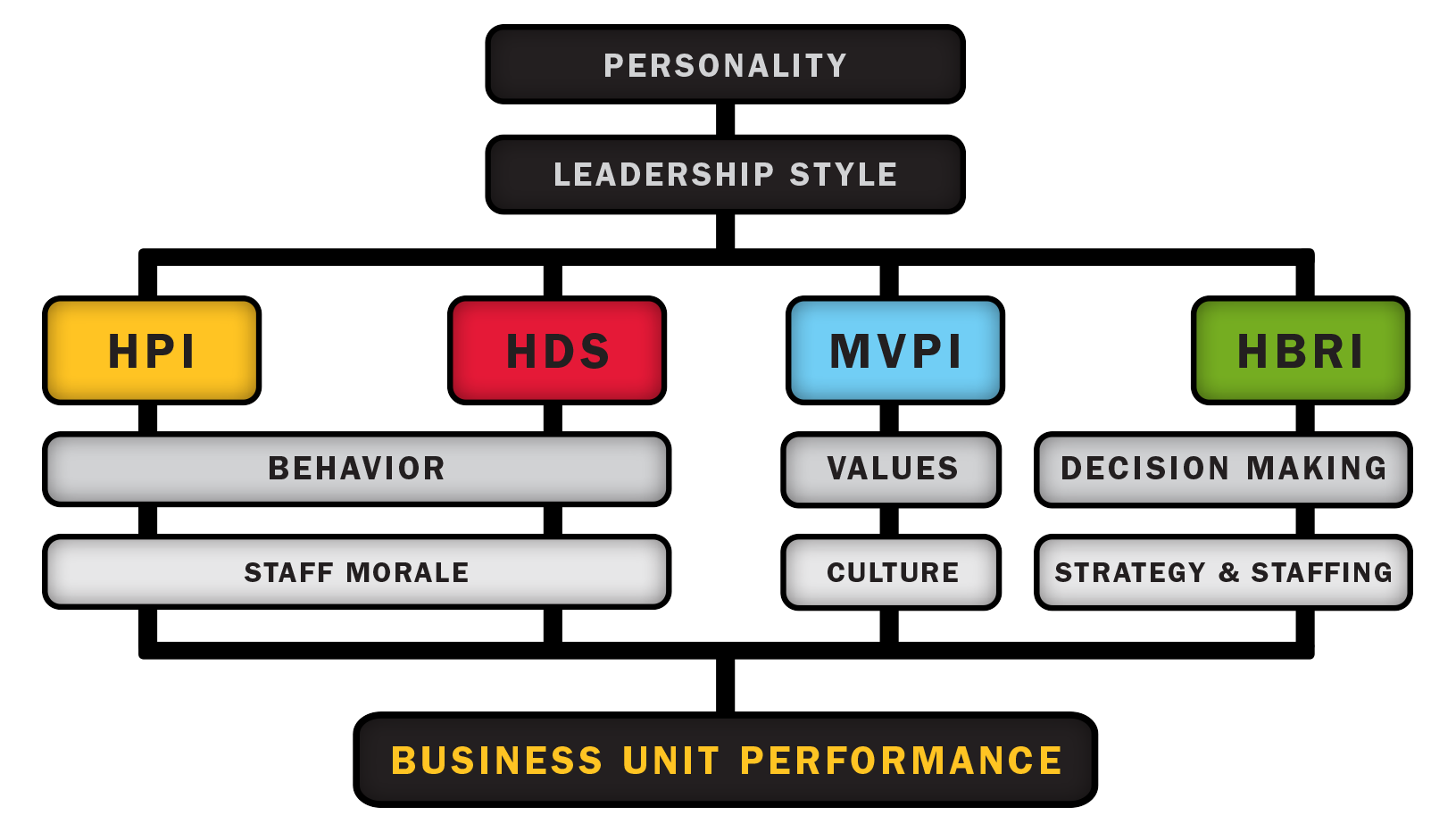
This model explains some anomalies in the real life study of leadership. Although psychologists focus almost exclusively on the upper circuit, we all know successful organizations or teams that are led by tyrants and bullies (e.g., Bill Parcells, former head coach of the New York Giants, the New York Jets, and the Dallas Cowboys). This is a problem for the psychological study of leadership, but the problem goes away if you consider the entire value chain. A bully who makes good decisions about staffing and strategy, and who creates a climate of winning can still run a successful operation—and this is the key to the success of persons like Bill Parcells. Obviously we think he would have been even more successful if he had treated his people well.
Although the Leadership Value Chain seems obvious, we think it was first described in an American Psychologist article by Rob Kaiser of Kaplan Devries in Greensboro, NC, and Robert Hogan of Hogan Assessment Systems entitled “Leadership and the Fate of Organizations.”
We now know that personality predicts leadership style, and that leadership style predicts ratings of leader effectiveness. There are also some data showing that leadership style predicts business unit performance. So there is a kind of causal arrow going from personality through leadership style to the performance of the business unit of which a manager is in charge. Thus, we can use personality to predict business unit performance.That is an important finding in itself, but it also raises a question about the links. That is, how do leaders affect organizational outcomes? Our Leadership Value Chain suggests an answer.