




People constantly ask us how faking affects the results of personality assessment. We believe that faking doesn’t matter, and we say this for two reasons. First, the data show that people can’t or don’t fake their answers on personality questionnaires. Second, it is very hard to define faking. Let’s take these two points in order.
1. Do People Fake their Responses on Personality Inventories?
With regard to people’s ability to fake their scores on, for example, the Hogan Personality Inventory (HPI), consider the following. Hogan, Barrett, and Hogan (2007) tested over 5,000 job applicants using the HPI; these people were subsequently denied employment. Six months later, they reapplied for the same job and completed the HPI a second time. It seems reasonable to assume that they would try to improve their scores the second time; however, virtually none of their scores changed beyond the standard error of measurement. The data are quite clear—even when motivated to fake, people’s scores on the HPI don’t change.
We believe that concerns about faking reflect a misunderstanding of what people do when they answer items on a personality inventory. There are two views about this: (a) self-report; and (b) impression management. These views have very different implications for understanding faking.
The Self-Report View of Faking. This view assumes that people answer items on personality measures by providing factual self reports, and faking involves lying. This view assumes that memory is like a videotape so that, when people read an item on an inventory (“I read ten books a year”), they compare the item with the memory tape, and then “report”; that is, they offer factual accounts of how an item matches their memory tape. Faking involves providing false reports about the match between the content of an item and the content of memory.
However, memory researchers from Bartlett (1937) to the present agree that memories are not factual recordings of past events, they are self-serving reconstructions designed to create a particular impression on others—people construct their memories and use them for strategic purposes.
Impression Management Theory. Our view is that during social interaction, people try to maximize social acceptance and status and minimize rejection and the loss of status (i.e., they are engaged in trying to get along and get ahead—cf. Hogan, 2006). When people respond to employment interview questions, assessment center exercises, or items on a personality inventory, they do what they always do during social interaction—they try to create a favorable impression of themselves. In this view, faking involves distorting the way one normally talks about oneself during social interaction. Personality is most important in social interaction, and it is useful to compare social interaction with hand writing. Both are skilled performances, they reflect skills that we learned as children. In both cases, we perform best when we think about what we are trying to do, and we perform poorly when we think about how we are doing it—that is, both types of performance are best when they are unreflective, automatic, even unconscious. Now imagine trying to change your handwriting—i.e., to fake it. It is extremely difficult to do, and even when we try, others can almost always recognize the handwriting as ours. Now imagine trying to change the way you interact with others—i.e., to fake. It is extremely difficult to do, and even when we try, others still know it is us.
2. How to Define Faking. We do not believe there are “true selves” inside people. We make a distinction between the person you think you are (your identity) and the person we think you are (your reputations). Identity is very hard to study; after 100 years of research, we still don’t know much about it. However, this may not matter because it seems clear that we make it up our identities in idiosyncratic ways. On the other hand, reputation is easy to study, we know a lot about it, and it is immensely consequential for our lives and careers. Successful people know how to control their reputations—this is impression management. Moreover, many successful people (e.g., former President Ronald Reagan) never engage in introspection and are unable and unwilling to talk about their identities; however, they are very shrewd at managing their reputations.
But most importantly, the HPI is designed to predict reputation not measure identity. Reputation reflects a person’s typical interpersonal style, which is like a person’s handwriting. So with regard to faking, the question of whether a person’s answers (to the HPI) are consistent with a person’s identity (his/her true self) is irrelevant. The right question concerns whether a person’s answers are consistent with a person’s reputation? This is the sense in which faking should be understood. Consider the goals of child rearing. Small children usually act in ways that are consistent with their “true” desires and urges—they pee their pants when they feel like it. Child rearing consists almost entirely of training children to hide, or at least delay, their “true” desires and to behave in ways that are consistent with the norms of civilized adult conduct. Some people believe that child rearing involves teaching children to fake, to be inauthentic, and is a process that is inherently alienating. In contrast, we believe child rearing involves training children to behave in a socially appropriate manner, and that their natural selves are something they need to overcome.
The items on the HPI sample ordinary socialized adult behavior. Most adults know the rules of conduct and respond to HPI items in terms of social norms rather than in terms of their true (childlike) desires and urges. On the other hand, criminals and other deviants answer HPI items in ways that are more consistent with their “true” selves—and with their typical behavior. The larger point is that it is almost impossible to distinguish faking from socialized behavior. And this means that it is very hard to assign a clear meaning to the claim that some people fake when they respond to personality measures.
3. A Practical Example.
Consider a practical question. There are three HICs on the HPI Prudence scale (Moralistic, Mastery, and Virtuous) that are designed to measure implausible responding—i.e., “faking”. A sample item would be “I have never told a lie.” Scores on these three HICs are normally distributed. How should we interpret very high or perfect scores on these three HICs? Regarding this interpretation, we would make four points. First, it is important to remember that the HPI is designed to predict reputation, to predict how people will be described by others—it is NOT designed to predict how people think about themselves. Thus, people with very high scores on these three HICs will seem socially appropriate in the extreme. They will be mannerly, polite, buttoned down, and careful not to give offense.
Second, a general principle is that scores should be interpreted in the context of other scores. A relatively frequent pattern of scores includes a very high score on these three HICs and a high score on the Mischievous scale of the HDS. This pattern suggests a person with good social skills—clever, pleasant, and quite charming—who is also manipulative, agenda-driven, risk-taking, limit testing, and very cautious. His/her potential deviousness will be very hard to detect—especially during an interview. In time, other people usually catch on to the person’s manipulative tendencies, and that may cause problems for the person’s career. But in the short term, such people prosper in organizations.
Third, a more common pattern includes very high scores on the three “faking” HICs, and high scores on HPI Prudence, HDS Diligent and/or Dutiful, and high MVPI Tradition and/or Security. These people tend to be socially correct, but self-righteous, rule bound, perfectionistic, and risk-averse; they are scrupulous in their treatment of others and exacting in their expectations. Bosses and senior managers usually find these tendencies attractive, but as managers, such people alienate and disempower their subordinates. Finally, we sometimes see a pattern that combines high scores on the “faking” HICs with overall attractive results on the HPI, HDS, and MVPI. Such people have superb social skills and few if any developmental needs. Their only issue is one of generating resentment in others because they seem too good to be true.
The major point of this section concerns how to interpret high scores on the HPI HICs designed to detect “faking”. We think the interpretation is substantive—such scores predict a particular interpersonal style. It is a style marked by extreme social appropriateness, good manners, and ultra-civility. Are people with these scores faking or are they engaged in a particular form of impression management?
--Dr. Robert Hogan
References
Bartlett, F.C. (1937). On remembering. Cambridge, England: Cambridge University Press.
Hogan, R. (2006). Personality and the fate of organizations. Mahwah, NJ: Erlbaum.
Hogan, J., Barrett, P., & Hogan, R. (2007). Personality measurement, faking, and employment selection. Journal of Applied Psychology, 92, 1270-1285.
People constantly ask us how faking affects the results of personality assessment. We believe that faking doesn’t matter, and we say this for two reasons. First, the data show that people can’t or don’t fake their answers on personality questionnaires. Second, it is very hard to define faking. Let’s take these two points in order.
1. Do People Fake their Responses on Personality Inventories?
With regard to people’s ability to fake their scores on, for example, the Hogan Personality Inventory (HPI), consider the following. Hogan, Barrett, and Hogan (2007) tested over 5,000 job applicants using the HPI; these people were subsequently denied employment. Six months later, they reapplied for the same job and completed the HPI a second time. It seems reasonable to assume that they would try to improve their scores the second time; however, virtually none of their scores changed beyond the standard error of measurement. The data are quite clear—even when motivated to fake, people’s scores on the HPI don’t change.
We believe that concerns about faking reflect a misunderstanding of what people do when they answer items on a personality inventory. There are two views about this: (a) self-report; and (b) impression management. These views have very different implications for understanding faking.
The Self-Report View of Faking. This view assumes that people answer items on personality measures by providing factual self reports, and faking involves lying. This view assumes that memory is like a videotape so that, when people read an item on an inventory (“I read ten books a year”), they compare the item with the memory tape, and then “report”; that is, they offer factual accounts of how an item matches their memory tape. Faking involves providing false reports about the match between the content of an item and the content of memory.
However, memory researchers from Bartlett (1937) to the present agree that memories are not factual recordings of past events, they are self-serving reconstructions designed to create a particular impression on others—people construct their memories and use them for strategic purposes.
Impression Management Theory. Our view is that during social interaction, people try to maximize social acceptance and status and minimize rejection and the loss of status (i.e., they are engaged in trying to get along and get ahead—cf. Hogan, 2006). When people respond to employment interview questions, assessment center exercises, or items on a personality inventory, they do what they always do during social interaction—they try to create a favorable impression of themselves. In this view, faking involves distorting the way one normally talks about oneself during social interaction. Personality is most important in social interaction, and it is useful to compare social interaction with hand writing. Both are skilled performances, they reflect skills that we learned as children. In both cases, we perform best when we think about what we are trying to do, and we perform poorly when we think about how we are doing it—that is, both types of performance are best when they are unreflective, automatic, even unconscious. Now imagine trying to change your handwriting—i.e., to fake it. It is extremely difficult to do, and even when we try, others can almost always recognize the handwriting as ours. Now imagine trying to change the way you interact with others—i.e., to fake. It is extremely difficult to do, and even when we try, others still know it is us.
2. How to Define Faking
We do not believe there are “true selves” inside people. We make a distinction between the person you think you are (your identity) and the person we think you are (your reputations). Identity is very hard to study; after 100 years of research, we still don’t know much about it. However, this may not matter because it seems clear that we make it up our identities in idiosyncratic ways. On the other hand, reputation is easy to study, we know a lot about it, and it is immensely consequential for our lives and careers. Successful people know how to control their reputations—this is impression management. Moreover, many successful people (e.g., former President Ronald Reagan) never engage in introspection and are unable and unwilling to talk about their identities; however, they are very shrewd at managing their reputations.
But most importantly, the HPI is designed to predict reputation not measure identity. Reputation reflects a person’s typical interpersonal style, which is like a person’s handwriting. So with regard to faking, the question of whether a person’s answers (to the HPI) are consistent with a person’s identity (his/her true self) is irrelevant. The right question concerns whether a person’s answers are consistent with a person’s reputation? This is the sense in which faking should be understood. Consider the goals of child rearing. Small children usually act in ways that are consistent with their “true” desires and urges—they pee their pants when they feel like it. Child rearing consists almost entirely of training children to hide, or at least delay, their “true” desires and to behave in ways that are consistent with the norms of civilized adult conduct. Some people believe that child rearing involves teaching children to fake, to be inauthentic, and is a process that is inherently alienating. In contrast, we believe child rearing involves training children to behave in a socially appropriate manner, and that their natural selves are something they need to overcome.
The items on the HPI sample ordinary socialized adult behavior. Most adults know the rules of conduct and respond to HPI items in terms of social norms rather than in terms of their true (childlike) desires and urges. On the other hand, criminals and other deviants answer HPI items in ways that are more consistent with their “true” selves—and with their typical behavior. The larger point is that it is almost impossible to distinguish faking from socialized behavior. And this means that it is very hard to assign a clear meaning to the claim that some people fake when they respond to personality measures.
3. A Practical Example
Consider a practical question. There are three HICs on the HPI Prudence scale (Moralistic, Mastery, and Virtuous) that are designed to measure implausible responding—i.e., “faking”. A sample item would be “I have never told a lie.” Scores on these three HICs are normally distributed. How should we interpret very high or perfect scores on these three HICs? Regarding this interpretation, we would make four points. First, it is important to remember that the HPI is designed to predict reputation, to predict how people will be described by others—it is NOT designed to predict how people think about themselves. Thus, people with very high scores on these three HICs will seem socially appropriate in the extreme. They will be mannerly, polite, buttoned down, and careful not to give offense
Second, a general principle is that scores should be interpreted in the context of other scores. A relatively frequent pattern of scores includes a very high score on these three HICs and a high score on the Mischievous scale of the HDS. This pattern suggests a person with good social skills—clever, pleasant, and quite charming—who is also manipulative, agenda-driven, risk-taking, limit testing, and very cautious. His/her potential deviousness will be very hard to detect—especially during an interview. In time, other people usually catch on to the person’s manipulative tendencies, and that may cause problems for the person’s career. But in the short term, such people prosper in organizations.
Third, a more common pattern includes very high scores on the three “faking” HICs, and high scores on HPI Prudence, HDS Diligent and/or Dutiful, and high MVPI Tradition and/or Security. These people tend to be socially correct, but self-righteous, rule bound, perfectionistic, and risk-averse; they are scrupulous in their treatment of others and exacting in their expectations. Bosses and senior managers usually find these tendencies attractive, but as managers, such people alienate and disempower their subordinates. Finally, we sometimes see a pattern that combines high scores on the “faking” HICs with overall attractive results on the HPI, HDS, and MVPI. Such people have superb social skills and few if any developmental needs. Their only issue is one of generating resentment in others because they seem too good to be true.
The major point of this section concerns how to interpret high scores on the HPI HICs designed to detect “faking”. We think the interpretation is substantive—such scores predict a particular interpersonal style. It is a style marked by extreme social appropriateness, good manners, and ultra-civility. Are people with these scores faking or are they engaged in a particular form of impression management?
Want to learn more about personality tests? Check out The Ultimate Guide to Personality Tests
References
Bartlett, F.C. (1937). On remembering. Cambridge, England: Cambridge University Press.
Hogan, R. (2006). Personality and the fate of organizations. Mahwah, NJ: Erlbaum.
Hogan, J., Barrett, P., & Hogan, R. (2007). Personality measurement, faking, and employment selection. Journal of Applied Psychology, 92, 1270-1285.
Topics: personality
(Note: This is an abstract of a chapter by Robert Hogan and Michael Benson in The Perils of Accentuating the Positive (Hogan Press), edited by Robert B. Kaiser)
George Gallup and Donald Clifton pioneered Positive Psychology under the banner of “science and the study of strengths”. Their survey research methodology is exemplary, and reveals important empirical links between employee attitudes and business results. I especially admire their focus on real business outcomes—e.g., profitability, productivity, turnover, and customer satisfaction. I also appreciate the humanism implied by their concern with employee well-being. In addition, Gallup researchers have firmly established that management practices are the key drivers of employee engagement, and employee engagement predicts a host of positive and negative business results.
Although I admire Positive Psychology’s focus on effectiveness and high level performance, it is important to note three things about this emphasis. First, it is not new. The Institute of Personality Assessment and Research (IPAR) at U.C. Berkeley was established in 1949, based on a Rockefeller Foundation Grant, explicitly to study the determinants of competence, effectiveness, and high level performance. Over the years, IPAR researchers assessed over 2,000 highly effective and creative professionals, and published many papers describing their findings. Perhaps the best known of these are papers on the nature of creativity (Barron, 1969; MacKinnon, 1962).
Second, high level effectiveness is not the same thing as “flourishing”, a key term for Positive Psychology. IPAR data, for example, clearly show that many if not most talented and accomplished people are driven by private demons. And finally, it is not at all clear what “flourishing” means. If it means being able to live with oneself, then it is clearly only one aspect of psychological health, and it is an aspect that is closely related to narcissism. As such, it is likely to increase the ability to live with oneself at the expense of the ability to live with others, which in turn, will decrease the probability of occupational success (Judge, LePine, & Rich, 2006). If flourishing means self-actualization in a Maslowian sense, then it is simply wrong-headed.
Leadership requires balancing a number of competing tensions—for example, focusing on short-term versus long-term results, or focusing on people versus task requirements (cf. Kaiser & Kaplan, this volume). This chapter concerns a different tension—that between living with oneself and living with others. Using personality psychology as a roadmap, we argue that leadership effectiveness depends more on being able to live with others than with being able to live with oneself. Moreover, being able to live with others depends on a capacity that we call strategic self-awareness—understanding one’s strengths, abilities, and limitations in relation to other people. Consider the following example.
Jean-Marie Messier was the CEO of the Paris-based Compagnie Generale des Eaux (CGE) from 1996 to 2001. Those who knew Messier described him as self-absorbed, utterly self-confident, and fond of the spotlight. His company, CGE, was a highly profitable, global leader in water, electrical, and waste utilities, and faced the prospects of steady long-term growth worldwide. Nothing about its environment, staff, or core competencies indicated any need for change. With no experience whatsoever in the world of media and entertainment, Messier transformed CGE to a movies and music enterprise that he named Vivendi, a transformation that turned into a total financial disaster.
Traditional personality psychology began with French and German psychiatry in the late 19th century; it extends through Carl Rogers and Abraham Maslow in the 1950s and 1960s, and is represented today by cognitive behavioral therapy and positive psychology (Seligman & Czikszentmihalyi, 2000). We call this tradition intrapsychic theory because it focuses on processes inside people; it emphasizes self-discovery and maintains that the big problem in life is learning to live with oneself. The underlying assumption of this tradition is that everyone has hidden secrets—these could be strengths or limitations; these secrets need to be revealed and explored so that people can “become whole”.
There is a second and much less influential tradition in personality psychology called interpersonal theory; it began in 1908 with the great Scottish psychiatrist William McDougall (whose thinking was not influenced by Freud) and extends through G.H. Mead in the 1930s and Irving Goffman and Theodore Sarbin in the 1960s; it is represented today by socioanalytic theory (cf. Hogan & Smither, 2001). This tradition focuses on social interaction and assumes that learning to live with others is more important than learning to live with oneself.
As noted earlier, the mainstream (and dominant) intrapsychic tradition of personality psychology defines self-knowledge in terms of becoming aware of thoughts and emotions (and strengths) that were formerly unconscious. This is sometimes popularly expressed as getting in touch with one’s emotions, strengths (or even one’s “inner child”). This definition of self-awareness is the cornerstone of traditional psychotherapy, and it would be difficult to overstate how influential it has been. In our view, it is also incorrect, and it takes the process of guided individual development in the wrong direction.
Socrates’ maxim was “know thyself”; he also famously maintained that the unexamined life is not worth living. However, Socrates and the ancient Greeks meant something very specific by self-knowledge. They were a practical people and they defined self-knowledge in terms of understanding the limits of one’s performance capabilities—i.e., knowing one’s strengths and shortcomings vis-?-vis one’s competitors in various activities. This is a sensible way to think about self-awareness; we refer to it as strategic self-awareness because it is information that can be used to shape and direct one’s career. There are two components of strategic self awareness: (1) understanding one’s limitations and strengths; and (2) and understanding how they compare with those of others. The second part is what distinguishes self-awareness from strategic self-awareness. We would like to note three points about this model of self-awareness.
First, strategic self-awareness cannot be gained in vacuo or through introspection. Strategic self-awareness depends on performance-based feedback using a systematic and objective assessment process. If people want to improve their golf games, they will consult a golf pro who asks them to hit some balls, perhaps video-tape their performance, then offers feedback. If they want to improve their tennis game, they will do the same thing. But what should they do if they want to improve their life (or career) games? They will need feedback on their habitual ways of dealing with other people—i.e., the interpersonal moves they typically employ in their efforts to both get along and get ahead.
(Note: This is an abstract of a chapter by Robert Hogan and Michael Benson in The Perils of Accentuating the Positive (Hogan Press), edited by Robert B. Kaiser)
George Gallup and Donald Clifton pioneered Positive Psychology under the banner of “science and the study of strengths”. Their survey research methodology is exemplary, and reveals important empirical links between employee attitudes and business results. I especially admire their focus on real business outcomes—e.g., profitability, productivity, turnover, and customer satisfaction. I also appreciate the humanism implied by their concern with employee well-being. In addition, Gallup researchers have firmly established that management practices are the key drivers of employee engagement, and employee engagement predicts a host of positive and negative business results.
Although I admire Positive Psychology’s focus on effectiveness and high level performance, it is important to note three things about this emphasis. First, it is not new. The Institute of Personality Assessment and Research (IPAR) at U.C. Berkeley was established in 1949, based on a Rockefeller Foundation Grant, explicitly to study the determinants of competence, effectiveness, and high level performance. Over the years, IPAR researchers assessed over 2,000 highly effective and creative professionals, and published many papers describing their findings. Perhaps the best known of these are papers on the nature of creativity (Barron, 1969; MacKinnon, 1962).
Second, high level effectiveness is not the same thing as “flourishing”, a key term for Positive Psychology. IPAR data, for example, clearly show that many if not most talented and accomplished people are driven by private demons. And finally, it is not at all clear what “flourishing” means. If it means being able to live with oneself, then it is clearly only one aspect of psychological health, and it is an aspect that is closely related to narcissism. As such, it is likely to increase the ability to live with oneself at the expense of the ability to live with others, which in turn, will decrease the probability of occupational success (Judge, LePine, & Rich, 2006). If flourishing means self-actualization in a Maslowian sense, then it is simply wrong-headed.
Leadership requires balancing a number of competing tensions—for example, focusing on short-term versus long-term results, or focusing on people versus task requirements (cf. Kaiser & Kaplan, this volume). This chapter concerns a different tension—that between living with oneself and living with others. Using personality psychology as a roadmap, we argue that leadership effectiveness depends more on being able to live with others than with being able to live with oneself. Moreover, being able to live with others depends on a capacity that we call strategic self-awareness—understanding one’s strengths, abilities, and limitations in relation to other people. Consider the following example.
Jean-Marie Messier was the CEO of the Paris-based Compagnie Generale des Eaux (CGE) from 1996 to 2001. Those who knew Messier described him as self-absorbed, utterly self-confident, and fond of the spotlight. His company, CGE, was a highly profitable, global leader in water, electrical, and waste utilities, and faced the prospects of steady long-term growth worldwide. Nothing about its environment, staff, or core competencies indicated any need for change. With no experience whatsoever in the world of media and entertainment, Messier transformed CGE to a movies and music enterprise that he named Vivendi, a transformation that turned into a total financial disaster.
Traditional personality psychology began with French and German psychiatry in the late 19th century; it extends through Carl Rogers and Abraham Maslow in the 1950s and 1960s, and is represented today by cognitive behavioral therapy and positive psychology (Seligman & Czikszentmihalyi, 2000). We call this tradition intrapsychic theory because it focuses on processes inside people; it emphasizes self-discovery and maintains that the big problem in life is learning to live with oneself. The underlying assumption of this tradition is that everyone has hidden secrets—these could be strengths or limitations; these secrets need to be revealed and explored so that people can “become whole”.
There is a second and much less influential tradition in personality psychology called interpersonal theory; it began in 1908 with the great Scottish psychiatrist William McDougall (whose thinking was not influenced by Freud) and extends through G.H. Mead in the 1930s and Irving Goffman and Theodore Sarbin in the 1960s; it is represented today by socioanalytic theory (cf. Hogan & Smither, 2001). This tradition focuses on social interaction and assumes that learning to live with others is more important than learning to live with oneself.
As noted earlier, the mainstream (and dominant) intrapsychic tradition of personality psychology defines self-knowledge in terms of becoming aware of thoughts and emotions (and strengths) that were formerly unconscious. This is sometimes popularly expressed as getting in touch with one’s emotions, strengths (or even one’s “inner child”). This definition of self-awareness is the cornerstone of traditional psychotherapy, and it would be difficult to overstate how influential it has been. In our view, it is also incorrect, and it takes the process of guided individual development in the wrong direction.
Socrates’ maxim was “know thyself”; he also famously maintained that the unexamined life is not worth living. However, Socrates and the ancient Greeks meant something very specific by self-knowledge. They were a practical people and they defined self-knowledge in terms of understanding the limits of one’s performance capabilities—i.e., knowing one’s strengths and shortcomings vis-?-vis one’s competitors in various activities. This is a sensible way to think about self-awareness; we refer to it as strategic self-awareness because it is information that can be used to shape and direct one’s career. There are two components of strategic self awareness: (1) understanding one’s limitations and strengths; and (2) and understanding how they compare with those of others. The second part is what distinguishes self-awareness from strategic self-awareness. We would like to note three points about this model of self-awareness.
First, strategic self-awareness cannot be gained in vacuo or through introspection. Strategic self-awareness depends on performance-based feedback using a systematic and objective assessment process. If people want to improve their golf games, they will consult a golf pro who asks them to hit some balls, perhaps video-tape their performance, then offers feedback. If they want to improve their tennis game, they will do the same thing. But what should they do if they want to improve their life (or career) games? They will need feedback on their habitual ways of dealing with other people—i.e., the interpersonal moves they typically employ in their efforts to both get along and get ahead.
Personality psychology began with German and Swiss psychiatry; Sigmund Freud and Carl Jung exerted an immense historical influence on all theorizing about human nature. In particular, they argued that everyone has problems and that their problems are caused by being out of touch with their emotions, by lacking appropriate self-knowledge. The solution to their problems is enhanced self-awareness, fostered and guided by feedback from a therapist. This line of thought encourages self-absorption, but more importantly, it ignores the impact of a person on other people; other people are not significant in these theories. Freud and Jung founded the intrapsychic tradition of personality psychology—they focused attention almost exclusively on the process of inner exploration.
There is an alternative view of personality that begins with William McDougall and extends through Timothy Leary, George Kelly, and Jerry Wiggins. These (Scottish/Irish/English) writers argued that peoples’ problems are caused by the way they perceive and treat other people. They started the interpersonal tradition of personality psychology—they focus almost exclusively on interpersonal relationships.
I identify with the interpersonal tradition for two reasons. First, Freud and Jung thought introspection was the key to psychological health, but introspective tendencies are uncorrelated with career success; many happy and successful people (Voltaire, U.S. Grant, Ronald Reagan) were incapable of introspection. Second, humans evolved as group living animals, and success in life entirely depends on social acceptance and approval—i.e., on building and maintaining effective relationships.
The study of relationships is an entire field of psychology; I can summarize the news from this field in terms of four broad points. First and most importantly, every relationship is an exchange process; successful relationships depend on both parties receiving some benefit. Thus, popular people are rewarding to deal with; unpopular people are punishing to deal with. There is only one way to be rewarding—by being consistent and accepting of others. There are many ways to be punishing—by being moody, hostile, inconsistent, untrustworthy, self-centered, or even weird. That which is exchanged during social interaction is respect and affection; after every interaction a person gains or loses a small bit of respect and affection depending on his/her performance. A person’s reputation is the summary of this accounting process, and smart people pay attention to it.
Second, relationships evolve in systematic ways over the human life cycle. The earliest kind of relationship is that between an infant and its caretakers; this process has been brilliantly analyzed by John Bowlby in his Attachment and Loss trilogy. Forming secure attachment bonds with caretakers is the source of self-esteem and the foundation of all subsequent psychological development; attachment is eroded by “separation”—physical or emotional. Bowlby compares separation to exposure to radiation; it is bad in any amount and it accumulates. The next kind of relationship concerns dealing with adult authority; to survive, children must learn to accept the rules of authority (for example, to learn language children must accept what they are told about names), and this is facilitated by secure attachment relations. Then, around age five, all children enter a peer group; they must then learn to negotiate relationships with peers—as opposed to demanding and accepting resources from adults. At some later point in adolescence the mating dance begins. This seems mostly to be hormone-driven chaos, but one firm generalization is that relationships founded on similar values tend to endure, and those based on dissimilar values do not. Finally, young people enter the world of work where they must negotiate a wide variety of relationships and this is a function of social skill.
Third, successful leadership involves managing three kinds of relationship problems. The first are relationships with subordinates; this is the primary focus of most discussions of leadership, and by far the easiest problem to deal with. The second are relationships with peers. Here the solution is to assure one’s peers that, if you become their boss, you will treat them fairly. The third problem is relations with superiors, and this one is crucial. The careers of Stanley O’Neal and John Thain, the recently failed CEOs of Merrill Lynch, are instructive because both men are similar in many ways. They are both talented and good with numbers and cost control; they are both arrogant, cold, and remote. But most importantly, both of them were superb at managing relations with their superiors (especially the board), while ignoring relations with subordinates. Such people, when they are talented, rise rapidly in organizations. They have great individual careers, but their damaged relationships with their subordinates inevitably undermine their leadership.
People are hard wired by evolution to seek social acceptance and status during social interaction. Life is about getting along and getting ahead, and both outcomes depend on relationships and on the social skill needed to maintain them. Social skill is like any other skill—it can be coached. But successful coaching depends on a good assessment of the person’s current level of performance. Personality assessment is the key to enhancing social skills and relationship management.
Personality psychology began with German and Swiss psychiatry; Sigmund Freud and Carl Jung exerted an immense historical influence on all theorizing about human nature. In particular, they argued that everyone has problems and that their problems are caused by being out of touch with their emotions, by lacking appropriate self-knowledge. The solution to their problems is enhanced self-awareness, fostered and guided by feedback from a therapist. This line of thought encourages self-absorption, but more importantly, it ignores the impact of a person on other people; other people are not significant in these theories. Freud and Jung founded the intrapsychic tradition of personality psychology—they focused attention almost exclusively on the process of inner exploration.
There is an alternative view of personality that begins with William McDougall and extends through Timothy Leary, George Kelly, and Jerry Wiggins. These (Scottish/Irish/English) writers argued that peoples’ problems are caused by the way they perceive and treat other people. They started the interpersonal tradition of personality psychology—they focus almost exclusively on interpersonal relationships.
I identify with the interpersonal tradition for two reasons. First, Freud and Jung thought introspection was the key to psychological health, but introspective tendencies are uncorrelated with career success; many happy and successful people (Voltaire, U.S. Grant, Ronald Reagan) were incapable of introspection. Second, humans evolved as group living animals, and success in life entirely depends on social acceptance and approval—i.e., on building and maintaining effective relationships.
The study of relationships is an entire field of psychology; I can summarize the news from this field in terms of four broad points. First and most importantly, every relationship is an exchange process; successful relationships depend on both parties receiving some benefit. Thus, popular people are rewarding to deal with; unpopular people are punishing to deal with. There is only one way to be rewarding—by being consistent and accepting of others. There are many ways to be punishing—by being moody, hostile, inconsistent, untrustworthy, self-centered, or even weird. That which is exchanged during social interaction is respect and affection; after every interaction a person gains or loses a small bit of respect and affection depending on his/her performance. A person’s reputation is the summary of this accounting process, and smart people pay attention to it.
Second, relationships evolve in systematic ways over the human life cycle. The earliest kind of relationship is that between an infant and its caretakers; this process has been brilliantly analyzed by John Bowlby in his Attachment and Loss trilogy. Forming secure attachment bonds with caretakers is the source of self-esteem and the foundation of all subsequent psychological development; attachment is eroded by “separation”—physical or emotional. Bowlby compares separation to exposure to radiation; it is bad in any amount and it accumulates. The next kind of relationship concerns dealing with adult authority; to survive, children must learn to accept the rules of authority (for example, to learn language children must accept what they are told about names), and this is facilitated by secure attachment relations. Then, around age five, all children enter a peer group; they must then learn to negotiate relationships with peers—as opposed to demanding and accepting resources from adults. At some later point in adolescence the mating dance begins. This seems mostly to be hormone-driven chaos, but one firm generalization is that relationships founded on similar values tend to endure, and those based on dissimilar values do not. Finally, young people enter the world of work where they must negotiate a wide variety of relationships and this is a function of social skill.
Third, successful leadership involves managing three kinds of relationship problems. The first are relationships with subordinates; this is the primary focus of most discussions of leadership, and by far the easiest problem to deal with. The second are relationships with peers. Here the solution is to assure one’s peers that, if you become their boss, you will treat them fairly. The third problem is relations with superiors, and this one is crucial. The careers of Stanley O’Neal and John Thain, the recently failed CEOs of Merrill Lynch, are instructive because both men are similar in many ways. They are both talented and good with numbers and cost control; they are both arrogant, cold, and remote. But most importantly, both of them were superb at managing relations with their superiors (especially the board), while ignoring relations with subordinates. Such people, when they are talented, rise rapidly in organizations. They have great individual careers, but their damaged relationships with their subordinates inevitably undermine their leadership.
People are hard wired by evolution to seek social acceptance and status during social interaction. Life is about getting along and getting ahead, and both outcomes depend on relationships and on the social skill needed to maintain them. Social skill is like any other skill—it can be coached. But successful coaching depends on a good assessment of the person’s current level of performance. Personality assessment is the key to enhancing social skills and relationship management.
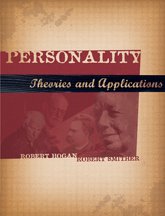 HoganPress is pleased to announce the second-edition release of Personality: Theories and Applications, by Robert Hogan and Robert Smither. From the back cover:
The major theories of personality contain important insights about human nature, but they are often unconnected with modern research. Personality: Theories and Applications bridges the gap between research-oriented books and traditional theory books by organizing each chapter around the specific topic that interested each of the major theorists. Designed for the first course in personality psychology, Personality: Theories and Applications combines a strong historical perspective with practical applications that largely concern the world of work.
For more information and to purchase the book, please click here.
 HoganPress is pleased to announce the second-edition release of Personality: Theories and Applications, by Robert Hogan and Robert Smither. From the back cover:
The major theories of personality contain important insights about human nature, but they are often unconnected with modern research. Personality: Theories and Applications bridges the gap between research-oriented books and traditional theory books by organizing each chapter around the specific topic that interested each of the major theorists. Designed for the first course in personality psychology, Personality: Theories and Applications combines a strong historical perspective with practical applications that largely concern the world of work.
For more information and to purchase the book, please click here.
I have known many smart guys in my life, but John Holland, who died last month, was the man who most influenced my career. John was part of a small group of famous psychologists (John Flannagan, J. P. Guilford, Robert Thorndike, Harrison Gough, Hans Eysenck, Alphonse Chapanis, and B.F. Skinner) whose interest in applied psychology and assessment was sparked by their experiences in World War II. If you have ever seen Warren Buffett interviewed on TV, you will have a good sense of John, who was also from Omaha. He was mild mannered, unpretentious, overtly modest, wickedly funny, ferociously competitive, and very hard working—he was one of the five most published scientists of the 20th century. He was a keen football fan (the Kansas City Chiefs), a fine pianist, and catnip for women—his wife Elsie (also from Omaha) could have had a career in the movies. And he created intense admiration and loyalty in everyone who worked with him because he was so smart, so perceptive, so principled, and so very funny. The same seems to be true for Warren Buffett.
I learned five lessons from John that are worth repeating. The first concerns the importance of assessment for guiding peoples’ lives. As Freud said, the two biggest problems in life concern choosing a mate and choosing an occupation and people never do either for rational reasons—and he was right. The process of choosing a mate—male/female relations—is bound up in biology and hormones and is utterly irrational. The process of choosing an occupation is bound up with one’s relationship with one’s parents; nonetheless, it is in principle possible to make rational career choices and the key to doing that is valid assessment and competent feedback.
The second lesson that I learned is utter disdain for the rules of the psychometric (or academic testing) establishment—e.g., what we learned in graduate school. One of John’s best lines was, “Forget everything you learned in graduate school”; he meant it and he was right. Mainstream psychometrics concerns measuring entities (i.e., determining “true scores”). But applied assessment has a job to do, and that is to predict outcomes. The psychometric establishment is only concerned in principle with how their methods apply to real world; in reality, they don’t care. Real test development is an intellectual and scientific activity that requires careful thought and some creativity; there are no formulae for good test development, there are no cook book recipes for developing meaningful assessment, and the best tests have been developed by mavericks.
The third lesson I learned was that it is essential to have a sound, well thought out, conceptual basis for your measurement model. John was an avid student of philosophy of science. He was greatly concerned about, and immensely pleased with, the way in which his measurement model was theory-based and his research was consistent with the best precepts of real science: have an idea, test the idea, refine the idea based on the test, then start over. This lesson is quite unique and none of our competitors understand it.
The fourth lesson I learned is that if you develop your assessments correctly, they will sell. John made a lot of money from his Vocational Preference Inventory and his Self-Directed Search. The same is true for Raymond Cattell and Harrison Gough. At some point, the market can distinguish between valid assessment and psychometric garbage.
Finally, I learned from all of these guys (Holland, Cattell, Gough, etc.) that you have to retain control of your intellectual property. They all found it difficult to manage the test sales by themselves (John’s garage was stacked full of paper products), they sold their rights to “real” business people, and spent the rest of their lives bitterly regretting their decision. In 1982, Joyce and I sold the rights of the HPI to National Computer Systems. They were as incompetent as all big public companies seem to be; it was a terrible decision, and when we got the rights to the HPI back in 1992, we began making money immediately, and we vowed never to make that mistake again.
It is important to remember John’s approach to assessment because, after the wind blows away all the psychometric schlock, his work will still be standing. There is a strong tendency in our discipline to forget the past, to assume that the research that is going on today is qualitatively better and has somehow superseded the earlier research. That, of course, has to do with the vanity and arrogance of youth. Virtually all of us could profitably reread the early work of Binet, Spearman, Strong, Allport, Murray, and of course, John Holland. And when we do, we will be surprised to discover how little progress has been made in the fundamentals of assessment over the past 100 years.
I have known many smart guys in my life, but John Holland, who died last month, was the man who most influenced my career. John was part of a small group of famous psychologists (John Flannagan, J. P. Guilford, Robert Thorndike, Harrison Gough, Hans Eysenck, Alphonse Chapanis, and B.F. Skinner) whose interest in applied psychology and assessment was sparked by their experiences in World War II. If you have ever seen Warren Buffett interviewed on TV, you will have a good sense of John, who was also from Omaha. He was mild mannered, unpretentious, overtly modest, wickedly funny, ferociously competitive, and very hard working—he was one of the five most published scientists of the 20th century. He was a keen football fan (the Kansas City Chiefs), a fine pianist, and catnip for women—his wife Elsie (also from Omaha) could have had a career in the movies. And he created intense admiration and loyalty in everyone who worked with him because he was so smart, so perceptive, so principled, and so very funny. The same seems to be true for Warren Buffett.
I learned five lessons from John that are worth repeating. The first concerns the importance of assessment for guiding peoples’ lives. As Freud said, the two biggest problems in life concern choosing a mate and choosing an occupation and people never do either for rational reasons—and he was right. The process of choosing a mate—male/female relations—is bound up in biology and hormones and is utterly irrational. The process of choosing an occupation is bound up with one’s relationship with one’s parents; nonetheless, it is in principle possible to make rational career choices and the key to doing that is valid assessment and competent feedback.
The second lesson that I learned is utter disdain for the rules of the psychometric (or academic testing) establishment—e.g., what we learned in graduate school. One of John’s best lines was, “Forget everything you learned in graduate school”; he meant it and he was right. Mainstream psychometrics concerns measuring entities (i.e., determining “true scores”). But applied assessment has a job to do, and that is to predict outcomes. The psychometric establishment is only concerned in principle with how their methods apply to real world; in reality, they don’t care. Real test development is an intellectual and scientific activity that requires careful thought and some creativity; there are no formulae for good test development, there are no cook book recipes for developing meaningful assessment, and the best tests have been developed by mavericks.
The third lesson I learned was that it is essential to have a sound, well thought out, conceptual basis for your measurement model. John was an avid student of philosophy of science. He was greatly concerned about, and immensely pleased with, the way in which his measurement model was theory-based and his research was consistent with the best precepts of real science: have an idea, test the idea, refine the idea based on the test, then start over. This lesson is quite unique and none of our competitors understand it.
The fourth lesson I learned is that if you develop your assessments correctly, they will sell. John made a lot of money from his Vocational Preference Inventory and his Self-Directed Search. The same is true for Raymond Cattell and Harrison Gough. At some point, the market can distinguish between valid assessment and psychometric garbage.
Finally, I learned from all of these guys (Holland, Cattell, Gough, etc.) that you have to retain control of your intellectual property. They all found it difficult to manage the test sales by themselves (John’s garage was stacked full of paper products), they sold their rights to “real” business people, and spent the rest of their lives bitterly regretting their decision. In 1982, Joyce and I sold the rights of the HPI to National Computer Systems. They were as incompetent as all big public companies seem to be; it was a terrible decision, and when we got the rights to the HPI back in 1992, we began making money immediately, and we vowed never to make that mistake again.
It is important to remember John’s approach to assessment because, after the wind blows away all the psychometric schlock, his work will still be standing. There is a strong tendency in our discipline to forget the past, to assume that the research that is going on today is qualitatively better and has somehow superseded the earlier research. That, of course, has to do with the vanity and arrogance of youth. Virtually all of us could profitably reread the early work of Binet, Spearman, Strong, Allport, Murray, and of course, John Holland. And when we do, we will be surprised to discover how little progress has been made in the fundamentals of assessment over the past 100 years.
