
3 Skills to Guide Employee Selection

Posted by Hogan Assessments on Mon, May 10, 2021

Employee Selection

Companies express their guiding principles most clearly during the employee selection process. For instance, employers that value the old adage of “not judging a book by its cover” tend to adopt equitable employee selection procedures. While the specifics of employee selection processes vary, using a universal employability framework will ensure that your organization takes a grounded approach to judging candidates, whether for entry-level or C-suite positions.1 The three universal competencies that orient an employee selection process are people skills, learning skills, and work ethic. Pursuing candidates with these competencies will strengthen any organization and guard against hiring employees with poor problem-solving, self-management, and interpersonal skills.

People Skills: Can This Person Get Along with Others?

People are social creatures, which means hiring managers should consider a fundamentally human question during employee selection: will this candidate be rewarding to work and spend time with? Although this question is simple, it is often overlooked. Employers are often enticed by bright candidates. But when these people are incapable of getting along with others, or at least unwilling, they tend to erode organizational morale.  

Tech guru Steve Jobs is a great example of someone who, despite being admired for his intelligence and creativity, was emotionally taxing to work with.2 His inability to get along with others was apparent from the start of his career. During his stint at Atari, his employers assigned him to the solitary night shift so he would stop upsetting his coworkers. Atari cofounder Nolan Bushnell later said that Jobs “was very often the smartest guy in the room, and he would let people know that.”3 Jobs was suspicious, argumentative, entitled, impulsive, prone to setting impossible standards, and emotionally volatile. He did not value people skills, which curbed his ability to get along with people throughout the ranks. Workers at Pixar and Apple both admitted that working with Jobs required inhabiting an almost egoless state because they were subject to constant abuse and expected to be extremely deferential. Although his genius made him successful, his harsh behavior prevented him from becoming CEO at Apple and eventually resulted in his ousting from the company.

Organizations may clamor to have a genius in their ranks, but focusing on candidates with strong people skills is more beneficial. The majority of today’s leaders are people leaders managing employees with team-based jobs.4 When folks who occupy these leadership positions lack the necessary people skills, productivity can plummet. For the sake of those already working within the organization, employers should ensure their employee selection processes place people skills at the heart of the search.

Learning Skills: Can This Person Do the Job?

The accelerated development of new technologies means professionals must pursue education to improve at their jobs and adapt to the business world’s ever-shifting terrain. Hiring managers should look for candidates who display, in addition to occupational expertise, a high degree of inquisitiveness and a propensity for learning. Even at the C-suite level, learning skills should not be taken for granted. As Steven Berglas, PhD, points out in The Perils of Accentuating the Positive, “super smart and capable people” often “fail to use their abilities to continually adapt and instead resist new information when it is obvious that the old way is working against them.”5

Berglas illustrates this refusal to adapt with the story of Sewell Avery, the CEO and chairperson of the department store retailer Montgomery Ward & Co. Prior to his time at the helm of Montgomery Ward, Avery was CEO of the United States Gypsum Company. Having come of age in the depressed 1890s, Avery applied the economic attitudes of his youth to his business by running his company frugally and keeping it debt-free. This approach paid off when the Great Depression arrived. Many of Avery’s competitors were forced to close their doors, but the United States Gypsum Company continued to grow. J.P. Morgan was so impressed with Avery’s leadership that he asked him to take charge of the ailing Montgomery Ward & Co. department store. Avery remained steadfast to his frugal formula throughout the post-World War II economic boom. His approach was so inflexible that, despite warnings from his subordinates, he refused to follow consumers and open stores in the suburbs. His reasoning was that another Great Depression would arrive soon, but it never did. Consequently, Montgomery Ward & Co. fell behind its competitors and never caught up. If Avery had stayed curious and kept learning about the changing market, Montgomery Ward might still be around today.

Regardless of a job’s context, learning skills and openness to new experiences are valuable competencies. Employee selection procedures should focus on candidates who are willing to resist clinging to tried-and-true methods and instead flex their learning abilities. The recent changes wrought by COVID-19 have served as a reminder of the importance of approaching new business environments, organizational and team structures, and social situations with a healthy dose of curiosity and openness.

Work Ethic: Can This Person Be Motivated to Do the Job?

Socially skilled, bright, and adaptable candidates can still fail to fulfill their promise if they are not motivated to work hard. Motivation is formed by personal values that impact career outcomes. If a candidate does not buy into the vision for their role or the company, their work ethic is bound to lag in the long run. Therefore, hiring managers should look for an overlap between candidate and organizational values. A fictitious but helpful example of what happens when employees aren’t motivated can be found in the character Stanley Hudson in the American version of the TV series, The Office.

Although stone-faced Stanley has a history of hitting high sales numbers with Dunder Mifflin Paper Company, he no longer musters the energy to do anything beyond his immediate job description. Stanley’s recurring catch lines are “no” and “do not care.” He refuses to coach younger employees such as Ryan, always leaves the office at 5 p.m. sharp, takes naps during the workday, and does crossword puzzles during meetings. The show makes the reason for his disengagement clear: Stanley does not buy into the vision that his boss Michael presents to his employees. In season 2, Stanley vents his frustration to Michael:

What is wrong with you? Do you have any sense at all? Do you have any idea how to run an office? Every day you do something stupider than you did the day before. And I think, “There’s no possible way he can top that.” But what you do you do? You find a way, damn it, to top it. You are a professional idiot!

The clash between Stanley and Michael becomes a running storyline in the show. Stanley’s disengagement eventually climaxes in season 5, when he has a heart attack due to stress from working in an environment he does not enjoy. Stanley returns to the office with a stress monitor that goes off whenever Michael approaches him. Although fictional, Stanley’s disengagement and resulting health issues are based in reality. According to a Gallup poll, 71% of Americans do not like their jobs and therefore do not work hard or show loyalty to their employers.6 Moreover, the National Institute for Occupational Safety and Health shows that people who work for employers with whom they don’t agree are at higher risk for cardiovascular disease and other health issues.7      

Alignment with organizational values will almost certainly affect employee engagement with work, as well as health. In turn, job engagement and health affect whether employees work hard in their roles. Educational psychologist Lee Cronbach summed it up best when he said, “If for each environment there is a best organism, for each organism there is a best environment.”8

Success in Employee Selection: A Matter of Good Data and Perspective

While reviewing candidates and what they each have to offer, it is helpful to use these three competencies as a big-picture barometer of hiring success. Understanding where each candidate stands in terms of these criteria helps employers make the best hiring decisions possible, plus anticipate areas that might require special attention or training.

References

  1. Larcher, A. (2019, August 16). Hogan Assessments Launches a New Product to Help Organisations Recruit the Right Candidates. Swiss Entrepreneurs Magazine.https://swissentrepreneursmagazine.com/index.php/2019/08/16/hogan-assessments-launches-a-new-product-to-help-organisations-recruit-the-right-candidates/
  2. Fernandez, J. (2018). The Entrepreneurial Personality: Meet Steve Jobs. Hogan Press.
  3. Cassidy, M. (2016, August 12). Cassidy on Nolan Bushnell: ‘Steve Was Difficult,’ Says Man Who First Hired Steve Jobs. Mercury News. https://www.mercurynews.com/2013/03/28/cassidy-on-nolan-bushnell-steve-was-difficult-says-man-who-first-hired-steve-jobs/
  4. Heerwagen, J., Kelly, K., & Kampschroer, K. (2016, October 5). The Changing Nature of Organizations, Work, and Workplace. Whole Building Design Guide. https://www.wbdg.org/resources/changing-nature-organizations-work-and-workplace
  5. Kaiser, R. (2009). The Perils of Accentuating the Positive. Hogan Press.
  6. Blacksmith, N., & Harter, J. (2011, October 28). Majority of American Workers Not Engaged in Their Jobs. Gallup. https://news.gallup.com/poll/150383/majority-american-workers-not-engaged-jobs.aspx
  7. National Institute for Occupational Safety and Health (1999). Stress… At Work (Publication Number 99-101). U.S. Department of Health and Human Services, Centers for Disease Control. https://www.cdc.gov/niosh/docs/99-101/default.html#Job%20Stress%20and%20Health
  8. Cronbach, L. (1957). The Two Disciplines of Scientific Psychology. Classics in the History of Psychology, York University. https://psychclassics.yorku.ca/Cronbach/Disciplines/#:~:text=If%20for%20each%20environment%20there,he%20can%20most%20easily%20adapt.

Topics: candidate selection

Artificial Intelligence Professionals in Leadership: Identifying and Developing Top Talent (Part 3)

Posted by Hogan Assessments on Tue, May 04, 2021

Two female artificial intelligence professionals, one Black with cropped platinum hair (left) and one Asian with long brown hair (right), sit on a sofa having a leadership development conversation. The woman on the left is holding a piece of paper and a pen. A tablet is on a table in front of them, and a wall of greenery is behind them.

This is the final installment of Hogan’s three-part blog series on selecting and developing artificial intelligence (AI) professionals. In the previous two installments, we discussed the demand for personality insights for artificial intelligence jobs, as well as using Hogan’s Artificial Intelligence Professionals personality profile for selection. In this final part, we will explain how to identify and develop AI professionals who have the potential to become organizational leaders.

Due to the high demand for artificial intelligence skills, organizations might not have a large talent pool from which to choose AI professionals. This may mean sacrificing some desirable aspects of performance, such as managerial potential. Plus, many of the characteristics that make someone a good AI professional won’t necessarily translate to leadership roles. For example, AI roles often involve working independently without needing to rely on a team. Individuals who thrive in independent environments have the potential to become managers who struggle to manage social behavior, communicate expectations, or spend time developing their team members. Fortunately, however, there are evidence-based strategies employers can use to identify and develop artificial intelligence professionals for leadership roles.

Hogan’s personality assessments can help identify the strengths and weaknesses of each employee’s unique personality characteristics. Measuring day-to-day personality (with the Hogan Personality Inventory), potential derailers (with the Hogan Development Survey), and values (with the Motives, Values, Preferences Inventory) can give employees a holistic view of their personalities and an understanding of how their strengths and weaknesses compare to others’. A disparity often exists between how we see ourselves (identity) and how others view us (reputation); Hogan measures reputation, which helps to reduce that disparity. Learning more about how others view our strengths and shortcomings can help us develop strategic self-awareness so we can capitalize on our strengths and start to develop our weaknesses, leading to stronger performance.

Many organizations rely on past performance data to promote employees. However, past performance is an imprecise predictor of future success when roles increase in scope, scale, and complexity. Good managers need to have highly developed interpersonal skills, which involves honest, open, and frequent communication with staff. The best leaders focus on developing others and building effective relationships that garner trust and draw out the best in the people they manage. Good managers should be able to move past their own egos and focus on building and developing high-performing teams. Organizations can use the Hogan assessments to provide opportunities for their employees to gain strategic self-awareness, orienting the organization’s development of current employees toward future opportunities.

Once employees are aware of their reputations, they can begin working on specific behaviors that impact them. As the organization supports their development journey, feedback should be provided to these employees to help inform their efforts and help them understand how to adjust their goals over time. To develop AI professionals for leadership roles, the organization may need to provide additional support, coaching, and structure to help them develop interpersonal skills that might not come naturally.

Organizations can continue to use the results of the Hogan assessments to engage and develop employees throughout their careers and to improve the health of their talent pipeline. If development efforts are only reserved for the highest potentials, organizations might miss out on a larger, more diverse group of talent. If organizations decide on high-potential talent without assessments, effective employees may be overlooked in favor of those who are overtly political but maybe not as effective. Not to mention, waiting to develop talent until they reach the highest levels creates the risk of small problems that could be easily addressed earlier on in an employee’s career becoming bigger issues as stress and pressure increase with job level. By investing in development earlier in the employee life cycle, organizations can strengthen their future pipeline. Change takes time, and the earlier you develop employees, the more practice they will have in developing the skills and coping methods to improve performance based on their strengths, weaknesses, and values.

Employees also see development as a top reason to remain with organizations, so investing in development both prepares future leaders and improves retention among high-value employees. This is especially important for companies hiring for jobs that are in high demand, such as AI jobs. Being able to retain employees in these types of jobs will provide organizations with a competitive advantage and help them save money and become more successful.

Hogan can provide a variety of personality- and competency-based reporting options to help organizations evaluate candidates and improve their assessment processes. To learn more about the Hogan Artificial Intelligence Professional profile, contact your local Hogan distributor or email info@hoganassessments.com.  

Topics: candidate selection

Distributor Spotlight: Peter Berry Consultancy

Posted by Hogan Assessments on Tue, Apr 27, 2021

pbc-new-web

Peter Berry Consultancy, also known as PBC, is an authorized distributor of Hogan’s personality assessment solutions in Australia and the author of several products, including the Hogan 360° suite and the High Performing Team Assessment. PBC is also coauthor of the Hogan Safety Climate Survey.

Founded by managing director Peter Berry in 1990, PBC has grown into a leading global provider of human capital consulting services. PBC is a multidisciplinary global consulting firm with more than 30 years of experience in the delivery of best-practice solutions aimed at maximizing the potential and behavior of individuals, teams, leaders, and organizations.

PBC provides customer-focused, evidence-based people solutions that enable organizations to select the right people, develop key talent, build better teams, drive leadership capability, and enhance organizational performance. From offices in Sydney and Melbourne, PBC employs highly skilled, experienced consultants with backgrounds in psychology, business consulting, and human resources to support clients both locally and globally.

Research Contributions

PBC proudly applies an extensive collection of research, case studies, and thought leadership in developing solutions for clients. PBC’s expertise and insight into both local and global leadership is highlighted in recent work:

  • What the Best Leaders Look Like – Research shows that the best leaders tend to be achievement focused, strategic, and inspiring, with high emotional competence. Leaders need to focus on improving their workload management and their ability to challenge poor performance.
  • Leader Personality and Performance Differences in the Public Versus Private Sector – Understanding what differentiates leaders can be useful for selection and development. This white paper summarizes research that examines similarities and differences in the personality and multirater performance reviews of executives and managers within the Australian public and private sectors.
  • Gender Differences in Australian Leadership – There has been a growing interest in understanding the similarities and differences between leaders of different genders. Insights in this area can have implications for the selection and development of leadership talent and leaders’ subsequent performance at the individual, team, and organizational levels.

For more details on these and other research topics, please visit peterberry.com.au/resources.

Topics: distributors

How to Select the Best People for Artificial Intelligence Jobs (Part 2)

Posted by Hogan Assessments on Tue, Apr 27, 2021

Two artificial intelligence professionals, a Black woman with locs and a Black man with a shaved head, beard, and glasses, are sitting in front of dual computer monitors, and the woman is gesturing as if she is giving instructions about coding.

This is part two of Hogan’s three-part blog series on selecting and developing artificial intelligence (AI) professionals. In the first installment, we discussed the demand that led to the launch of this project. This time, we’ll explain the research process and the application of the selection profile.

Hogan partnered with consulting firms and clients around the world to improve selection accuracy for AI professionals. Based on our research, we defined AI professionals as individual contributors who are responsible for working with computers to analyze information, interpret and communicate that information to the company to drive strategy and decision-making, and develop and implement solutions to manage data.

Hogan developed a scientifically valid screening tool to identify specific competencies, characteristics, and values that predict job success for AI professionals. Hogan then used this information to build a custom Artificial Intelligence Professionals personality profile using the Hogan Personality Inventory (HPI), Hogan Development Survey (HDS), and Motives, Values, Preferences Inventory (MVPI). This profile enables companies to select higher-performing AI professional candidates.

Our research involved two steps. First, we conducted a job analysis. We reviewed job descriptions from O*NET for AI professional jobs, including business intelligence analysts, software developers, data engineers/scientists, and machine-learning specialists. We also conducted focus groups with subject-matter experts, and they completed a quantitative online job analysis survey.

Second, Hogan used validity generalization strategies including job family meta-analysis and synthetic/job component validity to identify the HPI- and HDS-based predictors of successful performance in AI professional jobs. Job analysis results provided evidence for relevant MVPI scales.

Hogan determined that successful AI professionals adapt to new changes and are energized by the challenge of their work. They take initiative to solve problems and can tolerate the more tedious aspects of working with data. In addition, AI professionals have a drive to seek out knowledge and update themselves on new developments related to their work.

By incorporating Hogan’s Artificial Intelligence Professionals personality profile into the candidate assessment process, companies can more effectively select AI professional candidates with the characteristics most important for success in their profession. Hogan’s research shows that if they choose to use our assessments in the selection process, companies can expect to see a 21% improvement in overall accuracy, selecting 10.5% more good hires and avoiding 10.5% more bad hires.

If you are interested in using the Artificial Intelligence Professionals profile for your organization, Hogan has developed a variety of personality- and competency-based reporting options that can help your organization evaluate candidates for AI jobs. To learn more about how you can use the profile, contact your local Hogan distributor or email info@hoganassessments.com.

Topics: candidate selection

With Big Data Comes a Big Demand for Artificial Intelligence Professionals (Part 1)

Posted by Hogan Assessments on Mon, Apr 19, 2021

A female software developer, or artificial intelligence professional, with long red hair who is wearing a navy blouse with a white leaf print, a silver watch, and a silver bracelet sits at a desk in an open-plan office. She has two computer monitors and a laptop in front of her, along with some small tchotchkes and a box of tissues, and she is writing code for AI.

Some of the biggest and most successful companies in our economy have been using big data for years. Google started with incorporating data algorithms to analyze relationships between websites and improve web searches. Amazon uses a customer database and algorithms to provide personalized shopping recommendations. More recently, Facebook received attention for its use of personal information from billions of users. Researchers mine this data for everything from political ads to personality assessment.1

Today, it is challenging to find a company that is not using some form of AI. From algorithms to data mining to software development, AI has become a crucial means of becoming globally competitive. Companies such as Booking.com and India’s Flipkart use AI to inform their direction for product development. Websites such as Buzzfeed and Weibo that rely on clicks use AI to optimize the headlines they choose for their articles. Other companies, including Airbnb and Alibaba, use AI to inform their business decisions, while social networking sites such as Instagram and YouTube use it for recommending relevant content.

Given these trends, it is not surprising that AI jobs are in high demand or that the demand for AI skills is increasing. The U.S. Bureau of Labor Statistics lists information security analysts and other data scientists among their top 20 fastest-growing occupations. Employment in these jobs is expected to grow by 31% in the U.S. over the next decade.2 Meanwhile, in China the digital economy continues to grow rapidly, having reached $5.45 trillion USD (35.8 trln yuan) in 2019, accounting for 36.2% of the country’s total GDP, according to a report from the Chinese Academy of Cyberspace Studies.3 The growth is expected to continue over the next two decades and lead to the creation of numerous AI job opportunities. India will also experience an increase in digital growth; according to a McKinsey report, by 2025 the digital economy in India may account for 8% to 10% of India’s GDP.4

The U.S. Department of Labor’s Occupational Network online database (O*NET) reports a bright outlook for jobs such as computer and information research scientists, database administrators, business intelligence analysts, and computer systems engineers/architects. Burning Glass International, an analytics software company that specializes in job market analytics, has seen an increase in job descriptions that request machine learning skills.5 Indeed.com analyzed more than 30,000 listings and found that the top markets for AI jobs are China, the U.S., Japan, and the U.K.6

The global demand also means there’s an increased need to identify individuals who will be successful in these roles. As a personality assessment company with more than 40 years of research on job performance, Hogan knows that selecting the right people for these jobs will provide companies a key competitive advantage for becoming successful in the digital economy.

Hogan set out to research who will be most successful in AI professional roles. We interviewed numerous professionals in the digital economy from across the globe.  As an outcome of our research, we created a general profile of personality characteristics that are important for AI professional roles. We identified a variety of jobs that fall into this job family, including business intelligence analysts, data warehouse specialists, database administrators, computer and information research scientists, computer systems engineers, computer systems developers, and data scientists. A review of occupational activities and skills revealed that there is much overlap between these roles. Our final definition of an AI job in this family is “an individual contributor who works with computers to analyze information; interprets and communicates that information to the company to drive strategy and decision-making; and develops and implements solutions to manage data.”

Helping companies select and develop the highest-performing talent is Hogan’s main goal. With this AI professional roles research, we aim to set companies up for future success by understanding the jobs of the future and recommending the highest performers for those roles. 

This is part one of Hogan’s three-part blog series on selecting and developing artificial intelligence professionals, authored by Hogan’s Karen Fuhrmeister, PhD and Krista Pederson. In the next installment, we will discuss the research process we used to identify personality characteristics of successful AI professionals and the application of the selection profile.

References

1. Zialcita, P. (2019, October 30). Facebook Pays $643,000 Fine for Role In Cambridge Analytica Scandal. NPR. https://www.npr.org/2019/10/30/774749376/facebook-pays-643-000-fine-for-role-in-cambridge-analytica-scandal

2. U.S. Bureau of Labor Statistics. Occupational Outlook Handbook: Fastest Growing Occupations. https://www.bls.gov/ooh/fastest-growing.htm

3. Xinhua. (2020, November 23). China’s Digital Economy Reaches 35.8 trln Yuan in 2019 [Press release]. http://www.xinhuanet.com/english/2020-11/23/c_139538040.htm

4. Kaka, N., Madgavkar, A., Kshirsagar, A., Gupta, R., Manyika, J., Bahl, K., & Gupta, S. (2019, March 27). Digital India: Technology to transform a connected nation. McKinsey Global Institute. https://www.mckinsey.com/business-functions/mckinsey-digital/our-insights/digital-india-technology-to-transform-a-connected-nation#

5. Columbus, L. (2020, December 27). Top 10 job skills predicted to grow the fastest in 2021. Forbes. https://www.forbes.com/sites/louiscolumbus/2021/12/27/top-10-tech-job-skills-predicted-to-grow-the-fastest-in-2021/?sh=2b78afef6fde

6. Werber, C. (2019, February 12). This Is Where You Should Move if You Want a Job in AI. Quartz at Work. https://qz.com/work/1547302/the-best-cities-and-countries-to-live-in-if-you-want-a-job-in-ai/

Topics: candidate selection

Best Practices: Remote Coaching During Times of Disruption and Uncertainty

Posted by Cynthia Cuffie on Wed, Apr 14, 2021

A woman with short red hair wearing a sage-colored blazer over an ecru blouse holds a remote coaching meeting via laptop. She wears square black eyeglasses and uses a wheelchair. She sits at a white table in front of a brick wall. On the tabletop is a white coffee mug, a notebook and pen, two small flower vases, and a basket of office supplies.

* The Hogan Coaching Network (HCN) is comprised of approximately 50 coaches worldwide who are experts in both the Hogan instruments and in coaching. Even prior to the pandemic, they did the vast majority of their feedback and coaching calls remotely, and their customer satisfaction ratings are routinely over 4.5 on a 5-point scale. So, who better than a member of the HCN to author a blog on effective remote coaching? In her article below, Cynthia Cuffie, an accomplished HCN coach, combines her own tips and advice with those from other HCN members to ensure a productive and effective remote session.    

In any coaching session, whether remote or in person, it is important for the coach to provide an environment that is comfortable, safe, thought provoking, and informative. This sounds simple, but because the coach and coachee often have only a short period of time to connect, it requires planning, attention to the conversation, and adaptability.

So what do you do when there are factors beyond your control, such as a global pandemic or increasing calls for social and racial justice? While coaching was done remotely before the start of the pandemic, the use of video conferencing has increased exponentially in the past year. Today with video conferencing, we find ourselves sharing our personal worlds. Our homes have become offices, and our families have become officemates. These situations have added an intensity to the remote coaching experience that even the most seasoned coaches find challenging.

The article leverages the collective expertise of the global Hogan Coaching Network to share best practices for coaching remotely (table 1). Many of the best practices featured will be helpful in a variety of coaching situations, from the simplest coaching conversation to the delivery of a Hogan Assessment feedback session.

Table 1: Best Practices for Remote Coaching During Times of Disruption and Uncertainty  
Before the Session  
1. Set the Tone and Expectation: The Invitation  
2. Do Your Homework  
3. Prepare Yourself
During the Session  
4. Establish a Connection  
5. Review Confidentiality Boundaries  
6. Embrace Technology  
7. Explain the Process  
8. Set the Context  
9. Review and Discuss Hogan Assessment Data (Hogan Feedback Session)  
Wrap-up and After the Session  
10. Summarize Key Findings and Discuss Future Actions  

Let’s delve deeper into each of these best practices.

Set the Tone and Expectation: The Invitation

The invitation is an opportunity for the coach to set the tone and expectations for the coaching session. The invitation should be concise, warm, and informative. Provide a brief description of what will occur during the session and give instructions regarding what document(s) the coachee should have available for reference. Instruct the coachee to print required documents whenever possible or be prepared to take brief notes if printing is not possible or if digital is preferred. Share your expectations of document review before and after the session.

Let the coachee know you are looking forward to the session. While a video meeting may be your standard or preferred coaching communication method, always give the coachee an option to participate by phone only — no questions asked. Even if the coachee opts for a video conference session, have your phone ready during the session in case the coachee wants or needs to change their mind.

Do Your Homework

In the age of social media, it is often easy and helpful to find some information about the coachee before the session. Many times, LinkedIn or another site will have background and context information. This should be approached as a brief exercise based on strategic curiosity and not as a detailed research project.

Review any relevant information that may provide clues regarding the coachee’s motivators and willingness to accept feedback. Try to stick to objective information. If you are conducting a Hogan feedback session, look for validity, clues about the coachee’s receptiveness to feedback, and data patterns. For example, people with very high Adjustment scores on the Hogan Personality Inventory (HPI) may discount feedback. Conversely, people with low Adjustment scores on the HPI may be overly self-critical.

Prepare Yourself

Test technology (e.g., audio, video, computer readiness) at least 15 minutes before scheduled sessions. Give yourself a break for at least 30 minutes between contiguous sessions. This allows time for preparation, reflection, and technology testing. Additionally, an adequate break between sessions allows coaches to minimize any stressors that may have arisen during a prior session. Stay abreast of current events so that you can be prepared to address concerns effectively.

Being self-aware is important for coaches. Ideally, during a coaching session, coaches need to be fully present, perceptive, flexible, curious, active listeners, clear and diplomatic in communication, willing to accept some tension, and resistant to providing solutions without adequate exploration of ideas by the coachee.

Establish a Connection

If using video conferencing, make sure you and the coachee can clearly see and hear each other. Make eye contact. Make sure your background is calming and bright. Meet the coachee where they are emotionally. It may be helpful to start with a grounding exercise. For example, ask the coachee to give three words describing how they are doing. Acknowledge if they appear rushed, distracted, or anxious. Try to make the coachee comfortable by letting them know it is OK if they need a moment to wind down or take care of something first. Take note of the physical surroundings of the coachee. If it appears as if they may not be able to speak freely, ask if they are comfortable speaking at this time. If not, consider an alternative time. Acknowledge that there may be unexpected distractions in the virtual world, and that is OK. Share your brief background and acknowledge your limitations in the virtual world. Whenever possible, try to include some information about yourself that may help build rapport.

Review Confidentiality Boundaries

Confirm your understanding of the confidentiality boundaries of the coaching session. Generally, coaching discussions are completely confidential. However, if there are agreements with the coachee’s sponsor and/or employer that may require some sharing of information, be transparent with the coachee.

Embrace Technology

This section is intended to provide general guidance regarding how to enhance the remote coaching experience with the use of technology. Details regarding optimization of different platforms can be found on the websites of the platforms. Try to honor the coachee’s preferred video platform whenever possible. (e.g., Zoom, Microsoft Teams, Skype). This is especially important in making international connections.

Use a hardwired connection for better connection stability if possible. Be prepared for the unexpected. Have simple backup solutions to commonly observed technical glitches. Explain to the coachee early in the session that you have a backup plan if needed. For example, share telephone numbers or agree to email each other regarding reconnecting if video or telephone connections fail. Let the coachee know that if all connections fail, a future connection will be established, and you will recontact them by email as soon as possible.

The view is important. As mentioned previously, make sure your view is bright, calming, and has minimal background distractions. Be aware that Zoom virtual backgrounds can sometimes compromise connection quality. Keep camera at eye level to maintain eye contact and avoid distortions. Play with different distances from the screen so that you can refer to your notes and materials without the coachee viewing these materials.

Be expressive. Don’t be afraid to move. Body language does come across even if there is a limited view. Remember to smile (again, be natural!). Ask the coachee if they are comfortable with screensharing. If you plan to use screensharing, have documents readily accessible on your desktop to avoid searching for files.

Explain the Process

Take time in the beginning of the coaching session to briefly explain the process and what to expect during the session. Make sure you ask the coachee to share their expectations. Assure them that you will address their expectations so that you don’t appear to have an inflexible, predetermined agenda. If you are providing Hogan feedback during the session, let the coachee know that their results will be explained in the context of their role. The goal is to try to remove as much of the unknown as possible to minimize stress.

Remind the coachee of the materials each of you will need to refer to during the session. Be prepared to explain where the materials can be located quickly if the coachee does not have the materials readily available. Be prepared to share data or send materials if the coachee does not have access to necessary materials.

To encourage active participation by the coachee, explain that the session is a dialogue. Using open-ended questions and encouraging sharing of examples applicable to situations will help encourage active participation. Also, let them know they should feel free to ask questions.

Set the Context

Regardless of the situation, putting the coaching discussion into the context of something grounds the discussion. If conducting a Hogan feedback session, putting their Hogan assessment results into the context of their role is important. To do this, ask the client to briefly explain their role, career path and aspirations, and strengths and challenges. Ask questions about their initial reaction to their data, such as “Is there any data that is surprising, confusing, or conflicting?” Not only will this information help focus the feedback conversation, but it will also quickly provide insight regarding their communication style and potential additional areas of interest.

If a coachee has not looked at their data before the coaching session, assure them they will have an effective session. Discourage coachees from reading reports during the session. Encourage taking brief notes but emphasize the importance of engaging in the conversation.

Review and Discuss Hogan Assessment Data (Hogan Feedback Sessions)

Use the Hogan Flash Report as an anchoring document. If you are screensharing, use annotation features to help focus the discussion. This will also allow you to provide the coachee with an annotated document after the session.

How you approach the feedback session should take into account the coachee’s Hogan profile. For example, a person who is low on the HPI Prudence scale and high on the HPI Inquisitive scale may be more interested in focusing on big picture concepts and exploring different possible behaviors, whereas a person who is high on the HPI Prudence scale and low on the HPI Inquisitive scale, may prefer to focus on details and offer very little in the way of exploring new behaviors.

Making data connections is important. Look and listen for signs of impatience, boredom, or distractions. When discussing concepts, be sure to rephrase to confirm your understanding and ask appropriate follow-up questions. Periodically during the discussion, ask questions to gauge the coachee’s reaction to results. For example, “Does that resonate with you?” or “Have you ever experienced reactions like that to your behavior before?” Coaching is about coachee discovery; however, suggestions should be provided by the coach. Make sure your suggestions are relevant to the coachee’s reality in this virtual world. Ask about the feasibility of suggestions. Meet them where they are.

Summarize Key Findings and Discuss of Future Actions

As the coaching session comes to a close, ask the coachee how they feel. This will provide an additional opportunity to identify and resolve potential outstanding issues or questions. This is also a good time to ask the coachee to summarize key takeaways for future actions. If they need help getting started, ask them to consider these questions:

  • What will you continue doing? These are strengths to leverage.
  • What will you stop doing? These are opportunities for growth.
  • What will you start doing? These development opportunities.

Be clear about future contact sessions if applicable. Share additional resources if appropriate. Lastly, but importantly, thank the coachee for their willingness to share with you.

* The Hogan Coaching Network (HCN) is comprised of approximately 50 coaches worldwide who are experts in both the Hogan instruments and in coaching. Even prior to the pandemic, they did the vast majority of their feedback and coaching calls remotely, and their customer satisfaction ratings are routinely over 4.5 on a 5-point scale. So, who better than a member of the HCN to author a blog on effective remote coaching? In her article below, Cynthia Cuffie, an accomplished HCN coach, combines her own tips and advice with those from other HCN members to ensure a productive and effective remote session.    

Topics: Career Development, Talent Development

Screening and Assessing Potential Graduates Pays off for NSW Government

Posted by Peter Berry Consultancy on Tue, Apr 13, 2021

pbc-new-web

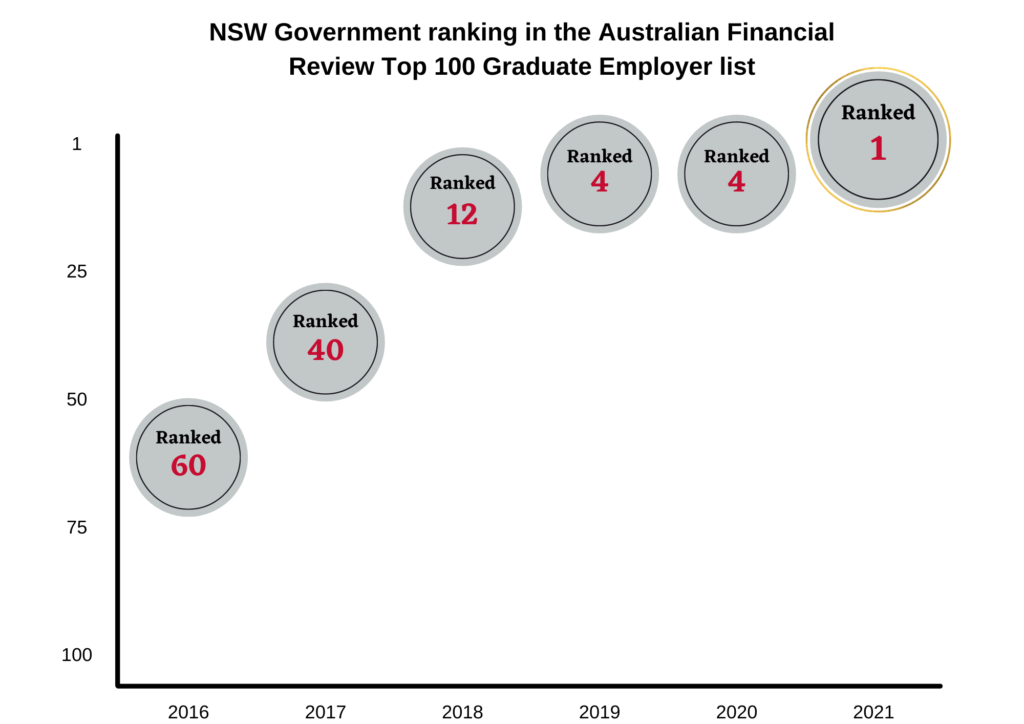
NSW Government in Australia has won top ranking in the Australian Financial Review’s 2021 Top 100 Graduate Employer List – an achievement that has been six years in the making. Peter Berry Consultancy’s (PBC) role in supporting NSW Government to attract talented new graduates has focused on designing and implementing the selection program, encouraging diversity , and identifying future leaders, in line with the NSW Premier’s priority to build and maintain a world class public service.

Since it started in 2016, the program has grown significantly and applications have largely increased year on year. From just 25 graduates in 2016 to 147 graduates in 2021, the program has seen over 800 graduates join NSW Government in just five years. In 2016 the NSW Government Graduate Program came in at 60 in the AFR 2021 Top 100 Graduate Employer List and has experienced an astonishing increase in popularity, demonstrated by the steady climb in its ranking in that time to top the list in 2021.

Assessing Potential Graduates 2021_02_25_PSC-Blog-AFR-Ranking-Graph

Innovative and best-practice techniques for screening and assessing potential graduates have played a key role in attracting the best and brightest graduate talent to NSW Government. In designing and implementing a selection process, PBC ensured that it met all relevant legislative requirements; provided a positive and equitable candidate experience; reflected the work skills required of NSW Government graduates; and used best practice evidence-based approaches to volume selection.

In the initial design phase of the selection program, PBC consulted extensively with the organization and relevant stakeholders to develop a process that includes:

  • Use of valid and reliable assessments including cognitive, personality and situational judgement
  • Use of online technologies to capture data efficiently and enhance the candidate experience
  • Consulting with other organizations to ensure equity, fairness, and inclusiveness in the process
  • Customization to reflect contemporary public sector issues
  • Knowledge transfer by training NSW Government assessors in best-practice capability-based assessment techniques

PBC has applied a continuous improvement approach during the five years it has supported the NSW Government Graduate Program, ensuring it attracts diverse candidates that best meet the requirements and values sought by NSW Government. This included a transition to full virtual delivery in 2020 in response to COVID-19.

Effective employee assessment and selection can have a significant impact on your organization’s performance, ensuring higher productivity, better team effectiveness, a more cohesive workplace culture and improved staff retention. To find out how PBC can help your organization select the right people, develop key talent, build better teams, drive leadership capability and enhance business performance visit our website.

About Peter Berry Consultancy (PBC)

PBC is a multidisciplinary global consulting firm with 30 years’ experience in the delivery of solutions aimed at maximizing the potential of individuals, teams, leaders and organizations. We undertake research to support our evidence-based solutions and have a network of partners and distributors globally.

PBC is the Australian distributor of Hogan Assessments and the author of a range of diagnostics including the Hogan 360 suite, High Performing Team Assessment (HPTA), Agile Suite and co-author of the Hogan Safety Climate Survey.

W: www.peterberry.com.au

E: info@peterberry.com.au

Ph: +61 2 8918 0888

Topics: distributors

Coaching in Context: A Tale of Two C-suite Execs

Posted by Hogan Assessments on Tue, Apr 13, 2021

Coaching in Context: Denison-and-Hogan_Social

We’d like to introduce you to the CEO of an energy company. Just about two years ago, he brought his friendly (high Interpersonal Sensitivity) and sociable (high Sociability) leadership to the organization. His assessment results portray a leader who is tuned into helping others (high Altruistic) and focused on creating a culture of teamwork (high Affiliation). A peek at his development plan outlines a focus on strategy and accountability.

Enter the COO, who is really the yin to the CEO’s yang; their personalities complement each other well. For instance, while the CEO is outgoing and takes a big-picture perspective, the COO tends to be more focused on the application of processes (moderate Inquisitive) and to approach social interactions in a Reserved manner. His lower Aesthetics score also leads him to focus on substance over form. He values productivity (low Altruistic) and likely prefers to work with minimal interruptions (low Affiliation). His development plan mentions goals of communication and collaboration, along with a need to react to scenarios with more urgency.

Both leaders are stress tolerant and resilient (high Adjustment). They are also high on the Imaginative and Mischievous scales — and they find commonality in valuing Recognition and Science. An investigation into the culture of the organization revealed growth in strategic direction and intent but decreases in capability development and organizational learning.

Interested in learning more about how their leadership styles shape the culture of the organization? Tune in to our collaborative webinar on Wednesday, April 21, 2021, beginning at 12:00 p.m. ET. The webinar will be cohosted by our partners at Denison Consulting. We’ll bring the personality narrative, and they’ll bring the culture data to tell an insightful story about how the power of multiple datapoints come together in a lesson of complementary work styles. The Denison Leadership Potential Report will also play a pivotal role in translating the insights from Hogan into a leadership model.

Click here to register for the webinar. We look forward to seeing you!

Topics: leadership development

Hogan to Present at SIOP 2021

Posted by Hogan Assessments on Mon, Apr 05, 2021

SIOP-2021_1200x630

The 36th annual Society for Industrial and Organizational Psychology (SIOP) conference is approaching, scheduled for April 14 through April 17. Like last year’s conference, 2021’s will be a bit different from those held in previous years — it will be virtual. This year, conference sessions will be both live and prerecorded, and many sessions will be available for viewing through May 7.

But one thing remains the same from pre-pandemic years: Hogan’s researchers and consultants are looking forward to attending and presenting some of Hogan’s many advances in personality research. Here’s a detailed schedule of the sessions we will be involved in.

Wednesday, April 14

Improving D&I: Personality Predicts Inclusion Behaviors

Chase Winterberg, JD, MA, Kimberly S. Nei, Jessica Walker

9:00 a.m. CT, Poster Room B

Inclusion fosters the benefits of diversity. Authors meta-analyzed personality, dark personality, and work-value predictors of inclusive work behaviors. Results suggest that individuals more likely to engage in inclusive behaviors at work are those who are emotionally stable, agreeable, conscientious, tolerant, open-minded, trusting, humble, honest, sympathetic, and concerned about helping others.

Providing Personality “Insight” to Competency Differentiation: A Synthetic Approach

Matthew R. Lemming

3:00 p.m. CT, Poster Room A

Competency modeling, when done correctly, should meet certain standards. Authors addressed whether Insight competencies are sufficiently specific without being too limiting. The study used synthetic validity meta-analyses to distinguish the personality predictors of business insight from industry insight and financial insight using the Hogan Personality Inventory and the Hogan Development Survey.

Development and Validation of a Personality-based Measure of General Employability

Michael Boudreaux, Nathan A. Hundley, Brandon Ferrell, Ryne A. Sherman

5:00 p.m. CT, Poster Room A

This research operationalizes a three-dimensional model of general employability. The model focuses on the broad personality domains of rewarding, able, and willing. Authors discuss the methods used to create scales for the general employability model, the psychometric properties and construct validity of those scales, and relationships to job performance.

Thursday, April 15

Executive Coaching in Extreme Times: Handling New and Unusual Scenarios

Josh Rogers

12:30 p.m., Room 8

This panel of experienced coaches will share best practices and insights from personal experience coaching leaders through new or unusual situations. Panelists will use a storytelling approach to this discussion, highlighting contextual considerations and tips for successfully building trust and rapport, as well as leveraging assessments to drive change and measuring the impact of coaching.

Are Machine Learning Algorithms a Hiring Panacea or Pandora’s Box?

Brandon Ferrell, Nathan A. Hundley

1:30 p.m. CT, Room 6

Machine learning has demonstrated value from predicting important workplace outcomes to solving complex data problems. However, challenges persist from limitations in extracting actionable insights to eliminating differences among protected classes. This debate will present different perspectives and seek a framework to analyze both the promises and limitations of machine learning in employment decision-making.

Professional Coaching: Issues, Perspectives, and Future Avenues

Scott Gregory

1:30 p.m., Room 8

The view of coaching is changing, and organizations are now increasingly receptive to its broader organizational value for all employees. This panel proposes discussions around future opportunities for coaching, new populations of employees who can benefit from coaching, and views on a multilevel coaching perspective to help inform future opportunities for IO psychology practitioners.

Friday, April 16

Diversity and Inclusion in Action: Approaches to Ignite Inclusive Workplaces

Kimberly S. Nei

12:30 p.m. CT, Room 3

This Ignite session brings together practitioners from different organizations to discuss the innovative approaches they are using to address diversity and inclusion. These strategies include leveraging engagement surveys to inform D&I initiatives, coaching, creating diverse candidate pools, incorporating minority employee journeys, and including personality measures to promote diversity.

Saturday, April 17

Toward Building a Better Understanding of Female Leaders

Ryne A. Sherman

9:00 a.m., Room 2

This symposium seeks to address the gender gap in the executive ranks by advancing our understanding of personality characteristics, obstacles, and development needs of female executives including ways in which they are different from and similar to their male executive and female nonexecutive counterparts.


The symposium will feature the following presentations:

  • An Investigation of Dark Side Characteristics in Female Leaders (Sherman)
  • Queen Bee Syndrome in Emotional Intelligence, Resilience, and Leadership
  • Gender Differences in Endorsed Leadership Strengths and Desires for Leadership Coaching

Prerecorded Sessions

Demonstrating Natural Language Processing Applications for Improving Job Analysis

Kimberly S. Nei, Matthew R. Lemming, Nathan A. Hundley

The traditional methods used for validating selection solutions are often time and resource intensive. Recently, researchers have been exploring machine learning methods, such as natural language processing, for improving the efficiency or accuracy of traditional methods. This session will demonstrate actual applications for improving job analysis using natural language processing.

The symposium will feature the following presentations:

  • BERT the Intern: An Application of Transfer Learning for Coding Focus Group Notes for Personality Relevance (Hundley, Nei, & Lemming)
  • Automating Job Matching with Artificial Intelligence
  • DEEP*O*NET: Using NLP to Leverage Detailed Text Descriptions of the World of Work

The Ever-evolving Testing Industry: Advancements and Trends

Brandon Ferrell, Ryne A. Sherman

This session examines trends in the testing industry (technology, AI, data privacy, diversity and inclusion), how the industry is innovating and adapting, and opportunities for research. The panel includes testing industry leaders from the Association of Test Publishers discussing industry shifts in assessment methods, trends that will shape the industry, and implications for IO professionals.

The Evolution of 360s and Practical Recommendations for Today

Ryne A. Sherman

Over the past 30 years, the psychometric foundations of 360-degree assessments have evolved and a wealth of experience on best practices in 360 assessments has been accumulated. In this session, four experts, two from large multinational organizations and two from major 360 consulting firms, share their knowledge, experiences, and views on changing trends regarding 360 assessments in applied settings.


Chaired by Hogan Chief Science Officer Ryne Sherman, the symposium will feature the following presentations:

  • Latest Trends in 360 Assessment
  • The Evolution of 360 Assessment at Shell: Conducting 360s at Large Scale
  • Every Day is a Winding Road: The Evolution of 360 Feedback at PepsiCo
  • The Leadership Versatility Index: A 25-year Odyssey to a Truly Innovative 360

Good Cop/Bad Cop: A Deep Dive into Police Officer Personality

Ryne A. Sherman, Chase Winterberg, JD, MA

Public awareness of police deviance and associated societal costs have driven a rethinking of what makes a police officer capable of doing their job well. Authors bring together three studies that examine the role of the police personality in public opinions about police, performance under pressure, and performance more generally. Implications for future research and practice will be discussed.


The symposium will feature the following presentations:

  • A Public-Recommended Personality Profile of Successful Police (Winterberg)
  • Cool Under Fire: Psychopathic Personality Traits and Decision-Making in Law Enforcement-oriented Populations
  • One Bad Apple Ruins the Bunch: A Critical Examination of Dark Personality and Job Performance Among Police Officers (Sherman)

How Do We Measure Up?: Benchmarking Best Practices and Lessons Learned

Karen M. Fuhrmeister

Benchmarking data can be a powerful tool to inform decision-making and strategic planning. Clients are increasingly interested in benchmarking data, but the conversations around this topic often remain brief and shallow. This hybrid panel will discuss the “what,” “when,” and “how” of effective benchmarking in consulting practices through four large-scale studies and an interactive Q&A session.

Personality in the Workplace: How Much Does the Situation Matter?

Nathan A. Hundley, Ryne A. Sherman

Four studies uniquely illustrate how methodological and theoretical advances in situations research can be leveraged to advance our understanding of the role of personality in predicting individuals’ functioning in the workplace.

The symposium will feature the following presentations:

  • Person-job Fit: Taking Situations Seriously (Hundley & Sherman)
  • Personality States at Work: The Role of Traits and Self- and Other-rated Situations
  • How Do Managers, Coworkers, and Subordinates Affect Workers’ Personality Expression?
  • Situations Predicting Changes in Transformational Leadership and Core Self-evaluations

Research Incubator: Linking C-suite Personality/Behavior to Firm-level Metrics

Matthew R. Lemming, Jessica M. Walker

C-suite success is measured by a company’s financial performance. Using a research incubator format, authors present work linking CEO personality to firm financial metrics and share challenges faced when building our dataset and generating models used for analyses. They then break into groups to collaborate and discuss future research ideas using leader personality data linked to firm performance.

Selection Strategies to Hire Safe Workers and Improve Workplace Safety

Michael Boudreaux, Stephen Nichols

Workplace safety is a critical, multilevel issue. Much of the past research on occupational safety has focused on environmental factors to promote safer workplaces. More recent research focused on individual factors has shown that personal characteristics can be used to identify people likely to cause accidents, hire safer employees, and build large-scale training programs.

Is COVID-19 Changing Personality Assessment Scores?: One Year Later

Posted by Brandon Ferrell on Tue, Mar 30, 2021

A woman wears a surgical mask over her face as protection from the COVID-19 pandemic. If you’ve wondered if the pandemic could be changing personality assessment scores, you’re not alone. Is COVID-19 Changing Personality Assessment Scores?

March 11 marked the one-year anniversary of the World Health Organization (WHO) declaring COVID-19 a pandemic. In May 2020, we analyzed changes in weekly mean scores during the seven weeks after the WHO declaration. At the time, we found little evidence of COVID-19 changing personality assessment scores, with the exception of statistically significant but minimal changes in Science and Altruism scores.

However, seven weeks may not have been sufficient for effects to show up. Over time, as stress from the pandemic and the changes it spurred in our lives accumulated, would we see widespread changes in personality or values? Would emotional volatility increase and change Adjustment scores? Would we lean even more on old derailers or find new ones? Would our motives change?

We wanted to see if personality assessment scores have changed in the past year. Following our earlier work, we grouped people using seven-day periods, counting backward and forward 52 weeks from the March 11 declaration. We had complete Hogan Personality Inventory (HPI) data for 280,196 people, complete Hogan Development Survey (HDS) data for 208,556 people, and complete Motives, Values, Preferences Inventory (MVPI) data for 186,164 people. We used a slightly different analytic technique than we did last year, but this approach still allowed us to estimate two important changes: changes in scores at the time of the pandemic declaration (an initial effect) and mean weekly changes thereafter (an ongoing effect).

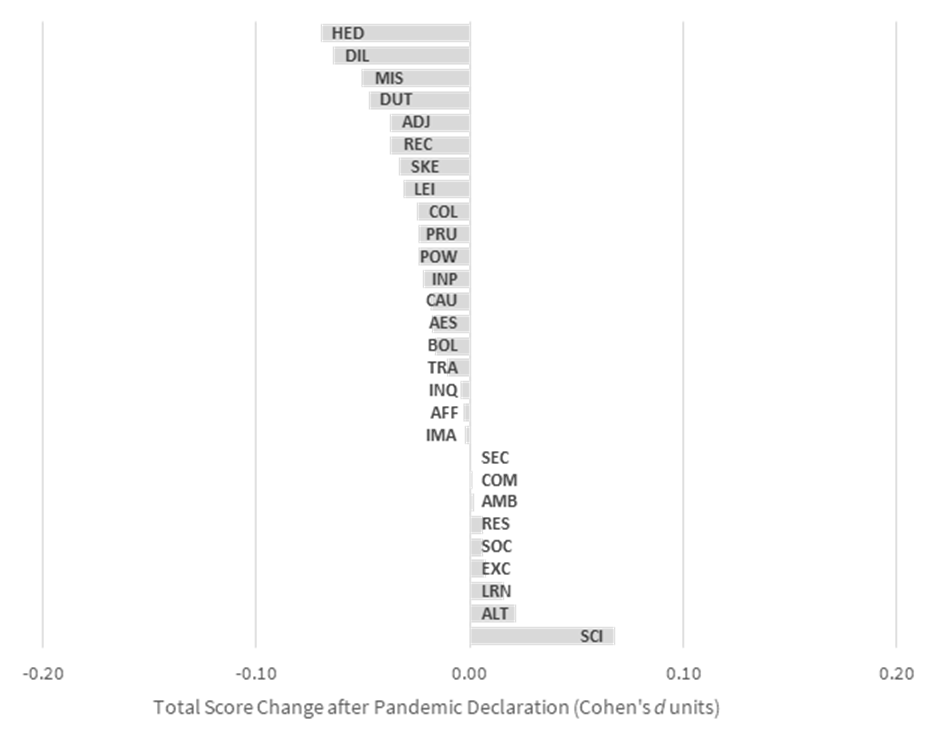
We combined the effect at the time of the pandemic declaration with the weekly effect, accumulated over 52 weeks, to estimate the total change since the pandemic began. We present those results in Figure 1. The changes are universally minimal. Cohen’s d values for the scales range from -.07 (MVPI Hedonism) to 0.07 (MVPI Science). For reference, Cohen recommends interpreting d values of 0.20 as small.

image001

When we look at the initial and ongoing effects separately, we see two reasons for these results. For most scales, the pandemic appears to have had no sizable effect whatsoever. For a smaller set of scales, any initial effect has been reversed by ongoing effects trending in the opposite direction. For example, Hedonism scores decreased slightly around the time of the pandemic declaration. However, weekly Hedonism scores have been increasing since then, so the overall pandemic effect has weakened over time.

These results suggest two things. First, the COVID-19 pandemic’s effect on personality and values scores has been largely nonexistent. Second, in even the few cases where the effects have been statistically significant but still minimal, weekly score trends are returning us to the pre-pandemic “normal.”

Want to learn more about personality tests? Check out The Ultimate Guide to Personality Tests

Topics: personality

Subscribe to our Blog

Most Popular Posts

Connect