Hogan Hosts Virtual Summit for Distributors

Posted by Hogan Assessments on Tue, Dec 15, 2020

Hogan Hosts Virtual Summit for Distributors

Hogan hosted 42 distributors for a virtual summit on December 3, 2020. Over three sessions, Hogan highlighted the unique projects and perspectives of nine of these distributors, and several distributors demonstrated how they used specific Hogan products to meet an organizational need.

Mobley Group Pacific (MGP; distributor in China, Hong Kong, Macau, and Taiwan) used Hogan’s Motives, Values, Preferences Inventory (MVPI), along with qualitative data, to help a client organization better describe its organizational culture. MGP’s research helped the client select leaders aligned with organizational culture, leading to reduced turnover.  

Optimal Consulting Group (distributor in China, Hong Kong, Japan, Malaysia, and Singapore) layers business intelligence gleaned from the Hogan Business Reasoning Inventory (HBRI) on top of personality data to help organizations identify how a candidate’s personality can affect job skills. Optimal shared several case studies featuring organizations that found their ideal mix of thinker types for effective job performance using the HBRI and personality assessment. The presentation demonstrated how the HBRI can be used as a gateway to show clients the importance of using multiple data points for maximal predictive power.

A&D Resources (distributor in Benelux and the Nordics) uses the Hogan High Potential report and model to help client organizations identify high-potential talent opportunities throughout the employee lifecycle. A&D acts as an advisor to clients, providing solid advice for understanding the difference between emergent and effective leaders and for developing employees without the interference of politics.

HR Tools (distributor in Mexico) recently collaborated with a mining company, the world leader in silver production. The company was challenged with a highly traditional culture, so HR Tools created a profile with several critical competencies related to high-potential leadership. They found evidence that the recommended high-potential profile predicts performance and potential for the client. These results provide support for using the Hogan High Potential report to identify and select high-potential future leaders at the company.

Authentic Talent Consulting (distributor in France) highlighted the benefits of a tight-knit distributor network when it comes to competing for international projects. Authentic Talent shared a success story in which they won and successfully delivered an international assessment project by collaborating with distributors in Germany, Italy, and Spain to provide individual coaching sessions and administrative support in the local languages.

Another way that Hogan’s distributors are building and maintaining their networks is by supporting certified users. Threefish Consulting (distributor in India) is building a Hogan ecosystem within the India market. Starting with certification workshop participants, Threefish focuses on engaging users from the time they graduate by holding informational support sessions, providing opportunities to practice Hogan skills, and providing special one-on-one support sessions for users needing additional help. Threefish also holds weekly Hogan events, master classes, and other virtual sessions to build a strong and knowledgeable Hogan community in India.  

Peter Berry Consultancy (PBC; distributor in Australia) has been working since 2003 to develop a growth strategy by using diagnostics to identify lucrative clients and opportunities. PBC emphasizes building momentum starting with certification workshops and empowering users to order and use the assessments.

Although Baltas Grubu (distributor in Turkey) did not use the Hogan certification workshop to engage a prominent Turkish conglomerate, Baltas pursued the company for six years before getting the opportunity to work with the organization on its selection process. For the past nine years, this conglomerate has been Baltas Grubu’s biggest client and advocate. Baltas shared the experience of working continuously to strengthen the relationship and detailed the additional support that won over leaders who questioned the need for personality assessment. The presentation even included a quick video from the client’s HR director, praising Baltas and the Hogan tools.

JvR Psychometrics (distributor in South Africa) is a diverse assessment tool provider, supporting clients with different levels of scientific research solutions. Everything from test validation to data analytics to qualitative research options could prove to be valuable sales opportunities for other distributors as well. JvR recommends pitching research as an option for clients and partnering with other firms to add value to long-standing client relationships.

Hogan appreciates everyone’s participation and willingness to share their expertise. We look forward to what 2021 will bring for our distributor network!
Topics: distributors

SAP Wins ICF Germany’s Prism Award 2020, Sponsored by RELEVANT Managementberatung

Posted by Hogan Assessments on Mon, Dec 07, 2020

CF Germany’s Prism Award

The third annual International Coach Federation German Prism Award was granted to SAP, the largest European software company, during a virtual celebration of Coaching Day on November 12, 2020. Sponsored by RELEVANT Managementberatung (an authorized distributor of Hogan Assessments), the award honors special coaching offerings in organizations and recognizes the work of human resources professionals, as well as companies that embody a strong coaching culture.

The groundwork for the SAP Global Coaching Program was laid several years ago. The Prism Award 2020 is now the reward for many years of work by SAP’s dedicated team in human resources and organizational development. The SAP Coaching Team, which has already been awarded with an honorable mention for the ICF’s global Prism Award, is now delighted to receive the Prism Award from ICF Germany as recognition.

The dynamic HR team has been demonstrating openness to innovation and growth within the company itself for years. With self-reflection and sustainability, the SAP Coach Community is committed to “employee empowerment” and thus offers room for the development of a coaching culture within the company. SAP has high standards with regard to the development and further expansion of its offerings and is strongly committed to the training and certification of coaches.

In his laudation, René Kusch, PhD, founder of RELEVANT Managementberatung, expressed appreciation for SAP’s Global Coaching Program: “SAP is not only a pioneer in the development of software, but also in the development of employees, which started as a grassroots movement. You see coaching as an investment that can help to provide people with an interface for important questions. I am deeply convinced that support in crises and coaching of employees is increasingly becoming a competitive advantage.”

Dr. Kusch emphasized these special features of SAP’s Global Coaching Program:

  • Coaches have a very high degree of self-guidance in their training and education with weekly training sessions, information events, peer consulting, supervision, and mentor coaching in some cases.
  • Coaches have access to a global coaching community, along with an ambassador network for local support.
  • The program includes a combination of trained internal line managers and external coaches.
  • Employees with and without management responsibility can call on coaching.
  • Coaches have an open-ended mandate to discuss private issues.
  • Coaching is free of charge for employees.
  • Quality control of external and internal coaches is conducted.
  • A range of criteria is used for continuous development.

All who attended the virtual awards ceremony will have fond memories of the lively presentation by the SAP executives. In the very lively Q&A session that followed the presentation, the lighthouse function of the SAP Global Coaching Program became clear once again.

Topics: distributors

CEOs in Crisis: The Influence of Leaders’ Values and Motivators (Part 3)

Posted by Hogan Assessments on Tue, Nov 24, 2020

The Influence of Leaders’ Values and Motivators

The values that drive our decisions are the most intimate part of personality. When we speak of values, we do not refer to universal moral principles, such as integrity, respect, or solidarity, but more specific qualities that are shaped by culture, upbringing, and more.

As pillars in our decision-making, our core values and beliefs determine the type of environment we strive to cultivate at work, the people with whom we prefer to associate, and the kinds of attitudes and behaviors we find distressing or dislikable. Hogan’s Motives, Values, Preferences Inventory (MVPI) measures several highly influential values on 10 scales: Recognition, Power, Hedonism, Altruistic, Affiliation, Tradition, Security, Commerce, Aesthetics, and Science.

The Leader in Times of Crisis Program

As part of the Leader in Times of Crisis program, Hogan’s strategic partner Thuoper collaborated with the Bogotá Chamber of Commerce to study the personality traits of more than 200 CEOs in Colombia. The program’s main objective was to help leaders achieve a higher level of strategic self-awareness, understand how to manage the crisis, and emerge stronger than before.

As part of the program, the CEOs completed Hogan’s personality tests — the Hogan Personality Inventory, the Hogan Development Survey, and the Motives, Values, Preferences Inventory — and attended a webinar during which Liliana López, CEO of Thuoper and expert in organizational leadership, explained the methodology and key personality characteristics for handling crisis effectively.

Subsequently, Thuoper’s research and development team analyzed the CEOs’ personality test results and found important patterns between their results and their companies’ economic sectors. This article, the third in a three-part series, will focus on how the CEOs scored on the MVPI.

Financial

In the financial sector, we found Power and Altruistic to be the CEOs’ main values ​​or motivators. The Power scale refers to the desire for success, achievement, and control. This is an unsurprising finding in a sector where status is valued. On the contrary, it was surprising to find Altruistic to be one of the top scales in this sector. The Altruistic scale refers to the desire to help others and contribute to the betterment of society. This finding refutes the general perception that the financial sector is one of the most greedy and least altruistic; its CEOs demonstrate interest in the well-being of others.

Industrial

What we found in the industrial sector was expected. Altruistic, Security, and Commerce were the main MVPI scales on which CEOs scored high. Many companies in this sector demonstrate a growing interest in care for the environment and dialogue with impacted communities, suggesting altruism in the sector’s leaders. Security is the scale that refers to the need for stability, safety, and the minimization of risks, which is totally relevant for this sector, since it poses greater risk to the physical well-being of its employees. Commerce is about interest in making money, making investments, and finding business opportunities. The industrial sector is one of the largest sectors and is among those hit hardest by the COVID-19 crisis, so the ability of its leaders to focus on financial results and generate new business to survive is vital.

Health

CEOs in the health sector, one of the most relevant at this time, scored high on Recognition, Power, and Altruistic. The importance of Recognition, which has to do with the desire for public attention, approval, and congratulations, is not surprising. In a sector where competition is high, the circumstances of the pandemic only increase the need for organizations to maintain good reputations. Like the financial sector, the health sector is characterized by high social standards, so that the CEOs tended to score high on the Power scale was not a surprise either. However, balance is maintained with the CEOs’ high scores on Altruistic, since the ultimate goal of a company in this sector is the collective good.

Services

In the services sector, CEOs tend to value Security and Commerce. This sector traditionally has been very conservative in its proposals to the market, hence the value for security. But obviously, this is also one of the sectors hit hardest economically by the pandemic, so the CEOs’ high scores on Commerce, in combination with Security, suggest a desire to stay in a known area but with the mentality of searching for monetization opportunities.

Technology

As for the technology sector, Altruistic and Security were the scales with the most high scores. This goes hand in hand with the widespread perception that companies in this sector are creating technology beneficial to society and vulnerable populations. The CEOs’ scores on Security are not a surprise, either — the leaders of this sector must be constantly alert to possible cyberattacks, which happen more often than we think.

Textiles, Transportation, and Tourism

The textiles sector did not offer any new impressions regarding CEOs’ highest values, ​​in general. Altruistic, Security, and Commerce represent the most recurring values ​​among the leaders whose results we analyzed. The same happened with the transportation and tourism sectors, although the latter showed an important and interesting difference: the leaders of this sector had Aesthetics among their highest values. The Aesthetics scale refers to the need for self-expression and concern for the quality and appearance of work products. Bringing this definition to the reality of this industry, we can conclude that one of the things that most interests the leaders of the tourism sector is keeping their hotels or tourist sites attractive, even during the pandemic.

*This post was authored by Sara Ruiz, Research and Development Talent Management Model Lead at THUOPER, Hogan’s authorized distributor in Colombia. 

Topics: leadership development

ICF Germany, RELEVANT Managementberatung to Present 3rd German Prism Award

Posted by Hogan Assessments on Fri, Nov 06, 2020

ICF Germany

Hogan’s distributor, RELEVANT Managementberatung, is partnering with the Germany chapter of the International Coach Federation to present the third annual German Prism Award.

The German Prism Award is awarded to companies making a difference in the coaching community through professionalism, quality, and data. The selection process and criteria were modeled after ICF’s International Prism Award, which is granted annually to companies that stand out by establishing a coaching culture with extraordinary results in difficult change processes. Those nominated are coaching programs that have innovative concepts or have made a significant contribution to achieving corporate goals. The nominees are tasked with providing insight into how their coaching programs contribute to the achievement of important corporate goals and advance the coaching profession.

“We are honored to be able to sponsor this prestigious award for the third consecutive year,” said RELEVANT owner, René Kusch, PhD. “Last year’s event was a huge success, and we look forward to replicating that again in the virtual world this year.”

The winner of the ICF German Prism Award for excellent coaching is certain: It is SAP, Europe’s largest software company.

The independent jury of experts — consisting of scientists, previous Prism Award winners, human resources managers and experienced coaches — spoke out in favor of the coaching program from SAP because its young and dynamic team has been open to innovation and growth for years. The SAP coach community is committed to employee empowerment through self-reflection and sustainability, thus providing space for the development of a coaching culture within the company.

As always, the award will be presented at Coaching Day during a festive gala, which will be held online this year on November 12, 2020.

Topics: distributors

Driving Future LATAM Organizations Forward: Personality Characteristics of High-Performing Leaders

Posted by Simon Castillo on Wed, Nov 04, 2020

Personality Characteristics of High-Performing Leaders

For the first time, Hogan has developed a science-based personality profile for leadership in the workplace specifically for the Latin America (LATAM) region. This profile is the best option for hiring and developing leaders in the region because it identifies the strengths, shortcomings, preferences, motives, and other personality characteristics of high-performing leaders.

Hogan partnered with local consulting firms in the LATAM region — namely Ateliê RH, Alto Impacto, Compass Consulting, HR Tools, and Thuoper — to improve selection accuracy and development for LATAM leaders. LATAM leaders are responsible for establishing broad policies, strategic planning, forecasting, and directing the work of their organizations.

Personality Characteristics of High-Performing Leaders

Hogan’s data science team worked with regional experts to develop a scientifically valid screening tool to improve the quality of leaders in LATAM. Hogan identified specific competencies, characteristics, and values that predict job success. Hogan built a custom personality profile using the Hogan Personality Inventory (HPI), Hogan Development Survey (HDS), and Motives, Values, Preferences Inventory (MVPI) that will enable companies to select higher-performing leader candidates.

Hogan found that leaders in the LATAM region emphasize the importance of teamwork by continually engaging in opportunities to learn, being supportive, and being willing to pitch in when needed. In addition, LATAM leaders need to balance a respect for the company history, but also innovation.

On one hand, this is important because there is a strong relationship between personality and performance in the workplace. The more we understand the characteristics and traits of leaders, the more we can predict their impact in organizations, including financial results. On the other hand, better leaders improve engagement among employees, and engaged employees are happier and produce better results as well. Hogan estimates that companies can improve the accuracy of their hiring by 28%, reducing bad hires by 14% and increasing successful hires by 14%, just by using this profile.

The LATAM leader profile can be implemented in any stage of the leadership life cycle within an organization, including recruitment, development, succession planning, and career reorientation. Hogan can provide a variety of personality- and competency-based reporting options to meet these needs.

To learn more about the Hogan LATAM Leader profile, contact your local Hogan distributor, or email info@hoganassessments.com.  

Topics: personality

Ideal Presidential Personality: American Democrats, Republicans, and Independents Mostly Agree on Who Should Be President

Posted by Chase Winterberg on Mon, Nov 02, 2020

Presidential Personality

It’s almost Election Day 2020 in the United States, and political tensions are historically high. This year has been saturated with massive protests for social justice, violent riots, foreign interference in democratic processes, economic recession, reemergence of the white supremacy movement, widespread scandals involving political officials, presidential impeachment trials, political clashes over government response to the pandemic, record-breaking natural disasters, and general social chaos. It’s been a year for the history books, to say the least. In fact, public opinion is so divided that some are skeptical that presidential power will transfer peacefully at the close of the election. Like most Americans, we can’t help but wonder: Who should be president?

Yet, as personality and data scientists, we aren’t concerned with who should be president in terms of identity, political party, or rhetoric. As expert performance forecasters, we care more about known scientific predictors of success: personality characteristics. A couple of years ago, we reported research suggesting the American public agreed on the personality characteristics an ideal U.S. politician should have, regardless of political affiliation.

Presidential Personality

But then came 2020. Surely, in this even more divisive climate just before Election Day, the American public would vigorously disagree on what personality characteristics an effective U.S. president embodies. Right?

Wrong! Not even the destructive reign of 2020 can thwart the unifying power of personality. Over the past couple of weeks, we collected data to check in with U.S. citizens. This time, given the proximity to the presidential election, we asked participants to rate the desirability of personality characteristics, derailers, and values for an ideal presidential personality, specifically. We even used our new and improved Hogan Job Evaluation Tool (JET) 2.0, which is calibrated to pick up on finer distinctions.

We again found no meaningful differences among democrats, republicans, and independents in preferred characteristics of the ideal U.S. president.

The Bright Side of Presidential Personality

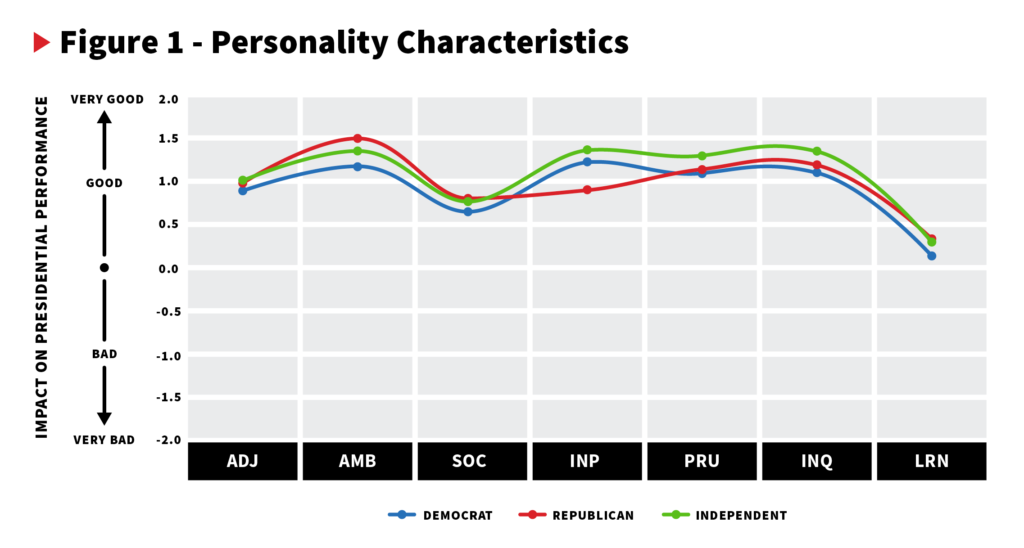
Differences in political party ratings were not statistically significant on any of the Hogan Personality Inventory (HPI) scales, which measure bright-side personality characteristics (figure 1). In other words, our statistical wizardry found no evidence that participants rated bright-side personality characteristics differently across political parties. However, although not statistically significant, ratings differ slightly for the Interpersonal Sensitivity scale, suggesting that republicans prefer their ideal president to have a more direct communication style.

As shown in Figure 1, all three political parties felt that an ideal U.S. president should exhibit a calm demeanor (Adjustment), drive (Ambition), kindness (Interpersonal Sensitivity), rule compliance (Prudence), and openness to diverse perspectives (Inquisitive).

PresidentialPersonality_HPI

The Dark Side of Presidential Personality

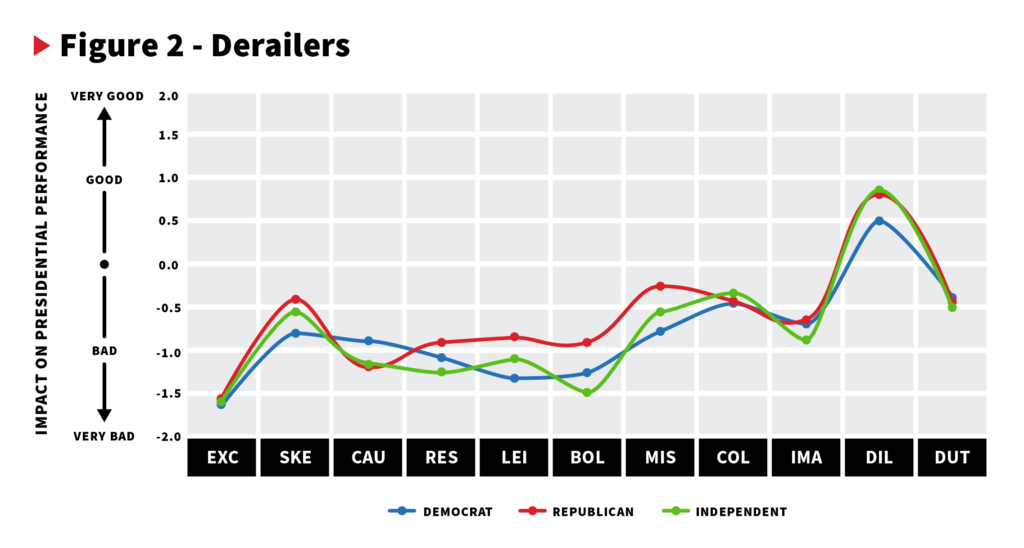
Figure 2 shows little difference in participant ratings of derailers that could impede presidential performance, which are measured by the Hogan Development Survey (HDS). All three political parties rated emotional outburst (Excitable), resistance to change (Cautious), social insensitivity (Reserved), and arrogance (Bold) as bad for presidential performance.

PresidentialPersonality_HDS

Although there was a slight statistical difference between democrats and republicans regarding the perceived impact of passive aggression (Leisurely), this gap has little practical effect. Democrats rated qualities associated with the Leisurely scale as bad for presidential performance, and republican ratings fell just below this threshold. In other words, although democrats might want a president who has a diplomatic communication style (HPI Interpersonal Sensitivity), they also find it disruptive to have a president who might agree outwardly but then take action counter to that agreement (HDS Leisurely). Participants identifying as independent did not rate Leisurely characteristics in a significantly different way from democrats or republicans. And no party rated Leisurely tendencies as good. There were no other statistical differences across these derailers.

The Inside of Presidential Personality

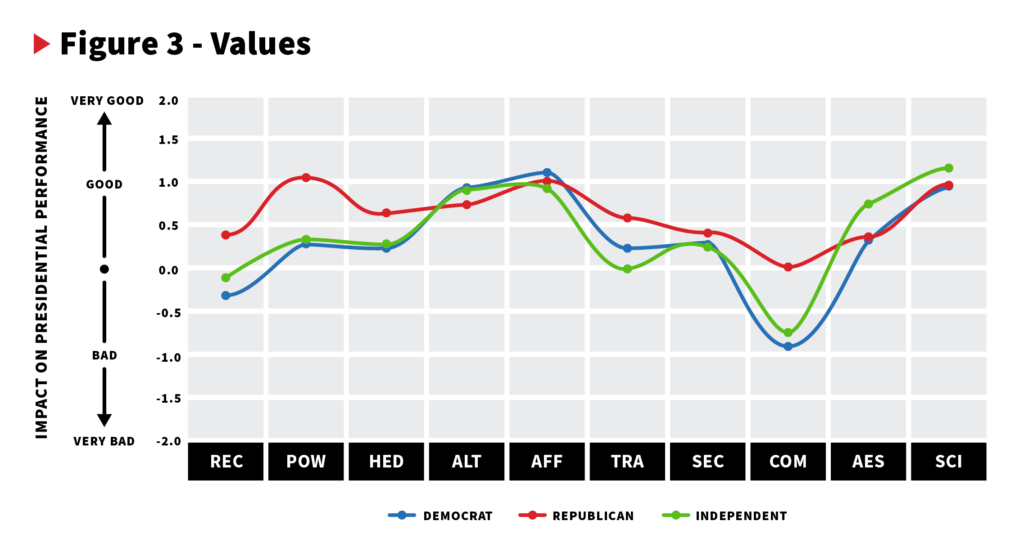
Research has shown that personal values predict presidential support. Nonetheless, we found no practical differences among the values democrats, republicans, and independents believe the U.S. president should hold, based on participants’ ratings of the Hogan Motives, Values, Preferences Inventory (MVPI) scales (figure 3). Specifically, participants rated values for collaboration (Affiliation) and data-based problem-solving (Science) highest.

PresidentialPersonality_MVPI

Commerce is the only value where we found statistical differences between republicans and democrats. These findings suggest that while republicans think monetary concerns (Commerce) are not an important driver for performance, democrats think being financially driven could be detrimental to performance. However, no group’s ratings fully crossed the threshold of good or bad. Thus, on average, Commerce was not significantly relevant to presidential performance.

Conclusion

This emphasizes the impact of in-group and out-group tribal psychology. When we strip away the political party (i.e., group membership) of the candidate and focus on more objective indicators of job performance, such as personality characteristics, we see people’s opinions come together and indicate they tend to agree overall.

Topics: personality

Personality and Mindfulness – More Natural for Some than Others and How it Matters

Posted by Hogan Assessments on Tue, Oct 27, 2020

Personality and Mindfulness

Mindfulness has been around the world for centuries. For roughly 40 years and popularized by Jon Kabat-Zinn in the west, it’s been taught as a set of practices to increase insight, manage pain, and reduce stress. Also known as present-moment awareness, mindfulness has become a bright, shiny object in business literature and, to a growing extent, in research. Everyone is, to some extent, mindful. Hogan practitioner Chris Altizer, Hogan’s Brandon Ferrell, and PhD candidate Alessa Natale explored the question: Is trait mindfulness related to personality? Here’s the answer from their study recently published in Consulting Psychology Journal and covered by Forbes Magazine.

What We Did

This project began in 2016 with Altizer interviewing 17 Hogan coaches on the topics of mindfulness and personality, generating several hypotheses. In 2017 and 2019, we asked two sets of working adults to take the HPI, HDS, and MVPI and two commonly used mindfulness assessments, the Mindfulness Awareness Attention Scale (MAAS) and the Five Facet Mindfulness Questionnaire (FFMQ).

What We Found

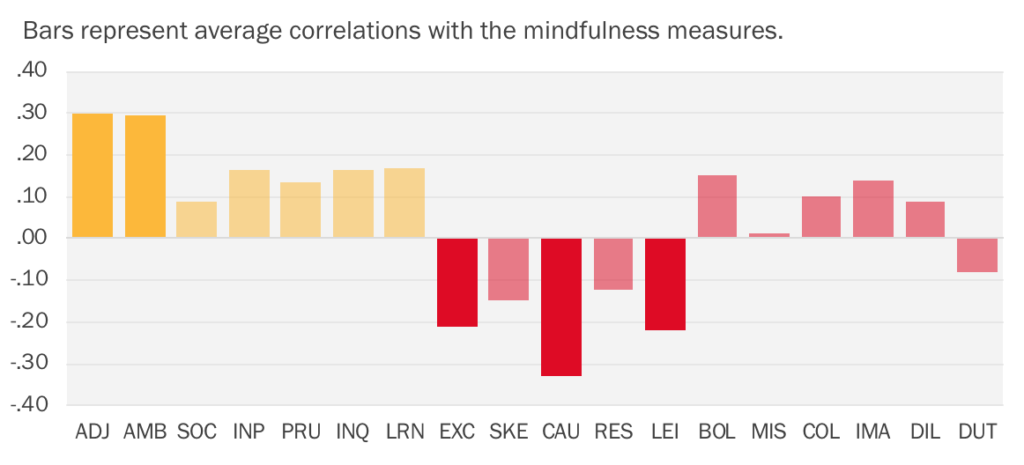
We found eight scales significantly related to one or more of the mindfulness scales across the two samples. HDS Cautious had the strongest correlations across the mindfulness scales, followed by HPI Adjustment, HPI Ambition, HDS Leisurely, and HDS Excitable. We found other interesting relationships between Hogan scales and different facets of the FFMQ. We present a summary of the results below.

Personality and Mindfulness

What It Means

We discuss potential ways to integrate mindfulness practices into the coaching of different personality profiles in the article. These profiles reflect themes of higher emotional reactivity, distractible attention, and a lack of awareness, including awareness of self, of others, and of self-on-others. For example

  • Low Adjustment or high Excitable – and especially in combination – may benefit from practices designed to create a pause between perception and reaction.
  • High Cautious, especially in combination with low Adjustment, may benefit from practices designed to increase insight and reduce anxiety.
  • Practices designed to increase awareness may benefit moderate- or high-risk Moving Against cluster profiles, particularly for the highly Adjusted, whose confidence may increase their risk of dominating others with less concern.

We also suggest that different personality profiles are likely to be open to different mindfulness practices. Some may be inclined toward various forms of meditation, and others to forms of dialogue or breathing practices. Of course, some will likely reject mindfulness at face value but may be open to practices like journaling, deliberate movement, or intentional eating. A key to understanding the application of mindfulness practices is that they are developable competencies – there’s no magic, therapy, or religious conversion, as Altizer wrote inMindfulness: performance, wellness, or fad? published in Strategic HR Review (2017).

Summary

There is no “silver bullet” practice that suits all profiles or people, which will likely come as no surprise to Hogan coaches regardless of their knowledge of mindfulness. As to integrating mindfulness as part of a development strategy, just as we bring in experts to build certain skills, coaching a client toward mindfulness practices may be best done by recommending a formal course, such as Kabat-Zinn’s Mindfulness-Based Stress Reduction, or, for the more adept, guided self-study on one of the many available device-apps. There are as many paths to mindfulness as there are different personality profiles. Coaches and consultants are encouraged to explore mindfulness practices as an option for developing leaders and choose based on what they learn on the journey. The journey is the destination – as challenging as that can be for some personalities, some more than others.

Topics: personality

Accelerating Team Effectiveness in the COVID-19 World: Strategies to Improve Team Function (Part 2)

Posted by Hogan Assessments on Tue, Oct 20, 2020

Strategies to Improve Team Function

In August, Hogan published the first of a two-part blog series about accelerating team performance. If you recall, we shared the importance of adapting by creating new strategies or running the risk of having an ineffective, unproductive, and misaligned team as a result of our changing environment. In this blog, I will discuss common challenges that teams are facing today. In support of these challenges, Hogan has developed a framework to enable teams to navigate complex dynamics quickly and focus confidently on what will accelerate their performance. The Team Acceleration framework guides teams through a process of self-reflection, discovery, and shared accountability, so they can move through the challenges posed by our changing environment and achieve higher levels of performance.

Some common challenges teams are facing include the following:

  1. Dispersal – Teams that were once co-located are now dispersed and working virtually.
  2. New team composition – Teams have lost members or added new members due to layoffs and reorganization.
  3. New priorities – Teams have been asked to put annual business plans aside and focus efforts on new priorities.

Strategies to Improve Team Function

At Hogan, we believe that Team Acceleration can accelerate your team’s long-term performance. If your team has experienced one (or more) of the common challenges facing team functioning, you may want to consider trying these strategies to improve team function.

Acknowledge the Impact

Reaffirm trust by having open and honest dialogue about the impact of the change.

Dispersed – Discuss the advantages and challenges of working virtually, personally and professionally. What have you enjoyed? What have you found to be difficult? What has been the impact on your team? What does the team need in order to continue operating effectively?  

New team ­- Discuss how work has been reallocated and how the team can ensure a smooth transition of responsibilities across team members. Share ideas on how to effectively onboard new team members. 

New priorities – Re-evaluate the work the team has been doing versus the work the team should be doing. Rethink and redefine the team’s value proposition: “Our team is here to accomplish [fill in the blank]. Our team is here to serve [fill in the blank].”

Revisit Team Values and the Culture Values Create

Identify team values and potential gaps in organizational culture, now and for the future.

Dispersed – Re-evaluate the needs of the team and strategies for how the team’s values will be fulfilled in the new working environment. For example, a high Affiliation team (one that values collaboration), might want to explore different approaches or technologies to support team-based tasks.

New team – Discuss how the culture of the team may have changed with the addition of new team members. What the team values now might not be the same as before. 

New priorities – Discuss alignment between new priorities and team values to ensure that the team is continuing to do work that is valuable for both the members and the organization.

Adjust Team Norms

Connect the impact of the change the team is facing with the team values and culture to inform effective team behavior and norms.

Dispersed – Focus on interpersonal norms, such as belonging, collaboration, and communication, to build and maintain strong relationships among the members of the team. Discuss how the team operates today versus how the team would operate in its ideal state.

New team – Spend time getting to know the new members of the team. Encourage an environment of belonging where team members understand how they fit into the team.

New priorities – Discuss the skills and abilities of the new members and determine how to leverage them according to the new priorities. Ask the team, “How can we work together in the right way to drive a higher level of team performance?”

Practice Adaptability

Respond to the changing needs of the business by rethinking your team’s goals and exploring behaviors that may interfere with the team’s ability to lead through change and proactively prepare for new challenges.

Dispersed – Identify opportunities to expand collaboration across transitional boundaries of expertise.

New team -Build in a regular cadence for the members of the team to discuss what they are working on and how their work fits in with the team’s goals and the organization’s business objectives.

New priorities – Encourage an open dialogue with your team and ask, “What do we need to start doing, continue doing, or stop doing?”

Regardless of the challenge your team is facing, spending time realigning the team’s values and norms, recommitting to desired behaviors, and remaining agile and adaptable can make all the difference in your team’s ability to remain effective and competitive in our constantly changing environment.

Now is the time to accelerate your team’s effectiveness and continue to raise its level of performance, even in the face of change. Using the strategies discussed in this blog and Hogan’s Team Acceleration framework, create new habits for yourself and your team so your team will be well positioned to achieve its goals, operate at its optimal level, and win in the marketplace.

*This post was co-authored by Hogan’s Erin Laxson, Holly Paine Magnuson, and Jessie McClure.

Topics: teams

Working with Derailers: Coaching Insights at the Top of the Stress-performance Curve

Posted by Hogan Assessments on Wed, Oct 14, 2020

Working with Derailers: Coaching Insights at the Top of the Stress-performance Curve

Derailers are important because they are the habitual behavioral patterns that can get in our way. Typically operating below the level of conscious awareness, these behaviors are often easy to ignore. But when overused, they hinder performance. Coaching people to learn to work with derailers and manage stress can be a gateway into new understanding and help them increase their effectiveness.

The Stress-performance Curve

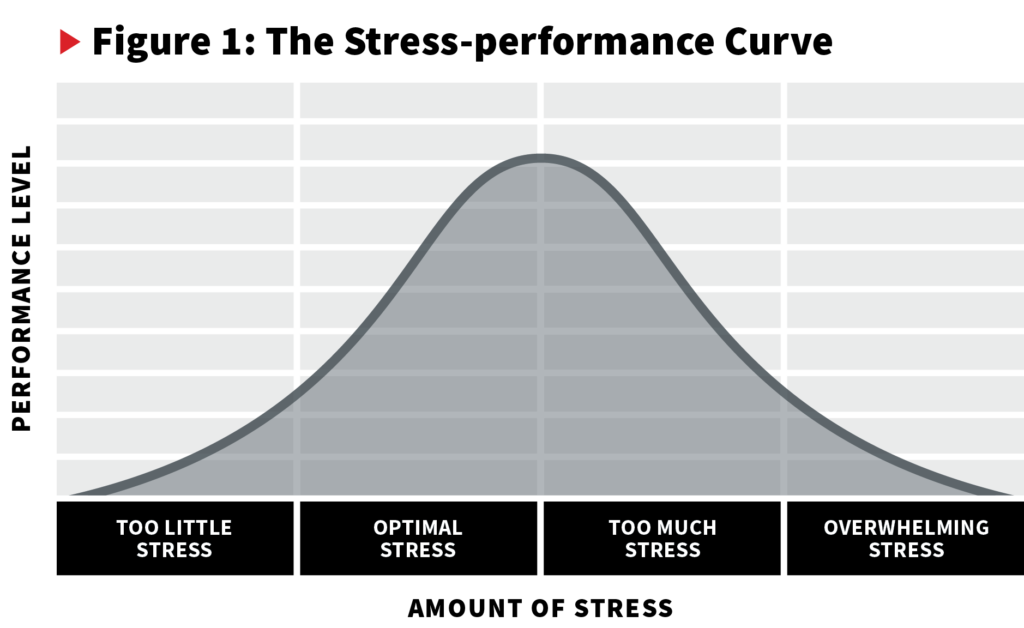
The relationship between stress and performance level can be summarized by the bell-shaped stress-performance curve, also referred to as Yerkes-Dodson law (figure 1).

Stress-performance Curve

At very low levels of stress, a person may feel lethargic and not very motivated. This is a zone of too little stress. As a person climbs the stress-performance curve, the amount of stress increases, and the level of productivity also climbs. This is a zone where the level of stress may be motivating and energizing. A positive relationship exists between the level of challenge and the positive reward cycle of getting things done, accomplishing things, concentration, and feedback. One may experience in this zone even a state of optimal experience or what Mihaly Csikszentmihalyi calls flow.1

However, as the amount of stress continues to rise, performance level ultimately peaks and then begins to decrease. When a person enters a zone of too much stress, his or her performance can be characterized by reduced capacity and narrowed judgment and behavioral resources. A person in this zone tends to rely on habitual patterns and go-to behaviors with limited attunement to circumstances and to others. As stress continues to increase, a person will increasingly enter a state of overwhelm and the range of resources contract to fight, flight, or freeze responses in order to address and minimize perceived danger.

The Hogan Development Survey (HDS)

Helping people understand where they are on the stress-performance curve is a starting point for helping them manage their derailing behavioral tendencies and their reputations under conditions of stress.

The Hogan Development Survey (HDS) captures common patterns of behavior and coping mechanisms that emerge under stress and pressure. Each behavioral pattern, or HDS dimension, has an adaptive and functional feature. Each also has a maladaptive quality, which is typically an exaggerated response or an automatic, inflexible response to situations. The top of the stress-performance curve is a place where these behaviors become more prominent and tend to dominate responses. As an important note, HDS behaviors can also be present when someone is relaxed (i.e., not self-managing), and some people might even have HDS traits present most of the time. The focus for this article, however, is on behavioral responses triggered by stress.

What happens for a person at the top of the stress-performance curve has a significant impact on that person’s ability to lead and collaborate. This is because each HDS tendency has a way of hindering the ability to “get along” with others and maintain effective interpersonal relationships. This is a zone that is important for awareness, and it can be a gateway into greater versatility and effectiveness.

Behavioral Modification

Many people talk about behavioral modification, yet behavior does not change because someone wants it to. In other words, it isn’t a matter of will. Behavioral modification comes from shifting patterns and responses to habitual stimuli. This involves a change in perceptions and a change in the internal responses that drive behavior. It is only the latter can be observed by others.

Working with the Hogan Development Survey (HDS) in combination with coaching techniques of self-observations and practices can be powerful methods for growing self-awareness. This makes it possible to shift into more effective responses and behaviors under pressure.

The Role of Coaching

I am trained in Integral Coaching, an approach that uses self-observation and practices for developing ways of responding to situations and developing more versatile ways of being in the world.

To describe these two techniques,

  • self-observations involve a semistructured process for taking time to observe oneself and reflecting on what behaviors arise in particular situations, and
  • practices are repetitive and intentional actions aimed at building a new ability.

Self-observations are effective in discovering unconscious behavioral patterns and habitual responses. Practices allow a person to introduce and build familiarity with a new behavior.

HDS behaviors can be challenging to work with, in large part because most stress responses lie below the level of conscious awareness. The power of self-observation and practices is that, once we can see how we are disposed to respond, we have the opportunity to introduce alternatives.

Working with Stress and Derailer Tendencies in Coaching

In working with a client, I may introduce the stress-performance curve and ask the person to mark an X on the part of the curve that matches his or her stress level. I may have the person take this diagram into the workday and stop multiple times a day (e.g., three times a day) for a fixed period of time (e.g., two weeks) to mark the stress-performance curve. The exercise gets a person to stop and notice their regulation state. It also creates familiarity with the concept of the curve. Through this activity, people are usually able to start to see where their energy and stress levels are during the day and bring this into discussion. This can help determine which behaviors a client may want to focus on based on their actual experiences.

Once someone can notice their state, then they have the possibility to look more closely at stress-based patterns. Here is where I may introduce a self-observation. I may ask the person to observe themselves in a specific stress behavior-inducing situation. I ask them to take notes afterwards on three areas: the context (i.e., who was there and the kind of event), their perceptions (i.e., their thoughts, interpretation, and emotions), and the kinds of actions that the situations provoked them to want to take. These reflections are often insightful to the client and increases their awareness about internal perceptions, habitual responses, and contextual triggers.

This process of self-observation creates a space to possibly introduce a new behavioral practice. A coach can help design a customized practice for a person and gauge readiness.

Practices may include the following:

  • A productive alternative and a new behavior to use more frequently (“do more of”)
  • A repair behavior (to mitigate impacts of habitual patterns)
  • A stress management practice to re-regulate and move down the stress-performance curve (to recharge and minimize spending time in the too-much-stress zone)

As an example, a leader with a high Bold tendency, who is known for not listening to feedback during meetings, may benefit from a self-observation in instances when they are the only person in the room talking. Via a semistructured self-observation, they may look to see if they could self-observe in a real instance. Using the three questions, they can independently reflect on what this observation reveals. Observing first on their own and then discussing this in session may open up new awareness and catalyze greater choice in how to respond (versus react). One example practice which may be fruitful would be to experiment with asking one to three questions, listening, and corroborating prior to sharing a new idea. A component of the practice would be to observe the impact of this new behavior on themselves and others in the real-time behavior practice.

Developing awareness of patterns and stepping into practicing new behaviors is an individualized process. It is supported by curiosity, experimentation, and nonjudgment. New patterns require multiple forms of feedback to develop. The attention of a focused coach and a big dose of curiosity can allow a person to work with derailers and have significant payoffs.

Summary

Managing one’s derailers means growing a capacity to observe oneself, respond differently, and develop practices that are more productive. Growing this capability will increase a person’s effectiveness and their ability to work with others under pressure.

While behavioral change takes attention, self-reflection, and ongoing practice, it is something people can take with them into their lives outside of work, and derailer behaviors are a powerful area to target. The HDS in combination with coaching can help to build this capacity and improve performance.

Reference

  1. Csikszentmihalyi, M. (1990). Flow: The Psychology of Optimal Experience. Harper Perennial: New York.

*This post was authored by Rebecca Ghanadan, PhD, founder of Aspis Coaching Group member of the Hogan Coaching Network.

Topics: leadership development

What Makes Up the Personality of a Successful Entrepreneur?

Posted by Hogan Assessments on Tue, Sep 29, 2020

The-Garage-nw-lockups-2015-06-03-4

Businesses have long used the powerful information contained in personality assessments to facilitate leadership performance and outcomes. Understanding an individual’s personality—or their unique characteristic ways of being—can be helpful when seeking to identify those who may be well-suited to leadership roles (i.e., selection), as well as to improve the performance and outcomes of those already inhabiting leadership roles (i.e., development).

Of personality tests available for these purposes, the Hogan Leadership Forecast Series (LFS) is far-and-away the most scientifically sound measure, and thus the most likely to facilitate measurable outcomes and predictions.* Given this, it’s unsurprising that the LFS assessments are used by over 75% of Fortune 500 companies and have been extensively used for leadership selection and development at the highest levels of these businesses. However, what is surprising is that very little is known about how the LFS might generalize to other types of business contexts—such as entrepreneurship. We set out to address this innovative and important question: when given to successful entrepreneurial leaders, are we able to identify key aspects of personality that might characterize successful entrepreneurs more broadly?

In an ongoing research project focusing on this question, we have collected data from 26 successful entrepreneurs so far (data collection is ongoing and we are actively looking for more successful entrepreneurs interested in participating in the study!). Even from this early sample, we can identify some key characteristics of the “Successful Entrepreneur Personality” (SEP).

Personality of a Successful Entrepreneur

Findings

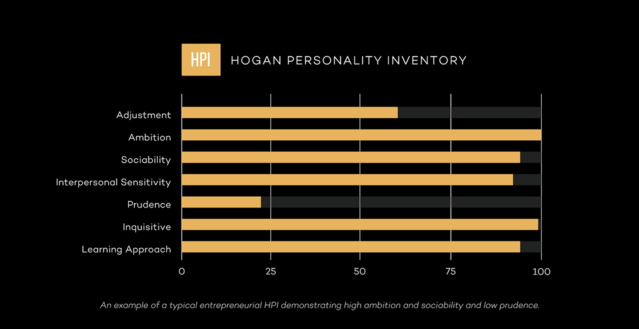
In terms of normal-range personality traits, or those characteristics that define how people usually are day-to-day, the SEP is someone who is likely very ambitious and sociable. Ambitious individuals tend to be high in aspects of self-confidence, identification as a leader, they tend to be competitive and highly energetic. Sociable individuals tend to be high in their individual needs for social interaction, and tend to enjoy social situations such as group meetings and parties. It makes sense that our SEP is high in both – these characteristics are likely very adaptive in the fast-paced, competitive startup world in which success is also very dependent on interpersonal interaction (e.g., speaking to and building the customer base, expanding one’s own professional network, pitching a project to investors).

Even more dramatic than the high scores for ambition and sociability, though, is what appears to be the quintessential SEP trait—by far, the overwhelming majority of our successful entrepreneurs were very low on the personality trait labeled “Prudence”. High prudence reflects the degree to which an individual is conscientious, dependable, structured, and rule-following. How do we then understand our low prudence SEP? The highly successful entrepreneurial leader is a risk taker, they think outside the box, they push the envelope, they pivot quickly, and when innovating, the sky is the limit.

Some of our other normal-range personality traits did not necessarily seem to characterize the SEP at the mean level – that is, it wasn’t necessarily the case that a certain level of the trait was found for the majority of the sample. However, we don’t just look at overall levels across the group, we are also interested in variability – that is, are there some traits that are so highly variable in our sample that they point to places where sometimes being high might work for one successful entrepreneur, whereas another one succeeds via a low level on the same trait.

takeaway_figure_fall_2020_brief

Two traits like this, in our data, were adjustment and interpersonal sensitivity.

Adjustment reflects the extent to which someone tends to stay cool, calm, and collected and does not react quickly to stress (versus low scores, who tend to respond more quickly to threats in the environment and manifest stress). In our sample of successful entrepreneurs, we found that both high and low levels of adjustment may result in a successful entrepreneurial leader. Low scores on adjustment may be quite adaptive in certain contexts – the ability to quickly spot a problem in a new product prototype or to get activated when presented with highly negative feedback from an early focus group – may allow the successful entrepreneur to more quickly pivot, to mobilize the necessary resources to correct errors and ultimately lead to a more successful launch.

The other trait that showed this kind of variability – with some of our successful entrepreneurs scoring very high and others scoring low – was interpersonal sensitivity. High scores on interpersonal sensitivity typically describe people who are empathic, warm, and trusting. Whereas high scores on interpersonal sensitivity can be helpful in certain situations – it may be easier for leaders high on this dimension to communicate care for subordinates, and to earn their trust and loyalty in return – low scores on interpersonal sensitivity can also facilitate effective leadership behavior. Leaders scoring low on interpersonal sensitivity, for example, may be more successful at challenging interpersonal tasks such as delivering critical feedback or even firing a subordinate, that are critical for a company’s ultimate success.

These early findings suggest that there may be some ways in which successful entrepreneurs are largely similar – high ambition and sociability, and low prudence – and other areas where being either high or low could lead to a successful outcome, perhaps depending on a combination of factors including the leader’s other personality traits, the personality of their cofounder and other team members, and the company’s industry.

Entrepreneurs

Beyond these normal-range personality traits – or how we usually are – the LFS is a powerful tool to highlight our potential “danger zones” as well – or how we respond under stress. Are some stress responses advantageous for SEPs? This is the topic we will explore in our next briefing.

About the Successful Entrepreneur Personality (SEP) Study

The SEP study is a collaboration between Jennifer L. Tackett, Ph.D., professor of psychology at Northwestern, and Melissa Kaufman, executive director of The Garage at Northwestern. Participants in our study have founded or co-founded a company and scaled it from a startup to multi-million dollars in revenue. Most have experienced either a significant exit or taken the company public. Data collection is ongoing and we are actively looking for more successful entrepreneurs interested in participating in the study! If you’d like to participate, please email thegarage@northwestern.edu.

To download a PDF of the report, please visit http://thegarage.nu/sep.

*This is a guest post authored by Jennifer L. Tackett, Ph.D., professor of psychology at Northwestern University, and Melissa Kaufman, executive director of The Garage at Northwestern UniversityThis article was originally published on Psychology Today.

* The authors of this study are not compensated by or affiliated with Hogan Assessments beyond a research relationship.

Topics: personality

Subscribe to our Blog

Most Popular Posts

Connect