Derail Leaders’ Derailment

Posted by Trish Kellett on Thu, Jul 09, 2020

Derailment

Despite the thousands of print and internet resources available on the subject of effective leadership, it remains elusive. The number of leaders who fail is consistently estimated to be greater than 50%. The impact that ineffective leaders have on their teams and entire organizations can be devastating from both a human and financial perspective. It’s no wonder that leadership effectiveness continues to be at the top of organizations’ agendas.

At the heart of ineffective leadership is the concept of leader derailment. “Derail” is defined as “to cause to become deflected from a purpose; to reduce or delay the chances for success.” The Hogan Development Survey (HDS), sometimes referred to as the Derailer Report, is a tool that assesses 11 derailers that get in the way of leaders’ success. These behaviors typically emerge when leaders are under stress or when they become complacent and stop monitoring their behavior. Leadership involves building and maintaining a high-performing team, and the 11 behaviors identified by the HDS can potentially undermine leaders’ performance and make them and their teams less effective. Derailing moments can also have a lasting negative effect on leaders’ reputations because they tend to be memorable.

Once leaders’ derailers are identified via the HDS, coaches spend quite a bit of time helping them mitigate and rein in these behaviors. But how about getting a step ahead of derailers and preventing them from appearing in the first place? Just think of the angst and negative impact that could be avoided if leaders were to prevent derailing moments from even occurring. This is a subtle but meaningful difference in the coaching approach.

Case No. 1

Susan was high Excitable and visibly showed her frustration during staff meetings by raising her voice and using a confrontational tone with her direct reports. She and her coach identified some coping tools for her to use in these Excitable moments, including taking a deep breath, counting to 10 before saying anything, and trying to be cognizant of her tone of voice. Unfortunately, even though she made a midcourse correction during one of her Excitable moments, some damage had already been done, and her behavior gave her a reputation for being hotheaded. How much better would work be for all concerned if Susan could prevent Excitable moments altogether?

She and her coach worked to determine what triggered her Excitable moments so she could get ahead of them. She discovered that one of her triggers was when her direct reports did not meet agreed-upon deadlines. She began to try to anticipate discussions about missed deadlines before staff meetings, and she and her coach practiced how she would handle these situations and control her derailing behaviors. Ultimately, her calmer handling of missed deadlines promoted more effective team performance and also prevented reinforcement of her reputation as a hothead.

Case No. 2

John was high Mischievous and had earned a reputation for making snap decisions. Some of his decisions involved ill-advised risks, had made his team uncomfortable, and had resulted in negative consequences for the company. John had received feedback on his behavior in his Mischievous moments, and he tried to modify it by being less cavalier — but that wasn’t enough.

John and his coach did a deeper dive into trying to understand his behavior, and they determined that his trigger was when he was very comfortable with the subject matter. If he had done something successfully in the past, he wanted to act immediately, and he didn’t explore possible consequences. To get ahead of this derailer, he and his coach agreed that he would slow down his decision-making to afford time for a realistic appraisal of the likely consequences and possible alternative courses of action. He created a T-chart of pros and cons, and he developed a list of standard questions to explore the possible implications of his actions. When John learned to avoid being derailed, his team appreciated his more deliberate approach, and the quality of his decisions started to dispel his former reputation.

The Lesson

In both Susan and John’s situations, “forewarned was forearmed” in that they knew their derailers, they knew their triggers, and they stopped their derailing behaviors before they emerged. By managing their behaviors upstream, they were able to change the trajectories of their interactions, thus making their teams more effective and certainly making themselves more effective leaders.

The keys for coaches to help leaders prevent derailment are:

  • identifying the leader’s derailers via the HDS assessment;
  • enhancing the leader’s awareness of the effects his or her behavior has on others;
  • enhancing the leader’s self-monitoring;
  • identifying triggers that cause derailers to emerge; and
  • developing coping strategies and tools to get ahead of derailers so derailing moments do not occur.

The old adage that “an ounce of prevention is worth a pound of cure” applies to getting ahead of derailers, and leaders and coaches will do well to implement this impactful approach.

Note: For more on avoiding derailment, please join our July 16 webinar to hear Trish Kellett, director of the Hogan Coaching Network (HCN), and Karin Fulton and Kevin Asbjörnson, both highly experienced HCN coaches, elaborate.

Topics: leadership development

Personality and the Problem of Police Brutality

Posted by Hogan Assessments on Tue, Jul 07, 2020

Problem of Police Brutality

The cases of George Floyd and Breonna Taylor represent just two recent and horrific examples of police brutality resulting in unnecessary loss of human life. The awfulness of these cases is amplified by fact that African Americans—both George Floyd and Breonna Taylor are black—are more than 2.5 times as likely to be killed by police than white Americans. Although statisticians, social scientists, and activists dispute the root cause of this difference (e.g., systemic racism, crime rates, culture, socioeconomics), one thing is for sure: when a police officer takes the life of another person the responsibility for doing so lies ultimately with that officer.

Personality refers to the ways in which people think, feel, and act differently from one another. Some people think doctors can be trusted, others do not. There are movies that some people love and other people hate. Some people make their bed every morning, others do not. Virtually every difference between people is related to personality. Police officers, like all people, differ in how they respond to situations they encounter. Where one police officer sees threats and responds violently, another does not.

The deadly encounters with the police over the past decade or have led to repeated calls for police reform. In 2018, for example, the NYPD began a program for implicit bias training. Similar programs had already been adopted across the US, though the effectiveness of these programs has been seriously questioned. Most recently, the city council of Minneapolis voted to defund the police department. Although some attempts at police reform are better than others, it is important to ask ourselves whether training, education, and policy reforms are even the right place to start in dealing with police brutality.

In a stand-up comedy routine that went viral, Chris Rock begins by stating what many of us already know. Police work is difficult, risky, and inherently dangerous. The people who dedicate their lives to serving and protecting their communities deserve the utmost respect. But, as Mr. Rock further points out, “in some jobs everybody has to be good.” You cannot have mistakes. You cannot have “just a few bad apples.” The best way to keep bad apples out of your barrel is to avoid picking bad apples in the first place. The best way to avoid police brutality is to avoid hiring people who are likely to resort to unjustifiable, violent, and life-ending tactics when they are under pressure.

Hogan has a long history of helping communities hire better police officers. Unlike clinical assessments used to diagnose personality disorders (e.g., the MMPI), our assessments are used to predict everyday work behavior, how effectively people do their jobs, and how people respond under stress. Moreover, our assessments promote diversity and inclusion by providing an unbiased view of a job candidate’s fit for a given job. That is, men and women get the same average scores and people of different ethnicities get the same average scores. In short, scientifically validated personality assessments provide an accurate and fair way to hire quality police officers, reduce police brutality, and rebuild the respect and admiration that police officers deserve.

*This post was authored by Hogan Chief Science Officer Ryne Sherman and Hogan Talent Analytics Consultant Chase Winterberg.

Topics: personality

Clones, Diversity, Innovation, and Personality

Posted by SGregory on Tue, Jun 30, 2020

Scott_IMG_9325_FB

People sometimes ask whether using personality assessment for selection will create an organization full of clones, decrease diversity, and narrow the range of innovative thought available to solve company problems. Their concern is that if they hire people with similar personality characteristics, they will create a culture of groupthink. Some assessment providers have fostered this view by (a) suggesting that personality assessment can enable you to clone your best workers’ personalities by hiring more like them, and (b) arguing that would be a good thing. Neither is true.

Because no two people have identical personalities, it is not possible to create a workforce of personality clones, regardless of the assessment used. We can’t clone personalities; even identical twins, who share 100% of their DNA don’t have identical personalities. The concern about personality assessment creating a workforce of clones is simply misguided.

When selection is done right, the core focus is on understanding and predicting future performance on job requirements, not on the personalities of existing workers. Any professionally developed selection process starts with conducting a job analysis, which is a systematic process for identifying the core requirements of the job. Although job analysis can help understand and specify the characteristics required for successful performance, its focus is on job requirements, not on duplicating the personalities of current employees.

Although research shows that personality predicts many different work and life outcomes, not all personality characteristics predict all outcomes. Effectively using personality assessment for hiring is based on identifying core job requirements and then identifying the subset of personality characteristics that predict performance on those requirements.

Personality consists of many facets, and the key is understanding which facets predict which performance outcomes. Hogan’s research archive contains thousands of data points that demonstrate the links between requirements of different jobs and the personality characteristics that predict success in each of them. Because different jobs require different personality characteristics, using personality assessment promotes personality diversity across the organization.

Let’s assume we have a job that requires positive customer relations, following systematic procedures, and resilience in the face of heavy workloads. Job analysis would help us scientifically identify and show evidence that those three requirements are more important than others.

Now let’s assume that we use a personality assessment to measure characteristics related to positive customer relations, following systematic procedures, and resilience and that we create an algorithm to combine measures of those characteristics into a final score to use for hiring decisions. We’re basing those decisions on personality characteristics we know will lead to better performance and, equally as important, we are ignoring lots of other personality characteristics that we could measure, but that we know aren’t important for success in this particular job. If we do that well, we would hire candidates who are interpersonally skilled, rule-following, and resilient but who also could be outgoing or quiet, visionary or tactical, leaderlike or comfortable following others, and/or decisive or cautious, to name a few possibilities. Although those candidates might resemble other successful people in the job on certain personality characteristics, they also would bring a diverse set of characteristics.

Using personality assessment for selection will not create clones. In fact, using personality assessment makes it more likely that you will have employees who are similar in ways that matter for job performance but who are diverse in many other characteristics and behaviors. In addition, because personality doesn’t systematically measure differences in race, gender, age, and other demographic characteristics, you can confidently use personality to hire the best employees while also hiring a diverse workforce that will bring differing personalities, perspectives, life experiences, demographics, and ideas to your company.

Topics: DE&I

Supreme Court Rules Gender Identity and Sexual Orientation Included in Sex as a Federally Protected Class

Posted by Chase Winterberg on Tue, Jun 30, 2020

claire-anderson-Vq__yk6faOI-unsplash

On June 15, 2020, the Supreme Court of the United States (SCOTUS) delivered a monumental decision for equal employment opportunity in our country, resolving a legal uncertainty haunting the LGBTQ community since the enactment of Title VII of the Civil Rights Act (1964). The result? SCOTUS made clear that Title VII prohibits employers from discriminating against individuals because of gender identity or sexual orientation. As the public engages in ongoing and collective pleas for equality and social justice across the nation, the time was ripe for this outcome.

Why Was This an Uncertainty?

Even before this decision, some state laws, federal circuits, and the Equal Employment Opportunity Commission already agreed with the result, but other states and federal circuits disagreed. This is apparent in the procedural posture of the case at hand. Specifically, in Bostock v. Clayton (2020), SCOTUS joined three separate cases from distinct circuits in the U.S. Court of Appeals: the 2nd, 6th, and 11th Circuits. At the appellate level, the 2nd and 6th Circuits held that the prohibition against sex discrimination also prohibited discrimination on sexual orientation and gender identity, respectively. On the other hand, the 11th Circuit held that Title VII did not prohibit discrimination based on sexual orientation.

This means that the courts would apply the law differently depending upon your region or jurisdiction. If, for example, you were a homosexual person in the 11th Circuit, which includes Alabama, Florida, and Georgia, you would not receive protection in the federal courts against employment discrimination due to your sexual orientation. And that was the case despite the EEOC’s stance. However, if you were in the 2nd Circuit, which includes Connecticut, New York, and Vermont, you would have such protection. Finally, in other circuits where this issue had not yet been decided, this protection was uncertain and not guaranteed. This piecemeal protection was clearly inadequate for our nation to achieve equality and unity. Hence, the Bostock (2020) decision resolved this dispute for the entire country in favor of protection for gender identity and sexual orientation.

Analysis of the Bostock (2020) Majority’s Reasoning

What’s most informative about this landmark opinion is, not the result, but how SCOTUS arrived at their decision. Adopting, for the sake of argument, the parties’ narrowest definition of “sex,” Justice Gorsuch reasoned that any difference in treatment based on gender identity or sexual orientation necessarily involves sex discrimination. Specifically, the Court examined the applicable definition of “sex,” interpreted “because of,” and unpacked the meaning of “discriminate,” all from Title VII’s statutory language.

Definition of ‘Sex’

In Bostock (2020), the Court explained that influential statutory terms must be interpreted in light of their plain meaning at the time of enactment, which was 1964. The employers contended that the term “sex” at that time, meant only the biological reproductive status of an individual. The employees countered that the term more broadly referred also to norms concerning gender identity and sexual orientation. For sake of argument, the Bostock (2020) Court adopted the employers’ definition. To the untrained eye, this seems as though the Court attempted to stack the cards against the employees. To the contrary, this approach helps ensure the outcome is more resistant to counterarguments. If a desirable result is still reached based on reasoning that concedes the opposition’s main assumptions, there are fewer factors the opposition can attempt to unravel.

Interpreting “Because of” Sex

SCOTUS further reasoned that the phrase “because of” incorporates a simple test of causation, known as but-for causation. The way this works is that, if you take consideration of sex out of the scenario, and the employment outcome changes, then sex was a but-for cause. In other words, but for the individual’s sex, discrimination would not have occurred. As the Bostock (2020) Court explained, the implication is that sex need not be the only, or even the primary, motivating factor in the employment decision at issue. If sex was a factor at all, the outcome was “because of” sex in accordance with Title VII. In addition, this reasoning takes away any defense grounded in the fact that some other permissible reason was also at play in causing the decision.

Applying this approach to gender identity and sexual orientation, the majority illustrated that it is impossible to consider either without considering sex. For example, a person is considered to be homosexual only because their sex is the same as the sex to which they are attracted. If you take a homosexual male and a heterosexual female, they both are, by definition, attracted to males. However, an employer with a policy to fire homosexual people would only fire the male but tolerate the same behavior (i.e., sexual attraction to males) by the female. Thus, the individual’s own sex is a but-for cause, along with the individual’s sexual orientation. The same reasoning also applies to gender identity. Each concept is defined in terms dependent upon the individual’s sex.

Meaning of “Discriminate”

The Court further demonstrated that, in the context of Title VII, “discriminate” means to treat an “individual worse than others who are similarly situated” (emphasis added). SCOTUS interpreted “individual” here to essentially rule out a defense that the bottom-line impact on males and females as a class was equal. In other words, for example, it is of little significance to a defense that an employer fires both male and female homosexual people equally based on sexual orientation. The Bostock (2020) Court showed, instead of preventing liability, this would constitute a double violation of Title VII.

Practical Implications

The most obvious implication that follows from this recent SCOTUS decision is that employers nationwide cannot intentionally discriminate against individuals based on their gender identity or sexual orientation. In other words, employers should not even consider gender identity or sexual orientation in making employment decisions. Although the Bostock (2020) case applied only to firing, there is no reason to suspect the analysis would not generalize to other employment practices, such as hiring.

A more nuanced implication is that employers should not only monitor treatment of males and females as a class, but also differential treatment of individuals within such classes. Based on the Court’s interpretation of “discriminate” just mentioned, tracking only how females and males are treated collectively will likely miss problems when gender identity or sexual orientation discrimination is applied to both sexes.

Because the Bostock (2020) case involved only intentional discrimination, or disparate treatment, it is not yet perfectly clear how this applies in the context of unintentional discrimination, or disparate impact. Nonetheless, one thing is certain: This decision lays the groundwork for gender identity and sexual orientation protection in unintentional adverse employment outcomes as well. Although intentional discrimination claims stem from Section 703 (a)(1) of Title VII, unintentional discrimination suits stem from Section 703 (a)(2). A side-by-side comparison of the language of each provision reveals that the only factor from the above analysis that may not have a direct application to unintentional discrimination is the reasoning relevant to the meaning of “discriminate.” The reason is that this word is not used in Section 703 (a)(2). Instead, it deems it unlawful for an employer to “adversely affect [a person’s] status as an employee.” However, it does analogously use both “sex” and “because of.” In sum, it would be reasonable to expect a court to find an adverse effect based on gender identity and sexual orientation a violation of Title VII. It is less clear whether the adverse impact must only be on one sex at a time to support a legal action, which would be distinguished from the individual focus of “discriminate” in terms of intentional actions. Nonetheless, even though Section 703 (a)(2) does not use the term, “discriminate,” it does indicate it is meant to also protect individuals:

It shall be an unlawful employment practice for an employer — to limit, segregate, or classify his employees or applicants for employment in any way which would deprive or tend to deprive any individual of employment opportunities or otherwise adversely affect his status as an employee, because of such individual’s race, color, religion, sex, or national origin. (emphasis added)

Furthermore, it is important to acknowledge SCOTUS cannot and did not create an additional protected class. Such an improvement would require congressional action. Rather, the Court demonstrated that gender identity or sexual orientation discrimination is a specific type of sex discrimination. In other words, a separate protected class is not needed because the protection is, or should have been, already there. Yet, the reasoning that allowed the Court to orient gender identity and sexual orientation within sex points to many other potential forms of sex discrimination based on combining sex as a but-for cause with other potential factors. Considering Justice Gorsuch’s example, firing a woman because she is a Yankees fan while allowing men to remain Yankees fans is still discrimination because of sex. It is analogous to firing a woman because she is attracted to women but not men who are attracted to women. Therefore, the proactive employer should be creative in monitoring how sex, or any other protected class, is combined with other seemingly insignificant factors in driving employment decisions.

Societal Implications

The fact that this opinion was a 6-3 decision and not unanimous — and that a circuit split even existed on the issue — reveals an uncomfortable truth about our nation’s legal system: There is much more work left to do in terms of ferreting out social inequality. Justice Gorsuch showed compellingly that the protection for gender identity and sexual orientation has been there since the enactment of Title VII. So, any previous differential protection highlights the role of subjective biases in judicial interpretation.

The Bostock (2020) majority provides many other examples of how the proper legal reasoning only meets resistance when it is applied to protect groups that are politically disfavored by some, such as a provision in the past that was applied to postal workers without opposition but was resisted when applied to prisoners. There are also examples within Title VII litigation itself. For instance, as the court also pointed out, no one thought twice when sex discrimination was applied to prohibit sexual harassment. Then, using the same reasoning, this current case applied it against vigorous resistance to protect individuals who are homosexual and those who are transgendered. Just as minority groups should not have to endure unequal employment opportunities, so too should minority groups not have to endure unequal legal protection. In fact, the U.S. Constitution calls for equal protection of all citizens.

From the beginning, Hogan has consistently advocated for fairness in employment practices and personnel decisions. The Bostock (2020) ruling that employers cannot discriminate on gender identity or sexual orientation is in line with our commitment to fairness in hiring practices. As a result, we will confirm our assessments impact such demographics fairly as we continue to ensure our assessments are fair to all individuals regardless of gender identity or sexual orientation. Based on the available evidence, there is no reason to suspect personality assessments produce differential scores by gender identity or sexual orientation.

[1]Disclaimer: Although the author is a licensed attorney, as an employee of Hogan Assessment Systems, neither he, within the scope of such employment, nor Hogan engages in the practice of law. Therefore, this document is not intended as legal advice but is instead a general interpretation of recent developments in the case law useful for broad audiences. Readers needing consultation on a specific individual legal issue should obtain independent legal counsel.

Topics: DE&I

Engaging and Inspiring the Global Workforce through Future Talent/Future Leader 4.0

Posted by Hogan Assessments on Wed, Jun 24, 2020

Picture1

According to the World Economic Forum 2022 Skills Outlook report, the growing workforce skills that will be imperative to businesses in the coming years include a more holistic approach to leadership incorporating complex, analytical, innovative, and creative thinking in combination with social influences and emotional intelligence. Lessening in demand will be traditional/transactional and isolated skills such as manual dexterity, memory, personnel management, quality control, time management, and technology management.

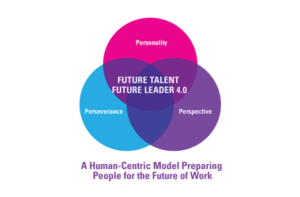
There has been intensive publicity and buildup around Industry 4.0 and IoT 4.0. However, the most significant, pending transition of the global workforce concerns preparing people for the future of work. Organizations looking to implement foundational change should look to the Future Talent/Future Leader 4.0, a contemporary, 21st century model of engaging or inspiring leadership.

The Future Talent/Future Leader 4.0, developed by Inspire Imagine Innovate Pte, Ltd., addresses these growing skills gaps through a new model which enables the global workforce to engage the goals and opportunities of Industry 4.0 and IoT 4.0 through:

Personality & Emotional Intelligence (EQ-i)

Perseverance & Resilience

  • Interdependent Collaboration
  • Synthesizer
  • Comprehensive Learning Agility

Perspective

  • Global Mindset (Diversity & Inclusion)
  • Coaching Mindset
  • Whole Brain® Thinking

In our experience, organizations are now realizing that their employment engagement surveys are revealing very limited insight into their employees and actually reflect an overall leadership deficiency and a lack of engaging or inspiring leadership with a coaching mindset, within their organizations. Global citizens are also expressing their dissatisfaction with and disapproval of the leadership of their governments as well as their educational and healthcare systems — which clearly have not advanced to Future Talent/Future Leader 4.0.

The fields of leadership, employee engagement, talent management, personality, and coaching have simultaneously converged, and the collective imperative of leading organizations has become ‘Engage Your Potential, Develop Your Talent, and Focus Your Performance.’ This confluence of disciplines presents a challenge to organizations, as many universities, business schools, consulting firms and leadership development service providers have not progressed their faculty, consultants, trainers, and coaches to align with these changes.

Based on our extensive experience working with global multinational organizations across the globe to improve their leadership performance, potential and well-being, we felt that a new ‘lens’ was needed, through which the talent development conversation would shift. To correct this perspective, I created Future Talent / Future Leader 4.0 — A Human Centric Model Preparing People for the Future of Work, to address the ever-increasing complexity and distributed nature of leadership and to align the global workforce with future leadership capabilities, one individual at a time.

The Future Talent/Future Leader 4.0 Model is built upon 15 years of global executive coaching experience with emerging, high-potential and senior level leaders, and Hogan Assessments.

In spite of a lack of confidence in leadership within organizations, government, and non-government organizations (NGO) that is prevalent throughout the world today, individuals, citizens, and stakeholders are realizing the value and path forward through Future Talent / Future Leader 4.0’s contemporary, 21st century model of engaging or inspiring leadership, to help them achieve their goals.

We are also beginning to realize that the original 70/20/10 guideline for talent and leadership development (70 percent of their knowledge is acquired from job-related experiences, 20 percent from interactions with others, and 10 percent from formal educational events) has shifted to 60/30/10, to reflect the following characteristics of the global workforce:

  1. Leaders are now expected to be engaging/inspiring leaders who recognize, acknowledge and develop others
  2. Leaders and managers are now expected to develop into leaders and managers with a coaching mindset
  3. Mentors are frequently assigned to leaders, by corporations, to assist with the learning and development of managers and leaders
  4. The outcome of executive coaching and leadership development initiatives is increasingly focused on enhancing the productivity and effectiveness of teams and work groups
  5. Peer-to-peer-based learning and interactive learning groups, with executive sponsorship, have replaced lectures and presentations in the classroom

To find out more and learn how you can help your organization engage the goals of Industry 4.0 and IoT 4.0 via the path forward through the Future Talent/Future Leader 4.0 (‘3 P’s’ Model), please visit https://www.inspireimagineinnovate.com/the-future-talent-future-leader-4-03ps-model.

*This is a guest blog authored by Kevin Asbjörnson, an advanced practitioner of Hogan Assessments and global leader and teams’ coach in the Hogan Coaching Network (HCN). The Future Talent/Future Leader 4.0 Model is not a Hogan model. 

*Kevin may be reached in Singapore  at his email address, at Kevin.Asbjornson@InspireImagineInnovate.com or on LinkedIn at the following URL: https://www.linkedin.com/in/kevinasbjornson.

References and Internet Links:

Topics: leadership development

Q&A: Natural Language Processing

Posted by Hogan Assessments on Tue, Jun 23, 2020

Screen Shot 2020-06-23 at 10.39.01 AMThe amount of text data we send out in the world is staggering. On average, there are 500 million tweets sent per day, 23 billion text messages, and 306.4 billion emails. Everything we say, every email we send, and every word on our resumes can be used to understand the world around us, and it also gives us clues about the individual speaking or writing. Hogan’s Data Science team is exploring how best to capture text data and harness its power in understanding human nature. Below are some frequently asked questions that people unfamiliar with text-based machine learning often ask us.

Q: What is NLP?

A: NLP is a type of artificial intelligence that uses machine learning to break down, process, and quantify human language. NLP helps us understand the hidden stories within text-based data.

Q: Why is NLP important?

A: Up to 95% of usable organizational data is unstructured, resulting in an increased drive for using this data to remain competitive. The competition and consistent advancements in computational power, data access, and open-source research initiatives have led the field of NLP to evolve and grow constantly.

Q: How do NLP, artificial intelligence, and machine learning relate to each other?

A: Broadly speaking, artificial intelligence refers to using machines to mimic human decision making. The decision making can be either rule-based (the machine is told which rules and procedures to follow explicitly by the designer) or learned (the machine learns the rules and procedures based on data).

Machine learning refers to machines learning from data. A machine is said to learn if its performance increases on a particular task in response to exposure to a new experience or new data that tells the machine how to perform a task better. Machine learning is a subset of artificial intelligence.

Natural language processing refers to using a machine to quantify human language. NLP includes both rule-based and machine learning techniques. So, NLP is a type of artificial intelligence centered around human language that often uses machine learning. 

Q: What are some common NLP techniques?

A: There are several common techniques used in this research, including:

  • Bag of words – A list of all the words used in a training sample.
  • Inverse document frequency – The number of documents a word appears in.
  • Lemmatization – Removing inflections from a word. For example, “studies” would become “study.”
  • N-grams – Word combinations where the N indicates the number of words to be combined. For example, a bi-gram could be “computer science.”
  • Stemming – Reducing a word to its stem. For example, “studies” would become “studi.”
  • Stop words – Frequently used or extremely common words often removed in NLP analyses.
  • Term frequency – How often a word occurs in a document.

Q: What are some everyday examples of NLP?

A: There are several applications in which NLP might drive something you encounter and use daily:

  • Siri, Alexa, or Google Assistant
  • Spell-check
  • Autocomplete
  • Voice-to-text messaging
  • Search engines
  • Spam filtering

Q: How is Hogan using NLP?

A: One way we are using NLP is by streamlining the coding process of focus group notes for personality scale relevance. We’re injecting NLP into our job analysis strategy to increase the efficiency of the approach and improve the quality of our results. Manually reading and coding focus group notes is a time-intensive and cognitively draining process. Using NLP, on average, we can decrease the overall time it takes while maintaining predictions that are both consistent and accurate. This approach has already shown promising results for correctly identifying the relevance of personality characteristics from focus group notes. When compared against human raters (i.e., subject-matter experts, or SMEs), our model was consistent and had an average accuracy score higher than the average accuracy of the SMEs. Please see our blog post on NLP from February 11, 2020, for more details.

Q: What are some new research directions Hogan is exploring with NLP?

A: Hogan’s Data Science team has several projects in the works using NLP to expand our insight from available text data housed internally as well as from open-source applications (e.g., O*NET):

  • Job family matching using job descriptions – Hogan is exploring using NLP to allow someone to enter their job description and receive the job family and relevant Hogan assessment scales linked to their job description.
  • Automatic item writing – Hogan is exploring using natural language generation to automatically generate assessment items that (1) tap specific Hogan personality domains, (2) are equivalent in difficulty and readability to our current items, and (3) are interchangeable with our current items to ensure both test security and fairness of the assessment process.
  • Automatic feedback generation – Hogan is exploring using natural language generation to provide accurate, quick, and unique feedback to every user based on that user’s assessment results.

Topics: personality

Hogan Launches The Science of Personality Podcast

Posted by Hogan Assessments on Tue, Jun 16, 2020

The Science of Personality Podcast

We’re excited to announce that Hogan has officially launched The Science of Personality podcast, which explores the impact of personality on life, leadership, and organizational success.

The Science of Personality is hosted by Hogan Chief Science Officer Ryne Sherman, PhD, a world-renowned personality psychologist, along with Hogan Public Relations Manager Blake Loepp. In each episode, Ryne and Blake will discuss current trends in personality psychology, leadership, and popular culture and how these affect our personal and professional lives.

“Our goal with this podcast is to simplify the very complex nature of personality psychology and make it relatable to a broader audience,” said Sherman. “Psychologists have struggled for decades just to define personality, yet it has a tremendous impact on how we communicate, build relationships, advance our careers, and live our lives. The goal of this podcast is to help people understand why personality is so important.”

The podcast will feature some of the world’s leading experts in personality psychology as guests and will cover topics such as women in leadership, diversity and inclusion, artificial intelligence, big data, and the dark side of personality. Episodes will be released every other week on Apple Podcasts, Spotify, Stitcher, and thescienceofpersonality.com.

“This is something Blake and I have been talking about doing for a couple of years,” said Sherman. “Once we found ourselves working remotely and unable to travel due to a global pandemic, we decided to make this a priority. It’s our hope that the audience finds this podcast both informative and entertaining.”

About The Science of Personality

Personality affects the way we relate to the world and the people in it, how we work, who we love, and how other people see us. Although the study of personality is centuries old, our ability to understand such a complex and abstract concept is relatively new in the context of history. Featuring some of the world’s leading experts in personality psychology and business, this podcast explores the impact of personality on life, leadership, and organizational success.

Topics: personality

An Open Letter from the CEO: Hogan Stands Against Racial Injustice

Posted by SGregory on Tue, Jun 09, 2020

Hogan Logo BWH

During the past few months, we all have experienced heartbreaking events and challenges related to the COVID-19 pandemic. During the past two weeks, it has become impossible to ignore another crisis, which the American Psychological Association labeled a “racism pandemic.” Sadly, the racism pandemic has been and continues to be a much more enduring, primary, intractable, and destructive one, which most recently was highlighted by the murder of George Floyd by a police officer.

This double pandemic intensifies our typical yearning for meaning. Considering the recent death and destruction, we might be tempted to conclude that there is nothing we can do to make things better. Like many of you, I have spent a lot of time thinking about Hogan’s history of commitment to social justice, and it is critical that this commitment is not only part of our history, but also our future. It is poignant that Hogan’s headquarters is located in an area once known as Black Wall Street that has a history of racial violence — because even before the official founding of Hogan, antidiscrimination and equal opportunity were core values and drivers of action for our founders.

For example, during the 1960s protests in Berkeley, Robert Hogan proposed and carried out research to improve police officer selection, despite being met with indifference (at best) from other researchers. His focus on research to improve social justice became an enduring one. Throughout her career, Joyce Hogan worked with the Department of Justice on many high-profile discrimination cases to create more equitable opportunities for women in traditionally male-dominated fields, such as heavy industry and police and fire departments.

Robert and Joyce started Hogan Assessments with a vision to create equal opportunity in the workplace. The confluence of three factors provided an opportune moment:

  1. The Civil Rights Act of 1964 made discrimination in the hiring process illegal.
  2. The Equal Employment Opportunity Commission (EEOC) was established to enforce the antidiscrimination part of the Civil Rights Act.
  3. The mainstream field of I/O psychology primarily focused on using IQ tests for selection, despite clear evidence that such tests discriminated against minority applicants.

Through the Hogans’ early research and the research that continues today, Hogan has shown again and again that personality measures predict performance across all jobs — without creating unfair discrimination based on demographic or non-job-related variables. Using personality measures in selection helps ensure that the best person for the job gets the job. That is key to social justice.

Aside from the ongoing and daily impact of the fairness of our approach, we continue to do research and seek opportunities to put our assessments to work in ways that benefit all. For example, we are actively engaged in research and proposals to improve hiring practices for law enforcement. This week, we put a small team together to expand use of our research and assessments in public safety settings, and we recently worked with a partner to implement a diversity and inclusion assessment for leaders.

Today, our impact on social justice is global. Even in countries where discrimination based on race, gender, ethnicity, sexual orientation, or social status is condoned or overlooked, companies that use our assessments are providing fair evaluations of job applicants, even if unwittingly so.

If, like me, you have been struggling over the past couple of weeks about what you can do to reject discrimination and support equality, you can be confident that our collective work at Hogan promotes social justice every day and in every region of the world. Social justice is not just our history. It is alive, critical, and a calling in which we all can find meaning.

Of course, we can and should do more collectively and individually to address this pandemic of racism and discrimination. But let’s at least take a brief moment to reflect on our founding principles. Let’s reaffirm Hogan’s commitment to social justice, antiracism, and equal opportunity for all. And let’s remember how our work every day is an opportunity to continue the principled action that Robert and Joyce started. Clearly, we have a lot of work left to do.

Topics: DE&I

Leveraging Personality in Onboarding

Posted by Jessie McClure on Tue, Jun 09, 2020

Personality in Onboarding

We’ve all experienced that feeling of excitement and energy on the first day of a new job. The feeling that emerges after walking through those doors is almost entirely dependent on the organization and its selection and onboarding processes. Many resources from Hogan discuss the importance of selecting the right candidates, including a variety of case studies from clients who have successfully implemented our assessments in their selection processes. But onboarding, while tremendously important, is often overlooked as a factor in the success of new hires.

The Case for Onboarding

K. Kellogg, the founder of Kellogg’s, once said, “I’ll invest my money in my people.” Without people, no organization can function. Over the years, we have seen case studies and data that clearly demonstrate when organizations treat their people poorly it leads to negative outcomes, such as lack of engagement, lower productivity, increased turnover, and poor organizational performance. From the moment they walk through your doors as new employees, it is imperative to invest in and support your people to avoid these negative outcomes. This is especially true in our current environment, where virtual work and decreased interaction between new hires and peers are commonplace.

According to Leadership IQ, a leadership consulting company, 46% of new hires leave within the first 18 months of beginning a new job.1 Click Boarding, an onboarding software company, found that organizations that have standard onboarding practices have 50% greater new hire retention.2 Finally, Gallup’s State of the American Workplace report found that only 12% of respondents believe that their organization does a good job with onboarding.3 It goes to show that the onboarding processes of most organizations have room to improve. Furthermore, improving the onboarding process is likely to have positive results for the organization’s culture and overall performance.

The Role of Personality in Onboarding

Many organizations have formal onboarding plans of various lengths that include a variety of paperwork, performance check-ins, training, and socialization. Some of these plans are as short as 90 days, and other plans last upwards of 18 months following the employee’s start date. So what differentiates a 90-day plan from an 18-month plan?

Longer, more comprehensive onboarding plans tend to have a more thought-out approach to employee development. These plans tend to involve more check-ins, coaching, and formal mentorship. This is where insights from personality assessment can play a critical role.

When using Hogan for development we always look at a person’s assessment results through the lens of his or her current role and future career goals. Getting this context helps us understand the individual and guides current and future development conversations. Starting these development conversations early in the employee’s tenure at the organization is beneficial, as it demonstrates that the organization is prioritizing the employee’s personal growth, which can lead to increased engagement and retention. These conversations also give new employees direction on the characteristics they should be leveraging, while also helping them be mindful of behaviors that could impede their success and potentially damage their reputation in those critical first days and weeks.

If you use Hogan to help with your selection process, you can easily generate a series of reports, such as the Leadership Forecast Series, and use this to help guide onboarding coaching conversations. As a certified Hogan user, we would recommend focusing on the following:

  • Alignment with the job role – Why did you hire this individual, and what characteristics do you want to see him or her leveraging in this new position?
  • Possible challenges – What aspects of personality could get this employee off-course? What parts of this person’s personality might not be well received by his or her new peers?
  • Leadership style and the type of team environment – What are the things that this employee will likely find rewarding in his or her new role? What types of tasks and projects will he or she likely invest a lot of energy and passion in?
  • Stress management skills – Starting a new position can be challenging, so how is this stress likely to manifest in the new environment. How are others likely to perceive it?

Ultimately these coaching sessions should lead to the creation of a formal development or onboarding plan with developmental goals outlined and check-in points clearly stated for accountability. For example, if networking and connecting with others could be a challenge for an individual as they start a new role, build in a development action that involves creating stakeholder maps and a plan for interaction with critical individuals in the employee’s network. As always, we recommend the employee share the development plan with his or her leader, so they can have conversations about development throughout the onboarding process.

In addition to providing the new employee with an individual development plan, these coaching conversations allow the employee a confidential space to discuss challenges and frustrations they might experience in a new environment. This kind of support may be most helpful coming from an internal advocate or sometimes an external coach. The Hogan Coaching Network is ready to help with any onboarding coaching needs your organization might have.

Closing Thoughts

There are many ways in which Hogan data can be used to guide onboarding. In addition to what we have addressed here, you can also leverage Hogan data to understand the dynamics of a new team, pair new hires with mentors, and understand interpersonal dynamics between a new hire and leader. At Hogan we understand the critical role people play in the success of an organization. We know that investing in your organization means investing in your people, so we encourage you to leverage Hogan assessments in your onboarding process.

References

  1. Schawbel, D. (2012, Jan. 23). Hire for Attitude. Forbes. https://www.forbes.com/sites/danschawbel/2012/01/23/89-of-new-hires-fail-because-of-their-attitude/#254d8cc1137a
  2. Click Boarding. (2015, Dec. 3). The 3 Best Ways to Retain Job Hoppers. https://www.clickboarding.com/the-3-best-ways-to-retain-job-hoppers/
  3. (2017). State of the American Workplace. https://www.gallup.com/workplace/238085/state-american-workplace-report-2017.aspx

Topics: personality

Essential and Frontline Workers’ Safety

Posted by Hogan Assessments on Tue, Jun 02, 2020

Untitled-1

The COVID-19 pandemic has shed light on how critical essential and frontline workers are in supporting the health and safety of our communities. Essential organizations and industries are hiring in large numbers to keep up with the demands of their customers and stakeholders. These new demands also require organizations to implement new policies to ensure their customers and workers are healthy and safe from potential infection. Now more than ever, essential organizations need methods to identify workers capable of following and adapting to these new safety policies.

Understanding Safety

When it comes to workplace safety, employee personality and behavior are as relevant as on-the-job training, equipment, and protocols. However, it doesn’t really matter what protocols are in place if employees are not prone to adhere to the protocols. Identifying safety-conscious personnel who will adhere to protocols, as well as people who exhibit potential for dangerous behavior, is a key step toward preventing costly and sometimes fatal accidents. Hogan researchers have distilled six factors that help organizations identify workers who will maintain and contribute to a safe work environment:

  • Compliant – The tendency to follow the rules. Low scorers ignore authority and company rules, while high scorers follow guidelines and protocols.
  • Strong – The ability to handle stress with confidence. Low scorers tend to panic under pressure and make mistakes, while high scorers are steady and reliable.
  • Poised – The ability to handle pressure without becoming irritable. Low scorers lose their tempers, blame others, and make mistakes. High scorers are calm and composed.
  • Vigilant – The ability to stay focused when performing monotonous tasks. Low scorers tend to make mistakes because they are easily distracted, while high scorers stick to the task at hand.
  • Cautious – The tendency to avoid risk. Low scorers tend to take unnecessary risks, while high scorers carefully weigh all options when facing a risky decision.
  • Trainable – The tendency to respond favorably to training. Low scorers are overconfident and difficult to train. High scorers are receptive to advice and genuinely enjoy learning.

Essential and Frontline Workers’ Safety

Examinations of safety behaviors associated with essential and frontline workers in the medical, protective services, and transportation fields reveal high scorers on the Hogan Safety Report are more likely to encourage and promote safety practices, act professionally and accept responsibility for errors, and avoid taking unnecessary risks. We present examples of safety-specific results for three groups of essential and frontline workers below.

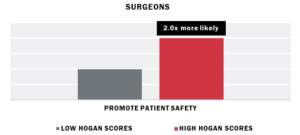
In the medical field, surgeons with high scores on the Safety Report are approximately twice as likely to promote patient safety and are 1.6 times more likely to accept responsibility for errors. Although our overall sample size was too small to confer significance, our evidence suggests nursing aides, orderlies, and attendants who score highly on the Safety Report are approximately 3.5 times more likely to observe and promote safety practices.

Surgeons

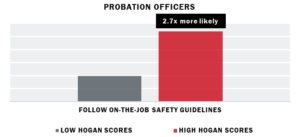
Workers in protective services, such as probation officers, who score high on the Cautious subscale are 2.4 times more likely to encourage safe behavior, 3.8 times more likely to avoid taking unnecessary risks, and 2.7 times more likely to follow on-the-job safety guidelines.

Probation Officers

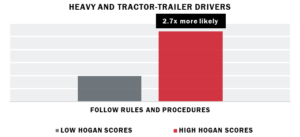
Among transportation workers, bus drivers who score high on the Safety Report are twice as likely to work safely and responsibly (according to their supervisors) and 1.8 times more likely to adhere strictly to rules and procedures. Bus drivers who score high on the Compliant subscale are half as likely to be involved in a traffic accident. Heavy and tractor-trailer drivers who score high on the Strong subscale are half as likely to be ticketed for speeding. Heavy and tractor-trailer drivers with high scores on the Cautious subscale are 2.7 times more likely set a good example to other drivers by following rules and procedures. And those with high scores on the overall Safety Report are four times more likely to act predictably and professionally.

Tractor Trailer

Bottom Line

The importance of safe and healthy work environments in essential organizations cannot be underestimated. Hogan understands the core aspects of an individual’s personality that help create and maintain safe work environments. Not only is there evidence that the Hogan Safety Report can work across a broad range of jobs, but Hogan’s Safety Report predicts across a broad range of criteria (supervisor ratings, number of accidents, speeding citations). This ability to predict extends to the subscale level, such as the Cautious subscale, providing an opportunity for more nuanced interpretation.

The broader outlook is that we, as a global society, have entered a new economic environment where safety is an important performance criterion for all essential industries and organizations. Hogan is prepared to apply knowledge from years of research to help navigate this new terrain.

*This blog post was authored by Hogan’s Nathan Hundley and Andrew Blake.

Topics: personality

Subscribe to our Blog

Most Popular Posts

Connect