
How Personality Can Help Protect Public Health (And Your Business)

Posted by SGregory on Tue, May 26, 2020

Public Health

Last weekend, I did something I never thought I’d do. I donned personal protective equipment to run a basic errand. I put on gloves and a mask, and in spite of the warm spring weather, I even wore long sleeves to cover as much of my skin as possible. It felt like I was walking into an operatory for surgery, not like I was walking into a liquor store to pick up a bottle of wine.

Despite the near-constant news regarding preventing the spread of the coronavirus, the salesperson in the liquor store wore no mask or gloves. He folded, refolded, creased, and re-creased the paper bag holding my purchase multiple times. By the time he finished, he had touched every square inch of the bag with his bare hands. A few months ago, I might have found his behavior a little obsessive. But considering the pandemic, the way he handled the bag, coupled with his lack of personal protective equipment, seemed dangerous. He interacts with hundreds of people per day — sometimes from behind a plexiglass shield but often by helping people find their favorite wine, which can involve handing bottles back and forth.

In April, more than 20% of consumers polled by Morning Consult indicated that they would not feel comfortable going out to eat, to a shopping mall, to a movie or theater performance, or to the gym for at least six months.1 A recent International Food Information Council Foundation survey assessed consumers’ opinions about essential workers’ attention to safety. Of those who responded, 43% said that frequently wiping down commonly touched surfaces was important, 28% said that it was important to them for employees to wear gloves, and another 28% said masks were important to them.2 If consumers perceive that front-line or essential workers are not attending to safety, their reluctance to shop may linger or even increase.

Safety: A Matter of Personality

So why would someone ignore basic safety precautions that so many people are concerned about? Because some people are more attentive to safety than others, and this is related to personality. Hogan’s research has identified six safety competencies that impact the prevalence of unsafe behaviors and on-the-job accidents. With our Safety report, we measure these safety competencies using the following scales:

Defiant – Compliant

Those who score high on this scale tend to adhere to organizational guidelines and are usually rule followers. Those on the defiant end of the scale often ignore authority and rules and can be reckless, causing accidents and injuries.

Panicky – Strong

Those who lean toward the panicky end of the scale often buckle under pressure and make mistakes that could prove to be costly or possibly even fatal. Those at the strong end of the spectrum are steady under pressure.

Irritable – Cheerful

Cheerful employees keep their temperament on an even keel, but those who are prone to irritability make mistakes by not staying focused.

Distractible – Vigilant

Those who remain focused on the task at hand usually score on the vigilant side of this scale and tend to be safer than those who are easily distracted.

Reckless – Cautious

Those who score on the reckless end of the scale tend to take unnecessary risks. Cautious scorers evaluate their options before making risky decisions.

Arrogant – Trainable

Low scorers tend to be arrogant, overconfident, and challenging to train. High scorers tend to be trainable, listen to advice, and enjoy learning.

Protection for Public Health

Screening employees for these safety competencies can help organizations do their part to keep their customers safe and flatten the epidemiological curve. As more state and local governments lift their shutdown orders, many business owners are finding themselves in positions to decide whether (or to what extent) they should reopen. When they do so, they assume some responsibility for the health of the public.

Many businesses are implementing enhanced sanitation protocols and new policies regarding personal protective equipment and social distancing. The success of these efforts relies on front-line employees being both safety conscious and trainable. Being able to identify employees whose personalities predispose them to be more attentive to safety can help mitigate the risk of inadvertent disease transmission through day-to-day business operations.

Protection for Your Business

Aside from helping to protect public health, screening staff for these safety competencies can also be good for business. Right now, consumers want businesses to be vigilant about safety. By knowing who will be more or less inclined to take it seriously, organizations can dramatically reduce costs associated with unsafe behavior and potentially increase customers’ willingness to shop, order takeout food, or use a delivery service.

These savings will add up, especially for businesses in industries affected most directly by the current economic crisis. We’ve estimated the comprehensive effect that the Hogan Safety report has had historically by analyzing our data on the reports we’ve generated for our clients, data on the report’s accuracy in distinguishing safe employees from their less-safe colleagues, and the most recent government statistics on workplace accidents. Our research shows a whopping $43.7 million USD in safety-related savings to organizations and an estimated ROI of 538% from using the Hogan Safety report.

Although employees’ safety precautions won’t necessarily increase the number of consumers who visit a store or use a service, unsafe employee behaviors will almost certainly have a negative impact on the bottom line. More importantly, the health of the public is at stake. It is time to ensure you are hiring and coaching employees who will be attentive to their own, their coworkers’, and their customers’ safety. Your future business may depend on it.

* Click here to register for our next webinar, “Safety Is No Accident – Using Personality to Improve the Safety of Your Organization,” on Thursday, June 4, hosted by Hogan’s Kristin Switzer and Kirsten Mosier.

References

  1. Meyers, A. (2020, April 10). When consumers say they’ll feel OK about dining out and other activities. Morning Consult. https://morningconsult.com/2020/04/10/consumer-expectations-normal-activities-comfortable
  2. International Food Information Council Foundation. (2020, April 14). Consumer survey: COVID-19’s impact on food purchasing, eating behaviors, and perceptions of food safety. https://foodinsight.org/consumer-survey-covid-19s-impact-on-food-purchasing

Topics: personality

Is COVID-19 Changing How People Score on Personality Assessments?

Posted by Brandon Ferrell on Thu, May 21, 2020

FlashBlog

COVID-19 continues to upend our daily lives. Hundreds, if not thousands, of people die daily, millions of jobs are lost weekly, and people continue to adjust to a new world. So much has changed within the past few months. It is fair to ask if people are changing too. We examined this question empirically using personality and values assessment data collected over the past 15 months.

What We Did

We used data from everyone who took the U.S. English versions of the Hogan Personality Inventory (HPI), Hogan Development Survey (HDS), and Motives, Values, Preferences Inventory (MVPI) between March 6, 2019, and May 5, 2020, to determine COVID-19’s effect on assessment scores. We focused specifically on the United States to limit the effect of the disease’s varying onset times across different countries. We used March 11, 2020, the day the World Health Organization (WHO) proclaimed COVID-19 a pandemic, to divide our samples into pre- and postpandemic cases. These groups allowed us to estimate a baseline and a pandemic effect.

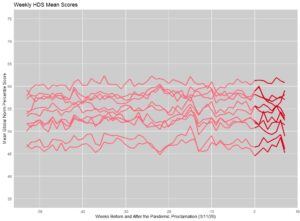
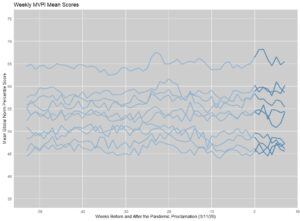
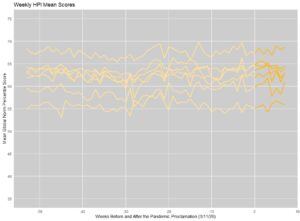
We grouped people using 61 seven-day periods, with 53 baseline periods occurring before and eight pandemic periods occurring after the WHO proclamation. We had complete HPI data for 175,619 people, complete HDS data for 140,071 people, and complete MVPI data for 119,930 people. We present the mean HPI, HDS, and MVPI scale scores for each period below.

HPI Line Graphs
HDS Line Graphs
MVPI Line Graphs

Random variation from week to week makes interpreting these types of line graphs difficult, so we used linear regression models to determine (a) if mean scores changed when the WHO proclaimed COVID-19 a pandemic and (b) if scores continued to change as the pandemic continued. We note that we are running large number of analyses (28 scales x 2 analyses = 56 analyses), so we used a Bonferroni correction to limit the number of spurious results.

What We Found

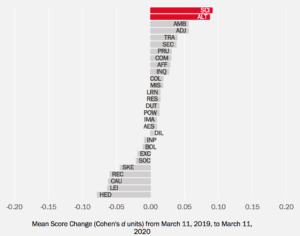
We present results for the mean score changes in the figure below. We see slight increases in scores for MVPI Science and Altruism, which increased by .09 standard deviations from March 2019 to March 2020. Although these changes are statistically significant, a Cohen’s d value of .09 is widely considered a minimal effect. In absolute terms, MVPI Science increased by 2.63 percentile points and MVPI Altruism increased by 2.56 percentile points

Screen Shot 2020-05-21 at 2.48.36 PM

Most scale scores did not change over the one-year period.

As to the question of whether scores continued to change over time, none of the results were statistically significant. This suggests that changes from one period to the next follow the same pattern before and after the pandemic proclamation.

What Does It Mean?

We do not see COVID-19 leading to consistent or pervasive changes in people’s personalities or values. We do see slightly higher mean scores on MVPI Science (wanting data and research to inform decisions) and on MVPI Altruism (wanting a society that helps people in need). Both values are relevant as countries around the world debate when and how to wind down shutdown and social distancing policies and how much aid to provide people affected by the disease and the resulting economic downturn. However, we note the score effects we see are quite minimal.

Why do we not see larger effects? COVID-19 is one of the worst pandemics in decades. The economic downturn it created has led to mass unemployment. If anything were to cause massive changes in how people act or believe, this should be it. We believe there are three reasons we don’t see larger changes:

  1. Personality and values are more stable than many people believe them to be. Research consistently suggests that personality and values are less prone to changing over time or across situations than other individual difference characteristics.
  2. Personality items function more as measures of self-presentation (i.e., how people want to be perceived) than self-report measures (i.e., what people do in a factual sense). This may help explain some of personality’s stability.
  3. We also note that COVID-19 may affect people in different ways in terms of their personality scores. However, to find the results we did, it means that the pandemic would have to be simultaneously making some people’s scores higher and other people’s scores lower across most of the 28 scales. This would cancel out any effect at the group level. This seems relatively unlikely, particularly for some scales (e.g., Security).

Topics: personality

Leadership Matters

Posted by Robert Hogan on Wed, May 13, 2020

Leadership Matters

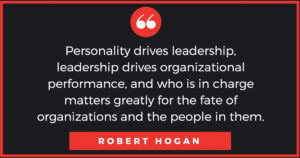
The quality of people’s lives depends on their careers. The quality of people’s careers depends on the organizations in which their careers are embedded. The success of these organizations depends on their leadership. The effectiveness of the leadership depends on the characteristics of the people in leadership roles. Ultimately then, personality drives leadership, leadership drives organizational performance, and who is in charge matters greatly for the fate of organizations and the people in them.

These statements are true, and we can use this line of reasoning to improve the functioning of any organizational unit, from a football team to a sales team to a military team to a city council. As obvious as this line of reasoning may seem, it is radical news to most business school professors for three reasons. First, until the mid-1990s, academics denied that personality exists, or that it affects occupational performance in any significant ways. However, a series of research studies in the early 1990s showed, for those who believe in data, that people differ in meaningful ways (personality), that these differences can be assessed (personality measurement), and that these differences predict occupational performance. Second, until the early 2000s, academics denied that leadership matters. However, a series of research studies in the early 2000s showed that personality predicts leadership performance, and leadership performance predicts team or organizational performance. The personality of the CEO is the most important determinant of firm financial performance other than the industry sector in which the firm operates. And third, as of today, academics ignore the topic of organizational effectiveness—the term “organizational effectiveness” doesn’t appear in the index of any major research compendium. But clearly Singapore has a better economy than Somalia, and South Korea has a better economy than North Korea; moreover, the differences in their economic performance have a huge impact on the well-being of the residents in those countries.

This argument is so important that it deserves repeating. It goes as follows:

  1. Personality is real: people are different, but their differences are consistent across situations, and this allows us to predict their typical behavior.
  2. Personality matters: well-validated measures of personality predict every consequential life outcome (i.e., health, marital satisfaction, occupational performance) better than any alternative indicator.
  3. Personality predicts leadership performance better than any other alternative indicator, including IQ. But personality doesn’t discriminate: women get the same scores as men; ethnic minorities get the same scores as ethnic majorities. This means good leadership can come from anywhere.
  4. Leadership predicts firm performance; good leaders guide profitable enterprises and bad leaders ruin organizations. This is the lesson of James Collins’ book Good to Great.

The next question concerns the personality characteristics of successful leaders. The data suggest that good leaders have most or all of the following seven characteristics.

The first and in many ways the most important characteristic is integrity. People need to know that they can trust their leaders not to betray, deceive, or exploit them. This is so powerful that a team’s ratings for the degree that they trust their leader is a proxy for team or business unit performance. People will not work for leaders they mistrust. Leaders need to take great care to gain and maintain the trust of their subordinates.

The second characteristic is competence—leaders need to know what they are talking about, they need to be well-grounded in the business at hand. Competence inspires trust, but more practically, staff need to be able to ask their managers for advice in solving the problems that come up constantly. In athletics, the team captain is often the best player on the team, and the best athletic managers know more about their sports than their rival managers.

The third characteristic is good judgment—subordinates need to know that their leaders will take them in the right direction. In the Vietnam War, a surprising number of newly minted US officers were killed by their own troops precisely because the troops thought their officers would get them killed.

The fourth characteristic is vision—leaders need to be able to explain to their staff why they are doing what they are doing and why it matters. A recent DDI survey of several thousand HR managers reported that 70% of the HR managers thought the leadership of their organization lacked any vision.

The fifth essential characteristic is ambition—wanting to be in charge and to outperform rival organizations.  Ambition concerns enjoying competition, wanting to win, being persistent and resilient in the face of defeat, and never being satisfied with or complacent about current levels of performance. Leaders without ambition are empty suits.

The sixth characteristic concerns “the dark side” of personality. Dark-side characteristics are strengths that, when overused, turn into problems. Passion and intensity can turn into bullying and tantrums, a keen work ethic can turn into micro-management, self-confidence can turn into arrogance and the inability to learn from experience. These tendencies are almost impossible to detect during interviews. Left unchecked they will cause leaders to fail—because they destroy trust.

The final characteristic is “global mindedness.” This characteristic is important if an organization is operating on the world stage. It is a personality syndrome that includes: being curious about other cultures and life styles; being tolerant of those other ways of living; and being able to adapt to strange circumstances while remaining focused on one’s competitive goals.

These are the essential ingredients of leadership. Needless to say, no one person has all these characteristics, every potential and existing leader has challenges as defined by these seven characteristics. But this profile provides a template against which people can compare their performance and determine how to improve it—providing they have the requisite ambition. People can only improve their performance if they understand their performance limitations.

Topics: leadership development

Follow Hogan Assessments on WeChat!

Posted by Hogan Assessments on Mon, May 11, 2020

WeChat

Hogan Assessments is proud to introduce the official Hogan WeChat account. Used by most companies with a footprint in the China market, WeChat is a multipurpose app developed by Tencent with more than one billion active users who span the globe.

Hogan’s WeChat account will feature unique articles, written in Simplified Chinese, about Hogan and personality assessments with the goal of educating the China market and Chinese audiences about the Hogan’s talent management solutions.

In addition, Hogan will also use the WeChat account to support China-based distributors — including Optimal Consulting, Mobley Group Pacific, Empower Leaders, Edge Consulting, and Infelligent — by linking to their WeChat accounts, publishing their contact information and certification workshop dates, and by republishing and linking to their unique Hogan-focused articles.

Hogan is committed to supporting distributors in the Asia-Pacific markets and will continue to provide education about Hogan and personality assessments across the region.

To follow the Hogan WeChat account, please scan the QR code in this post or add the Hogan WeChat ID: HoganAssessments.

Topics: distributors

Leading Effective Virtual Teams: Practical Advice for Transitioning Team Norms in this ‘New Normal’

Posted by Hogan Assessments on Fri, May 08, 2020

visuals-sW_BS0OVgv0-unsplash

At Hogan, we define leadership as the ability to build and maintain a high-performing team. And high-performing teams consistently outperform the competition. You want your team to be one of those, right? We don’t know what impact the current pandemic will have on our businesses, but we do know that high-performing teams are critical to our success.

Hogan’s data scientists recently conducted a literature review to define the characteristics of high-performing teams more clearly. From that review, we know that high-performing teams have strong norms around how they engage interpersonally. Because we are social and group-dwelling beings, it’s no surprise that teams are suffering interpersonally right now as we practice social distancing. Although other factors are at play, the interpersonal norms (the “rules” for how the team operates) have likely deteriorated further than the process-oriented norms. Specifically, this global pandemic has disrupted our social interactions. For example, imagine a high-performing team who used to gather in a coffee shop for morning kickoff meetings. Now what are they doing? Drinking coffee alone at their kitchen tables?

Interpersonal norms are critical to team efficacy, and you cannot let them go unattended yet expect teams to keep functioning at a high level. It does take some extra effort, but the team results are worth it. Based on Hogan’s literature review, we decided to focus our message on how to handle conflict, belonging, communication, and collaboration virtually. These norms keep teams connected, motivated, and engaged; they ground teams in productive interpersonal interactions. They are the invisible glue to a high-performing team. Without them, a team will come apart, not only at the edges, but at the core.

Whether you’re coaching leaders or you’re a member of a team, consider the following questions:

  • How does your team address conflict when you aren’t all in the same physical location?
  • What do you do to create a sense of belonging and connection for your team? How do you inspire and acknowledge contributions when so many factors compete for your team members’ attention?
  • What about communication? How have you adjusted your practices around keeping people informed and aligned?
  • How does your team collaborate and work together toward important business results?

Click here to listen to Brandy and Wendy’s webinar, “Practical Advice for Transitioning Team Norms in this ‘New Normal.’”

Topics: teams

The State of Remote Work

Posted by Hogan Assessments on Tue, May 05, 2020

Working from home is a not a new experience for many employees. In the United States, 50% to 70% of jobs can be done from home, but the number of remote workers is actually much lower. This trend is mirrored around the globe. That is, the actual number of remote workers trails the number of jobs that can be done remotely. At least, this was the trend before the current situation we find ourselves in with the COVID-19 crisis. What we have seen recently is that the COVID-19 pandemic has forced many workers and organizations to officially make the shift to a remote working environment.

The State of Remote Work

During the initial influx of new remote workers, organizations focused on ensuring that these workers had the necessary resources to work remotely effectively by addressing technology and infrastructure concerns (e.g., availability of smart devices, video conferencing platforms, internet security, etc.). However, it is important that we do not overlook the behaviors and characteristics that will be most important for individuals to be effective as they move to remote work.

Critical Competencies for Working Remotely

The current situation presents an opportunity for us to revisit what we know about effective remote workers. First, we know that being an effective remote worker requires the following:

  • Self-managing by demonstrating self-control and motivation without direction from others.
  • Communicating effectively with others.
  • Working in a dependable and timely manner.
  • Being able to adapt to different situations, approaches, and ideas.
  • Developing collaborative relationships to achieve key objectives.

Personality Characteristics of Remote Workers

Our research shows that there are some personality characteristics that are more closely linked to these effective remote working behaviors. Individuals who are seen as reliable, structured, and conscientious tend to be more successful remote workers because they work in a predictable and dependable manner. Additionally, those individuals who are perceived as considerate, warm, and sympathetic are more likely to build the collaborative relationships that are important when working remotely. Self-management requires individuals who can handle daily stressors well, while effective communication is not just driven by extraverts but by those who are seen as taking initiative and working efficiently.

Qualities that might detract from effective remote working behaviors are those characterized by volatility, timidity, and avoidance. People who cope with uncertainty and stressful situations by moving away from others and disengaging might have a harder time being effective while working remotely.

Maximizing Success in a Remote Environment

At Hogan, we know that context is everything. To understand the elements of an individual’s personality that may be strengths at work (or conversely, weaknesses), you must understand the person’s work context. In our current situation, it is safe to say that everyone’s context has changed. Many people who used to spend their days in bustling offices interacting with coworkers are now spending hours working in solitude at home. Others have traded their coworkers’ banter and cooperation for their children’s conversation and education. Even those who worked remotely previously are significantly impacted as they may now have (1) family members intruding upon their previously sacrosanct home office spaces, or (2) teammates who are new to working remotely. As we all adjust, we can offer a few practical recommendations based on our research into the competencies and characteristics that promote success in a remote work environment.

Take Care of Yourself

Engage in self-care. While this storm may be lighter for some and heavier for others, it is a storm for us all. The stress associated with unexpected changes and an unknown future is likely impacting you and everyone around you to some degree. Tune into your own emotions and make sure you are utilizing healthy, effective coping mechanisms that work for you. Work with your team to recognize the volatility and ambiguity currently impacting your organization, locale, and industry and determine how you can navigate this storm together.

Establish a Schedule

Consider how your schedule and productivity might change in this new season. What would your ideal working hours be in your work-from-home environment, and what does your employer prefer? If you can work with your boss and team to establish and communicate a clear schedule — when you are likely connected and available, versus when you are likely to be out-of-pocket — it will help you build your reputation as a predictable, accessible resource.

Maintain Your Motivation

Identify the triggers that impact your motivation and productivity. In what situations do you find it difficult to work with tenacity and resolve? Define and act on things that you can do in your new context to maintain your motivation and engagement at work. This may mean volunteering for special projects, pursuing development opportunities, or offering to help others. Think of what really motivates you at work and try to create opportunities for yourself.

Adapt Your Objectives

Revisit your individual and team goals and how they align with the organization’s overall goals. What has changed in the season of COVID-19 and what remains the same? How do you need to adapt your objectives or those of your team? Collaborate with key stakeholders to set new expectations. Then make sure these are clearly communicated so everyone understands what you need to accomplish and how you are likely to get there.

Make Relationships a Priority

Reflect on your relationships at work and identify steps you can take to network and connect in this new, fully virtual environment. Are there past or currently unaffiliated colleagues with whom you could collaborate to achieve mutual goals? Are there individuals or teams with whom you could communicate to provide support or guidance? How can you help lift others’ morale? Once you have identified your critical connections, create a plan for meaningful collaboration. Take care not to overschedule people, which can happen too easily when people are trying to stay connected without physical proximity.

Some people may enjoy working in remote environments and find success easily. They might be naturally suited to a more distanced, independent approach to work. Others find remote work more difficult and less enjoyable, and they count down the days until they can get back to the office and their teammates. What is important is that we find ways to be effective during this time. This likely means we need to put more conscious effort into how we work, and it requires that we engage in honest self-reflection and self-evaluation to ensure we are leveraging our strengths and compensating for our weaknesses. But together, we can all get the job done.

Want to know more? Watch Hogan’s on-demand webinar, “Personality Characteristics of Effective Remote Workers.”

*This is post was authored by Hogan Senior Consultant Jocelyn Hays and former Senior Consultant Amber Burkhart.

Topics: personality

Leading into the “New Normal”

Posted by Hogan Assessments on Wed, Apr 29, 2020

2

As governments around the world are under increased demands to reopen, leaders everywhere are making decisions in the face of staggering uncertainty and conflicting information. In many ways, the decisions that first closed down businesses and quarantined cities, although certainly difficult, were much easier exercises in short-term decision making and execution than those that leaders will have to make for the longer-term journey.

And now everyone is asking, what will this “new normal” look like?

Let’s start with what we know. As our coaches at Hogan Assessments will tell you, in order to gain something new and worthwhile in your life, you will inevitably face choices. You won’t lose weight without changing behaviors around your eating and activity levels. You won’t strengthen your family relationships without investing in quality time with your loved ones. You won’t learn a new language without reprioritizing your time in consistent study and practice.

For leaders, 2020 has thus far been an intensive exercise in making hard choices. I would hypothesize that, for both leaders and teams, the remainder of 2020 will be an exercise in cultivating appropriate strategic self-awareness to make choices that will carry their organizations and talent into the future.

In many of these forthcoming decisions, identifying the right choice and the wrong choice might be difficult. In those times, it will be critical for leaders to reflect on the appropriate questions:

  1. What did you have to let go of against your wishes in 2020? How have you been forced to change the way you lead? The way your team operates?
  2. Where are you still using approaches or processes that brought you and your team success in the past? Where are these working? Where are they not working?
  3. Are you paying attention to signals telling you that an approach or process isn’t working today? What are those signals?

Leading in a “new normal” season will require deliberate management of the tension between the “normal” and the “new.” At Hogan, we know that innate personality characteristics and motivators may lead some people to crave returning to the past, to the pragmatic, to solutions that have worked before, to the “normal.” These individuals often look for certainty, for steadiness, and for signals that remind them of past success. They might be hoping desperately to regain a sense of normalcy in their life. They might also be working diligently right now to apply processes or systems that brought them success in the past.

We also know that others naturally will find an abundance of freedom in the ambiguity. They will come up with new ideas or methodologies quickly, worrying little about appropriate application or execution. These creative innovators might be looking to drive significant change in the way they have operated before. Their comfort with ambiguity often frees them from a need for process and possibly even short-term expectations. If these individuals also have higher levels of ambition, they might be very quick to take on new challenges and run into the unknown.

In the second half of 2020, effective organizational leadership must balance these inevitable perspectives, deciding when to lean toward “normal” and when to lean toward “new,” and then lead others in that direction.

Our research on humility in leadership shows that the leaders with the most potential to effectively manage the tension through this next milestone will be those who are naturally open to coaching and feedback, as well as admitting when they make mistakes along the way. These humble leaders will quickly value and respect other points of view and new ways of thinking. They will help keep the focus on aligned team performance and a healthy organizational culture.

Humble leaders will also keep both the humanity and accountability in organizational processes in the coming months. They will keep lines of communication and therefore critical knowledge open. They will encourage sharing insights, and they will celebrate mistakes. Because of their focus on learning and development, humble leaders will raise up other leaders around them without being threatened or fearful of losing positional power or credibility.

At Hogan, we have seen time and time again that having a strategic self-awareness rooted in the science of personality provides leaders with a competitive advantage. Having this awareness across your team increases your organization’s competitive advantage. As we step into this season of our “new normal” and everything that it brings, that competitive advantage just may make the difference between companies that remain healthy in the coming months and those that do not.

The choices you make today will determine the strength you have tomorrow.

Topics: leadership development

Hogan Now Offering Virtual Certification Workshops

Posted by Hogan Assessments on Thu, Apr 23, 2020

Virtual Certification Workshops

Due to the current COVID-19 pandemic, Hogan Assessment Certification Workshops are now offered virtually using Zoom. In the wake of the pandemic, the Hogan Global Learning team quickly transitioned its previously scheduled in-person workshops scheduled through June 30 to the virtual platform, and the feedback from participants has been overwhelmingly positive. Here are some of the responses Hogan has received via post-workshop surveys:

“The flexibility of being able to attend online was a real bonus, especially considering that I needed to get the information quickly. Brandy and Jackie did a great job leading virtually.” 

“I thought for the first online class it was remarkable. Seriously, the learning for me personally did not suffer. In fact, I may have been more focused as I wasn’t distracted by getting to know people as I am a people-person.”

I think Hogan did a great job at adapting to the current climate of the world with Covid-19 and making this an effective virtual classroom training. The facilitators were very engaging and knowledgeable–very impressive!”

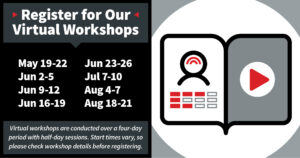
Each virtual US-based Hogan workshop will be delivered over a 4-day span with half-day sessions. Start times vary, so please check workshop details before registering. In addition to the 4-day format for virtual workshops, there is also a mandatory introduction/Zoom orientation call at 3:30 pm EST the Monday before each workshop. The cost to attend the US-based workshops is $2,500.

The Hogan Certification workshop is required for use of our full assessment suite.

This course teaches professionals to interpret and apply Hogan’s three core personality-based assessments at a basic level:

  • Hogan Personality Inventory (HPI): measures the “bright side” of personality; strengths that facilitate successful performance
  • Hogan Development Survey (HDS): measures the “dark side” of personality; potential career derailers that impede performance
  • Motives, Values, Preferences Inventory (MVPI): measures the “inside” of personality; values and drivers that powerfully influence organizational fit and leadership style

Participants attending all four days and successfully completing the workshop will be certified to use and interpret the Hogan inventories. Insights acquired during this intensive workshop will challenge and change the way you think about human nature, leadership and performance.

The Hogan Global Learning team plans to continue offering virtual workshops beyond the dates listed above and will also continue to offer in-person workshops once it’s safe to do so. Click here to register for a virtual Hogan Assessment Certification Workshop today!

Topics: certification

Leveraging Values to Keep Individuals and Teams Engaged

Posted by Hogan Assessments on Fri, Apr 17, 2020

Untitled-1

The world of work, and our individual and collective place in it, has been continually shifting over the past hundred years. But with the current unprecedented global disruption, these shifts have become dramatic and jarring, seemingly redefining weekly what it means to work. Employee motivation has been thrust into the spotlight, and for good reason. People’s motives affect, at conscious and unconscious levels, the way they make sense of and respond to the world around them.

Values act as a lens – they color what we find important and motivating and determine which messages we find inspiring or distasteful. Leaders’ values are especially important in organizations, as they often set the standard for internal communication, impact company culture, and guide reward systems. Their values are conspicuous right now in the ways they communicate with their employees. Left unexamined, leaders’ communications may highlight values-based blind spots and fail to compel their intended audience.

For example, many leaders seem to be trying to inspire their organization by emphasizing the importance of the work itself, couching disruption as something that can and should be overcome, and speaking confidently about their ability to win and emerge triumphant, as seen here in this message from Jeff Bezos to Amazon employees. While these messages may align with that leader’s values regarding competition, winning, and comfort with risk, many individual contributors will not share those values to the same degree. At best such messages may fall flat with a large percentage of the workforce, and at worst they could be disengaging or seem out-of-touch.

In our research on values, as measured by the Motives, Values, and Preferences Inventory (MVPI), there are clear, noticeable differences between leader and individual-contributor populations in the types of communications they are likely to find compelling or aligned with their values. For example, across industries and job families and in comparison with individual contributors across all job families, leaders tend to score higher on Power (valuing authority, top-down influence, impact), lower on Security (valuing risk-taking, limit-testing, experimentation), lower on Altruism (valuing personal responsibility, self-reliance), and lower on Hedonism (valuing professional, formal work environments) than the average individual contributor. This suggests that if leaders could often provide more effective communications by managing their value-based blind spots; they may need to:

  • Curtail the desire to invoke the language of war, winning, and beating the virus
  • Broaden their perspective beyond work and consider issues related to work-life balance; emphasize collegiality and a whole-person focus
  • Provide greater clarity on plans, tasks, and deadlines than they may do naturally
  • Consider how their requests and directions impact the greater good; find more ways to illustrate the higher purpose and link their employees’ actions to beneficial outcomes for others

For example, the message to employees delivered by Arne Sorenson, CEO of Marriott, has received extensive positive media attention and provides values-based messages likely to resonate with a broad array of employees.

Understanding values is key to enabling leaders to connect with individual contributors in ways that are likely to inspire commitment, compel them to put forth discretionary effort, and provide them with a deeper sense of meaning. To learn more about the importance of values, and especially how to leverage values-based communications, join us at 2 p.m. on Tuesday, April 28 for the webinar Leveraging Values to Keep individuals and Teams Engaged. During the webinar, we will dive deeper into values differences between managers and individual contributors and highlight common values differences across functions that may help managers target their communications for the greatest motivational impact.

*This post was authored by now-former Hogan CEO, Scott Gregory, and Hogan Consultant, Amy Sarraf Renshaw.

Topics: teams

Breathing Awareness and Flourishing with Awair’s Webinar Series

Posted by Hogan Assessments on Thu, Apr 16, 2020

Awair

Since the outbreak of COVID-19 became a serious health threat all over the world and everyone was forced to lock up at home in self-quarantine, it was clear that everyday routine – going to work included – was abruptly interrupted for an indefinite period of time.

In this moment of discontinuity and need to forcedly reorganize our own daily activities, many of us have started reading, studying, participating in trainings – activities that until this very moment have been frequently neglected – to fill up all that time that suddenly is free.

Everyone at Awair thought of what their extended community must have been feeling and the need to do something to virtually shorten the distance grew stronger. A webinar series was eventually born to share some knowledge on psychometric tools and Hogan Assessments with a focus on the uncertainty and the stress that comes with it, packed with practical tools to cope with the emerging crisis.

Awair’s series of webinars aims at taking a pause within the pause, to breathe and grow awareness of what is happening around and within us; to reflect and to equip ourselves to cope with the crisis and get ready for the future.

With the support of the Hogan tools, this series represents an excellent starting point to learn more about our own personality, or how we handle stressful circumstances, or how we can re-focus on our deepest values to realign ourselves with our motivations to go on. However, it is also a valuable opportunity to learn new methods to keep “hanging on” in complex situations, or to develop our own way to make sense of an experience and tell the “right” story.

The first episode of this series is “Personality 101”

Dimitra Kakaraki, Senior Consultant of Awair, Psychologist, and Cognitive Behavior Therapist, gives us an overview of Awair’s leadership and potential assessment model based on Hogan’s assessments. She shares the principles of Hogan’s personality analysis applied to the organizational context with strong emphasis on the concept of reputation. This is the kind of evaluation that facilitates growing self-awareness and a deeper understanding our own individual journey.

The second episode is “The Dark Side of Personality: Self-Analysis at the Time of COVID-19”

Andrea Facchini, Partner of Awair, Business Psychologist, and Executive Coach, guides us through the dark side of our personality. Using Hogan’s HDS model, he highlights and illustrates behaviors that emerge in stressful situations that respond to the primal instincts of flight, fight, and freeze and that might derail our business relationships and impact our careers negatively. The COVID-19 pandemic is currently a significant source of stress, and it is good to have someone who helps us navigate them and grow more self-aware.

The third episode is “What Really Matters: The Relevance of Values and Preferences”

Andrea Facchini, Partner of Awair, Business Psychologist, and Executive Coach, gives us a compass so that we do not lose sight of what matters the most to each one of us. Using Hogan’s MVPI model, he facilitates the understanding of what gives us satisfaction and energy or, on the contrary, takes the wind out of our sails and demotivates us.

Under pressure and in wearing times such as these, we might give more importance to basic priorities and to survival instincts, pushing our values and preferences to a far-off corner of our mind, but these represent the beacon that guides the decisions of our lives and wellbeing, of our careers and our relationships, helping us make a sense of everything.

The fourth episode is “Mental Toughness & Resilience”

Andrea Facchini, Partner of Awair, Business Psychologist, and Executive Coach, explores two concepts borrowed from sports “mental toughness” and “resilience.” They echo that kind of attitude that helps champions emerge exactly when everyone else is “slacking off.” He shares some practical tools to develop a mindset able to keep the performance level high, even in the most unfavorable circumstances.

The fifth episode is “Storytelling: A Journey to Self-Discovery”

Alberto De Biasi, Executive Consultant of Awair and Learning and Leadership Expert, starts from an interesting premise: from new challenges, we can always learn something about ourselves, the others, and the world. These times are accelerating the collective process of learning and discovery that needs words to really sink in. Yet, it is not always easy to name emotions, to shape thoughts, to straighten them up, and express them in a clear, engaging, and memorable way. He provides insights on storytelling principles, elements, and techniques to help us tell our stories.

A new season is currently in the making, with more episodes available soon on Awair’s website and social media accounts.

All the episodes are available on Awair’s YouTube channel.

*This is a guest post provided by Awair, Authorized Hogan Distributor. 

Topics: distributors

Subscribe to our Blog

Most Popular Posts

Connect