RECAP: Mentis Hosts 2019 Hogan Summit in Dubai

Posted by Hogan Assessments on Tue, Mar 26, 2019

Mentis Logo

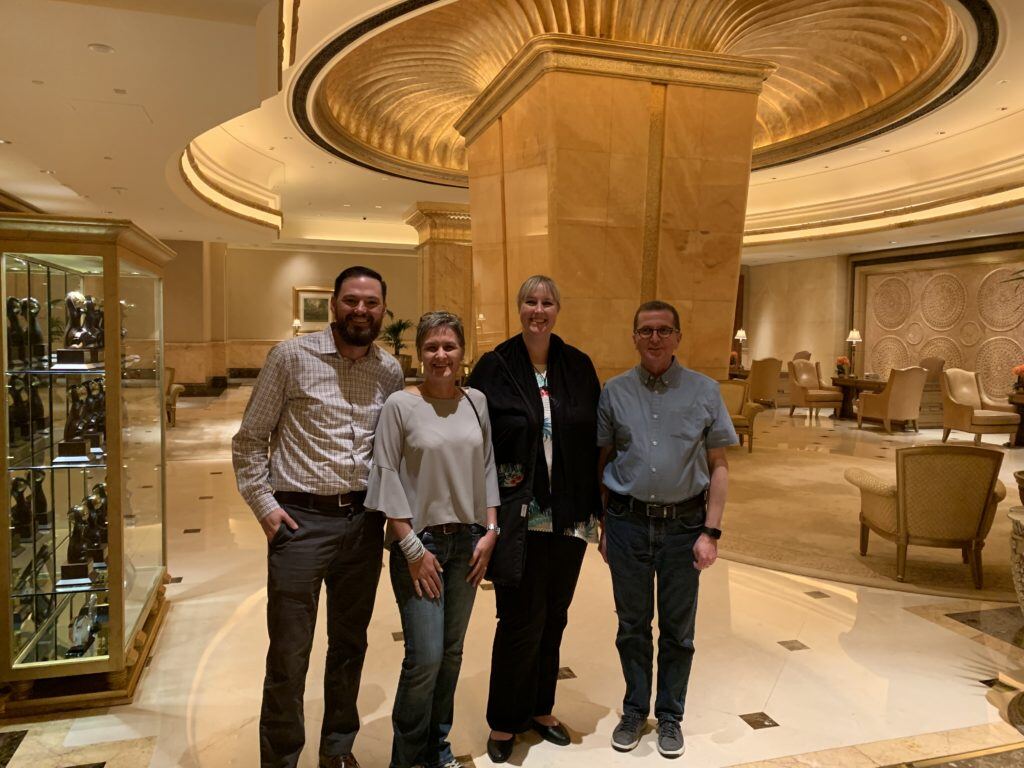
On February 24 in Dubai, more than 70 CEOs, HR managers, executive coaches, and talent management professionals attended the 2019 Hogan Summit, hosted by Mentis, an authorized Hogan distributor since 2003 with operations in the UK, UAE, and Thailand.

The theme of the event was “Identifying and Developing Your Talent Network,” and featured presentations by Andrew Salisbury, CEO of Mentis; Alia Al Serkal, Vice President of People Learning and Growth at Du; Delel Chaabouni, IT Senior Director at PepsiCo AMENA; and Marcus Gee, Consultant at Mentis.

Representing Hogan at the event was Hogan Chairman & President, Dr. Robert Hogan, who spoke about leadership and humility, and Hogan Managing Partner, Ryan Ross, who spoke about employability.

Overall, the event was a huge success in a market where Hogan continues to see rapid growth and increased brand visibility. Here’s a video recap of the entire event. Cheers!

Topics: Hogan, Hogan Assessment Systems, dubai, Hogan Summit

Hogan at SIOP 2019

Posted by Hogan Assessments on Tue, Mar 12, 2019

Hogan at SIOP 2019

I-O experts from Hogan’s Research and Consulting divisions will showcase advances in personality research during an impressive 19 sessions, symposia, panel discussions, practice forums, and poster sessions at the 34th Annual SIOP Conference in Washington DC, April 4-6. Visit us at booth #303. #hoganatsiop

Thursday, April 4

12:00pm

Understanding Curvilinear Relationships in Selection Research and Practice

Chesapeake A-C

Understanding how individual characteristics influence various organizational outcomes, particularly in curvilinear fashion, is crucial for selection research and practice. Five studies are presented that utilize a variety of methods to demonstrate curvilinear relationships between individual characteristics and organizational outcomes. Findings are discussed in a scientist–practitioner framework.

Kimberly Nei, Michael Tapia, Matt Lemming, Karen Fuhrmeister

12:00pm

I Can See Clearly Now: Transparent Talent Management Practices

Chesapeake G-I

Organizations struggle with issues of transparency and talent management practices. Surveys show a mix of practices in terms of disclosure of talent management metrics. More evaluations of transparency are needed to help guide future transparency decisions. This symposium outlines the intermediate-level impact of several talent management practices where transparency was a conscious decision.

Jocelyn Hays

12:30pm

A Longitudinal Examination of How Learning Agility Impacts Future Career Success

Prince George’s Exhibit Hall D

The relationship between learning agility, and performance and learning over time was examined among 78 global leaders. Findings show a significant relationship between learning agility and performance (p < .01) and learning agility and learning (p < .01), but not the rate at which these factors changed over time. These results demonstrate partial support for the hypothesized relationships.

Erin Laxson

1:30pm

Mobile Assessments: Big Considerations for Small Screens (Demo & Discussion)

Chesapeake 7-9

Recent research would suggest that the majority of job searches are originating from mobile devices, often leading to the completion of an application, assessment, or even interview through their smartphone or tablet. Assessment vendors will discuss their recent practical research and strategies for the use of mobile assessments, and opportunities, challenges, and future directions.

Jennifer Lowe

4:30pm

Darkness Around the Globe: Cross-Cultural Differences in Moving Against, Away, and Toward

Prince George’s Exhibit Hall D

Using a geography of personality model, authors use SEM and path analyses to find the degree to which a three-dimensional derailment model of moving away, against, and toward others is transportable across the globe. Using a sample of 26 countries (N = 65,426), authors establish the universality of a dark personality framework and show how characteristics vary across cultural norms and values.

Dan V. Simonet, Kimberly Nei, Brandon Ferrell

4:30pm

Using Personality to Predict Truck Driver Performance

Prince George’s Exhibit Hall D

Authors present two studies demonstrating the value of personality’s role in selecting truck drivers across the transportation industry. These studies focus on relationships between personality and (a) job analysis ratings for truck drivers and (b) overall job performance using meta-analysis. Results suggest that multiple personality scales are important and predictive for truck driver selection.

Matt Lemming, Burkhart Hahn

4:30pm

Using Bright and Dark Side Personality to Predict the Managerial Hierarchy

Prince George’s Exhibit Hall D

Personality similarities exist in the managerial hierarchy, as supervisors advance into manager roles who eventually lead the organization. Using job family meta-analyses with overall job performance, authors investigated bright and dark side personality differences across three managerial job levels. They provide practical implications and discuss areas for future research.

Matt Lemming, Burkhart Hahn

Friday, April 5

8:30am

The Effects of Leader-Follower Relationship and Humor Style on Job Satisfaction

Prince George’s Exhibit Hall D

Authors examined positive humor styles (affiliative and self-enhancing) and group (in-group and out-group membership) and their effects on job satisfaction. Results showed a significant difference between group membership on job satisfaction but no significant difference between humor styles. An interaction between humor styles and group membership was not supported but a main effect was found.

Cody Warren

12:00pm

Job Analytic Comparisons of Sales, Sales Managers, and Leaders Competencies

Prince George’s Exhibit Hall D

This study used data-driven best practices to identify the most critical competencies for three job families: sales, sales manager, and leader. Although subject matter experts rated some competencies as critical across the job families, key competencies were unique to each job family.

Cody Warren, Kimberly Nei, Karen Fuhrmeister

1:00pm

Avoiding Personalized Charismatics: The Incremental Value of Humility over the FFM

Prince George’s Exhibit Hall D

Personalized charismatic leadership (PCL) is known to be particularly toxic to organizations and employees. Humility and the Five-Factor Model (FFM) characteristics were explored as predictors of PCL. Not only did the FFM characteristics largely predict PCL, but humility offered incremental validity, demonstrating the value of including humility in selection criteria.

Dena Rhodes, Georgi Yankov

3:00pm

Challenges Faced by the Testing Industry: Current Trends and Looking into the Future

Potomac 1-2

This session discusses challenges faced by the testing industry (technology, globalization), how the industry is adapting, and future opportunities for applied research. The panel includes applied researchers who discuss how the testing industry is responding to current shifts in assessment methods, future trends that will shape the industry, and implications for I-O professionals.

Kimberly Nei

4:00pm

Honestly, I Have Made Mistakes. But I Have Learned from My Mistakes

Chesapeake D-F

This session will build I-Os identity as a body of professionals who are trying to do the right thing but occasionally fail. I-O practitioners will share mistakes they have made and what they have learned from these situations. Each real-life experience will be framed with the scientific background, the presenting problem, the outcome, and a description of the insight gleaned from the situation.

Robert Hogan

Saturday, April 6

11:30am

How to Coach as an I/O Psychologist (and Whether You Should)

Chesapeake 4-6

This session will present research and experience, grounded information, advice, and recommendations on coaching for I-O academic and applied practitioners who are considering coaching, whether as a new career path or in addition to a full-time job. Topics will include the current landscape of coaching, exercising the scientist–practitioner model, barriers to entry, money, and how to get started.

Karen Fuhrmeister

12:00pm

The Impact of Extreme Responding on Sliding Scales

Prince George’s Exhibit Hall D

Authors explore whether individuals who use sliding scales are likely to resort to extreme responding (ER) techniques. Some ER may reflect genuine individual differences; however, research suggests those who use ER are attempting to conserve resources and/or manage others’ impressions. They investigate how ER may influence personality, performance, and relationships between variables.

Dena Rhodes

12:30pm

Toothless Shark Tank for I-O Psychologist Entrepreneurs IV

Maryland D

I-O psychologists who want to commercialize their knowledge often need feedback from experienced folks who understand both the science and the business of I-O psychology. Using a format similar to the popular TV show, this session will improve upon the tradition from previous conferences by preselecting and coaching entrepreneurial I-Os to pitch their ideas to legendary I-O entrepreneurs.

Robert Hogan

1:00pm

Robust Importance and Personality Predictors of Ethical Behavior Across the Workforce

Prince George’s Exhibit Hall D

The organizational literature takes for granted the broad importance of ethical behavior in the workforce. Authors examined job analysis results for 563 organizations from across the globe to provide empirical evidence of the robust criticality of ethics. They then meta-analyzed local validation studies to identify general personality-based predictors of important ethical behaviors.

Chase Winterberg, Kimberly Nei

3:00pm

Building a Competency Taxonomy: A Personality-Based Cluster Analytic Approach

Prince George’s Exhibit Hall D

To understand the underlying structure of common workplace competencies, authors analyzed personality predictor–competency criterion validity coefficients using hierarchical clustering. A 2-level, 4-domain, and 8-subdomain competency framework was uncovered. Uses and implications of such a competency framework are interpreted and discussed.

Brandon Ferrell, Kimberly Nei, Steve Nichols

3:00pm

Using Personality to Predict Stress Tolerance in Sales Personnel

Prince George’s Exhibit Hall D

Stress tolerance differs from person to person and is an important component of sales performance. Using synthetic meta-analyses of job components, authors investigated personality relationships with stress-related competencies rated important for performance. They provide practical implications and discuss areas for future research on personality’s impact on how sales people handle job stress.

Michael Tapia, Matt Lemming, Kimberly Nei, Karen Fuhrmeister

3:00pm

Content Analysis of Adverse Impact Litigation in Selection and Promotion: 2010-2018

Prince George’s Exhibit Hall D

Employment disputes cause organizations to incur enormous legal costs. Notwithstanding psychometric quality, it is useful to know which practices are more likely to be the subject of legal challenge. A content analysis of adverse impact litigation in the U.S. was conducted to assess the rate at which various selection and promotion procedures lead to legal action and the outcomes of such cases.

Chase Winterberg, Michael Tapia, Kirby Hockensmith

Topics: Hogan, Hogan Assessment Systems

Hogan Visits Singapore

Posted by Hogan Assessments on Thu, Mar 07, 2019

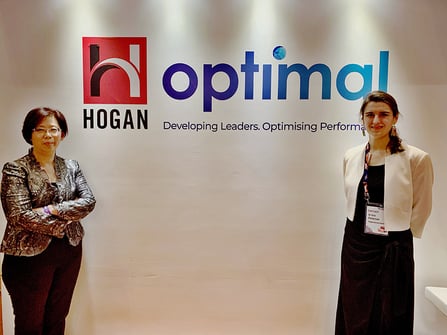
opt_4

The Hogan team including Dr. Robert Hogan, Ryan Ross, Wendy Howell, and Krista Pederson joined Hogan distributor Optimal Consulting in Singapore last week for two days of events.  On February 28, Hogan and Optimal cosponsored the HR Tech Conference in Singapore which covered topics related to digital technology, AI, and maintaining a future outlook for the HR Industry in Asia. As the keynote to the conference, Dr. Hogan spoke on Personality and the Fate of Organizations and presented an elite invite-only session on Identifying the Future-Oriented High Potential. Ryan Ross led a panel about Skilling Your Workforce from 3.0 to 4.0, and Krista and the Optimal team held further discussions about Hogan at the Hogan Optimal booth.

Following up with the topic of Technology and the HR field in Asia, Dr. Hogan presented on Digital Leadership at an exclusive event held by Optimal on March 1. He discussed about how the characteristics for good leaders including Integrity, Competence, Judgment, and Vision, do not change based on technology. He maintained that these characteristics are essential for growing and maintaining high performing teams. He warned, however, that if leaders do not pay attention and adapt to new technology, these leaders will quickly fall by the way side.

Taking a deeper dive into one of these important leader characteristics, Ryan Ross presented on Judgment and how leaders can learn from their mistakes. He maintained that making bad decisions are a part of the learning process; however, what is most important is the ability for a leader to learn from her mistakes and move forward.

After a lively Q&A session entitled “Ask Bob and Ryan Anything,” Ryan presented on the topic of Safety. He explained how personality is an essential factor to safety in the workplace that has been overlooked in traditional behavioral-based safety programs and protocols. He explained the importance of incorporating personality data from the start as part of overall safety training and provided keen insights on how to implement personality as an essential element to any company’s safety program.

Hogan has been partners with Optimal in Singapore for over 13 years and is a key Hogan Distributor across the East and Southeast Asian markets. We look forward to continued cooperation with Optimal and greater brand awareness and growth for Hogan across the Asia markets.

The Unforeseen and Unintended Consequences of Bans on Personality Testing

Posted by Ryne Sherman on Fri, Mar 01, 2019

Are personality tests legal

On February 13th, the Nevada assembly heard a proposal for a new bill, Nevada AB132. The bill itself is only 2.5 pages long and is pretty easy to read, but effectively has two parts:

  1. Making it unlawful to deny employment on the basis of a marijuana screening test
  2. Making it unlawful to condition employment on the completion, or results, of a personality test

The first part of the bill concerning pre-hiring marijuana testing has received a fair amount of local news coverage, and is outside of my areas of expertise. However, I will say it does seem odd that one can be excluded from a job for testing positive for a drug that is recreationally legal in the state. If an alcohol test could determine if you drank alcohol at any time over the past, say 30 days, should people of legal age to consume alcohol be excluded from jobs on the basis of that test result?

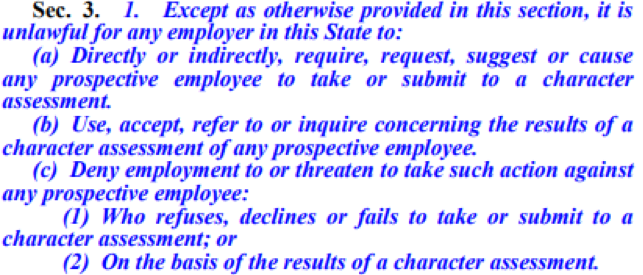
The second part has received far less attention, but is nonetheless disturbing. The key part of the bill reads:

Picture1

In other words, this is a ban on using personality assessments for the purposes of employee selection.

What does this have to do with marijuana screenings you may ask? At face value, very little. However, one of the bill’s sponsors, Assemblyperson Dina Neal, provided some insight in a recent interview:

Neal said she had a constituent who applied for a retail association position to stock shelves and was subjected to a 50-question character assessment, which prompted her to add the provision to the bill.

Neal said she is willing to work to address concerns. “I’m open to finding a solution,” she added. “The solution needs to lead to people finding a way to get a job, not the opposite.”

Clearly, the intention of this bill is to remove barriers for employment. I fully support the intention of the bill. However, if this bill is passed Nevada will suffer a number of unintended consequences. To understand why, consider the following two points:

  1. All employers must make employment decisions. These decisions can be based on many things: a coin flip, a dream, a lie detector test, an interview, a behavioral test, resumes, references, a personality assessment, etc. Obviously, some of these methods are more valid at predicting job performance than others (e.g., a coin flip is random, a lie detector has no validity). The validity evidence for personality assessments is overwhelming and undeniable. A meta-analysis by Barrick and Mount (1991) showed this definitively nearly 30 years ago. Since then, the validity evidence for personality has only grown more massive and more convincing (e.g., personality and workplace safety; an update of Barrick and Mount). Our own data show that when personality assessments are properly aligned with job performance criteria, personality predicts job performance as well as any cognitive ability assessment (curiously, cognitive ability assessments were not mentioned in the bill at all) and better than interviews. The evidence is quite clear: if one is making an employment decision, well-validated personality assessments based on scientific principles provide useful predictive insights into the candidates potential job performance.
  2. Personality assessment for the purposes of employment selection largely came as a response to the Civil Rights Act and the creation of the EEOC. Virtually all personality assessments do not discriminate on the basis of sex, gender, sexual orientation, race, religion, or age. The same is not true of interviews, resumes, or reference requirements. Additionally, while scholars debate about whether or not cognitive ability tests are discriminatory or not, it is factually true that scores on cognitive ability test do tend to show adverse impact. In this regard, well-validated personality assessments offer both a high degree of predictive validity and virtually zero discrimination. Simply put, if all hiring decisions were based on personality assessments alone, employment discrimination on the basis of gender, race, etc. would cease to exist.

In summary, personality assessments provide employers with an unbiased evaluation of a candidates work potential and job fit. When used properly, such assessments give historically discriminated against groups (e.g., women, minorities, elderly, etc.) a fair playing field in the application process. This bill would eliminate that and, presumably, leave employers with only interviews and cognitive ability tests as their main resources. The former is well-known to be biased (especially against such groups) and the latter shows marked group differences.

The Nevada Assembly person sponsoring this bill clearly have the best of intentions in mind. However, they do not fully understand the consequences this bill – if passed – will cause for groups who have historically been the targets of discriminatory hiring practices. In this regard, AB132 reflects a failure to educate our lawmakers about the value of personality tests in terms of validity and fairness.

Want to learn more about personality tests? Check out The Ultimate Guide to Personality Tests

Topics: personality

Don’t Miss Early-Bird Registration for RELEVANT´s “JAM SESSION” in Frankfurt

Posted by Hogan Assessments on Tue, Feb 19, 2019

relevant_logo_RGB

Time is running out to register for RELEVANT´s JAM SESSION in Frankfurt, Germany, at a discounted price of EUR 79 plus VAT. The early-bird registration is open until February 28, with the price increasing to EUR 99 plus VAT on March 1.

The event, hosted by RELEVANT Managementberatung, an authorized Hogan Assessments distributor from Germany, will be held on July 4 and will also feature presentations by corporate and consulting experts. Moreover, they will welcome Dr. Robert Hogan as well as Hogan CEO, Dr. Scott Gregory, as special guests who will also be on stage.

RELEVANT’s interactive session, “New Leadership? Authentic in Turbulent Times,” provides the opportunity for all RELEVANT customers, partners, and friends to come together, learn from case studies, and discuss how leadership in times of continued transformation might change, how it affects managers, and how managers can be supported addressing turbulent times in a way that is true to their personality.

Space is limited, so register here today

Topics: Hogan, Hogan Assessment Systems, Bob Hogan, Germany

Personality Assessment and Performance Management

Posted by Hogan Assessments on Tue, Feb 12, 2019

Performance Management

A critical task for leaders is to ensure that their followers are working efficiently toward the organization’s goals. In business, employees whose work is aligned with the organization’s objectives are more productive. So-called “performance management processes” are intended to create alignment between the employee’s work and the organization’s goals. A typical performance management process might include planning and setting goals, monitoring progress toward those goals, development and improvement, and periodic performance appraisals (or reviews). These performance management processes could be substantially improved by the use of personality assessments.

Personality is related to every meaningful individual difference. Scientifically validated personality assessments can predict substance use and abuse, longevity, relationship satisfaction, job performance, criminality, and occupational choice, just to list a few examples. Beyond these applications, well-validated personality assessments provide individuals with insights into their own motives, reputations and destructive behaviors, many of which they may not be aware of. Employees can use such strategic self-awareness to modify their behaviors at work to be more in line with the expectations of management. Consider the following (real) example.

Using Personality in Performance Management 

Maria is 36 years old and joined her company when she graduated from college. Since her first day on the job, she has been one of the top performers and has rapidly progressed to an upper-level management position. Senior managers have identified her as high potential, and she is in line for the next opening in the C-suite. Her stated goal is to reach the C-suite by age 40. While her superiors see her as a top performer, some of Maria’s co-workers and subordinates see her as pushy, overbearing and having unrealistic expectations for her staff. Some of her staff indicated that they did not like the “within-team” competitions Maria set up to motivate performance. A few suggested that they did not particularly like working for Maria and that they would consider leaving their positions with the company.

As part of her performance management plan, Maria completed a well-validated personality assessment. The assessment consisted of three parts: Maria’s drivers and motivators; her reputation or everyday behavior; and the “dark side” tendencies, or de-railers, that detract from her performance. Her scores on drivers and motivators indicated that Maria was motivated by competition, the thrill of winning and taking charge of situations. Her reputational scores indicated that other people perceive Maria as ambitious, leaderlike and competitive. Finally, her dark side scores indicated that Maria was prone toward risk-taking behavior and overconfidence.

Post-assessment, Maria met with a certified assessment user to discuss her results. During the session, she learned that she sees the world differently than others, particularly her subordinates. While Maria values competition, she learned that other people – particularly many of her subordinates – find competition off-putting and uncomfortable. This knowledge helped Maria better understand why her superiors viewed her differently from her subordinates. More importantly, it helped her develop a plan for behavioral change. Specifically, Maria now begins meetings with her staff by listening to them. This approach allows her staff to set their own expectations and Maria to use them as a starting point, rather than setting unrealistic expectations. While Maria was encouraged to retain her own competitive drive, she has removed the within-team competition and replaced it with both individual and team-based goals for performance.

Overall, Maria found the experience of taking personality assessments and receiving feedback on them to be beneficial. They helped her learn about her hidden biases and how they were affecting her workplace performance. The strategic self-awareness Maria gained by taking personality assessments was a critical part of her performance management, as it helped her perform better as a leader, thereby better aligning her behavior with the company’s goals.

Want to learn more about personality tests? Check out The Ultimate Guide to Personality Tests

*Photo by Thomas Drouault on Unsplash.

*This article was authored by Hogan Chief Science Officer Ryne Sherman, and was originally published by Training Industry on December 10, 2018.

Topics: personality

Diversity and the Dark Side

Posted by Hogan Assessments on Tue, Feb 05, 2019

andrew-hughes-262054-unsplash

Diversity in the workplace remains a top concern for HR professionals and hiring managers. Changing the hiring process is a necessary step in preventing discrimination and keeping ahead of the competition —  a recent study from the Center for Talent Innovation found workplaces that ensure diversity enjoy more success and attract more innovative employees than workplaces that don’t.

However, any institutional change will fail if leaders and hiring managers aren’t driven to build a climate that encourages diversity. It’s not always easy to spot those who will let their biases negatively impact those around them, but early research suggests those with high Bold and Excitable scales might not foster inclusive environments.

Hogan’s in-house research team is always looking to find new applications for our assessments. With that in mind, Brandon Ferrell and Steve Nichols conducted a meta-analysis of results from four Hogan Development Survey (HDS) studies to measure which personality scales hinder leaders’ ability to leverage diversity.

To search for these diversity-derailing characteristics, our researchers examined four studies with HDS data from 443 managers and executives. They compared this information with subjective ratings of the Leveraging Diversity competency from the Hogan Competency Model.

Of the 11 scales in the HDS, Ferrell and Nichols found only those who scored highly on the Bold and Excitable scales were less likely to “leverage diversity.” Although concrete explanations for this negative relationship are somewhat speculative, one suggestion from Ferrell and Nichols is that leaders scoring high on Bold may hold excessive self-worth and view individuals in other categories as less attractive in order to build their ego.

As for the Excitable scale, the authors suggest that leaders with high Excitable scores (who generally are more sensitive to criticism) may more easily perceive a person’s behavior as critical or antagonistic when that person is dissimilar demographically from the leader. This tendency, if acted upon, might give people with high Excitable scores a reputation for being poor promoters of diversity.

This line of research is just a start, as four studies and 443 participants aren’t enough to start widely generalizing. As the report concludes, future research could start to examine just how over-confidence or emotional volatility work against workplace diversity. The full report, which was presented during the 2018 Society for Industrial and Organizational Psychology annual conference, is available to read here.

Topics: DE&I

Hogan Sponsors the MEA-ATP in Abu Dhabi

Posted by Hogan Assessments on Mon, Feb 04, 2019

IMG_3411

The Middle East and Africa Association of Test Publishers (MEA-ATP) held their inaugural conference entitled “Education Technology in the Middle East and North Africa: Unlocking Student Potential,” in Abu Dhabi on January 28-30. As a gold sponsor, Hogan sent now-former CEO Scott Gregory, Senior Consultant Darin Nei, and Director of Asia Pacific Business Development, Krista Pederson to attend and present on various topics along with several of Hogan’s distributors in the region, including Career Connections in Kenya, Mentis in the UAE, UK, and Thailand, Baltas in Turkey, and JvR Africa in South Africa.

Scooping up the first speaking session of the day, Scott and Krista presented Hogan’s take on using personality to assess General Employability, while Madeleine Dunford of Career Connections, and Andrew Salisbury of Mentis, followed by sharing Hogan case studies.

910856584

During the next session, Darin and Scott discussed the merits of Competencies and how Hogan maps them, while Nicola from JvR Africa, and Ekin Capar from Baltas, shared Hogan competencies case studies from South Africa and Saudi Arabia.  Hogan Distributor JvR Africa also made an additional three presentations across the course of the conference.

Some strong themes from the conference included Technology and how to use technology to further advance the assessment market in education and all other fields; General Employability, especially the need to assess student graduates and other entry level employees on this; and Education Assessment, and how to use assessment to promote further development of the field of education. During the conference, Senior Officials from the UAE announced the launch of MESA, the Moral Education Standardised Assessment, becoming the first nation to implement standardized testing for moral education.  

Hogan is a long-time sponsor of the Association of Test Publishers (ATP), supporting various events across the word including the main “Innovations in Testing” conference each year in the US; the E-ATP conference held in Europe each year; and smaller events organized by the Asia-ATP steering board. 

Topics: Hogan, Hogan Assessment Systems, Darin Nei

Get Hogan Certified in 2019!

Posted by Hogan Assessments on Tue, Jan 29, 2019

Banner Image

Whether getting Hogan certified is one of your New Year’s resolutions or something you’ve been planning to cross off your bucket list, there are several Hogan Assessment Certification Workshops planned throughout the United States in 2019. By completing this two-day program, you will be able to administer and interpret Hogan’s three core assessments: the Hogan Personality Inventory, the Hogan Development Survey and the Motives, Values, Preferences Inventory.

If you are already Hogan certified and want to hone your feedback skills, you should consider registering for the Hogan Advanced Feedback Workshop, previously known as Hogan Level 2 Certification. This one-day workshop was designed for practitioners who want to receive more extensive instruction and opportunities to practice delivering effective feedback.

In addition, Hogan certified users can now register for the newly-developed Hogan Advanced Interpretation Workshop. This one-day workshop was designed for practitioners who want to gain more advanced instruction and practice on how to interpret Hogan assessment profiles. Attendees will also gain a deeper understanding of how to extract maximum interpretive value from Hogan scales and subscales.

The workshops will be offered in multiple cities across the United States throughout 2019, with the advanced workshops occurring on the third day. Participants can complete the Hogan Assessment Certification Workshop during the first two days with the option to attend either the Hogan Advanced Feedback Workshop or the Hogan Advanced Interpretation Workshop on the third day. Each of the two, one-day advanced workshops are also available upon request for those who have previously completed the Hogan Assessment Certification Workshop. Hogan certified users can email training@hoganassessments.com to register for an advanced workshop separately.

Click here to learn more about Hogan’s three certification programs.

Topics: Hogan, Hogan Assessment Systems, Hogan Certification Workshop, Hogan Certification

WEBINAR: Talent Quarterly to Discuss Humble Leadership with Ryne Sherman

Posted by Hogan Assessments on Tue, Jan 29, 2019

TQ20 Webinar 1 Social-03

At Hogan, we work with organizations every day to help them identify effective leaders using a data-driven approach leveraging the predictive power of our personality assessments. To ensure our services are the best in the business, we have spent decades studying successful and failed leaders.

Our data show that three psychological factors have a profound influence on leadership effectiveness: charisma, narcissism, and humility. Charismatic and narcissistic CEOs have plagued organizations for decades. However, their strong political skills and ability to stand out from the rest of the pack have helped them emerge as leaders within their organizations. On the other hand, humble leaders often go unnoticed, largely because they focus primarily on their teams and not drawing attention to themselves, but research shows they are more likely to be effective leaders.

Join Ryne Sherman, chief science officer of Hogan Assessments, for a webinar hosted by Talent Quarterly 10 am EST on Monday, February 14 as he discusses these three leadership qualities and why “The Charismatic CEO is Dead.” Register here!

Topics: Hogan, charisma, Hogan Assessment Systems, charismatic CEO

Subscribe to our Blog

Most Popular Posts

Connect