Advanced People Strategies and CRF Explore Implications of Digital Disruption

Posted by Hogan Assessments on Fri, Jun 07, 2019

Advanced People Strategies (APS), authorized Hogan distributors for the UK, has once again, teamed up with Corporate Research Forum (CRF) to explore the implications of Digital Disruption for leaders and leadership development.

APSLogo2018-02

We live in an era of digital disruption, characterized by the rise of digital technology, the emergence of new competitors, reshaping of traditional industry rules and boundaries, which brings with it an accelerating pace of change and increasing complexity. For organizations, future success and business sustainability rely on the ability to adapt to these changes. To succeed in this new economy, organizations are having to build the capacity for fast innovation underpinned by:  

  • Agility: The ability to anticipate changing market conditions and adjust quickly.
  • Rapid decision making and prototyping through collaborative team working.
  • A culture of curiosity, experimentation, and learning.
  • A tolerance for risk.
  • Pragmatic vision and the skill to devise corresponding objectives, boundary parameters, key results, and metrics that matter.

Leaders need to both develop these capabilities themselves and foster them within their organization. In short, leadership must evolve in response to the changing context. 

The research report explores the implications of the Digital Age specifically for leadership and leadership development. We examine how the role and expectations of leaders are changing in the Digital Age and review the implications of these changes for leadership development practices. 

Interested to read the report? Contact APS today!

*This post was authored by the Corporate Research Forum.

VIDEO: Michal Kosinski, Pioneer of Measuring Personality in the Digital Age, Speaks in Tulsa

Posted by Hogan Assessments on Tue, Jun 04, 2019

Hogan was honored to host a special event on May 21 featuring Stanford University Professor Michal Kosinski, a world-renowned data scientist and psychologist.

Remember Cambridge Analytica? You know, the political consulting firm that mined personal data from Facebook users without their consent to influence the 2016 Presidential Election? Well, Kosinski was the data scientist who first demonstrated one’s Facebook “likes” can predict their personality better than friends or family.

Kosinski had been warning the public of the risks and challenges brought by the digital revolution long before Cambridge Analytica’s inception, and he turned down an opportunity to work with the organization because of the legal and ethical implications that were inevitably to follow. Since then, his research has been brought to the forefront, including a cover story for The Economist, an interview with Fareed Zakaria to discuss the role of big data in the 2016 election, and he authored an op-ed in the New York Times about how Facebook sells data despite its claims.

Here’s the full-length video of Kosinski’s presentation in Tulsa:


Topics: Hogan, Hogan Assessment Systems, cambridge analytica, data scientist

VIDEO: Hogan’s Karen Fuhrmeister Delivers TEDx Talk at University of Tulsa

Posted by Hogan Assessments on Tue, May 21, 2019

KFuhrmeister_highres

Have you ever taken a Buzzfeed quiz to tell you what Harry Potter house you’re in? Or maybe what character from The Office you are most like? How much weight do you put on the results of those quizzes? Would you want companies making hiring decisions based on similar assessments?

In March, Hogan Senior Research Consultant Karen Fuhrmeister gave a TEDx Talk at the University of Tulsa on “The Science Behind Hiring Assessments: It’s Not a Waste of Time.” The talk aimed to inform students and other attendees about the use of personality assessments in the workplace, and how this trend isn’t going away any time soon. In fact, it’s becoming more and more likely that those going through the interviews will be asked to take one of these assessments.

In this TEDx Talk, Karen explains why these assessments are important to both the organization and the individual, and not just a waste of time.


Topics: Hogan, Hogan Assessment Systems

CEO Assessment and the Performance of Portfolio Companies

Posted by Hogan Assessments on Wed, May 15, 2019

rick-tap-110126-unsplash

In the final analysis, business is about money and people. By definition, successful private equity firms understand finance, but on average they tend to be less sophisticated about people issues. This makes sense: deal partners and analysts are trained in finance and are good at spotting undervalued assets. But savvy private equity players also understand that reviving an underperforming business depends to a large degree on people issues—in particular, it depends on the leadership of the portfolio company and its working relationship with new ownership.

Considerable evidence suggests that PE firms could do a better job evaluating the ability of the leadership team in their acquired companies. A recent survey by Alix Partners found that nearly three-quarters of portfolio company CEOs are removed during the investment life cycle. Over half are replaced in the first two years; but only 15% are replaced at the outset. These data suggest that, for 4 out of the 5 replaced CEOs, the decision takes too long, thereby delaying strategic milestones and prolonging the hold time.

PE firms can more quickly realize returns on their investments if they analyze the leadership of the companies they acquire with the same rigor that they analyze the business fundamentals during the diligence phase. The good news is that there is a science to analyzing people and the same discipline that is used to identify untapped business value can be used to evaluate the leadership potential of CEO candidates.

Barking up the Wrong Tree

In our experience working with PE firms, the conventional wisdom regarding what to look for in portfolio company CEOs can be misleading. People assume that brains and experience are crucial. But it turns out that IQ and prior industry and CEO experience do not predict the ability to lead through a profitable exit. For instance, a recent survey of managing partners at 32 PE firms (including Blackstone, KKR, and Carlyle) revealed that experience as  a CEO in a publicly traded firm does not prepare people for success in the intense PE environment. The data also showed prior industry experience predicts the tendency to run the same playbook rather than driving radical change typically required.

The experience factors associated with successful leadership of a portfolio company include having worked in a PE environment and having previously performed a similar transformation. This doesn’t necessarily mean having been a portfolio company CEO before; having held a big job in a PE environment is enough to appreciate the pace, the sense of urgency, and the need to be in close communication with ownership about everything from strategic direction to performance details. And a track record of having performed the same task successfully—whether that be cutting costs, growing revenues, managing debt, raising capital, going digital, expanding channels, or what have you—bodes well for doing it again and quickly. 

Soft Skills Make the Difference

Beyond PE experience and task experience, the factors that best predict the ability of CEOs to lead to a successful exit are found more on the soft side than the hard side. And this is where it can be challenging for financial experts: understanding people is different from understanding balance sheets. However, people differ in certain regular and quantifiable ways and research has shown which differences make a difference when leading a portfolio company. They fall into two general categories.

The first category contains the personal factors common to most successful PE CEOs. They include:

  • The ability to build and lead a high-performing team with complementary strengths
  • A tough-minded temperament with a sense of urgency
  • Resilience—the ability to recover from the inevitable setbacks
  • The willingness to admit problems and face difficult realities without spinning or sugarcoating them

PE environments usually have limited resources, which points to the need for versatile chiefs with a broad range of expertise and skills. But versatility is a rare commodity. Less than 10% of senior leaders are able to consult with their staff in decision making while still being able to act acting decisively, or pay attention to the big picture while also attending to the day-to-day details. Successful portfolio CEOs need to be able to recognize their limitations and staff accordingly; they also need humility in order to turn their staff loose. It’s a complex set of capabilities, which accounts for the staggering number of CEOs who are replaced.

The second category of differences concern the chemistry between the CEO and PE ownership. The big issue concerns compatibility: can the CEO and primary deal partner agree on performance expectations, communication cadence and content, and other, often unspoken, rules of engagement? This is about far more than “liking” each other; it more about mutual respect and trust. Establishing a short-hand vocabulary, sharing values, and minimizing surprises is very important in a fast-paced, pressure-cooker environment.

The Science of Personality

Many people tend to think that personality tests are on-line questionnaires or magazine quizzes designed to tell them about their “type,” “color,” or the house at the Hogwarts School of Witchcraft and Wizardry into which they would best fit. However, there is a science of personality assessment based on research going back over 100 years. It isn’t rocket science, it’s behavioral science—and it leads to solid, dependable results. The evidence is clear that personality assessment powerfully predicts real life behavior; hundreds of studies with hundreds of thousands of working adults show that competently constructed personality measures predict performance with surprising accuracy. Properly validated personality measures predict job performance, career success, and leadership better than any known alternative, including IQ.  Personality is stronger than Viagra: the correlation between personality and leadership is stronger than the correlation between Viagra use and improved sexual functioning.

Moreover, well-designed personality assessments can forecast an individual’s ability to build a team, make tough calls, handle pressure, and be candid, flexible, and humble. Being able to penetrate the veil of self-presentation is important because sitting CEOs are likely to be on their best behavior during the courtship phase of an acquisition. There is a big difference between people at their best—what we call “the bright side” of personality —and people under sustained pressure when you see their “dark side”—the behavioral tendencies that derail teams and careers.  For example, over time confidence can turn into arrogance, collaboration morphs into appeasement, and passion and a sense of urgency turn into erratic tantrums. Personality testing is especially useful when evaluating possible replacement candidates, because you will often have little direct exposure to the person yourself and smart people can conceal their dark sides for short periods of time.

Personality testing is also effective at determining the compatibility between people. It’s the basic theory and measurement system behind successful online dating platforms, and it can also be applied effectively to working relationships. In addition to predicting how well two peoples’ interpersonal, thinking, and communication styles will mesh, personality assessment can also predict how people are likely to rub each other the wrong way and push each other’s hot buttons. Perhaps most importantly, a comprehensive personality assessment that includes core values can identify whether people are aligned in what they really want—versus likely to be working at cross purposes. In a PE context, for example, it is vital that the CEO and the primary deal partner agree about core values—i.e., about the relative importance of money, status, fame, relationships, and pleasure.

Managing Risk on the People Side

Assessing the personalities of CEOs and their leadership teams should be a routine part of doing diligence on a potential acquisition company. On the one hand, evaluations of the leaders’ work histories can indicate whether they understand the pressures of PE environments and if they know how to execute the sorts of changes needed to realize value. This tells you whether people can do the job on paper. Similarly, personality assessment will provide a sense of what it would be like to work with them—how they will do the job once in office, what it will be like to have them in your life. It is interesting to note that most failures of leadership are less about a deficiency in what they know and more about how they prioritize time, focus attention, and interact with key people. And the most important interaction of all is between the CEO and the primary deal partner; with so much at stake, it’s best to understand how this relationship will work at the start, including how it could go wrong and how to manage it when things get tense.

*This post was co-authored by Robert Hogan and Rob Kaiser, and was originally published by Hunt Scanlon Media.

Topics: leadership development

VIDEO: Dr. Adrian Furnham Makes Special Visit to Hogan HQ

Posted by Hogan Assessments on Mon, May 13, 2019

The Hogan team recently hosted Dr. Adrian Furnham at its global headquarters in Tulsa for a special visit. As one of leading personality psychologists in the world, Furnham has a been a vocal advocate of using Hogan for decades. He regularly points to Hogan in media interviews and articles as the most accurate predictor of workplace performance in the world, and he also was a key figure in the 2014 documentary, The Science of Personality.

As part of his visit, Dr. Furnham delivered a special presentation to the Hogan team highlighting the research he’s been doing. Here’s the full-length version of his talk:

Topics: Hogan, Hogan Assessment Systems

News from India

Posted by Hogan Assessments on Mon, May 13, 2019

3FI

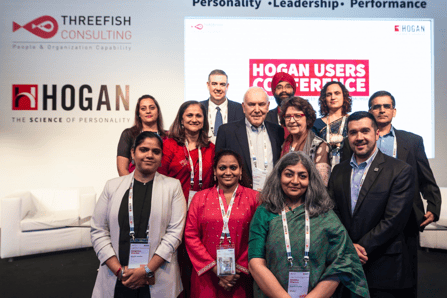
India’s financial and commercial capital, Mumbai, played host to the inaugural Hogan Users Conference organized by ThreeFish Consulting, the Master Distributor for Hogan Assessments in India on February 27th. The series aims to provide an ideal platform for the Hogan Users Community in India to interact with luminaries in the field of leadership and talent development from India along with key global Hogan practitioners and leaders.

The inaugural Hogan Users Conference focused the spotlight on the interrelationship between personality, leadership, and performance, and featured panel discussions covering a wide range of topics. The list of speakers featured luminaries in the field of leadership and talent development from India along with key global Hogan practitioners and leaders, including Ryan Ross, Managing Partner, Hogan Assessments; Dustin Hunter, Practice Manager, International Distributors, Hogan Assessments; and Gus McIntosh CEO, Winsborough Consulting, the New Zealand Hogan Assessments distributor. Delegates also engaged in some post-lunch fun during the Fireside Chat session, when they shared some interesting stories using fun props!

The highlight of the conference was undoubtedly the Keynote Address delivered by Dr. Robert Hogan, who held the audience spellbound with his perspective on why organizations should look for humility and not charisma in leaders.

More than 100 Hogan practitioners, business leaders, HR leaders, and consultants in the talent management space attended the conference. The event was a huge success!

ThreeFish Consulting is now looking forward to welcoming Ryan Ross back to India for a series of Breakfast Roundtable events in July and TechHR 2019.

*This post was provided by Indrani Gupta of ThreeFish Consulting.

Topics: Hogan, Hogan Assessment Systems, Dustin Hunter, Hogan Users Conference, Gus McIntosh

RELEVANT’S and Odgers Berndtson´s JAM SESSION in Frankfurt to Feature Robert Hogan and Scott Gregory

Posted by Hogan Assessments on Mon, Apr 29, 2019

JamSesion Odgers Posting 04072019_EN

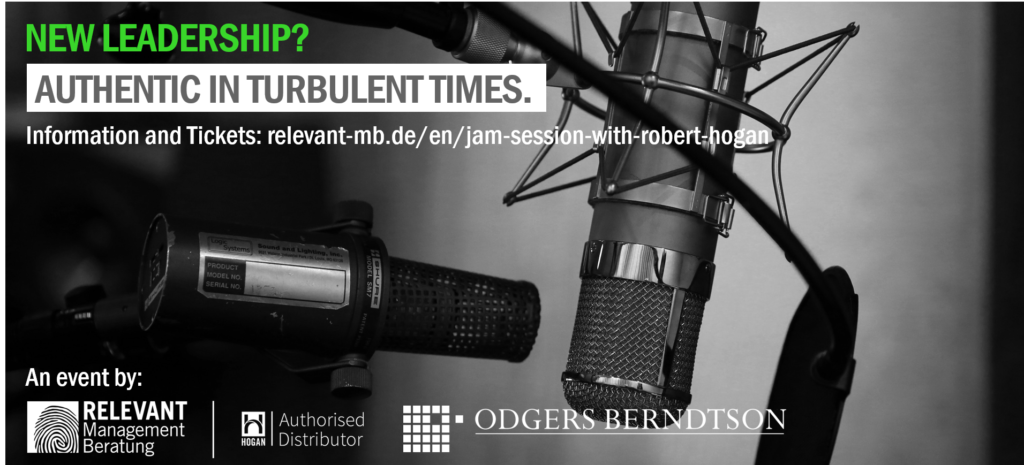
RELEVANT Managementberatung and Odgers Berndtson will host a JAM SESSION on July 4 in Frankfurt featuring Hogan Assessments Chairman & President Dr. Robert Hogan and former CEO Scott Gregory as speakers.

The theme of the event is “New Leadership? Authentic in Turbulent Times,” and aims to provide an opportunity for all RELEVANT and Odgers customers, partners, and friends to come together, learn from case studies, and discuss how leadership in times of continued transformation might change.

With New Work expected to change everything, leadership faces completely new challenges. It is clear that there is insecurity in executive search and selection, management development, and career planning about which success factors from the past (may) still apply in the future and where new approaches are necessary. Even current managers are asking themselves whether they are fit for the future. Therein lies the purpose of this event: What can we learn from the past and how can leaders be successful and authentic in the future?

In addition to Hogan and Gregory, other featured speakers for talks and interactive breakout sessions at the event include RELEVANT Managing Director Rene Kusch, Daniel Nerlich of Odgers Berndtson, Dr. Niklas Friedrich of Vodafone, Jana Schlinsog of Daimler, Dr. Matthias Lichtblau of CMS Legal Services EEIG, Sebastian Henrichs of Fondsdepot Bank, Dr. Kevin-Lim Jungbauer of Beiersdorf, and Marcus K. Reif, one of Germany’s leading HR thought leaders.

We do hope that our friends in Germany and throughout Europe are able to attend this very special event. The price to attend is €99 plus VAT, and you can click here to register. We’ll see you there!

Topics: Hogan, Hogan Assessment Systems, Germany, RELEVANT, Frankfurt

Unconscious Bias, Real-World Impact

Posted by Hogan Assessments on Thu, Apr 11, 2019

*This is a guest blog post authored by Melvyn Payne, Commercial Director of Advanced People Strategies.

I was recently asked to support a successful senior leader – Chris – with some personal development insights from a recent 360 and set of Hogan Assessment results. Chris works in a fast-paced retail environment and has very high expectations for business success.

Having quickly achieved senior roles at a younger age than most colleagues, Chris finds it hard to understand why the broader management team and staff do not seem to respond to stretching targets. Very concerned about the potential negative impact on results, Chris recently ruled out an idea that emerged from a staff survey suggesting people who achieve their targets should be able to take time off as an incentive, rather than take a bonus.

Chris’s 360 feedback indicates an autocratic and inflexible style of leadership; demanding and somewhat intimidating. Chris’s thoughts on the 360 feedback… “I’d prefer it if they started to take responsibility and challenge me back if they think I am wrong.”

It may seem obvious to an outside observer that Chris is motivated by personal and material success. While no one wants to fail, a lack of a challenge is more demotivating to Chris than a target that others might see as unrealistic or unachievable. 

What Chris does not grasp, or prefers not to acknowledge, is that some of the most talented managers and salespeople in the organization do not wake up in the morning wanting to be the next CEO like Chris does. Unfortunately, Chris’s behaviors reflect this bias and, rather than inspire others to perform better, the relentless focus on pushing aggressively for results is having a negative impact on performance. 

The Hogan Assessments have been helpful to raise Chris’s awareness about why others might react differently to what Chris believes is ‘normal behavior.’ It has also provided some key insights for Chris about how to motivate others as their leader. 

However, what made me smile the most is when someone, hearing about Chris’s bias in this instance, said “typical alpha male.” Interestingly Chris, in this case, is a woman. As professionals supporting the development of others, how many of us really understand and acknowledge our own biases – how easily they show up and how they impact on our behavior?

Topics: DE&I

How Hogan’s Personality Assessments Improve Workplace Safety

Posted by Hogan Assessments on Fri, Apr 05, 2019

iStock-923671710

Each year, accidents and work-related illnesses cost billions of euros in needless business expenses. In 2017, Europe lost more than €476 billion – an amazing 3.3 % of the European Union GDP. That figure can be reduced with better occupational safety and health strategies, policies, and practices.  

The easiest way for companies to reduce these costs is to assess and predict potential candidates’ likely workplace safety behavior during the recruitment process. In traditional job interviews, candidates present the best versions of themselves, and this may not accurately portray their day-to-day behavior. In safety conscious industries—e.g., oil and gas, construction and medicine—being able to evaluate and predict a candidate’s safety behavior is crucial.

At Hogan we have been developing selection solutions for companies worldwide since the early 1970s. We provide different assessments for different business needs; organizations wanting to recruit safety-minded staff will benefit hugely from the company’s Safety Assessment. The associated Safety Report evaluates candidates’ suitability for employment in safety-critical work environments.

The Hogan Safety Assessment aims to improve workers’ safety awareness and behavior by scoring applicants on six components of safety-related behavior. Safety conscious individuals are compliant, resilient, cheerful, vigilant, cautious, and trainable. Individuals who are safety risks are defiant, panicky, irritable, distractible, reckless, and arrogant. The Safety score predicts the likelihood that an applicant will engage in certain behaviors that tend to make accidents more likely.

Hogan has assessed more than 40,000 people across Europe specifically with a focus on safety-related behaviors, leading to the following outcomes:

  • € 64,260,000.52 – Approximate workplace injury and accident costs to employers saved
  • € 1,605.50 – Approximate amount per report saved by employers
  • 5,255% – Approximate ROI for European employers
  • 1,728 – Approximate number of production days saved

These results show that the Safety Assessment prevents unnecessary accidents when companies recruit safety-minded employees. It also improves training and creates awareness around safety issues when employees understand how their behavior impacts workplace safety and how they are accountable. This builds a safer, more engaged culture which prevents accidents, saves time, and improves overall employee satisfaction on the job.

Dr Robert Hogan said: “Without the proper workplace safety culture, a company puts its employees and revenues in danger. The Hogan reports allow organizations to identify safety-minded candidates and recognize and repair safety-related gaps in the company culture. As a result, the assessment saves clients time and unnecessary costs while making the workplace a safer environment for everyone.”

Topics: personality

Empower Leaders Consulting Hosts Successful Hogan China Event

Posted by Hogan Assessments on Mon, Apr 01, 2019

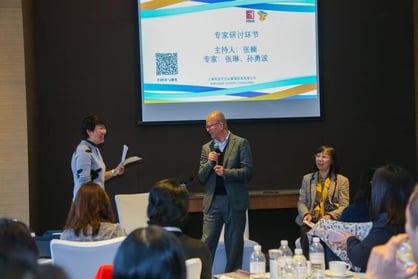
Nancy Zhang_Sun Yongbo_ Linda Zhang _ Executive Coach Panel

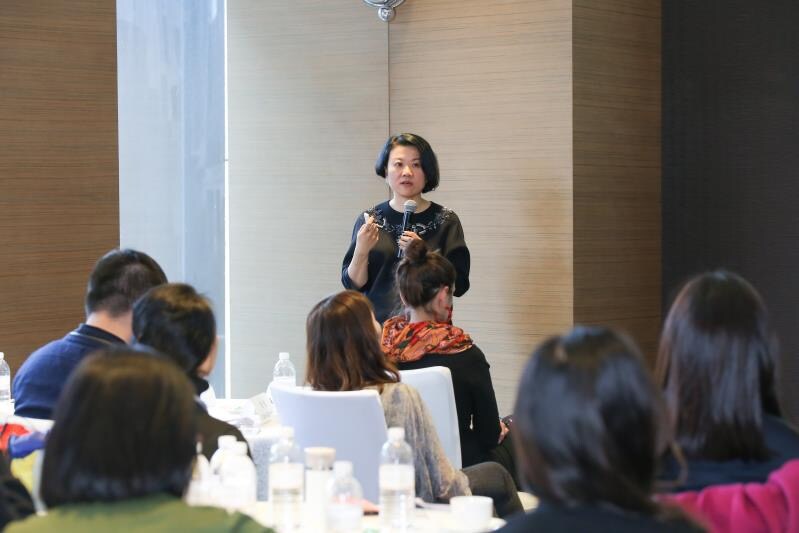
On Friday, March 22, Empower Leaders Consulting (ELC), one of Hogan’s China distributors, hosted a half-day Hogan event in Shanghai for its clients and their Hogan certified network. Nancy Zhang, founder and CEO of ELC, invited Hogan representative Krista Pederson to announce ELC’s official launch of the updated Hogan Assessment Certification Workshop and Advanced Certification Workshops in China.

ELC also invited two important clients, Dowell Real Estate Group and Faurecia Services Group, to share case studies on their Hogan use. Huang Xue, Director of HR Talent Development and Head of Culture at Dowell shared how Hogan has transformed Dowell company culture and become a crucial part of the entire employee lifecycle, from external and internal selection to high potential and leadership development. Wei Wei, Director of HR for greater China at Faurecia, explained how they have used Hogan for over a decade and how it has helped them address various talent needs during different cycles in the market.

Krista launching the HACW and Advanced Workshops

Finally, ELC invited a panel of Hogan Certified coaches, including Linda Zhang (Columbia University Certified Coach & ICF MCC) and Sun Yongbo (Former Director of L&D for China’s Bank of Communications and Standard Charter Bank), to share their experiences using Hogan to coach executives and C-Suite leaders and answer questions about using Hogan. Linda shared how she uses Hogan as the key data point throughout an entire coaching assignment. Sun shared learnings from his most difficult assignments, including how he once coached a CEO who went from being belligerently resistant to his Hogan results to full heartedly accepting to the point where he encouraged use of Hogan throughout his entire team. 

Wei Wei HR Director Faurecia China

Hogan has been in China for over 13 years thanks to our network with distributors like Empower Leaders Consulting. Through this network we have accumulated a wealth of personality research and are able to offer a robust Chinese norm and a strong data-based point of view on the unique characteristics of local leadership and personality in China. Please feel free to contact us for more information on Hogan in China.

Topics: Hogan, Hogan Assessment Systems, China, Empower Leaders Consulting

Subscribe to our Blog

Most Popular Posts

Connect