The Most Important Challenges for HR in the Next Five Years

Posted by Robert Hogan on Wed, Jun 14, 2017

My experience and lots of data indicate that people are not very good at predicting the future. Rather than speculate on potential HR challenges, I would like to discuss an existing challenge that, if it went away, would represent significant progress.

The Nature of the Challenge

If we think about the history of the world since the end of the last ice age (13,000 years ago), we will see steady improvement in the quality of human life. Advances in agriculture have made food more plentiful, clothes have become more functional, transportation has become more efficient, communication has expanded its reach, public health has improved, and life has become easier. There have been costs, of course, primarily to the environment and other living species forced to cohabit with humans, but the lot of common humanity has been transformed in ways that would be unimaginable 13,000 years ago.

How can we explain this improvement in our living conditions? It is probably not due to improved practices in HR. The transformations are the result of steady incremental improvements in technology created by clever, practical people who like working with things. The first big leap forward was learning to use fire, which allowed many new food products to be cooked and consumed. Then people learned to put edges on rocks to be used as cutting tools. Four thousand years ago, people living on the Black Sea learned how to smelt gold — a surprisingly complex and tedious process. Early engineers figured out how to make wheels, and early horse whisperers put horses in front of carts. It is easy to think that this accumulation of technical knowledge led to human progress.

These improvements in technology were cultural not individual; groups of craftsmen shared observations and techniques and built upon one another’s accomplishments. Culture itself depends on certain assumptions: (1) the external world is real; (2) truth depends on: (a) observations that can be repeated (this kind of wood burns quickly, that kind burns slowly); or (b) what reliable observers tell you they have seen. Progress also depends on believing that the world is real and not something we invented to amuse ourselves.

During the last 50 years, the definition of truth has changed in popular culture. There are three sources of this change. First, stimulated by the work of Michel Foucault (1926-1984), many people began to argue that what authorities claim as scientific knowledge is political and serves the interests of powerful economic interests (e.g., climate change is a politically inspired hoax). Second, as society becomes more litigious, people increasingly think like lawyers, and for lawyers, there is no objective truth, there are just more or less convincing stories to be told. Third, as politics intrudes ever farther into everyday life, people increasingly believe the world is composed of “alternative facts” and we are free to pick and choose those that best suit our purposes.

So what we see on a massive scale is radical relativism, where truth depends on one’s perspective and agenda. If taken seriously, this will lead to the end of scientific progress. But what does it have to do with the future of HR? These trends call into question important “facts” on which productive HR processes depend.

First, human nature is rooted in biology, and it changes very slowly. Specifically, this means human motivation changes very slowly. Because leadership involves dealing with human motives, this means the principles of leadership change very slowly — e.g., what Napoleon Bonaparte knew is still valid today. Unless, of course, knowledge is politically inspired ideology.

Second, much of what HR does concerns talent identification. At its base, talent identification is a special case of personnel selection. There is one right way and many wrong ways to do talent identification. The most popular and the worst from an empirical perspective is human judgment based on interviews. The most defensible method from a legal and moral perspective is well-validated psychological assessment — a well-established process whose principles have remained unchanged for 100 years. In my view, the big challenge for HR over the next five years concerns remembering the hard earned lessons of the past. To the degree that HR pursues unvalidated gamified assessment methods and forgets the lessons of the past, true meritocracy will suffer and internal politics will drive talent identification.

This article originally appeared in the May issue of Human Resource Executive.


Self-Awareness in the Age of Individualism

Posted by Hogan Assessments on Fri, Jun 02, 2017

Academics and businesspeople agree that self-awareness is a key aspect of improving performance. Studies show that without it, people tend to be closed-off to feedback, difficult to coach, overestimate capabilities, and ultimately struggle to build and maintain high performing teams. Conversely, awareness of one’s own behavioral tendencies facilitates leadership effectiveness.Self-Awareness

As it’s generally understood that self-awareness is essential for improvement, it might follow that investment in leadership development would result in increased effectiveness. But there is actually a strong negative correlation between spending on development and confidence in leadership, which highlights an unfortunate conclusion: The majority of managers and executives aren’t receiving interventions that move the needle. In fact, at least half of all leaders get in the way of team productivity and don’t live up to their full potential. And, perhaps even more concerning, executive turnover costs organizations somewhere between 50-200% of a leader’s annual salary—thus making it vastly consequential to the bottom line.

Why aren’t interventions changing the behavior of bad leaders and improving financial results? I think it’s because many researchers and practitioners use an individualistic (and inaccurate) definition of self-awareness that emphasizes self-knowledge and strengths over ways to improve one’s reputation with others. From my perspective, the goal of self-knowledge and celebrating yourself is inward looking, antisocial, and selfish—when leadership is a team sport and function for the group, as opposed to a source of personal privilege and individual power.

As an alternative, I propose a more prosocial definition that is congruent with human nature and, by extension, more likely to impact employee engagement and the bottom line. Further, I go on to provide evidence that there are individual differences in self-awareness. That is, some personality characteristics facilitate self-awareness while others, such as being too competitive or overly confident, get in the way of an accurate understanding of what’s going on around us.

The Individualistic Version of Self-Awareness 

Philosophers and psychologists have a long history of being concerned with self-knowledge. As Aristotle put it, “knowing yourself is the beginning of all wisdom.” But the first question is, “What do we mean by self-awareness?”

Historically, psychologists have used an individualistic approach. Individualism suggests that civilization is an alien intrusion and de-emphasizes social bonds, commitments to the majority, and self-control. The positive psychology movement, for example, is rooted in individualistic presuppositions; the major premise is that effective leadership starts with finding the Authentic Self – the real you that is objectively true.

From this paradigm, leadership development is about introspection and self-regulated positive behaviors that foster self-development, well-being, and the ability to cope with daily life. The more you self-control for the benefit of the group, the more you become neurotic and guilt-ridden. Thus, you should just be yourself, focus on what you do best, and act in ways that align with your personal agenda.

Yet, empirical research finds that a strengths-based approach intensifies natural dispositions and influences leaders to neglect opposing but complementary actions. For example, leaders with an inclination to push people toward task performance overdo forceful behaviors and disregard building relationships and creating an environment that cultivates morale and engagement.

In effect, improving your leadership productivity doesn’t actually look like being more of yourself; it looks like the parent who balances imposing structure with acceptance and sensitivity, or the businessperson who dexterously shifts from radical innovation to practical implementation.

Three Motives that Re-Frame Self-Awareness

The alternative to individualism is an evolutionary perspective, namely, socioanalytic theory. Socioanalytic theory integrates findings from biology, sociology, evolutionary psychology, and cultural anthropology to assert three overarching motives which each have a role to play in self-awareness:

  1. We all want to get along and achieve harmonious relationships and social attention. For the last 250,000 years as modern humans, 5 million years as chimpanzees, and 7 million years as gorillas, we have lived together in families and troops, respectively. From building pyramids to winning wars, everything consequential in human affairs happens between people – not within people.  We are social creatures motivated to create and maintain relationships with others.
  2. We all want to get ahead by obtaining power, status, and resources. People have always organized in hierarchies of inequality. Hierarchies facilitate passing on information to future generations and assist with coordination. It’s much easier to learn how to behave from other people than figuring it out for yourself, and the same goes for which berry to eat, language, reading, and solving math problems.
  3. We all want to render life interpretable. People need to feel as though life has meaning, purpose, and predictability – hence the reason for philosophy, religion, scientific exploration, and rules for social interaction, games, and language. People are first and foremost rule-formulating and rule-following animals that impose a culture and its rules on other people (i.e., socialization). Rules help people forecast and understand what will happen next in a chaotic and meaningless world.

Of course, a person may place more or less value on each motive than another person, but nevertheless all three motives are present in everyone.

Rethinking Self-Awareness

A key point in understanding self-awareness and leadership is that these motives are in a state of tension: The more you self-sacrifice, the more people like you; and the more you win, the less people like you. Therefore, one of the fundamental challenges in everyday life (and leadership) is being liked while being promoted or being sensitive while telling people what to do.  People who get it right enjoy more relationships and power than those who get it wrong, and these are the same people who are good at leadership. This point is widely established in the research literature and known as the too-much-of-a-good-thing effect (TMGT) and strengths overused. Balancing the tension and getting it right requires self-awareness.

The situation you’re in is an important variable in determining which behavioral strategies meet your underlying motives and promote good leadership. But because we’re social primates, the situation isn’t mysterious environmental variables guiding our behavior – it’s other people. We spend the majority of every day in social interactions for the purpose of negotiating acceptance and status (the first two motives) and each of these interactions comes with an agenda and roles (agendas and roles are projections of the human need for structure and order, the third motive).

For instance, when you step into a team meeting everyone has a part to play, perhaps one person is giving a presentation and the others are pretending to listen. Each role comes with serious expectations regarding appropriate behavior and people become genuinely upset, emotional, and confused when someone breaks the rules. What if the presenter randomly stops talking or has an emotional outburst? What if an audience member turns around and faces the other direction?

Understanding Self-Awareness

Here’s what happens: After an interaction, people evaluate social performances and assign adjectives based on how well individuals played their parts. Good role performances are assigned positive adjectives; bad role performances, such as a presenter who stops talking or Sean Spicer in a press conference, are assigned negative adjectives and made fun of on Saturday Night Live.

Life is essentially one social interaction after the next to which people evaluate and describe each other. The aggregate of these descriptions is called reputation. For better or worse, it’s an individual’s reputation (not self-concept) that determines how they are treated and whether or not they fit in at work, influence a team, or get promoted to the C-suite.

To be very clear, I am saying that just sitting in your office and thinking about yourself is not helpful in facilitating leadership effectiveness and obtaining shared goals. Extreme individualism feeds the natural human tendency to distort reality in a self-serving way and breeds a culture of internal competition that discounts between-group competition—remember Enron? Consequently, this closed-off focus on the self is quite literally the antithesis of good leadership and what’s best for company financials.

On the other hand, knowing something about your reputation is very useful. What other people think determines your fate and ability (or inability) to engage and rally the troops. Looking to the external world instead of inward helps leaders acquire strategic self-awareness and compensatory behaviors that are in line with role expectations, self-sacrifice, cooperation, and managerial performance. Accordingly, we define self-awareness as the degree to which self-evaluations of behavior match others’ evaluations.

Personality Predicts Self-Awareness

At Hogan, we recently assessed the values and personality of 1,255 managers and executives. These leaders and their supervisors, peers, and subordinates then completed a 360-degree assessment measuring competency behaviors and overall effectiveness. We operationalized self-awareness by subtracting other-ratings of performance from self-ratings and then computed analyses to determine which personality characteristics predict misinterpreting reality.

As socioanalytic theory hypothesizes, leaders who were egocentric, competitive, non-conforming, unemotional, arrogant, focused on the past, closed off to others, and overly serious were unaware of what other people think about them. These characteristics place individual survival above the group and reduce both self-awareness and team and organizational performance.

This is the central challenge in improving organizational effectiveness: Selfish dictators (getting ahead) are the ones who are promoted, but a group of cooperators (getting along) outperform a group of dictators. And what do all dictators have in common? They get noticed and rise to power but are bad at leadership. They are unaware of their lack of competence; and they spend most of their waking hours fantasizing about unique talents and trying to convince others they were sent from the heavens to save the world. But in the end they always lose: Dictatorships are outperformed by a functional culture that encourages cooperation and balances individualism with high standards of moral conduct.

On the contrary, leaders who were self-critical, insecure, curious, humble, and open-minded had a better grasp on others’ perceptions of their behavior and leadership style. This psychological profile is prosocial and orients the individual to the external world. The benefit is a sensible approach to leadership development: They get feedback from the environment, target specific weaknesses, and evaluate whether or not they’ve changed.

Using this approach, leaders are better equipped to navigate the balancing act of getting along and getting ahead, and thus keep friends while emerging as leaders via an aggressive political process. Further, when they do ascend the hierarchy, they resist the corrupting influences of power, see things from other people’s point of view, and set aside the ego to concentrate on firm performance.

Final Thoughts

Self-knowledge is about who you are in relation to other people and, therefore, self-awareness should be defined by how much you know about your reputation. Do others perceive you as overly conforming (i.e., too much getting along) or sucking the oxygen out of the room (i.e., too much getting ahead)? The most important part of navigating social life and being a good leader is keeping tabs on your reputation and modifying your behavior accordingly.

Lastly, well-constructed measures of personality predict individual differences in self-awareness and are useful in the workplace. It is empirically true that certain people are predisposed to taking in information from the external world and adjusting their behavior to fit the context. These folks steer clear of self-reflection, self-obsession, and the imaginary root causes of their social conduct. They resemble what most of us were taught as children but quickly forgot as adults: You should be humble, empathic, considerate, curious, willing to admit a mistake and try again, focused on how other people feel, and maybe even do the right thing and expect nothing in return.

This post originally appeared at www.vantageleadership.com. Vantage, a partner of Hogan, is a Chicago-based professional services firm that helps companies around the world build exceptional leadership capability throughout their organizations.

A Quick and Dirty Guide to Validity & Reliability

Posted by Allison Howell on Tue, May 30, 2017

Choosing the right assessment for selecting or developing employees can make or break the success of a talent initiative. Why bother using assessments that don’t predict performance, or that fail to resonate with your business leaders?

When deciding on the right assessment for your valuable talent, pay attention to the scientific rigor with which the instruments have been tested. Any good tool should have concrete data demonstrating its validity and reliability. Validity and reliability can tell you two general things: 1) that the assessment is measuring what you want it to, and 2) that it will reliably assess the same thing each time — ensuring that the results you get aren’t a one-off.

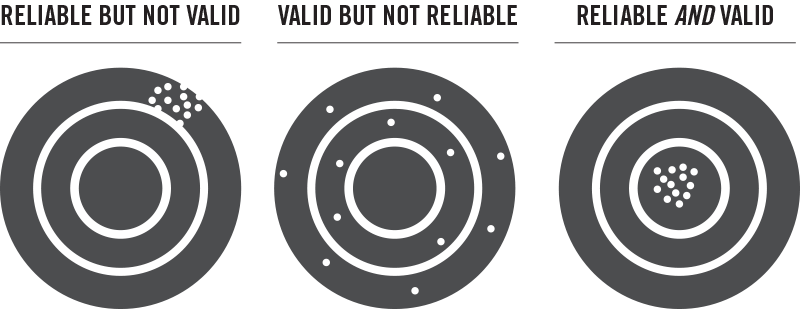
An easy way to think about this concept is with a bullseye metaphor: The very center of the bullseye is exactly what you want to assess.

validity

Reliable but not valid means that you are consistently testing the same thing over and over again, but it’s not testing what you want to test.

Valid but not reliable means that the average scores align with the goals of the test, but individual scores are inconsistent.

Both reliable and valid means that the test will consistently measure what it is supposed to over a period of time – it’s consistently hitting the bullseye.

What is Validity?

Validity refers to the accuracy of the assessment. In essence, does it measure what it is supposed to measure? While there are several types of validity to pay attention to, the most important for our purposes is predictive validity.

Predictive validity tells us how accurate a tool is at predicting a certain outcome. In the case of personality assessments, a good tool will be able to predict how well someone will perform their job. Validity is typically measured with a coefficient between -1 and 1 (called the Pearson correlation coefficient). The closer to one, the higher the predictive power of the test. The predictive validity of the Hogan Personality Inventory (HPI) is .29 for predicting performance across job families. However, when the HPI is combined with the Hogan Development Survey (HDS) and Motives, Values, and Preferences Inventory (MVPI), that number jumps to .54. While this may not seem very high, a good comparison is to look at the validity for something completely unrelated.

For example, the predictive validity of ibuprofen for pain reduction is only .14. For another, more closely-related example, the correlation between structured job interviews and job performance is .18. There are many ways of measuring validity, some more useful than others. Any assessment provider worth their salt should be able to provide you with evidence of validity. If they don’t, it’s worth considering why not.

What is Reliability?

Reliability, on the other hand, refers to the consistency of the test. The reliability of an assessment can be evaluated in two broad ways: 1) internal consistency and 2) test-retest reliability.

Test-retest reliability is a measure of consistency of responses over time. In other words, are people responding to questions the same way each time they take the test? Inconsistent responses can indicate that assessments results are not actually measuring personality, which should be relatively stable over time. Test-retest reliability uses a correlation of scores (again, using the Pearson coefficient) from a first assessment and a second assessment sometime later. For Hogan, the short-term test-retest reliability is .81 for the HPI, .70 for the HDS, and .79 for the MVPI.

Internal consistency relates to the questions that are used in each assessment. Test takers will notice that many questions appear to measure the same thing. This is on purpose. Asking a question in a few different ways helps us to ensure that we are getting an accurate measurement of the concept. Internal consistency scores are measured between 0 and 1 (this time with a coefficient called Cronbach’s alpha).i The closer to one, the higher the internal consistency reliability. The average internal consistency for the HPI scales is .76, .71 for the HDS, and .76 for the MVPI.

The important thing to note is that there is no one right way to measure reliability or validity. In fact, assessment publishers should constantly be monitoring their products to ensure they are as effective as they claim. Hogan Assessments are far above industry standards with continual evaluation of our own assessments. We are partial though, and we encourage you to seek out this information with any assessment system you choose.

Hogan Assessments have appeared in over 400 peer-reviewed publications to ensure that our tests are hitting the bullseye. We invite you to contact us for more information on the validity and reliability of Hogan Assessments at info@hoganassessments.com or +1 918 749 0632.

Note

i. Absolute value. Scores between -1 and 0 indicate a negative correlation.

Topics: personality

Podcast: Hogan CEO Discusses His New Book

Posted by Blake Loepp on Tue, May 23, 2017

Too often, HR practitioners and talent management experts rely on intuition when it comes to identifying and developing key talent, even when armed with an overwhelming amount of data and objective tools that contradict their instincts. The problem is that the data they ignore is right in almost every case.Talent Delusion

When these “experts” are wrong, it costs organizations all over the world billions of dollars each year in turnover and wasted development expenses. Unfortunately, all of that money could have been salvaged if organizations instead relied on data over intuition in their selection and development practices.

In a recent collaboration with National Business Review Radio and Spotify, Hogan CEO Dr. Tomas Chamorro-Premuzic spoke with Andrew Patterson to discuss his new book The Talent Delusion – Why Data, Not Intuition, Is the Key to Unlocking Human Potential. The book aims to education HR practitioners and leaders on how to measure, predict, and manage talent.

All organizations have problems, and they nearly always concern people. Psychology, the main science for understanding people, should be a pivotal tool for solving those problems.


Distributor Spotlight: metaBeratung Focusing on Innovation in Leadership

Posted by Blake Loepp on Mon, May 22, 2017

It’s no secret that technology is affecting all facets of our lives. Social media has affected how organizations attract new customers. Smartphones have put the internet at our fingertips, which has changed the way we communicate, how we access information, and even how we order lunch. But, how will it affect leadership?metaBeratung Logo

metaBeratung, a Hogan Distributor in Germany, Switzerland, and Austria, is staying at theforefront of this issue as it is hugely impactful to the global workforce. Organizational landscapes have changed and continue to change. Therefore, what it takes to be an effective leader has also changed. metaBeratung, in conjunction with IMD Business School, recently examined the qualities and competencies that translate to effective leadership in today’s workforce.

Agile Leadership in an Age of Digital Disruption

In 2017, metaBeratung became an official partner of IMD Business School in Switzerland, and conducted a study that revealed why leaders need to adapt their approach to leadership.

“This is a win-win collaboration for us,” says Nicole Neubauer, managing director of metaBeratung Switzerland. “On the one hand, will we be working together on joint research, on the other, we are able to offer IMD executive programs to our clients based on individual development needs. A perfect match.”

Digital Disruption Demands Agile Leaders 

How we approached IMD? Prof. Mike Wade and his team at the Center for Digital Business Transformation (an IMD Lausanne Business School, Switzerland and Cisco initiative) researches and educates organizations to lead in digitally disrupted times. His book ‘The Digital Vortex’ sheds light on how digital disruption is redesigning industries.

So far, no one had looked at changes at the individual level, so the metaBeratung team wanted to shed more light on the individual leadership component of digital disruption. Jointly with Prof. Wade and his team, metaBeratung started interviewing and surveying more than 1,000 executives globally. Running the qualitative interviews, was very interesting for all of us; while some organizations were already well prepared with regards to digitization, others were not at all. This March, the joint research was published at executive forums in Switzerland as well as in Germany (Frankfurt and Munich). With more than 80 executives in each location, it proved once again that ‘agile leadership’ is a hot topic. Both Prof. Mike Wade and Rainer Neubauer presented results.

metaBeratung Image

Now, Taking Results to the Next Level

metaBeratung then approached Hogan Assessments on collaborating together to design a customized report to predict agile leadership around the competencies we identified in our joint research study. Hogan will carry out a validation study and the report will be ready for production in July 2017 and available to all distributors/resellers. Very exciting news – stay tuned!

About metaBeratung

metaBeratung is a Hogan Distributor 2005 in Germany, Switzerland and Austria since 2005. The agile team of 12 (business psychologists, marketing and sales people) is located in Düsseldorf, Zurich and Vienna. Rainer Neubauer, managing director Germany/Austria, has been a PhD student with Robert Hogan back in the day…the main focus of our work is supporting organizations in the area of high potential identification, delivering Hogan Feedbacks, running management audits and certification workshops.

And, we’re hiring! So, if you know someone in your network (senior business psychologist), contact nicole.neubauer@metaberatung.com.

Podcast: Dr. Hogan Discusses Future of High Potential Programs

Posted by Blake Loepp on Tue, May 16, 2017

HRD Connect LogoIt’s no secret that identifying high potentials (HIPOs) is a hot topic in the global discussion on talent management, and for good reason. Those who hold leadership positions today will inevitably move on or retire. Thus the need to identify and develop successors is vital to the future of organizations worldwide.

Numerous organizations across the globe have implemented HIPO programs to groom the next generation of leaders. Unfortunately, most organizations are not very good at identifying HIPOs. Instead of using data and objective measures that are backed by science, companies tend to promote those who emerge, such as the confident, charismatic, and politically savvy individuals. However, science tells us those who emerge are often ineffective.

In an interview with HRD Connect in Amsterdam, Dr. Hogan addressed the HIPO topic, and offers his top tips for assessing employee potential.

If HIPOs are critical to the success and sustainability of your organization, contact a Hogan consultant or visit hoganhipo.com.

SIOP 2017: Collected Wisdom from Orlando

Posted by Hogan Assessments on Wed, May 10, 2017

The 2017 SIOP Conference was the largest in history, and several Hogan representatives presented on a wide variety of topics. For those of you who were unable to attend or for attendees interested in accessing the Hogan presentations, here is a recap with links to many of the Hogan presentations at this year’s conference.

*Please note that symposium titles will differ from linked content. The content provided is to a paper within the symposium.

Conceptual Foundations of Personality Assessment in Organizations: “Useful” to “Optimal”

Interest in personality assessment in organizations continues to grow.  However, criterion-related validities are only at the “useful” level currently.  Three personality models are presented that have organizationally relevant labelling and are more differentiated at the primary factor level.  These models should help personality validity reach “optimal” levels.
Jeff Foster, Steve Nichols

Development of Empirically Based Short Form Personality Assessment

Short form personality assessments are nothing new, but many existing forms are constructed with an emphasis on internal reliability rather than predictive utility. A short form was developed using an empirical approach that simultaneously optimizes reliability and criterion validity. Evidence supporting the utility of the short form is provided.
Brandon Ferrell, Blaine Gaddis

Derailers Versus Personality Disorders: What are the Differences?

There remains little consensus regarding the structure and meaning of personality derailers. This research aims to fill this gap by comparing items from the HDS and the PID-5.  Results support the concept of derailers as personality constructs that align with disorders but are not clinically debilitating.
Jeff Foster, Blaine Gaddis

The Use and Utility of Big Data in I-O Psychology

Recent SIOP conferences have seen a surge in sessions on big data, most of which highlight future possibilities of using big data techniques in the field.  In contrast, this session will focus on active projects within the field and the real benefits of big data for I-O psychology today.
Brandon Ferrell, Jeff Foster, Blaine Gaddis

Factors to Consider in 360-Degree Feedback Ratings

The goal of this symposium is to discuss factors that can affect 360 performance ratings. Four studies on the effects and relationships of (a) culture, (b) gender and personality, (c) gender and importance performance, and (d) personality and self–other discrepancies in 360-ratings are discussed.
Karen Fuhrmeister, Derek Lusk

Identifying Grit in Existing Personality and Other Individual Differences Taxonomy

Proponents of grit treat it as a completely new construct, though a few studies suggest it is indistinguishable from other well-established constructs like Conscientiousness. This session focuses on examining relationships between grit and constructs from personality, positive psychology, and interests.
Brandon Ferrell, Robert Hogan

Differences in Judgment and Decision-Making Across Job Levels

Leadership judgments drive corporate performance. However, it is common for leaders to make poor decisions. Therefore, it is necessary to look at judgment tendencies and the ability to learn from past mistakes. This study examines judgement at different job levels to identify differences in key judgment tendencies.
Michael Tapia, Blaine Gaddis

Job Analytic Comparisons of Critical Competencies Across Industries

Using archival job analytic data, authors examined the degree of consistency in competencies required for effective job performance across 10 industries. Findings suggest that characteristics identified as important for jobs in one industry are likely to generalize across industries with few exceptions.
Matt Lemming

Validation of an Off-the-Shelf Competency Solution for Nine Job Families

Many organizations develop competency models to guide HRM efforts, but models may be based in business trends more than science, making validity evidence scarce. the authors developed and validated an off-the-shelf competency solution to help organizations identify individuals with personal characteristics aligned with critical competencies for 9 job families.
Blaine Gaddis

Beyond Cognitive Ability: Using Personality to Predict Student Retention

This study examined the relationship between personality and student retention. Conscientiousness predicted student retention across 3 years and eventual graduation rates. Researchers and practitioners can use these findings to develop personality-based interventions to increase student retention and reduce costs for colleges and universities.
Matt Lemming

Personality Assessment as a Supplementary Predictor of Tenant Behavior

Current tenant screening methods lack thorough research support and may be subject to adverse impact. This study proposes the use of personality assessment as a supplementary tool and provides evidence for the use of personality measures to predict tenant behavior, including payments, vacating, maintenance, cleaning, landlord interactions, and causing damages.
Michael Tapia, Brandon Ferrell, Matt Lemming

Improving Prediction Through Personality and Criterion ABC Alignment

Authors hypothesize that by aligning the affective, behavioral, and cognitive content of personality and workplace criteria, prediction will be improved. This hypothesis is tested in 2 datasets that have both personality and performance data. The results generally support the hypothesis; there was better prediction of performance on average.
Michael Tapia, Kimberly Nei

Using Personality Assessment to Predict Valued Outcomes in Healthcare

The healthcare industry significantly affects people’s lives but relies on objective data. As such, assessments of “softer” individual differences have been underused despite evidence that these constructs predict health-related outcomes. This symposium allows professionals to demonstrate how personality assessments predict a range of outcomes for healthcare providers and recipients alike.
Blaine Gaddis, Kimberly Nei, Derek Lusk

Maladaptation: Building the Nomological Net of Derailing Traits and Behaviors

Despite increasing interest in derailing traits and behaviors, there remains much to be learned about their construct space. By presenting quantitative and qualitative research results, authors seek to deepen understanding of how derailing traits and behaviors relate to other individual differences and work-related outcomes, expanding insight into maladaptation at work.
Brandon Ferrell, Blaine Gaddis

Hogan Launches New Online Post-Certification Course

Posted by Blake Loepp on Wed, May 03, 2017

In response to overwhelming customer demand, we have launched a new online Level 1 Hogan Certification course that will serve as a post-certification “refresher” program for Hogan-Certified users. The program will be geared toward the review and reinforcement of basic Hogan interpretation skills gained in the Level 1 Hogan Certification Program.Certification Banner

“With approximately 50,000 Hogan-Certified professionals across the globe, it became clear that our users were hungry for a way to hone their skills and continue to learn more about the Hogan Assessment Suite,” says Jackie VanBroekhoven Sahm, Hogan’s Director of Global Learning. “This new program gives them that opportunity at their fingertips.”

The web course provides Hogan users with a thorough review of all 28 scales across Hogan’s three core assessments: Hogan Personality Inventory (HPI); Hogan Development Survey (HDS); and the Motives, Values, Preferences Inventory (MVPI). The course begins with a diagnostic assessment of the learner’s current knowledge of the Hogan scales, and offers appropriate tutorials to strengthen and reinforce interpretation of the Hogan Assessment Suite.

The course will include challenging exercises to both assess and teach scale meanings and their performance implications. Additionally, informational feedback is provided throughout the course to guide interpretive thinking versus rote recitation.

“We’re really excited to launch this new program, but we’re even more excited that we have thousands of Hogan users who already see the value in it,” says Sahm. “It confirms that our users understand the importance of personality assessment and its role in the future of talent management and leadership development.”

The price of the course is $195 USD, and is available via Hogan’s On-Demand Learning Course Catalog. For more information, contact training@hoganassessments.com.

Hogan Forms Partnership with Talent Quarterly

Posted by Blake Loepp on Wed, May 03, 2017

We’re excited to announce that Hogan has partnered with Talent Quarterly, the leading voice for science-based, practical advice on hiring, developing and retaining exceptional talent.

Talent Quarterly, published by The Talent Strategy Group, makes organizations more successful by providing evidence and insights to help leaders make higher-quality talent decisions. With that mission, and a commitment to improve the global discussion around talent management, a partnership with Hogan made perfect sense.TQ Cover

“I’ve been a fan of Hogan for quite some time, and their views on talent management align perfectly with what we’re trying to accomplish at Talent Quarterly,” says Marc Effron, Founder & Publisher of Talent Quarterly and Founder & President of The Talent Strategy Group. “I started this publication because the current dialogue around talent management simply wasn’t sufficient. Hogan has been battling the status quo around personality assessment and leadership development for decades, so this partnership was a natural fit.”

With contributions from some of the world’s leading management authors, consultants, and scholars, Talent Quarterly offers readers a fresh perspective and allows them to view the world’s talent issues through a new lens. Each issue focuses on a particular theme around talent management, including culture, female talent, performance, and engagement. The latest, The Boss Issue, covers such hot topics as curing incompetent leadership, how to become a superboss, and how smart bosses build smarter employees.

The partnership will allow both organizations to continue their mission of improving the global workforce.

“We are quite excited about this partnership,” says Hogan CEO Dr. Tomas Chamorro-Premuzic. Marc is not only a superstar in the world of talent management, but he is also on a quest to educate professionals and leaders in order to make talent practices more data-driven and effective. Talent Quarterly embodies this mission and we are honored to play a part in making it an even bigger success.”

Talent Quarterly is a quarterly print magazine accompanied by a daily digital operation. Print and digital subscriptions, complete issues, and individual articles are all available at talent-quarterly.com. Also, follow them on Twitter: @TalentQuarterly.

Distributor Spotlight: After a Decade of Success, Mobley Group Pacific Continues to Deliver Stellar Results

Posted by Blake Loepp on Thu, Apr 13, 2017

MGP Logo_Big Size

When American psychologist, Dr. William H. Mobley, founded Mobley Group Pacific in 2004 in Shanghai, he had a vision to revolutionize the development of China’s business community. In 2007, he made the decision to put his entire staff through Hogan Certification, and MGP became an official member of the Hogan Distributor Network. Fast forward 10 years, it is quite apparent that his vision has become reality.

Focusing on executive assessment for senior executives, leadership teams, and emerging leaders, MGP has used the Hogan assessment suite to enhance the effectiveness of organizations across the Greater China region, covering Mainland China, Hong Kong, Macau, and Taiwan. The diversity of their client portfolio, including industries such as automotive, healthcare, manufacturing, and food & beverage, is a true testament to the versatility of Hogan products. In 2015, MGP deployed a Hogan-centric coaching program for a large, international pharmaceutical company, and recently shared how they implemented it:

“A leading multinational in the pharmaceutical industry initiated an organizational change in the beginning of 2015. To facilitate such a change, the client wanted to increase its leaders’ awareness of what such changes may bring. The entire process started with a Hogan-based development feedback and coaching session. MGP worked with the top-200 leaders in China over a period of 18 months. The feedback we gathered from such a process was that we successfully kicked off the change process through cultivating an in-depth self-understanding. On top of the individual sessions, we also conducted (over different cohorts) Hogan-based group analyses, helping the senior executive and the program champion to form a high-level understanding of whom do they have, how their leaders lead, as well as the implications to such a big change.” 

The implementation of such a comprehensive leadership development program is a daunting task for any organization, regardless of industry or company size. With the help of MGP, organizations across China have seen significant outcomes, and the region can expect many more years of superb service and stellar results.

Hogan Assessments has experienced a great deal of success through the years, and this is largely due to Bob Hogan’s emphasis on generating results that help a company’s bottom line. When partnering with organizations across the globe like MGP, those results are delivered frequently, and all parties involved benefit greatly.


Subscribe to our Blog

Most Popular Posts

Connect