What is Good Judgment…Really?

Posted by Hogan Assessments on Mon, Dec 15, 2014

Good judgment isn’t about being smart. It’s not even about making good decisions. The essence of good judgment is about learning from past mistakes. It’s about applying feedback to the next opportunity so as not to needlessly repeat blunders or continue to pursue a course that just isn’t panning out. It’s about remaining open to reviewing the landscape, and understanding that unexpected outcomes are a real and likely occurrence. Even though around half of our decisions will lead to unintended consequences, that’s not to say we’re only as good as chance in making them. That would mean we could just flip a coin and hope for success. Rather, if we can all accept that each and every one of us brings our own inherent biases to a situation, we can raise our strategic self-awareness to better monitor shifting parameters and readjust accordingly. Judgment, therefore, is less about getting it right, and more about the personal and cognitive characteristics that enable us to recalibrate so as to continuously improve.

Below are three examples of well-known business leaders whose good judgment led to their success.

Alibaba: The story of “1001 Mistakes”

In the early 2000s, Jack Ma, founder of Chinese e-commerce firm Alibaba, decided to relocate the domestic headquarters from Hangzhou to Shanghai, the so-called business center of China, and to move the global base to Silicon Valley. It turned out that the environment was not right for the firm. The headquarters in the U.S. took a hit when the dot-com bubble exploded, while the Shanghai office faced the reality of difficulty reaching small manufacturing companies interested in going global (the backbone of their business at the time, of which there were few in Shanghai). The strategy caused distress and dismay to its number one priority, the customers.

“We expanded too fast,” Ma said in an Inc. interview. “By 2002, we had only enough cash to survive for 18 months. So we developed a product for China exporters to meet U.S. buyers online. This model saved us.”

With constant refocusing on the customer, and improving each year, Alibaba has become one of the most valuable tech companies in the world after raising $25 billion from its 2014 U.S. IPO. As Ma puts it, Alibaba is the story of the successful firm built on “1,001 mistakes.”

Disney: Why have one, when you can have two for twice the price?

In Married to the Mouse: Walt Disney World and Orlando, Richard E. Foglesong explains a scene between Disney brothers Walt (the creative brother) and Roy (the business-oriented brother). At one meeting, there was a large parcel of land in Orlando [Florida] available for about $100 per acre. Walt said, “Buy it!” Roy asked, “But Walt, we already own 12,000 acres. Do we have the money?” Walt replied, “Roy, how would you like to own 7,000 acres around Disneyland [California] right now [if you had the chance]?” to which Roy immediately responded, “Buy it!” Despite the stretch of resources, the business-oriented Roy Disney understood the value of property. They learned their lesson in California with Disneyland. What if they had purchased more? They could have expanded and avoided the tacky sets of shops and stores that sprung up around Disneyland. It only made sense to get as much land as possible so that Disney could have room to grow his dreams and insulate his utopian vision.

Virgin Wines: So it shall be written…

Rowan Gormley previously worked with Richard Branson at Virgin for many years and set up Virgin Wines.

“The lowest point in my career was when I refused to acknowledge my mistakes and believed my own publicity,” he said. “The data was telling us where we were going wrong at Virgin Wines but we kept reading how brilliant we were in the press. I was in denial. It’s amazing how a group of highly intelligent people can get things so categorically wrong. What looks good on a Powerpoint presentation just didn’t do it for the customer. Once we accepted what was wrong, we stripped the business down and rebuilt it and then it really took off.”

Industry Case Study: Nurses

Posted by HNews on Mon, Aug 18, 2014

Challenge: The quality of a patient ’s experience plays an important role in defining the competitive advantage of healthcare organizations, especially during times of change and reform. Because nurses have the most frequent and direct contact with patients, their performance and behaviors have a significant impact on patient evaluations.

Understanding the antecedents of successful performance is critical to the selection, development, and attrition of nurses who can deliver high-quality treatment. Working with ill and stressed people on a daily basis requires personal attributes such as caring and empathy that are beyond general cognitive ability. To identify these characteristics, we initiated a research study to investigate the personality-based success factors for Nurses and Nurse Managers.

Solution: Based on years of experience working with clients in the healthcare industry and existing research on healthcare professionals, we concluded that individual differences in emotional intelligence play a critical role in differentiating nursing job performance. Therefore, we used the Hogan EQ Report, a personality-based measure of interpersonal and intrapersonal emotional intelligence competencies, to study the personal attributes of 167
Nurses and 90 Nurse Managers sampled from various hospitals across the U.S.

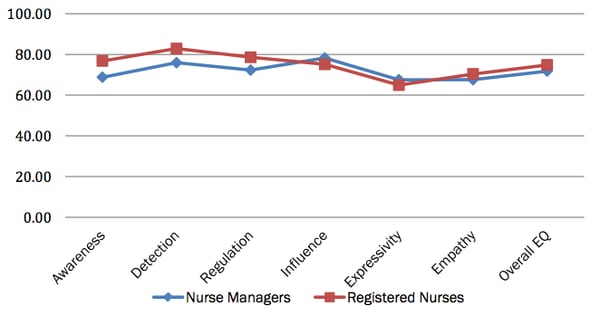
Results: The graph below summarizes the average EQ scale scores (in percentiles) for Nurses and Nurse Managers.

Nurses

In general, both Nurses and Nurse Managers score relatively high (above 60%) on all EQ scales compared to the general working population, which suggests that nursing jobs require higher emotional intelligence than other occupations.

In comparing the two groups:
• Nurses are significantly higher than Nurse Managers on emotional Awareness, Detection, and Regulation (p< .05)
• Nurses tend to be higher than Nurse Managers on Empathy and Overall EQ
• Nurses tend to be lower than Nurse Managers on Influence and Expressivity

These results are consistent with the nature of the two jobs. For Nurses, frequent interactions with patients require them to be aware of inner emotions (Awareness) and the emotional signals of others (Detection) so they can maintain a stable emotional state and effectively react to patients’ stress. Nurses also tend to be skilled at selecting effective coping strategies under stress (Regulation), which enables them to retain cognitive resources for problem-solving.

In contrast, Nurse Managers interact less with patients. Instead, they are responsible for supervising Nurses and coordinative nursing activities. This role requires different personal characteristics such as the ability to openly confront subordinate misbehaviors, which requires the ability to alter others’ emotions (Influence) and convey desirable emotional states to others (Expressivity).

Implication: Our findings show that while both Nurses and Nurse Managers are higher on EQ across the board when compared to the general public, the two groups possess somewhat different strengths. This phenomenon is not uncommon in other industries. We have also seen teams in Sales, Engineering, and Finance who have difficulty promoting managers from within because different or even opposing skills and personal attributes are required at higher levels.

Based on the current findings, we recommend that healthcare providers take
into consideration personal attributes critical to different roles to effectively select or develop high potential Nurses into managerial positions.

2014 Q2 Article Review

Posted by HNews on Wed, Aug 13, 2014

Here’s the rundown of useful articles from the second quarter of 2014.

Arthur et al. found that personality scores were unaffected when individuals completed instruments on tablets or phones. Cognitive ability scores, however, were typically lower when completed on mobile devices.

In contrast, Morelli et al. found that scores were similar for mobile versus PC users on both a cognitive ability test and two biodata instruments, but were lower for mobile users on a situational judgment test.

Bakker et al. argue that, although often considered opposite ends of the same dimension, burnout may have more impact on individual heath, while engagement has more impact on job performance.

Dragoni et al. show that global work experiences, especially those involving work in culturally diverse countries, may help develop a leader’s strategic thinking skills.

Hoch and Kozlowski found that shared team leadership predicts performance for all types of teams, but is especially important for virtual teams. In contrast, traditional hierarchical leadership can actually detract from virtual team performance.

Iliescu et al. demonstrate that a lack of vocational fit predicts counter productivework behaviors, even above and beyond more established personality-based predictors.

Ispas et al. found that impression management had incremental validity over cognitive ability when predicting earned revenue in sales jobs.

Within an LMX framework, Vidyarthi et al. presented evidence for the detrimental effects of reporting to two leaders who aren’t on the same page.

Winograd et al. found that drinking alcohol increases extraversion and openness, but decreases agreeableness, conscientiousness, and emotional stability. Emotional stability and conscientiousness are most strongly related to negative outcomes.

It’s Shark Week…In the C-Suite

Posted by Hogan Assessments on Mon, Aug 11, 2014

sharks

Oh, my friends, it’s the most wonderful time of the year – it’s Shark Week 2014. In case you don’t already know, Shark Week is a magical seven-day spectacle each year when the Discovery Channel shows nothing but shark-themed programming – everything from a program delving into the mystery of the submarine shark, a legendary 30-foot great white that terrorized the South African coast in the 1970s (so much for overcoming my irrational fear of the ocean) to an episode of “Sharks After Dark” where the LA Beast attempted to eat a shark cactus. Yes, that does sound terrible. No, I didn’t make it up. But I digress.

In the spirit of this seven-day salute to Selachimorpha (science!), we thought we’d take a moment to talk about a different species of shark – the type you find in the corner office. Everyone has worked with (or, worse, for) a shark – a ruthless individual set on self-advancement at any cost. In a survey of more than 700 people we conducted last year, more than 81% of people said they had been lied to, stolen from, cheated, or betrayed by a boss or coworker.

How do so cutthroat people make it to the top? Unfortunately, the corporate structure at most large organizations are tailored to reward the type of personality characteristics typical of sharks – charisma, self-absorption, ruthless ambition, self-deception, and a driving need for external validation. To learn more about how to identify and protect yourself from a shark (the kind at work – you’re on your own when it comes to the other kind), check out our free ebooks, “Trust and Betrayal” and “6 Ways to Keep Your Managers Honest”.

Michael Sanger on Global Leadership

Posted by HNews on Sun, Aug 10, 2014

People universally look for the same characteristics in their leaders – integrity, judgment, business acumen, and vision. However, every culture has a set of social norms that color leader behavior. Global Alliances consultant Michael Sanger explores the differences in eastern and western leadership styles.

Stress in the Workplace

Posted by Hogan News on Thu, Jul 31, 2014

More than 80% of Americans are stressed about their jobs, and 75% of people said the most stressful aspect is their boss. Although a few bad bosses seem inevitable, the chronic stress they cause costs companies $300 billion annually. What can companies do about bad bosses and the stress they cause?

Stress Infographic resized 600

Stress in the Workplace

Posted by HNews on Wed, Jul 30, 2014

More than 80% of Americans are stressed about their jobs, and 75% of people said the most stressful aspect is their boss. Although a few bad bosses seem inevitable, the chronic stress they cause costs companies $300 billion annually. What can companies do about bad bosses and the stress they cause?

Stress Infographic resized 600

Managing a Dishonest Employee? Take Action.

Posted by Hogan News on Tue, Jul 29, 2014

Honesty 200 blogWe’ve all dealt with them – the employee that makes questionable decisions around the office, whether that’s stealing some pens from the supply closet or, more seriously, pocketing company revenue on the sly.
It’s “time to admit that some people are more vulnerable to unethical temptations than others,” says Dr. Tomas Chamorro-Premuzic, Hogan Assessments’ vp of research and innovation, “and managers can play an important role in attenuating (or increasing) the rate of unethical incidents in their teams and organizations.” Here are some tips on how to manage these morally weak employees.

Engage them. Even less ethical individuals will be more likely to act morally if they are engaged at work. By the same token, alienating employees may enhance moral disengagement even in those with higher integrity.

Lead by example.  For managers, the implication is clear: if you want your employees to act morally, start by acting morally yourself.

Pair them with ethical peers. Teaming your less moral employees with colleagues who have strong integrity will motivate them to behave more ethically. Humans learn via observation and imitation, and much of this learning occurs without awareness.

Invest in moral training. Organizations can influence employees’ ethical choices via explicit educational programs. For example, the Ethics Resource Center reports that businesses that implement formal programs to support ethical choices, such as whistleblowing, decrease counterproductive behaviors and misconduct rates, as well as increasing employee satisfaction.

Reduce their temptation. Everybody has a dark side, but the antisocial aspects of our personalities are much more likely to surface in toxic environments or situations of weak moral pressure. It is hard to change someone’s personality, but managers can do a great deal to affect the environment employees inhabit.

Create an altruistic culture. Although organizational culture cannot be created overnight, meta-analytic reviews have demonstrated that a caring culture prevents unethical work behaviors, whereas a culture of self-interest promotes them.

Find out how to put these tips into action in our ebook 6 Ways to Keep Your Manager Honest.

Managing a Dishonest Employee? Take Action.

Posted by HNews on Mon, Jul 28, 2014

Honesty 200 blogWe’ve all dealt with them – the employee that makes questionable decisions around the office, whether that’s stealing some pens from the supply closet or, more seriously, pocketing company revenue on the sly.

It’s “time to admit that some people are more vulnerable to unethical temptations than others,” says Dr. Tomas Chamorro-Premuzic, Hogan Assessments’ vp of research and innovation, “and managers can play an important role in attenuating (or increasing) the rate of unethical incidents in their teams and organizations.” Here are some tips on how to manage these morally weak employees.

Engage them. Even less ethical individuals will be more likely to act morally if they are engaged at work. By the same token, alienating employees may enhance moral disengagement even in those with higher integrity.

Lead by example.  For managers, the implication is clear: if you want your employees to act morally, start by acting morally yourself.

Pair them with ethical peers. Teaming your less moral employees with colleagues who have strong integrity will motivate them to behave more ethically. Humans learn via observation and imitation, and much of this learning occurs without awareness.

Invest in moral training. Organizations can influence employees’ ethical choices via explicit educational programs. For example, the Ethics Resource Center reports that businesses that implement formal programs to support ethical choices, such as whistleblowing, decrease counterproductive behaviors and misconduct rates, as well as increasing employee satisfaction.

Reduce their temptation. Everybody has a dark side, but the antisocial aspects of our personalities are much more likely to surface in toxic environments or situations of weak moral pressure. It is hard to change someone’s personality, but managers can do a great deal to affect the environment employees inhabit.

Create an altruistic culture. Although organizational culture cannot be created overnight, meta-analytic reviews have demonstrated that a caring culture prevents unethical work behaviors, whereas a culture of self-interest promotes them.

Find out how to put these tips into action in our ebook 6 Ways to Keep Your Manager Honest.

Four Qualities You Think are Great in a Hire, But Actually Aren’t

Posted by Hogan News on Tue, Jul 22, 2014

HonestIn business, the adage holds true that one bad apple can spoil the bunch – even one dishonest manager can cost companies hundreds of thousands, if not millions of dollars, in low morale and lost productivity. Unfortunately, history shows that there is more than one bad apple in the business world, and dishonest work behaviors, such as staff abuse, rule bending, and theft cost the economy billions each year.

How can organizations combat dishonesty in their management team? They can start by recognizing why dishonest individuals are such enticing hires. Unfortunately, the same attractive qualities we find in these candidates are the same qualities that will short change us in the long run.

1. CharismaPsychologists recorded 73 first-year college students individually introducing themselves to a group. The study found students with narcissistic tendencies excelled at making initial impressions. They used more charming facial expressions, a more confident speaking tone, were funnier, wore more fashionable clothes and had trendier haircuts.

2. Self-absorption – The second characteristic is an unusual degree of self-absorption, or, more to the point, a relentless drive for self-advancement. These individuals possess a ruthless dedication to self-advancement to the extent that other people lose their value as humans and become objects to be manipulated.

3. Self-Deception – Ben Dattner, author of The Blame Game, notes that narcissists “lead with the main purpose of receiving personal credit or glory. When things go wrong or they make mistakes, they deny or distort information and rewrite history in order to avoid getting blamed.”

4. Hollow Core Syndrome – The underlying dynamic that unifies these themes is a pattern of personality characteristics called the hollow core syndrome. The hollow core refers to people who are overtly self-confident, but who are privately self-doubting and unhappy.

Learn more about combating dishonesty in the workplace and managing the dishonest employee.

Subscribe to our Blog

Most Popular Posts

Connect