




“High Potentials – Are you doing it wrong?” asks Hogan Assessment’s Ryan Ross in his presentation at Mentis Consulting’s Hogan Summit 2013. This in-depth talk focuses on identifying candidates most likely to help meet the future leadership needs of your company.
“High Potentials – Are you doing it wrong?” asks Hogan Assessment’s Ryan Ross in his presentation at Mentis Consulting’s Hogan Summit 2013. This in-depth talk focuses on identifying candidates most likely to help meet the future leadership needs of your company.
0 Comments Click here to read/write comments
 With technology and organizations more advanced and complex than they’ve ever been, HR is struggling to keep up the good fight. “Unfortunately, what we see is HR systems developed ad-hoc; one set of tools for selection, another for middle managers, and another for high-level leadership development, and none of those systems communicate,” said Ryan Ross, vice president of Global Alliances at Hogan.
The problem is that this information often comes from divergent systems, and therefore lacks context or common language. If HR wants to act strategically, it needs to consolidate those systems so that data can be viewed in context. The key to getting quality people in all levels of an organization is to “put a system in place that stays relevant throughout the entire employee lifecycle,” said Ross.
Check out the 4 other issues HR is running up against in our ebook How to Conquer the 5 Things Keeping HR up at Night.
0 Comments Click here to read/write comments
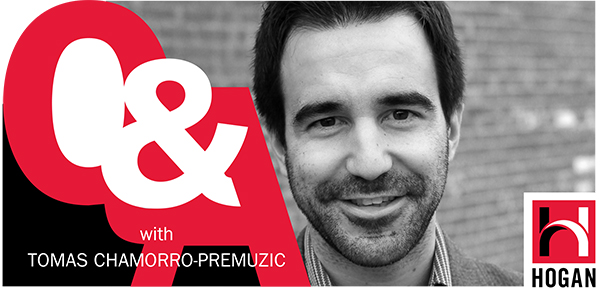
A Q&A with Dr. Tomas Chamorro-Premuzic | Creativity vs. Innovation
We sat down with Tomas Chamorro-Premuzic, Hogan’s VP of Research and Innovation, to pick his brain on the ups and downs of creativity at work.
What makes innovation valuable to an organization?
Experts disagree on the type and level of innovation that is most beneficial for organizations. Some studies suggest that radical innovation confers sustainable competitive advantages, but others show that “mild” innovation – think iPhone 5 rather than the original iPhone – is generally more effective, not least because it reduces market uncertainty.
Can we accurately evaluate the merit of our own ideas?
Most people fall into the trap of an illusory superiority that causes them to overestimate their creative talent, just as in other domains of competence (e.g., 90% of drivers claim to be above average – a mathematical improbability). It is therefore clear that we cannot rely on people’s self-evaluation to determine whether their ideas are creative or not.
Who will generate creative ideas?
Research shows that some people are disproportionately more likely to come up with novel and useful ideas, and that – irrespective of their field of expertise, job title, and occupational
background – these creative individuals tend to display a recurrent set of psychological characteristics and behaviors. As summarized in a detailed review of over 100 scientific studies creative people tend to be better at identifying (rather than solving) problems, they are passionate and sensitive, and, above all, they tend to have a hungry mind: they are open to new experiences, nonconformist, and curious.
What is the difference between creativity and innovation?
Execution – the capacity to turn an idea into a successful service, product, or venture. Entrepreneurship is the process by which creative ideas become useful innovations.
Is creativity alone sufficient for innovation?
No. Innovation also requires the development, production, and implementation of an idea. This is why the number of “latent” innovators is far larger than the number of actual innovations, and why we all have at some point generated great ideas that we never bothered to implement.
What are some of the core characteristics of entrepreneurial people?
I can think of five:
1) An opportunistic mindset that helps them identify gaps in the market. Opportunities are at the heart of entrepreneurship and innovation, and some people are much more alert to them than others.
2) Formal education or training, which are essential for noticing new opportunities or interpreting events as promising opportunities.
3) Proactivity and a high degree of persistence, which enable them to exploit the opportunities they identify. Above all, effective innovators are more driven, resilient, and energetic than their counterparts.
4) A healthy dose of prudence. Contrary to what many people think, successful innovators are
more organized, cautious, and risk-averse than the general population.
5) Social capital – serial innovators tend to use their connections and networks to mobilize resources and build strong alliances, both internally and externally; innovation is always the product of teams.
What about vision?
Even when people possess these five characteristics, true innovation is unlikely to occur in the absence of a meaningful mission or clear long-term vision. Indeed, vision is where entrepreneurship meets leadership, regardless of how creative, opportunistic, or proactive you are, the ability to propel others toward innovation is a critical feature of successful innovation. Without it, you can’t attract the right talent, build and empower teams, or ensure that you remain innovative even after attaining success.
Anything else you’d like to add?
In short, there is no point in just hoping for a breakthrough idea – what matters is the ability
to generate many ideas, discover the right opportunities to develop them, and act with drive
and dedication to achieve a meaningful goal. Ideas don’t make people successful – it’s the
other way around.
###
Tomas serves as Hogan’s vice president of research and innovation, spearheading research and development for new products. An international authority in psychological profiling, consumer analytics, and talent management, he represents Hogan at conferences worldwide. Tomas also is a professor of Business Psychology at University College London (UCL), and has previously taught at New York University and the London School of Economics.
0 Comments Click here to read/write comments
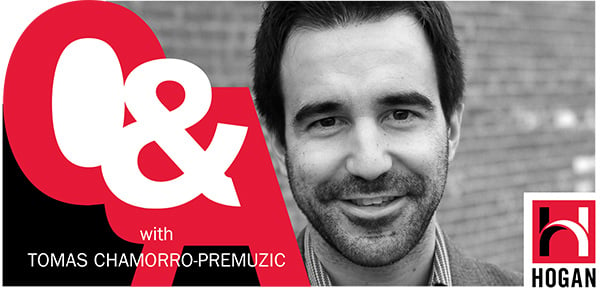
A Q&A with Dr. Tomas Chamorro-Premuzic | Creativity vs. Innovation
We sat down with Tomas Chamorro-Premuzic, Hogan’s VP of Research and Innovation, to pick his brain on the ups and downs of creativity at work.
What makes innovation valuable to an organization?
Experts disagree on the type and level of innovation that is most beneficial for organizations. Some studies suggest that radical innovation confers sustainable competitive advantages, but others show that “mild” innovation – think iPhone 5 rather than the original iPhone – is generally more effective, not least because it reduces market uncertainty.
Can we accurately evaluate the merit of our own ideas?
Most people fall into the trap of an illusory superiority that causes them to overestimate their creative talent, just as in other domains of competence (e.g., 90% of drivers claim to be above average – a mathematical improbability). It is therefore clear that we cannot rely on people’s self-evaluation to determine whether their ideas are creative or not.
Who will generate creative ideas?
Research shows that some people are disproportionately more likely to come up with novel and useful ideas, and that – irrespective of their field of expertise, job title, and occupational
background – these creative individuals tend to display a recurrent set of psychological characteristics and behaviors. As summarized in a detailed review of over 100 scientific studies creative people tend to be better at identifying (rather than solving) problems, they are passionate and sensitive, and, above all, they tend to have a hungry mind: they are open to new experiences, nonconformist, and curious.
What is the difference between creativity and innovation?
Execution – the capacity to turn an idea into a successful service, product, or venture. Entrepreneurship is the process by which creative ideas become useful innovations.
Is creativity alone sufficient for innovation?
No. Innovation also requires the development, production, and implementation of an idea. This is why the number of “latent” innovators is far larger than the number of actual innovations, and why we all have at some point generated great ideas that we never bothered to implement.
What are some of the core characteristics of entrepreneurial people?
I can think of five:
1) An opportunistic mindset that helps them identify gaps in the market. Opportunities are at the heart of entrepreneurship and innovation, and some people are much more alert to them than others.
2) Formal education or training, which are essential for noticing new opportunities or interpreting events as promising opportunities.
3) Proactivity and a high degree of persistence, which enable them to exploit the opportunities they identify. Above all, effective innovators are more driven, resilient, and energetic than their counterparts.
4) A healthy dose of prudence. Contrary to what many people think, successful innovators are
more organized, cautious, and risk-averse than the general population.
5) Social capital – serial innovators tend to use their connections and networks to mobilize resources and build strong alliances, both internally and externally; innovation is always the product of teams.
What about vision?
Even when people possess these five characteristics, true innovation is unlikely to occur in the absence of a meaningful mission or clear long-term vision. Indeed, vision is where entrepreneurship meets leadership, regardless of how creative, opportunistic, or proactive you are, the ability to propel others toward innovation is a critical feature of successful innovation. Without it, you can’t attract the right talent, build and empower teams, or ensure that you remain innovative even after attaining success.
Anything else you’d like to add?
In short, there is no point in just hoping for a breakthrough idea – what matters is the ability
to generate many ideas, discover the right opportunities to develop them, and act with drive
and dedication to achieve a meaningful goal. Ideas don’t make people successful – it’s the
other way around.
###
Tomas serves as Hogan’s vice president of research and innovation, spearheading research and development for new products. An international authority in psychological profiling, consumer analytics, and talent management, he represents Hogan at conferences worldwide. Tomas also is a professor of Business Psychology at University College London (UCL), and has previously taught at New York University and the London School of Economics.
0 Comments Click here to read/write comments
In our ebook 5 Things Keeping HR Up At Night, we identified succession planning as one of HR practitioners’ major concerns moving into 2014.
Baby Boomers, many of whom were forced to work later in life due to the recent financial crisis, are finally starting to age out of the workforce, taking with them a wealth of essential knowledge and skills.
In his post on the Harvard Business Review, however, author David DeLong points out that companies need to identify which people in their organizations are nearing retirement and what skills they will take with them.
He also makes an interesting point:
“Not all skills gaps are due to looming retirements. For example, shortages of mobile app developers, networking engineers, and sustainability managers are due to the rapid growth of new industries. These jobs didn’t exist a decade ago, and there is no older generation to draw on. This poses different challenges, such as identifying patterns of your most successful hires, like the schools they come from, where they live, and other characteristics that predict high performance and retention.”
This challenge isn’t limited to tech companies – how do you effectively build a workforce when you don’t have any incumbent data on which to base your decisions? Check out this 30-second video for the answer.
0 Comments Click here to read/write comments
 It seems more trouble is brewing in the military’s upper ranks. In the same month the Army released a report detailing its problem with toxic leaders and their role in the rash of soldier suicides over the past year, the Washington Post is reporting misconduct among the nation’s top brass. From allegations drinking on duty in the Air Force to sexual misconduct and even assault in the Army and Navy, no branch was exempt.
What is the source of this widespread corruption? From the article:
Martin L. Cook, a professor of military ethics at the Naval War College in Newport, R.I., said the recent eruption of misconduct is “frankly a puzzle to everybody.” One factor, he added, may be that as officers climb higher in the ranks they become insulated and fewer people are willing to challenge or question them.
Although this pattern of derailment is new, or more likely just newly reported, in the military, it is all too familiar to politics and the corporate world.
Judgment is a multi-part process in which an individual (a) processes the available information, (b) makes a decision, (c) receives feedback, and (d) adjusts their decision-making based on that feedback.
Business and political leaders are faced daily with heavy decisions. As they rise up the ranks, their circle of peers and advisors grows smaller and feedback scarce and more biased, putting them at greater risk of bad judgment.
In the political arena, Mitt Romney was so insulated from realistic feedback in 2012 that he was reportedly shocked as Obama won a decisive victory. In the private sector, leaders who made and then doubled down on bad decisions launched the country into a financial crisis from which we’re still recovering.
Whether in the private sector, politics, or the military, the net effect of those poor decisions is the same:
Cook said, military leaders recognize “they’ve got a major trust problem with the American people . . .”
0 Comments Click here to read/write comments
Topics: leadership, judgment
“Personality is about what people do and judgment is about why they do it,” says Dr. Robert Hogan in this presentation given at Mentis Consulting’s Hogan Summit 2013. This 30-minute talk focuses on good judgment and decision making. Using examples and case studies from notable entrepreneurs and politicians around the world, Dr. Hogan illustrates how people’s decisions relate to leadership and how this affects their business.
2 Comments Click here to read/write comments
Topics: judgment
“Personality is about what people do and judgment is about why they do it,” says Dr. Robert Hogan in this presentation given at Mentis Consulting’s Hogan Summit 2013. This 30-minute talk focuses on good judgment and decision making. Using examples and case studies from notable entrepreneurs and politicians around the world, Dr. Hogan illustrates how people’s decisions relate to leadership and how this affects their business.
0 Comments Click here to read/write comments
In our ebook 5 Things Keeping HR Up At Night, we identified succession planning as one of HR practitioners’ major concerns moving into 2014.
Baby Boomers, many of whom were forced to work later in life due to the recent financial crisis, are finally starting to age out of the workforce, taking with them a wealth of essential knowledge and skills.
In his post on the Harvard Business Review, however, author David DeLong points out that companies need to identify which people in their organizations are nearing retirement and what skills they will take with them.
He also makes an interesting point:
“Not all skills gaps are due to looming retirements. For example, shortages of mobile app developers, networking engineers, and sustainability managers are due to the rapid growth of new industries. These jobs didn’t exist a decade ago, and there is no older generation to draw on. This poses different challenges, such as identifying patterns of your most successful hires, like the schools they come from, where they live, and other characteristics that predict high performance and retention.”
This challenge isn’t limited to tech companies – how do you effectively build a workforce when you don’t have any incumbent data on which to base your decisions? Check out this 30-second video for the answer.
0 Comments Click here to read/write comments
