Do Creative People Make Good Leaders?
+1.918.749.0632




Topics: leadership
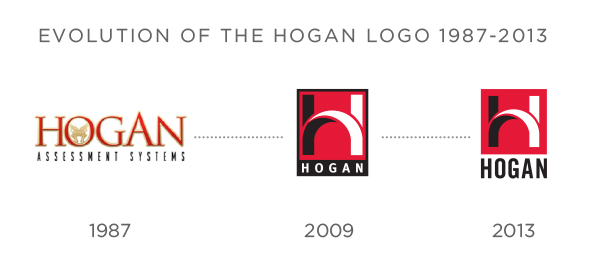 When I joined Hogan as creative manager in 2008, one of the first major projects I undertook was redesigning the logo. The existing logo had gone through a couple of iterations since 1987, and at that point was too visually complicated and not very versatile. Also, the logo at that time used the full Hogan Assessment Systems name, while it had become clear that a large part of our client and distributor base was referring to us simply as The Hogan or Hogan, both in noun and verb form.
With these factors in mind, my goal was to develop a bold and recognizable new brand identity that worked well across a number of applications. The prospect of distilling Hogan’s business focus into a few simple shapes was not a simple one, and a good logo should maintain visual integrity whether reproduced digitally or in print, in color or black and white, whether large or small. For the sake of maximum flexibility, I also wanted an icon that was instantly recognizable independently of the Hogan name.
From my initial conversations with Robert Hogan, I knew that part of what needed to be conveyed was a sense of strength and boldness, an extension of the idea that Hogan is nothing short of a commanding presence in the personality assessment arena. The other element I wanted to incorporate was the idea of a bright side and a dark side, which is the unique and fundamental basis of our core assessments. Out of those ideas came the current logo’s stylized H in black and white, on top of a bold red field.
From then to now.
#throwbackthursday #tbt
 Companies have spent millions of dollars designing complicated competency models, fruitless training programs, and elaborate perks to select, develop, and retain their middle managers. But when you boil it down, only three things really matter:
Can they do the job? In the modern economy, mid-level managers are often required to motivate employees and harness increasingly scarce resources to achieve a common goal. When it comes to selecting individuals to promote into middle management, it’s critical to find people with the correct skill set.
Will they enjoy doing the job? Happy, engaged managers make for happy teams and higher organizational performance. Some experience a natural urge to lead, others don’t. And when the latter gets promoted, companies often lose a high-performing employee and gain a mediocre manager.
What will get in their way? The same bold, assertive, risk-taking behavior that can help launch individuals’ careers can become debilitating weaknesses under the pressure of middle management. For these behaviors, knowledge and skills training is not enough – they need to develop the proper self-awareness and leadership behaviors for their mid-level management role.
Find out Hogan’s solution to these questions as well as four reasons your middle management may be underperforming in our ebook, 4 Ways Companies Are Failing Their Middle Managers And Why It’s Killing Innovation.
 Companies have spent millions of dollars designing complicated competency models, fruitless training programs, and elaborate perks to select, develop, and retain their middle managers. But when you boil it down, only three things really matter:
Can they do the job? In the modern economy, mid-level managers are often required to motivate employees and harness increasingly scarce resources to achieve a common goal. When it comes to selecting individuals to promote into middle management, it’s critical to find people with the correct skill set.
Will they enjoy doing the job? Happy, engaged managers make for happy teams and higher organizational performance. Some experience a natural urge to lead, others don’t. And when the latter gets promoted, companies often lose a high-performing employee and gain a mediocre manager.
What will get in their way? The same bold, assertive, risk-taking behavior that can help launch individuals’ careers can become debilitating weaknesses under the pressure of middle management. For these behaviors, knowledge and skills training is not enough – they need to develop the proper self-awareness and leadership behaviors for their mid-level management role.
Find out Hogan’s solution to these questions as well as four reasons your middle management may be underperforming in our ebook, 4 Ways Companies Are Failing Their Middle Managers And Why It’s Killing Innovation.
 Life is determined by the decisions you make; from the mundane to major life choices. When it comes to decision-making, everyone is different. There are individuals who prefer to act swiftly and seem to generate their plan midstream, while others appear to become paralyzed by what could go wrong.
Our decisions are influenced by our personality, values, biases, emotions, and past experiences. Chances are, the people you work with are different from you in what influences their decisions. These differences can lead to conflict among colleagues, teams, and direct reports, thus causing delays and impeding progress. So, how can you ensure decisions are made in a timely manner and everyone is on board?
Driving change and influencing decision-making requires energy, savvy, and a lot of hard work.
Topics: personality
 Life is determined by the decisions you make; from the mundane to major life choices. When it comes to decision-making, everyone is different. There are individuals who prefer to act swiftly and seem to generate their plan midstream, while others appear to become paralyzed by what could go wrong.
Our decisions are influenced by our personality, values, biases, emotions, and past experiences. Chances are, the people you work with are different from you in what influences their decisions. These differences can lead to conflict among colleagues, teams, and direct reports, thus causing delays and impeding progress. So, how can you ensure decisions are made in a timely manner and everyone is on board?
Driving change and influencing decision-making requires energy, savvy, and a lot of hard work.
 As a leader in personality assessment, we've been studying this stuff for decades (really, ask us anything). We know cognitive ability is only a partial predictor of career success. In most jobs, it's EQ, the ability to identify and manage your own and others' emotions, that really matters. People skills determine success, and individuals who lack the ability to build effective relationships are destined to fail -- no matter how smart or talented they are.
 Topics: EQ, emotional intelligence
 As a leader in personality assessment, we’ve been studying this stuff for decades (really, ask us anything). We know cognitive ability is only a partial predictor of career success. In most jobs, it’s EQ, the ability to identify and manage your own and others’ emotions, that really matters. People skills determine success, and individuals who lack the ability to build effective relationships are destined to fail — no matter how smart or talented they are.
The Hogan EQ Report provides organizations with a scientifically validated tool to measure emotional intelligence. Based on the Hogan Personality Inventory and Hogan Development Survey, the easy-to-understand report provides an overall EQ score, as well as scores and feedback for six emotional competencies.
Check out this video for more on the Hogan EQ Report.
Topics: EQ, emotional intelligence
“You don’t start at the top if you want to find the story. You start in the middle, because it’s the people in the middle who do the actual work in the world.”
– Malcolm Gladwell, journalist and bestselling author
Unfortunately, many companies spent the past decade diverting resources from middle management, creating a talent vacuum that has proved difficult to fill. Without proper development, a company’s most valuable assets – their people – can derail and fall short of performance expectations. There are four ways companies get managing their middle managers wrong:
1) They promote the wrong people. Many organizations rely on performance appraisals and supervisor nominations to identify and promote talented individuals rather than objective measures.
2) They don’t effectively train them. Most companies focus their development efforts at the extremes of their management hierarchies rather than honing in on the central figures – the middle managers.
3) They stress them out. The shift to more flat organizational structures has placed the lion’s share of pressure and accountability on the shoulders of middle managers.
4) They let them disengage. In a 2007 study, 41% of HR leaders said engagement among mid-level managers had dropped noticeably over the previous 18 months.
How can organizations turn their underperforming middle managers into a group of competent, engaged leaders? Find out in our ebook, 4 Ways Companies Are Failing Their Middle Managers And Why It’s Killing Innovation.
