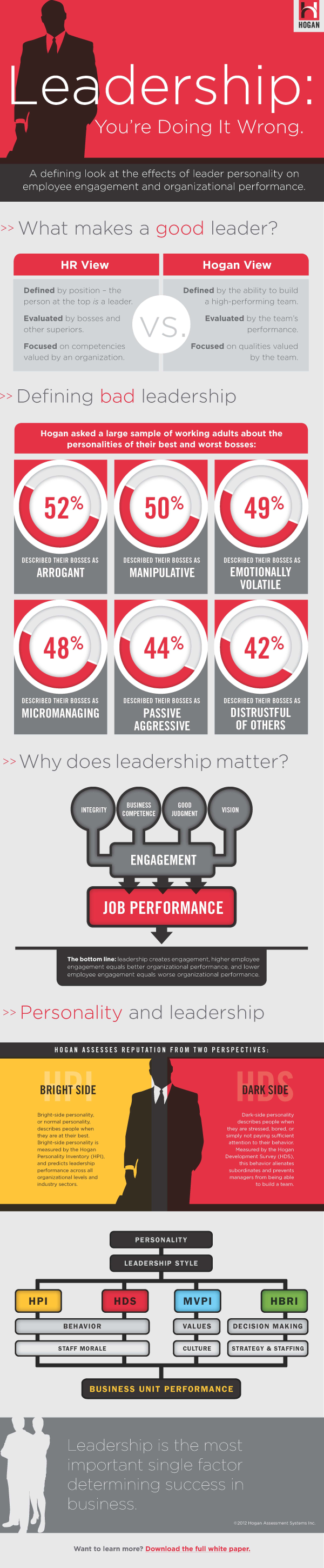
Leadership is the most important single factor in determining success in business.
+1.918.749.0632




Leadership is the most important single factor in determining success in business.
Hogan has been studying emotional intelligence and its impact on organizational effectiveness for decades. In this short video, Dr. Tomas Chamorro-Premuzic, vice president of research and innovation, explains the concept of emotional intelligence, why it’s important, how we measure it, and what it means for you.
For more information, check out our ebook, Want a Better Job? Learn to Control Your Emotions.
Topics: EQ, emotional intelligence
Hogan has been studying emotional intelligence and its impact on organizational effectiveness for decades. In this short video, Dr. Tomas Chamorro-Premuzic, vice president of research and innovation, explains the concept of emotional intelligence, why it’s important, how we measure it, and what it means for you.
For more information, check out our ebook, Want a Better Job? Learn to Control Your Emotions.
Topics: EQ, emotional intelligence
When it comes to understanding your employees, there are three things that matter.
Our assessments provide insight you can leverage to get the most out of your people and help them get the most from their careers.
Topics: HPI, MVPI, Hogan Personality Inventory, Hogan Development Survey, assessments, HDS
When it comes to understanding your employees, there are three things that matter.
Our assessments provide insight you can leverage to get the most out of your people and help them get the most from their careers.
Topics: assessments
“Control, control, you must learn control,” Yoda said to Luke Skywalker during Jedi training. Just like Luke, employees must be aware of and learn to control their emotions if they want to be successful at their job (whether their job involves fighting intergalactic forces or receiving critical feedback on a presentation). Fortunately for Luke, he had a great coach and eventually became self-aware enough to conquer his volatile tendencies and channel his emotional energy into the task at hand.
When hiring, it is common to assess not only a candidate’s hard skills, educational background and resume points, but also to take into consideration his or her workplace demeanor. Unfortunately, brief interview sessions provide little opportunity to examine a person’s emotional output when faced with certain workplace situations.
Like Luke, many employees have greatness within them, but lack the tools to successfully put their emotions aside. Assessing emotional intelligence (EQ), the ability to identify, process, and manage one’s own and others’ emotions, provides this acumen in the form of self-awareness. The Hogan EQ assessment measures along six essential workplace emotional competencies:
Emotional Perception
Emotional Control
Emotional Sharing
By providing a measurement of emotional intelligence, Hogan’s EQ report gives employees insight into the roles their emotions play in their worklife as well as how they are perceived by others. By understanding their natural strengths and weaknesses, employees can learn to compensate for those behaviors. Interested in learning more about how we assess EQ? Download our complimentary eBook, Want a Better Job? Learn to Control Your Emotions.
Topics: EQ, emotional intelligence
“Control, control, you must learn control,” Yoda said to Luke Skywalker during Jedi training. Just like Luke, employees must be aware of and learn to control their emotions if they want to be successful at their job (whether their job involves fighting intergalactic forces or receiving critical feedback on a presentation). Fortunately for Luke, he had a great coach and eventually became self-aware enough to conquer his volatile tendencies and channel his emotional energy into the task at hand.
When hiring, it is common to assess not only a candidate’s hard skills, educational background and resume points, but also to take into consideration his or her workplace demeanor. Unfortunately, brief interview sessions provide little opportunity to examine a person’s emotional output when faced with certain workplace situations.
Like Luke, many employees have greatness within them, but lack the tools to successfully put their emotions aside. Assessing emotional intelligence (EQ), the ability to identify, process, and manage one’s own and others’ emotions, provides this acumen in the form of self-awareness. The Hogan EQ assessment measures along six essential workplace emotional competencies:
Emotional Perception
Emotional Control
Emotional Sharing
By providing a measurement of emotional intelligence, Hogan’s EQ report gives employees insight into the roles their emotions play in their worklife as well as how they are perceived by others. By understanding their natural strengths and weaknesses, employees can learn to compensate for those behaviors. Interested in learning more about how we assess EQ? Download our complimentary eBook, Want a Better Job? Learn to Control Your Emotions.
Topics: EQ, emotional intelligence
 After analyzing the personality profiles of Homer’s Greek heroes, Achilles and Agamemnon, Rastislav Duriš, an HR consultant, and Matus Porubjak, a philosophy professor, asked the question, “In which occupations, organizations or environments would these heroes prosper today?”
Career counselling for these two ancient heroes starts with their motivation (Motives, Values, Preferences Inventory). Achilles feels fulfilled by helping others, developing them and generally working for a prosperous society. He values material success, profit, ROI, trade and money, as well as traditional social values and virtues, morale, history and principled attitude towards life and work. His motives indicate that Achilles would be satisfied in a well-established organization with a clear mission, values and business purpose. The company should also be commercially oriented, such as a financial institution, and care about the satisfaction of its employees or customers. A good example would be a private bank with a long tradition of customer care and elaborate employee program.
Valuing commerce, finance and material success, Agamemnon, unlike Achilles, feels motivated by social status – the desire to stand out and get recognition – and desires influence and power. Self-sacrifice for others and helping society doesn’t really work for him. He is more likely to feel satisfied in environments that enable him to work on his individual career, achieve an important position, and gain credit as well as high financial remuneration. He would be happiest working in financial and insurance companies or private firms focused on profit and beating the competition.
The two share Hogan Personality Inventory (HPI) scores that are like those of successful entrepreneurs. Achilles and Agamemnon would be successful in launching companies and organizations (though probably not together as per the last blog in this series). Both have traits of leadership, though their disposition could be more suited for crisis management which involves time restrictions and often requires making unpopular decisions. It is important to note that their definitive success or failure would also be shaped by their ability to cope with their potential risky behavior indicated in the Hogan Development Survey (HDS). High scores in these assessments mean a raised flag for entrepreneurs and managers – “Beware! You have certain exceptional characteristics; however, if you don’t learn to handle them and use them constructively, they may contribute to your fall later.” Which, in the case of Achilles and Agamemnon, they did.
Topics: HPI, MVPI, Hogan Personality Inventory, Hogan Development Survey, HDS
 After analyzing the personality profiles of Homer’s Greek heroes, Achilles and Agamemnon, Rastislav Duriš, an HR consultant, and Matus Porubjak, a philosophy professor, asked the question, “In which occupations, organizations or environments would these heroes prosper today?”
Career counselling for these two ancient heroes starts with their motivation (Motives, Values, Preferences Inventory). Achilles feels fulfilled by helping others, developing them and generally working for a prosperous society. He values material success, profit, ROI, trade and money, as well as traditional social values and virtues, morale, history and principled attitude towards life and work. His motives indicate that Achilles would be satisfied in a well-established organization with a clear mission, values and business purpose. The company should also be commercially oriented, such as a financial institution, and care about the satisfaction of its employees or customers. A good example would be a private bank with a long tradition of customer care and elaborate employee program.
Valuing commerce, finance and material success, Agamemnon, unlike Achilles, feels motivated by social status – the desire to stand out and get recognition – and desires influence and power. Self-sacrifice for others and helping society doesn’t really work for him. He is more likely to feel satisfied in environments that enable him to work on his individual career, achieve an important position, and gain credit as well as high financial remuneration. He would be happiest working in financial and insurance companies or private firms focused on profit and beating the competition.
The two share Hogan Personality Inventory (HPI) scores that are like those of successful entrepreneurs. Achilles and Agamemnon would be successful in launching companies and organizations (though probably not together as per the last blog in this series). Both have traits of leadership, though their disposition could be more suited for crisis management which involves time restrictions and often requires making unpopular decisions. It is important to note that their definitive success or failure would also be shaped by their ability to cope with their potential risky behavior indicated in the Hogan Development Survey (HDS). High scores in these assessments mean a raised flag for entrepreneurs and managers – “Beware! You have certain exceptional characteristics; however, if you don’t learn to handle them and use them constructively, they may contribute to your fall later.” Which, in the case of Achilles and Agamemnon, they did.
 Although much of the panic surrounding their generation has subsided, the fact that many Millennials struggle to find and maintain employment has not. According to recent numbers from the U.S. Department of Labor, unemployment among Millennials (ages 18-29) was nearly double the national unemployment rate in January 2013, having risen faster than any other demographic.
Some of this can be blamed on a still-recovering job market, but the persistent nature of under- and unemployment among millennials suggests that this demographic lacks some skill necessary to obtain employment.
In the 1990s, the U.S. department of labor conducted a survey examining what companies want from their employees. The report identified five critical workplace competencies:
1) Locating and allocating resources
2) Acquiring and interpreting information
3) Understanding complex systems
4) Technological literacy
5) Interpersonal skills
When it comes to the first four requirements, today’s young employees are quite advanced relative to their older peers at that age. Millennials came up in the age of the Internet search, social media and crowdsourcing, and are adept at searching for, finding, and synthesizing information. And as far as technological literacy, the Pew Research Center called them digital natives in a landscape of immigrants. However, the fifth competency, interpersonal skills, is where many young employees fall short. And that’s a big problem.
Emotional Intelligence (EQ) - the ability to identify, process, and manage one’s own and others’ emotions – is an essential part of building and maintaining positive, productive relationships, which is an essential skill in most jobs. Interested to know more about how we measure and improve individuals’ EQ? Check out our complimentary eBook here.
Topics: EQ, emotional intelligence
