

EQnomics

Posted by HNews on Sun, Apr 14, 2013


EQAlthough much of the panic surrounding their generation has subsided, the fact that many Millennials struggle to find and maintain employment has not. According to recent numbers from the U.S. Department of Labor, unemployment among Millennials (ages 18-29) was nearly double the national unemployment rate in January 2013, having risen faster than any other demographic.

Some of this can be blamed on a still-recovering job market, but the persistent nature of under- and unemployment among millennials suggests that this demographic lacks some skill necessary to obtain employment.

In the 1990s, the U.S. department of labor conducted a survey examining what companies want from their employees. The report identified five critical workplace competencies:

1)     Locating and allocating resources

2)     Acquiring and interpret­ing information

3)     Understanding complex systems

4)     Technological literacy

5)     Interpersonal skills

When it comes to the first four requirements, today’s young employees are quite advanced relative to their older peers at that age. Millennials came up in the age of the Internet search, social media and crowdsourcing, and are adept at searching for, finding, and synthesizing information. And as far as technological literacy, the Pew Research Center called them digital natives in a landscape of immigrants. However, the fifth competency, interpersonal skills, is where many young employees fall short. And that’s a big problem.

Emotional Intelligence (EQ) – the ability to identify, process, and manage one’s own and others’ emotions – is an essential part of building and maintaining positive, productive relationships, which is an essential skill in most jobs.

 

Topics: EQ, emotional intelligence

Can’t We All Just Get Along? (Iliad Series Part II)

Posted by Natalie O'Neal on Fri, Apr 12, 2013

IliadIs it possible to know how two people will interact with each other based solely on their personality? In the article “Homer and Big 5,” Rastislav Duriš, an HR consultant, and Matus Porubjak, a philosophy professor, analyzed the personality profiles of the two heroes – Achilles and Agamemnon – from the first song of Homer’s Iliad to find out whether the two Greeks were predisposed for mutual conflict.

The authors considered both characters’ potential for behavioral conflict and value conflict. When looking at Achilles and Agamemnon’s Hogan Personality Inventory (HPI) and Hogan Development Survey (HDS) profiles, Duriš and Porubjak found that both men were very goal-oriented, competitive and ambitious. They were also self-critical, dissatisfied, sensitive to threats, and communicated in a straightforward manner without the tendency to build or maintain relationships with others.

Duriš and Porubjak predicted the possibility of conflict between the warrior and his king. For example, lower to average Prudence in both heroes indicates that they may attempt to use non-standard means in order to achieve goals or break rules. In some situations, Achilles as well as Agamemnon will be short-tempered and hot-headed, which will add an element of unpredictability as well as strong emotional and black-and-white perception to their interactions (e.g. mutual denigration). Achilles will only minimally respect the authority of Agamemnon and will be quite independent. On the other hand, if confronted, Agamemnon may perceive Achilles’ actions as especially negative, hostile, threatening or deceitful. While under stress, he may even attack Achilles by means of non-critical self-confirmation and misinterpretation or fabulation of events.

Duriš and Porubjak also found that the two also had potential towards mutual antipathy due to differing motivations. By analyzing their Motives, Values, Preferences Inventory (MVPI) profiles, they found that, while Achilles is interested in the prosperity of a wider community and welfare of others in general, Agamemnon is a relationship pragmatist and materialist who is predominantly interested in his own agenda.

While Agamemnon probably won’t get the world’s best boss award, his management of Achilles fails disastrously due to their conflicting personalities and motivations. And to think, all of this might have been avoided had the two been self-aware of their differences and motivational tendencies beforehand.

Topics: HPI, MVPI, Hogan Personality Inventory, Hogan Development Survey, HDS

Can’t We All Just Get Along? (Iliad Series Part II)

Posted by Hogan Assessments on Thu, Apr 11, 2013

IliadIs it possible to know how two people will interact with each other based solely on their personality? In the article “Homer and Big 5,” Rastislav Duriš, an HR consultant, and Matus Porubjak, a philosophy professor, analyzed the personality profiles of the two heroes – Achilles and Agamemnon – from the first song of Homer’s Iliad to find out whether the two Greeks were predisposed for mutual conflict.
The authors considered both characters’ potential for behavioral conflict and value conflict. When looking at Achilles and Agamemnon’s Hogan Personality Inventory (HPI) and Hogan Development Survey (HDS) profiles, Duriš and Porubjak found that both men were very goal-oriented, competitive and ambitious. They were also self-critical, dissatisfied, sensitive to threats, and communicated in a straightforward manner without the tendency to build or maintain relationships with others.

Duriš and Porubjak predicted the possibility of conflict between the warrior and his king. For example, lower to average Prudence in both heroes indicates that they may attempt to use non-standard means in order to achieve goals or break rules. In some situations, Achilles as well as Agamemnon will be short-tempered and hot-headed, which will add an element of unpredictability as well as strong emotional and black-and-white perception to their interactions (e.g. mutual denigration). Achilles will only minimally respect the authority of Agamemnon and will be quite independent. On the other hand, if confronted, Agamemnon may perceive Achilles’ actions as especially negative, hostile, threatening or deceitful. While under stress, he may even attack Achilles by means of non-critical self-confirmation and misinterpretation or fabulation of events.

Duriš and Porubjak also found that the two also had potential towards mutual antipathy due to differing motivations. By analyzing their Motives, Values, Preferences Inventory (MVPI) profiles, they found that, while Achilles is interested in the prosperity of a wider community and welfare of others in general, Agamemnon is a relationship pragmatist and materialist who is predominantly interested in his own agenda.

While Agamemnon probably won’t get the world’s best boss award, his management of Achilles fails disastrously due to their conflicting personalities and motivations. And to think, all of this might have been avoided had the two been self-aware of their differences and motivational tendencies beforehand.

Introducing the Hogan EQ Report

Posted by Hogan News on Thu, Apr 11, 2013

EQ brochure
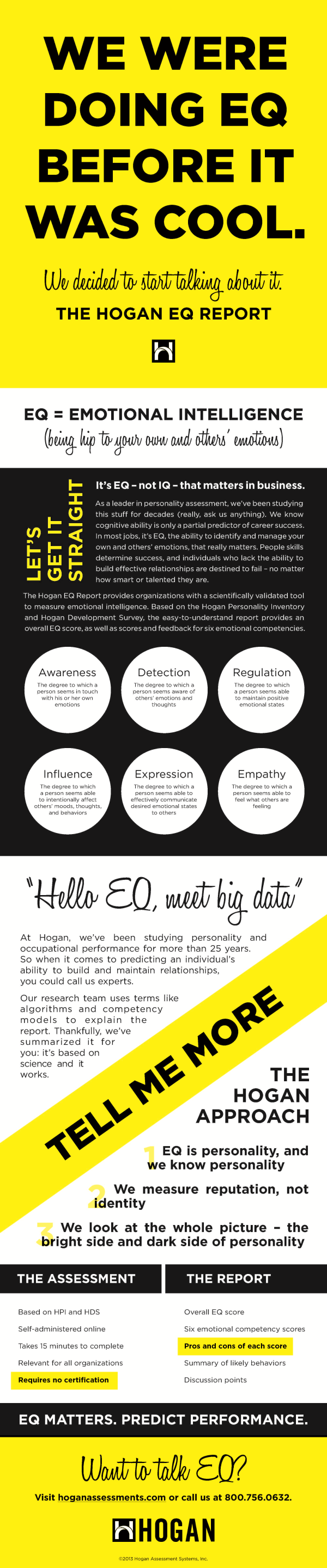
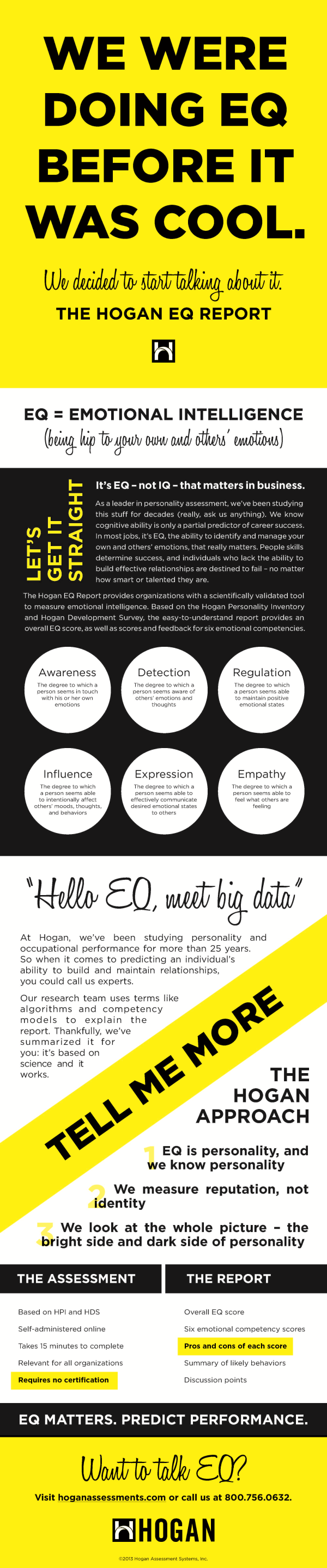
Introducing the Hogan EQ Report. EQ, the ability to identify and manage your own and others’ emotions, determines success in nearly every job. Those who lack the ability to build effective relationships are destined to fail – no matter how smart they are. The Hogan EQ Report provides organizations with a scientifically validated tool to measure emotional intelligence.

Want to know more? Check out our ebook, Want a Better Job? Learn to Control Your Emotions.

Topics: EQ, emotional intelligence

Introducing the Hogan EQ Report

Posted by HNews on Wed, Apr 10, 2013

EQ brochure
Introducing the Hogan EQ Report. EQ, the ability to identify and manage your own and others’ emotions, determines success in nearly every job. Those who lack the ability to build effective relationships are destined to fail – no matter how smart they are. The Hogan EQ Report provides organizations with a scientifically validated tool to measure emotional intelligence.

Want to know more? Check out our ebook, Want a Better Job? Learn to Control Your Emotions.

Topics: EQ, emotional intelligence

Field Guide to SIOP II

Posted by Blaine Gaddis on Wed, Apr 10, 2013

The original Field Guide to SIOP blog post was a hit so I've added a few additional species you may encounter at SIOP this year. Please enjoy this second installment.

  1. The Supermarket Sampler – Often confused with The Tourist, this similar species can be found in the exhibitor’s hall which it calls home.  However, The Supermarket Sampler stalks the space in search of edible treats and may make repeated trips through favored booths, attempting to pass off such trips as their first.
  2. The Eager Seeker – This adorable and younger form of The Card Dealer eagerly and broadly distributes his/her resume or CV to anyone wearing a SIOP name badge. This species is most typically observed at the placement center, but may also be found in search of opportunities in the exhibitor’s hall. In some cases, The Eager Seeker may have its own business cards printed to mimic the more-experienced Card Dealer.
  3. The One-Upper – The easiest way to identify the One-Upper is to tell a story around them. Whatever the story, chances are they can quickly follow it with a similar story of higher achievement. If you published on a topic last year, chances are they will remind you that they published on the same topic in a better journal three years ago.
  4. The Stalker – If you’re a SIOP fellow, you’ve probably encountered The Stalker. This species is typically seen waiting after sessions have ended or nervously pacing by the fringes of booths to meet the big names in the field. The Stalker may have an idea to offer, or may just want to meet the face behind the name. If you find yourself cornered by the Stalker, offer them your autograph – they may faint.
  5. The “We Should Collaborate” – Like the casual acquaintance who suggests getting together more often after a few drinks, this creature makes plans with colleagues every year to collaborate on research for journal publication or future conferences. This creature is the Publisher’s Clearing House of the SIOP kingdom, so don’t plan on them actually following up on such offers.
  6. The Sales Robot – Found in exhibitor’s hall and various parties, receptions, restaurants, and bars, the sales robot is a particularly aggressive creature. This species holds the notion that SIOP is the perfect opportunity to pitch their latest you’ve-got-to-hear-me-out-on-this, don’t-miss-this-opportunity product or service. You can identify them by their trouble with the words “no thanks."
  7. The Spy – To The Spy, SIOP is an opportunity for covert intelligence operations on competitors. This sly creature may obscure his/her professional affiliation in an attempt to gain access to sensitive information they can later use as a competitive advantage against others. The Spy is often observed in the exhibitor’s hall, where they may attempt to find information before and/or after hours.
  8. The Substitute – This species can be found in conference poster sessions and symposia, where they typically present research conducted primarily by other more senior professionals. Many members of this species are younger graduate students presenting research on which they collaborated with advisors, but this creature may sometimes endure into professional careers.
  9. The Are-You-at-the-Right-Conference? – A rare find at SIOP, but not entirely unknown. With no apparent connection to the I-O community (or perhaps psychology as a whole), this species attends the conference but may appear lost or unfamiliar with their surroundings. This creature is easy to spot due to a lack of familiarity with even basic I-O concepts.

Armed with the full Field Guide to SIOP, we hope you enjoy the SIOP Conference this year. See you in Houston!

Topics: SIOP

Field Guide to SIOP II

Posted by Hogan Assessments on Tue, Apr 09, 2013

The original Field Guide to SIOP blog post was a hit so I’ve added a few additional species you may encounter at SIOP this year. Please enjoy this second installment.

  1. The Supermarket Sampler – Often confused with The Tourist, this similar species can be found in the exhibitor’s hall which it calls home.  However, The Supermarket Sampler stalks the space in search of edible treats and may make repeated trips through favored booths, attempting to pass off such trips as their first.
  2. The Eager Seeker – This adorable and younger form of The Card Dealer eagerly and broadly distributes his/her resume or CV to anyone wearing a SIOP name badge. This species is most typically observed at the placement center, but may also be found in search of opportunities in the exhibitor’s hall. In some cases, The Eager Seeker may have its own business cards printed to mimic the more-experienced Card Dealer.
  3. The One-Upper – The easiest way to identify the One-Upper is to tell a story around them. Whatever the story, chances are they can quickly follow it with a similar story of higher achievement. If you published on a topic last year, chances are they will remind you that they published on the same topic in a better journal three years ago.
  4. The Stalker – If you’re a SIOP fellow, you’ve probably encountered The Stalker. This species is typically seen waiting after sessions have ended or nervously pacing by the fringes of booths to meet the big names in the field. The Stalker may have an idea to offer, or may just want to meet the face behind the name. If you find yourself cornered by the Stalker, offer them your autograph – they may faint.
  5. The “We Should Collaborate” – Like the casual acquaintance who suggests getting together more often after a few drinks, this creature makes plans with colleagues every year to collaborate on research for journal publication or future conferences. This creature is the Publisher’s Clearing House of the SIOP kingdom, so don’t plan on them actually following up on such offers.
  6. The Sales Robot – Found in exhibitor’s hall and various parties, receptions, restaurants, and bars, the sales robot is a particularly aggressive creature. This species holds the notion that SIOP is the perfect opportunity to pitch their latest you’ve-got-to-hear-me-out-on-this, don’t-miss-this-opportunity product or service. You can identify them by their trouble with the words “no thanks.”
  7. The Spy – To The Spy, SIOP is an opportunity for covert intelligence operations on competitors. This sly creature may obscure his/her professional affiliation in an attempt to gain access to sensitive information they can later use as a competitive advantage against others. The Spy is often observed in the exhibitor’s hall, where they may attempt to find information before and/or after hours.
  8. The Substitute – This species can be found in conference poster sessions and symposia, where they typically present research conducted primarily by other more senior professionals. Many members of this species are younger graduate students presenting research on which they collaborated with advisors, but this creature may sometimes endure into professional careers.
  9. The Are-You-at-the-Right-Conference? – A rare find at SIOP, but not entirely unknown. With no apparent connection to the I-O community (or perhaps psychology as a whole), this species attends the conference but may appear lost or unfamiliar with their surroundings. This creature is easy to spot due to a lack of familiarity with even basic I-O concepts.

Armed with the full Field Guide to SIOP, we hope you enjoy the SIOP Conference this year. See you in Houston!

6 Advantages of Hogan’s Certification Program

Posted by Hogan News on Mon, Apr 08, 2013

1. Quality. Hogan’s assessments are based in decades of scientific theory and research. The Hogan Assessment Certification Workshop covers two days of intensive education and training designed to help users understand the science behind our products and how it affects their outcomes.

2. Consistency. Hogan provides assessments in more than 40 countries and languages. But no matter where our users are, our standardized training materials and curriculum guarantee they receive the same quality experience our clients have come to expect.

“We have been conducting Hogan workshops in Australia for the local market and on behalf of our global Hogan Partners for last 10 years,” said Shayne Nealon, managing partner at Australian firm Peter Berry Consultancy. “Our clients appreciate the consistency that applies with Hogan and the ability to offer a consistent global accreditation solution and ongoing support.”

3. Hands-on learning. The best way to learn is by doing. At Hogan’s workshops, participants analyze and interpret assessment results and give comprehensive feedback on our three flagship assessments, the HPI, HDS, and MVPI in both an individual and group setting.

Here’s what participants are saying: 

“Great program, well structured, and excellent opportunity to practice case studies.”

“The content of the workshop
was right on point with giving
us the skills to be able to interpret and provide feedback to our customer's on their assessment. I learned a lot from my fellow participants and will stay in touch with many of them in the future.” 

“I learned techniques that I will immediately apply to my report analysis and feedback sessions.” 

4. Advanced interpretation. Understanding how an individual’s scores impact, buffer, and nuance each other is an essential foundation for development planning, executive coaching, and working with high potential employees.

“One of Hogan’s principal advantages, particularly for development, relies on feedback being administered right,” said Rahul Baswani, managing partner at Sierra Alta Consulting.

5. Validity. We go to extraordinary lengths to ensure our products work. By ensuring Hogan users are qualified and properly trained to use our products, we ensure the best possible outcomes at their respective companies. Proper training is also important to ensure that our assessments are legally defensible. In our 25 years in business, our assessment solutions have never been legally challenged.

6. Support. When Hogan was founded in 1987, it was a four-person test publisher in Tulsa, Oklahoma. We built our reputation based on two things: an outstanding product and an unparalleled level of customer support. Today, our global network of consultants, partners, and distributors carries on this legacy.

Topics: certification, feedback, training

6 Advantages of Hogan’s Certification Program

Posted by HNews on Sun, Apr 07, 2013


1. Quality. Hogan’s assessments are based in decades of scientific theory and research. The Hogan Assessment Certification Workshop covers two days of intensive education and training designed to help users understand the science behind our products and how it affects their outcomes.

2. Consistency. Hogan provides assessments in more than 40 countries and languages. But no matter where our users are, our standardized training materials and curriculum guarantee they receive the same quality experience our clients have come to expect.

“We have been conducting Hogan workshops in Australia for the local market and on behalf of our global Hogan Partners for last 10 years,” said Shayne Nealon, managing partner at Australian firm Peter Berry Consultancy. “Our clients appreciate the consistency that applies with Hogan and the ability to offer a consistent global accreditation solution and ongoing support.”

3. Hands-on learning. The best way to learn is by doing. At Hogan’s workshops, participants analyze and interpret assessment results and give comprehensive feedback on our three flagship assessments, the HPI, HDS, and MVPI in both an individual and group setting.

Here’s what participants are saying:

“Great program, well structured, and excellent opportunity to practice case studies.” “The content of the workshop
was right on point with giving
us the skills to be able to interpret and provide feedback to our customer’s on their assessment. I learned a lot from my fellow participants and will stay in touch with many of them in the future.” 
“I learned techniques that I will immediately apply to my report analysis and feedback sessions.” 

4. Advanced interpretation. Understanding how an individual’s scores impact, buffer, and nuance each other is an essential foundation for development planning, executive coaching, and working with high potential employees.

“One of Hogan’s principal advantages, particularly for development, relies on feedback being administered right,” said Rahul Baswani, managing partner at Sierra Alta Consulting.

5. Validity. We go to extraordinary lengths to ensure our products work. By ensuring Hogan users are qualified and properly trained to use our products, we ensure the best possible outcomes at their respective companies. Proper training is also important to ensure that our assessments are legally defensible. In our 25 years in business, our assessment solutions have never been legally challenged.

6. Support. When Hogan was founded in 1987, it was a four-person test publisher in Tulsa, Oklahoma. We built our reputation based on two things: an outstanding product and an unparalleled level of customer support. Today, our global network of consultants, partners, and distributors carries on this legacy.


Topics: certification, feedback

It’s All Greek To Me (Iliad Series Part I)

Posted by Natalie O'Neal on Fri, Apr 05, 2013

IliadEver wonder how your personality assessment results compare to well-known figures in history? What about ancient Greek heroes? In their article “Homer and Big 5,” Rastislav Duriš, an HR consultant, and Matus Porubjak, a philosophy professor, explore the socio-psychological aspects of Homer’s famous war epic, the Iliad, by putting the head-butting heroes, Achilles and Agamemnon, to the Hogan test.

Hellenic thinkers and orators, like Homer, dealt with subjects of the human condition and broached many topics which subsequently manifested as modern-day psychology. Ancient Greece is the cradle of one of the earliest personality typologies – Hippocrates’ division of people into sanguine, choleric, melancholic and phlegmatic types. Although personality research has advanced since then, it is illuminating (not to mention fun) to retrospectively apply it to ancient Greek history. By applying current psychological models of personality to a close reading of the first song of the Iliad, uriš and Porubjak were able to make assumptions based on content analysis about the Greek heroes’ inner motivators and derailers.

When analyzed using the Hogan Development Survey (HDS) scales, Achilles, the Achaean warrior who flew off the handle and dragged his Trojan opponent’s lifeless body around for days after his best friend was killed in battle, is (not surprisingly) high on the Excitable scale. His moodiness and irritability are coupled with a low Adjustment score on the Hogan Personality Inventory (HPI) to make one pretty emotionally volatile and unpredictable Greek guy. High scores in Ambition (HPI) and Tradition also explain his competitive nature and intense loyalty to his friend’s memory.

Agamemnon, the Achaean king who stole the Trojan king’s daughter only to give her back and then steal Achilles’ girlfriend, has scores similar to those of Achilles. Add in low Prudence (HPI) and high Bold (HDS) scores and you’ve got a stubborn king who thinks he’s the bee’s knees. His values? Power and Recognition. All this coupled with high Skeptical and Mischievous scores (HDS) creates the potential for a power hungry, mistrusting ruler who would quickly kick his army to the curb and flee the scene as soon as the going got tough – which he almost did (a couple of times).

Topics: HPI, Hogan Personality Inventory, Hogan Development Survey, HDS

Subscribe to our Blog

Most Popular Posts

Connect