
The Kids Are All Right…Derailers and All

Posted by Hogan Assessments on Mon, Jan 17, 2011

I am the proud father of three children: a 4-year-old boy, a 4-year-old girl, and a 7-month-old baby girl. As you might assume, the 4-year-olds are twins. I have observed many things that have amazed me with the twins over the past 4 years. One observation was that a multitude of people, from strangers at the shopping mall to professionals with PhDs, would ask me if the boy and girl were identical. I would, of course, politely respond “no.” I wanted to say that not only did these children not result from the splitting of a single zygote, but there is a very fundamental difference between the anatomy of a boy and a girl that prevent them from being identical!

Another observation that I noticed very early on was how differently they behaved when they were upset. The children share the same family circus environment and around 50% of the same DNA, however their reactions under stress follow very consistent, yet distinctly unique, patterns. Through my work at Hogan as a consultant, I began to see clear parallels between the derailing behavior of leaders as assessed by the Hogan Development Survey (HDS) and the challenges I was facing at home as a father.

A derailer is a counterproductive tendency that, in normal circumstances, likely manifests as a strength. When we are tired, pressured, bored, or otherwise distracted, these behaviors can become overused strengths or risk factors that inhibit our effectiveness. The HDS measures 11 such risk factors. For example, leaders scoring in the high-risk zone on two of these HDS risk factors, Excitable and Diligent, are likely to struggle with a vicious cycle of behavior when under stress. They tend to be perfectionistic and typically impose high performance standards on their employees causing others to view them as demanding and nitpicky (Diligent). When employees do not meet these lofty expectations, the leader may react with emotional outbursts and become overly disappointed in others performance (Excitable). As a result, leaders might demoralize and disempower staff through moody overreactions and a refusal to delegate, which places additional pressure upon the leader to deliver results, and this increased stress level is likely to further trigger the Diligent/Excitable cycle of behaviors.

Now, I obviously cannot administer the HDS to my 4 year-old son. If I could, I would bet dollars to donuts that he would score in the high risk zone on both Excitable and Diligent. Like any leader, child, or human, my son has many wonderful aspects to his personality. He is very hardworking (loves to help his dad shovel snow, pull weeds) and his positive enthusiasm is contagious in our household. However, he has very specific and rigid expectations for his own and others behavior (Diligent) and he becomes overly upset when things don’t play out to his liking (Excitable) such that his negative emotions also set the tone for the house.

Another interesting combination of HDS factors occurs when a leader scores in the high risk zone on both Mischievous and Colorful. These leaders tend to get noticed and succeed early on through their ability to command the spotlight with outgoing and animated behavior (Colorful) and charm others with their impulsivity and excitement seeking (Mischievous). However, these behaviors can cross the line into the realm of derailment when leaders are too dramatic too often such that they manage by crisis in reaction to stress. Performance can also be inhibited when leaders invite negative attention by testing limits, taking risks, and favoring pleasure over commitments. On a smaller scale, Colorful and Mischievous are very accurate labels for my daughter. On the positive side, she is endlessly entertaining with her family room theatrical productions and already demonstrates a capability to use finesse to win others over. However, her dramatic antics are less entertaining when she reacts to a simple splinter extraction as if it were major surgery without proper anesthetic.

The real fun begins when one person’s derailers collide with the derailers of another individual. In my work life as a consultant, these derailers collide among members of work teams. In my personal life, they collide between my twins. What do you think happens when you pair one child who demands that everyone color inside the lines and gets upset when they don’t with another child who truly relishes coloring outside the lines and pushing other peoples’ buttons? Sometimes it resembles a mixed martial arts pay-per-view event. That being said, the twins also function like a little old married couple where neither individual could function without the other. I can’t wait to see what my 7-month-old eventually adds to this behavioral stew!

The Hogan leadership research tells us that most people will struggle with at least one or two derailers. So I guess that makes my children normal. The research also indicates exactly what I’ve observed in that we develop risk factors early in life while learning to deal with parents, peers, and relatives. This behavior that develops while we are young may become habitual and we may be unaware that we behave in certain ways because it’s simply the way we’ve always acted. These derailers can inhibit both individual and team performance both at work and at home. Strategic self-awareness of these potential risk factors is the critical first step for understanding our behavior and beginning to manage ourselves to get the most out of our strengths.
Topics: derailment, derailer

Why Freud Matters

Posted by Robert Hogan on Tue, Jan 11, 2011

Social psychology concerns how people behave in specific situations—for example, as members of a jury panel or eye witnesses to a mugging. Social psychology is very popular, but it doesn’t concern “human nature,” it concerns how people behave in carefully defined contexts.

Personality psychology concerns “human nature"—understanding oneself and other people independent of specific situations. Despite its importance, it is vastly less popular than social psychology—for example, there are only about 400 personality psychologists in the United States.

Even worse, modern personality psychology largely focuses on aspects of the so-called Big Five Theory. According to this respected academic model, what we know about ourselves and other people can be described as follows:

1. Some people are shy and reserved; others are outgoing and talkative
2. Some people are nervous and guilt prone, others are confident and resilient
3. Some people are impulsive and reckless, other people are cautious and self-disciplined
4. Some people are rude and insensitive, others are charming and tactful
5. Some people are narrow minded, others are open-minded.
Much modern research is devoted to the genetics and neurological underpinnings of these five dimensions.

An academic friend just returned from an accreditation visit to a psychology program in Denmark. He was surprised to find that the Danes are interested in Sigmund Freud and psychoanalysis and have yet to discover Big Five Theory—which would represent progress on their part.

But consider the following six Freudian generalizations about people and decide which theory—Big Five or Freud—has the more interesting things to say about people.

1. Development matters; unpleasant events from childhood nag us for the rest of our lives.

2. The most important developmental event concerns how children relate to adult authority. Some children become rebellious and defiant, some accommodate, and some become slaves to authority. The Conscientiousness dimension of Big Five theory captures attitudes toward authority. Scores on this dimension predict a wide range of important career and health related outcomes. Low scorers tend to be creative and entrepreneurial and do well in sales—but they have problems following rules of any kind. High scorers tend to be disciplined and procedural and do well in accounting and law enforcement—and enjoy following and enforcing rules.

3. Every human relationship is ambivalent; even those people we most like and respect do things that annoy us and that is a lesson with which we have to learn to live.

4. Everyone is self-deceived, all people lie to themselves about their motives and desires, and spin theories about why they behave as they do. The real motives behind much social behavior—including behavior that seems perfectly altruistic—are completely selfish and egoistic.

5. There are real, biological differences between women and men, and these differences have consequences. For example, women are better students than men because they are more conscientious, dutiful, and eager to please.

6. Leadership and personality are inextricably intertwined. Leaders have charisma, but are ultimately narcissistic and possibly psychopathic; followers are needy, dependent, and gullible. The leadership process can only be understood in terms of the relationships that form between leaders and followers.

We can learn many important lessons about human nature from Freud, lessons that we ignore at our personal and collective peril. At the same time, however, Alfred Adler, Carl Jung, Karen Horney, Erik Erikson, and George Kelly have important things to say about human nature; their ideas are an important part of the rational/humanistic intellectual heritage of the West. The modern indifference to personality theory means we are in danger of losing this heritage.

Dr. Robert Hogan
President
Hogan Assessment Systems

Topics: leadership, Sigmund Freud, personality psychology, Big Five Theory, social psychology

Engagement: Part II

Posted by Robert Hogan on Mon, Dec 20, 2010

The data are quite clear: employee engagement is the “g” factor in organizational life. Engagement, which is easy to measure, predicts every important organizational outcome at both the individual and the group level. Higher levels of engagement bring better financial results in terms of lower turnover, lower absenteeism, higher productivity, and higher customer satisfaction. When organizations pay attention to engagement, they make more money.

Nonetheless, the base rate of bad management in corporate American remains pretty steady at about 65%. Why do managers destroy employee engagement and corporate profitability? The answer, I fear, is that many managers in most organizations are focused on doing what it takes to advance their own careers with little regard for the welfare of the overall organization. Developing engagement is a long term, strategic undertaking; promoting one’s career is often a short term, tactical activity based on “targets of opportunity.”

Research shows that the principle factor driving employees’ decisions to quit an organization is their immediate boss, and the most important factor affecting employees’ relationships with their boss is integrity. Thus, managerial integrity is at the core of employee engagement. With regard to the archetypal dimensions underlying managerial behavior, structure and consideration, integrity is most highly correlated with consideration and essentially unrelated to structure. This means that integrity is associated with being considerate. How can we measure managerial integrity?

Virtually every competency model used to evaluate managerial performance contains an entry for integrity; that is to say, virtually every organization claims to believe that managers should have integrity. Asking people to rate the integrity of managers turns out not to work. On the one hand, research shows that in most competency reviews the managerial cohort gets its highest ratings for integrity; individual managers rarely get low ratings for integrity. Rob Kaiser reports a study in which all 340 managers in an organization got high ratings for integrity but that 10% of them were subsequently indicted for fraud. On the other hand, bad people are good at disguising their naughtiness; actually observing someone seriously misbehaving is a very low base rate phenomenon. Thus, behavioral ratings for integrity lack integrity.

Kaiser suggests an alternative method for evaluating integrity. He begins with Walter Mischel’s distinction between strong and weak situations. Strong situations provide clear cues for behavior, which then suppress individual personality. Weak situations provide ambiguous cues for behavior, which then potentiates individual personality. Dealing with one’s boss is a strong situation, but dealing with one’s subordinates is a weak situation. Subordinates are, therefore, better able to observe bad managerial behavior than are the bosses of the managers.

Kaiser suggests asking subordinates to estimate the likelihood that their manager will lie, bully, betray, deceive, demean, procrastinate, shout, grope, or dehumanize them. Subordinates are able to do this quite easily and subsequently give many managers poor ratings for integrity, and these estimate-based ratings predict a variety of leadership outcomes including employee engagement. Kaiser notes (correctly) that this process amounts to evaluating a manager’s reputation, which I believe is the best personality data we can possibly gather. Kaiser also notes that the politics of many organizations make it difficult to use these kinds of ratings, but politics aside, the data clearly indicate that: (1) employees know which managers do and do not have integrity; (2) employee ratings of managerial integrity predict employee engagement; and (3) organizations would be well advised to pay attention to this kind of data—if they care about overall profitability.

Engagement: Part II

Posted by RHogan on Sun, Dec 19, 2010

The data are quite clear: employee engagement is the “g” factor in organizational life. Engagement, which is easy to measure, predicts every important organizational outcome at both the individual and the group level. Higher levels of engagement bring better financial results in terms of lower turnover, lower absenteeism, higher productivity, and higher customer satisfaction. When organizations pay attention to engagement, they make more money.

Nonetheless, the base rate of bad management in corporate American remains pretty steady at about 65%. Why do managers destroy employee engagement and corporate profitability? The answer, I fear, is that many managers in most organizations are focused on doing what it takes to advance their own careers with little regard for the welfare of the overall organization. Developing engagement is a long term, strategic undertaking; promoting one’s career is often a short term, tactical activity based on “targets of opportunity.”

Research shows that the principle factor driving employees’ decisions to quit an organization is their immediate boss, and the most important factor affecting employees’ relationships with their boss is integrity. Thus, managerial integrity is at the core of employee engagement. With regard to the archetypal dimensions underlying managerial behavior, structure and consideration, integrity is most highly correlated with consideration and essentially unrelated to structure. This means that integrity is associated with being considerate. How can we measure managerial integrity?

Virtually every competency model used to evaluate managerial performance contains an entry for integrity; that is to say, virtually every organization claims to believe that managers should have integrity. Asking people to rate the integrity of managers turns out not to work. On the one hand, research shows that in most competency reviews the managerial cohort gets its highest ratings for integrity; individual managers rarely get low ratings for integrity. Rob Kaiser reports a study in which all 340 managers in an organization got high ratings for integrity but that 10% of them were subsequently indicted for fraud. On the other hand, bad people are good at disguising their naughtiness; actually observing someone seriously misbehaving is a very low base rate phenomenon. Thus, behavioral ratings for integrity lack integrity.

Kaiser suggests an alternative method for evaluating integrity. He begins with Walter Mischel’s distinction between strong and weak situations. Strong situations provide clear cues for behavior, which then suppress individual personality. Weak situations provide ambiguous cues for behavior, which then potentiates individual personality. Dealing with one’s boss is a strong situation, but dealing with one’s subordinates is a weak situation. Subordinates are, therefore, better able to observe bad managerial behavior than are the bosses of the managers.

Kaiser suggests asking subordinates to estimate the likelihood that their manager will lie, bully, betray, deceive, demean, procrastinate, shout, grope, or dehumanize them. Subordinates are able to do this quite easily and subsequently give many managers poor ratings for integrity, and these estimate-based ratings predict a variety of leadership outcomes including employee engagement. Kaiser notes (correctly) that this process amounts to evaluating a manager’s reputation, which I believe is the best personality data we can possibly gather. Kaiser also notes that the politics of many organizations make it difficult to use these kinds of ratings, but politics aside, the data clearly indicate that: (1) employees know which managers do and do not have integrity; (2) employee ratings of managerial integrity predict employee engagement; and (3) organizations would be well advised to pay attention to this kind of data—if they care about overall profitability.

Narcissism and Leadership

Posted by Info Hogan on Thu, Dec 09, 2010

In his NY Times Health section article on November 29, 2010 entitled “A Fate That Narcissists Will Hate: Being Ignored,” Charles Zanor described practicing psychiatrists’ responses to omitting Narcissistic Personality Disorder as a mental health diagnosis. For professionals who select, develop and supervise decision-makers, the central concerns about powerful, arrogant managers are more immediate than diagnostic nosology. They include:

1. What is the cost to the organization of failure to identify and coach arrogant, self-absorbed managers?

2. At what point does a manger advance from self-confidence to derailing arrogance?

3. Why can’t we detect that potential risk with in-depth interviews, assessment centers, and detailed examinations of past roles?

4. Are there benefits to the organization to have supremely confident leaders? In fact, aren’t many business books written about just those individuals?

5. How do we harness the strength of bold and arrogant leaders while preventing them from derailing both themselves and the organization?

The potential costs of hiring arrogant leaders are seldom recognized during recruitment interviews. Arrogant leaders seem confident and forward looking in initial interactions, even when they involve multiple interviewers. Arrogant people often perform well in assessment centers because they seem inspiring and resilient. Their arrogance is often not easily seen in the job history because we do not see the wake that arrogant leaders leave behind them. In addition, their former roles were often sufficiently restricted to keep their arrogance in check. The costs of hiring arrogant leaders is substantial, however, because of their disrespect toward team members, failure to develop their direct reports (often out a concern for creating a rival), inability to assess risk, and their penchant for making rash decisions based on a supreme belief in their own skills.

The Hogan Development Survey (HDS), especially the Bold scale, goes much further in assessing the strengths and risks of arrogant managers than do other selection procedures. When a decision-maker’s Bold scale is very high (above 90), the individual is making two basic assertions. First, the individual is claiming “I achieve better results than do most people I know because I am more talented.” Second, the individual is claiming “Because of my superior talent and results, I am entitled to greater recognition, authority and status.”

Many of the negative impacts, both the organization and to the other team members, usually arrive in the medium and long-term rather than immediately upon assuming the role. For example, anyone who has been awake during the past four years has witnessed the costs to the world’s economy of over-reaching decision-makers who failed to assess looming threats, and often also failed to respond to offers of help until it was too late (e.g., Richard Fuld at Lehman Brothers). In addition, the Whitehall study in the UK has demonstrated that supervisors who are disrespectful and demeaning toward direct reports increased those direct reports’ heart disease and death rates. Clearly, arrogant managers (very high Bold scorers) are often not skilled at engaging competent team members.

In fact, part of the risk of high Bold managers is their selection of direct reports. They tend to surround themselves with subordinates whose posture is “If I hitch my wagon to this star, I can become confident too, and will be part of the new vision. This manager is moving up, and I want to be there, cheering. I don’t want to miss this golden opportunity. I get the impression that this individual has the guts to throw the nay-sayers under the bus, but I’ll be one of the people with a good seat on that bus.”

Though extremely high Bold scorers can achieve a great deal, it is prudent during recruitment to recognize the risks. When the organization decides to take the chance that the individual’s self-confidence seen on Bold is a net plus, constraints need to be put in place on the person’s scope of authority and financial discretion prior to his/her first day on the job. “Waiting until there is a problem”, a popular if misguided management strategy, is not a winning formula for extreme Bold scorers. Caution is especially critical if the individual will be chief executive or other senior manager. In those cases, the Board needs to know in advance of the blessings and potential curses that accompany powerful but arrogant executives.

As Zanor’s article indicated, the psychiatric diagnosticians are jettisoning some of the “type” diagnoses in order to adopt a “dimensional” approach, a strategy that Hogan Assessment Systems values. However, we can select “consistent pattern” plus “dimensional” descriptions of individuals. We can pay attention to candidate’s individual qualities (e.g., arrogance as measured by Bold) as well as recognizable patterns (very high scores on Excitable, Skeptical and Bold, usually predicting an abusive autocrat). The HDS, especially when combined with the HPI and the MVPI, can give us a rich picture of an individual that cannot be seen with interviews, assessment centers or job history.

Narcissism and Leadership

Posted by Hogan Assessments on Wed, Dec 08, 2010

In his NY Times Health section article on November 29, 2010 entitled “A Fate That Narcissists Will Hate: Being Ignored,” Charles Zanor described practicing psychiatrists’ responses to omitting Narcissistic Personality Disorder as a mental health diagnosis. For professionals who select, develop and supervise decision-makers, the central concerns about powerful, arrogant managers are more immediate than diagnostic nosology. They include:

1. What is the cost to the organization of failure to identify and coach arrogant, self-absorbed managers?

2. At what point does a manger advance from self-confidence to derailing arrogance?

3. Why can’t we detect that potential risk with in-depth interviews, assessment centers, and detailed examinations of past roles?

4. Are there benefits to the organization to have supremely confident leaders? In fact, aren’t many business books written about just those individuals?

5. How do we harness the strength of bold and arrogant leaders while preventing them from derailing both themselves and the organization?

The potential costs of hiring arrogant leaders are seldom recognized during recruitment interviews. Arrogant leaders seem confident and forward looking in initial interactions, even when they involve multiple interviewers. Arrogant people often perform well in assessment centers because they seem inspiring and resilient. Their arrogance is often not easily seen in the job history because we do not see the wake that arrogant leaders leave behind them. In addition, their former roles were often sufficiently restricted to keep their arrogance in check. The costs of hiring arrogant leaders is substantial, however, because of their disrespect toward team members, failure to develop their direct reports (often out a concern for creating a rival), inability to assess risk, and their penchant for making rash decisions based on a supreme belief in their own skills.

The Hogan Development Survey (HDS), especially the Bold scale, goes much further in assessing the strengths and risks of arrogant managers than do other selection procedures. When a decision-maker’s Bold scale is very high (above 90), the individual is making two basic assertions. First, the individual is claiming “I achieve better results than do most people I know because I am more talented.” Second, the individual is claiming “Because of my superior talent and results, I am entitled to greater recognition, authority and status.”

Many of the negative impacts, both the organization and to the other team members, usually arrive in the medium and long-term rather than immediately upon assuming the role. For example, anyone who has been awake during the past four years has witnessed the costs to the world’s economy of over-reaching decision-makers who failed to assess looming threats, and often also failed to respond to offers of help until it was too late (e.g., Richard Fuld at Lehman Brothers). In addition, the Whitehall study in the UK has demonstrated that supervisors who are disrespectful and demeaning toward direct reports increased those direct reports’ heart disease and death rates. Clearly, arrogant managers (very high Bold scorers) are often not skilled at engaging competent team members.

In fact, part of the risk of high Bold managers is their selection of direct reports. They tend to surround themselves with subordinates whose posture is “If I hitch my wagon to this star, I can become confident too, and will be part of the new vision. This manager is moving up, and I want to be there, cheering. I don’t want to miss this golden opportunity. I get the impression that this individual has the guts to throw the nay-sayers under the bus, but I’ll be one of the people with a good seat on that bus.”

Though extremely high Bold scorers can achieve a great deal, it is prudent during recruitment to recognize the risks. When the organization decides to take the chance that the individual’s self-confidence seen on Bold is a net plus, constraints need to be put in place on the person’s scope of authority and financial discretion prior to his/her first day on the job. “Waiting until there is a problem”, a popular if misguided management strategy, is not a winning formula for extreme Bold scorers. Caution is especially critical if the individual will be chief executive or other senior manager. In those cases, the Board needs to know in advance of the blessings and potential curses that accompany powerful but arrogant executives.

As Zanor’s article indicated, the psychiatric diagnosticians are jettisoning some of the “type” diagnoses in order to adopt a “dimensional” approach, a strategy that Hogan Assessment Systems values. However, we can select “consistent pattern” plus “dimensional” descriptions of individuals. We can pay attention to candidate’s individual qualities (e.g., arrogance as measured by Bold) as well as recognizable patterns (very high scores on Excitable, Skeptical and Bold, usually predicting an abusive autocrat). The HDS, especially when combined with the HPI and the MVPI, can give us a rich picture of an individual that cannot be seen with interviews, assessment centers or job history.

Why Validity Matters

Posted by Robert Hogan on Fri, Dec 03, 2010

Personality psychology concerns three questions. First, in what important ways are people all alike? This question involves analyzing the nature of human nature. Second, in what important and systematic ways are people all different? This question concerns individual differences. The third question concerns how to measure, in a reliable and valid manner, important individual differences in personality? These measures can then be used to predict practical outcomes—e.g., job performance, career and financial success.

But why are personality data so useful? The reason is simple: (1) The best predictor of future behavior is past behavior; (2) A person’s personality (defined in terms of observer’s ratings) is the summary of that person’s past behavior; so that (3) Personality (defined in terms of observers’ ratings) is the best data source we have regarding a person’s future behavior. Our assessments are keyed into observer ratings and provide an objective way to predict a wide variety of life outcomes, including life expectancy, marital satisfaction , substance abuse, and career and financial success.

The principal statistic used in our research (as well as research in economics, sociology, and medicine) is the Pearson correlation coefficient (r). The value of r can range from -1 (a perfect negative association between two variables) to 0 (no relationship between two variables) to +1 (a perfect positive association between two variables). The validity coefficients found in most medical research are below .20. For example, the correlation between smoking and contracting lung cancer within 25 years is .08; the correlation between taking ibuprofen and reduced pain is .14. Typical validities in psychological studies tend to be higher. For example, the correlation between applicants' scores in a personnel selection interview (which is an inefficient form of personality assessment) and subsequent job performance is .30, and the correlation between IQ scores and school grades is .70. Our research over the past 30 years has produced validity coefficients that are significantly higher than those typically found in published medical or economic research.

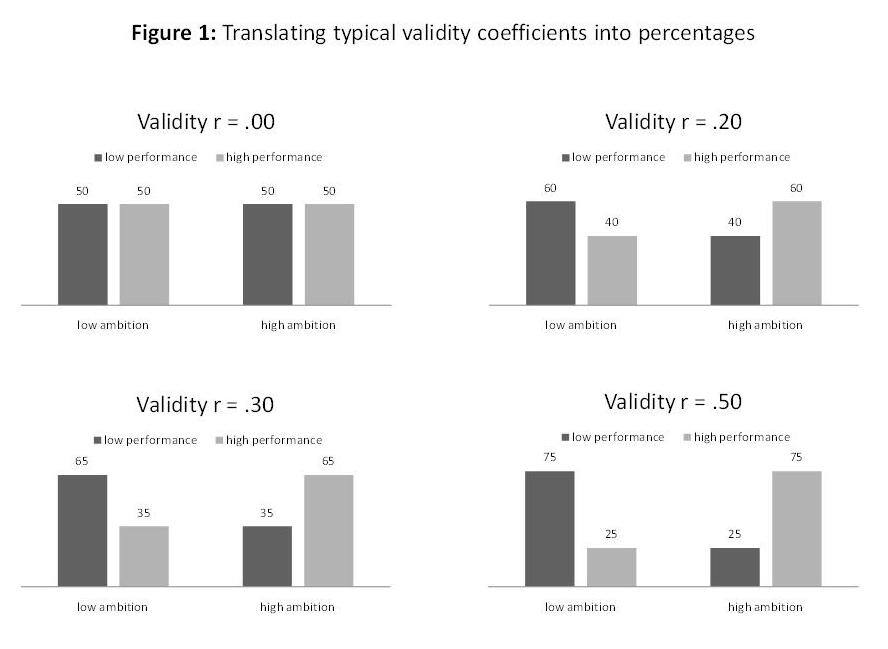
Personality and industrial/organizational psychologists use correlation coefficients to predict individual differences in peoples’ present or future performance. The best way to interpret a correlation is in terms of hits and misses. Imagine we have tested 200 sales candidates on the HPI Ambition scale, and then hired all of them; Figure 1 shows the expected percentages of high and low performers as a function of the validity of the ambition scale, using validities of .00, .20, .30, and .50.


If the validity coefficient for the Ambition scale in predicting sales performance is 0, then 50 of the new hires with above average Ambition scores will be high performers and 50 will be low performers (a validity coefficient of 0 implies that the prediction based on test scores is no better than chance). If the validity coefficient is .20, then 60 of the new hires with high Ambition scores will be high performers and 40 will be low performers, whereas 60 of the new hires with low scores will be low performers and 40 will be high performers. If the validity coefficient is .30, then 65 of the new hires with high scores will be high performers and 35 will be low performers; conversely 65 of the new hires with low scores will be low performers and 35 will be high performers. If the validity coefficient is .50, then 75 of the new hires will be high performers, and 25 will be low performers, etc. Thus, validity coefficients allow us to estimate how much better than chance (50%) we can predict performance (e.g., if r = .20, then we will predict 10% better than chance or we will make the correct prediction in 60% of the cases; if r = .60, then we will predict 30% better than chance or we will make the correct prediction in 80% of the cases).

The importance of this becomes obvious when we consider that the top 25% of employees in any job or profession will contribute 400% more than the bottom 25% of employees. The major point, however is that validity coefficients are the primary index for estimating the practical significance of any test.

Topics: validity coefficients, performance, assessment validity

Why Validity Matters

Posted by RHogan on Thu, Dec 02, 2010

Personality psychology concerns three questions. First, in what important ways are people all alike? This question involves analyzing the nature of human nature. Second, in what important and systematic ways are people all different? This question concerns individual differences. The third question concerns how to measure, in a reliable and valid manner, important individual differences in personality? These measures can then be used to predict practical outcomes—e.g., job performance, career and financial success.

But why are personality data so useful? The reason is simple: (1) The best predictor of future behavior is past behavior; (2) A person’s personality (defined in terms of observer’s ratings) is the summary of that person’s past behavior; so that (3) Personality (defined in terms of observers’ ratings) is the best data source we have regarding a person’s future behavior. Our assessments are keyed into observer ratings and provide an objective way to predict a wide variety of life outcomes, including life expectancy, marital satisfaction , substance abuse, and career and financial success.

The principal statistic used in our research (as well as research in economics, sociology, and medicine) is the Pearson correlation coefficient (r). The value of r can range from -1 (a perfect negative association between two variables) to 0 (no relationship between two variables) to +1 (a perfect positive association between two variables). The validity coefficients found in most medical research are below .20. For example, the correlation between smoking and contracting lung cancer within 25 years is .08; the correlation between taking ibuprofen and reduced pain is .14. Typical validities in psychological studies tend to be higher. For example, the correlation between applicants’ scores in a personnel selection interview (which is an inefficient form of personality assessment) and subsequent job performance is .30, and the correlation between IQ scores and school grades is .70. Our research over the past 30 years has produced validity coefficients that are significantly higher than those typically found in published medical or economic research.

Personality and industrial/organizational psychologists use correlation coefficients to predict individual differences in peoples’ present or future performance. The best way to interpret a correlation is in terms of hits and misses. Imagine we have tested 200 sales candidates on the HPI Ambition scale, and then hired all of them; Figure 1 shows the expected percentages of high and low performers as a function of the validity of the ambition scale, using validities of .00, .20, .30, and .50.
 

If the validity coefficient for the Ambition scale in predicting sales performance is 0, then 50 of the new hires with above average Ambition scores will be high performers and 50 will be low performers (a validity coefficient of 0 implies that the prediction based on test scores is no better than chance). If the validity coefficient is .20, then 60 of the new hires with high Ambition scores will be high performers and 40 will be low performers, whereas 60 of the new hires with low scores will be low performers and 40 will be high performers. If the validity coefficient is .30, then 65 of the new hires with high scores will be high performers and 35 will be low performers; conversely 65 of the new hires with low scores will be low performers and 35 will be high performers. If the validity coefficient is .50, then 75 of the new hires will be high performers, and 25 will be low performers, etc. Thus, validity coefficients allow us to estimate how much better than chance (50%) we can predict performance (e.g., if r = .20, then we will predict 10% better than chance or we will make the correct prediction in 60% of the cases; if r = .60, then we will predict 30% better than chance or we will make the correct prediction in 80% of the cases).

The importance of this becomes obvious when we consider that the top 25% of employees in any job or profession will contribute 400% more than the bottom 25% of employees. The major point, however is that validity coefficients are the primary index for estimating the practical significance of any test.

Topics: assessment validity

Unconscious Biases

Posted by Robert Hogan on Wed, Nov 17, 2010

Psychologists define unconscious biases in terms of memories that people repress or drive out of consciousness but that continue to influence their lives in various ways—inexplicable fear of heights or closed spaces or spiders. For psychologists, unconscious biases are almost always pathological in some way.

Sociologists define unconscious biases in terms of cultural influences that people assume are normal because of how they were raised—racism, sexism, respect for authority, thriftiness. For sociologists, these biases can be positive—valuing hard work—or negative—valuing self-indulgence.

 Psychologists have never convincingly demonstrated the existence of their kinds of unconscious biases, but sociologists can easily demonstrate the effects of, for example, a good work ethic on a person’s income. The MVPI builds on this sociological model of unconscious biases. Peoples’ core values determine their behavior in ways that they often don’t realize. For leaders, core values shape what they pay attention to and what they ignore, the kinds of subordinate behavior of which they approve, or of which they disapprove. A person’s performance as a leader will be improved by some understanding of his/her unconscious biases.

Recognition: Wanting to be the center of attention, assuming that other people need attention as much as you do, and not understanding modesty.

Power: Wanting to win and make a difference, assuming that other people are as competitive as you, and disliking people who lack a winning attitude.

Hedonism: Wanting to have fun and share experiences, assuming that other people are as fun seeking as you, and not understanding people who are overly serious.

Altruism: Wanting to help those who are disadvantaged or victimized, assuming that others are as concerned about them as you, and not understanding the need for self-reliance.

Affiliation: Wanting opportunities to network, assuming that others want to interact as much as you do, and not understanding people who don’t want to be part of something bigger than themselves.
 
Tradition: Respecting hierarchy, rules, and tradition, assuming that others are as conservative as you, and disapproving of any kind of non-conformity.
 
Security: Disliking risk-taking and risky activities, assuming that others are as cautious as you, and not understanding people who enjoy uncertainty and like to test the limits.

Commerce: Wanting to acquire concrete symbols of success, assuming that others are as materialistic as you, and not understanding people who are indifferent to money.

Aesthetics: Wanting to be in attractive environments, assuming that others care as much about quality as you, and not understanding people who lack a sense of style.

Science: Wanting to solve problems with logic and data, assuming others care as much about finding the right answers as you, and not understanding irrational or intuitive decisions.

Unconscious Biases

Posted by RHogan on Tue, Nov 16, 2010

Psychologists define unconscious biases in terms of memories that people repress or drive out of consciousness but that continue to influence their lives in various ways—inexplicable fear of heights or closed spaces or spiders. For psychologists, unconscious biases are almost always pathological in some way.

Sociologists define unconscious biases in terms of cultural influences that people assume are normal because of how they were raised—racism, sexism, respect for authority, thriftiness. For sociologists, these biases can be positive—valuing hard work—or negative—valuing self-indulgence.

 Psychologists have never convincingly demonstrated the existence of their kinds of unconscious biases, but sociologists can easily demonstrate the effects of, for example, a good work ethic on a person’s income. The MVPI builds on this sociological model of unconscious biases. Peoples’ core values determine their behavior in ways that they often don’t realize. For leaders, core values shape what they pay attention to and what they ignore, the kinds of subordinate behavior of which they approve, or of which they disapprove. A person’s performance as a leader will be improved by some understanding of his/her unconscious biases.

Recognition: Wanting to be the center of attention, assuming that other people need attention as much as you do, and not understanding modesty.

Power: Wanting to win and make a difference, assuming that other people are as competitive as you, and disliking people who lack a winning attitude.

Hedonism: Wanting to have fun and share experiences, assuming that other people are as fun seeking as you, and not understanding people who are overly serious.

Altruism: Wanting to help those who are disadvantaged or victimized, assuming that others are as concerned about them as you, and not understanding the need for self-reliance.

Affiliation: Wanting opportunities to network, assuming that others want to interact as much as you do, and not understanding people who don’t want to be part of something bigger than themselves.
 
Tradition: Respecting hierarchy, rules, and tradition, assuming that others are as conservative as you, and disapproving of any kind of non-conformity.
 
Security: Disliking risk-taking and risky activities, assuming that others are as cautious as you, and not understanding people who enjoy uncertainty and like to test the limits.

Commerce: Wanting to acquire concrete symbols of success, assuming that others are as materialistic as you, and not understanding people who are indifferent to money.

Aesthetics: Wanting to be in attractive environments, assuming that others care as much about quality as you, and not understanding people who lack a sense of style.

Science: Wanting to solve problems with logic and data, assuming others care as much about finding the right answers as you, and not understanding irrational or intuitive decisions.

Subscribe to our Blog

Most Popular Posts

Connect