What Is Your Greatest Weakness?

Posted by Hogan Assessments on Wed, Feb 23, 2011

As a recent alumnus of the job market, I can personally attest to the fact that while there is a shortage of available jobs, there is apparently no shortage of inane interview questions:

Where do you see yourself in five years?

If you were an animal (vegetable, mineral, superhero, whatever), what kind would you be?

What would your last employer say about you?

If you were the size of a pencil and we put you in a blender, how would you escape?

But my least favorite of all time has to be: What is your greatest weakness?

Hunting for my first job, I must have answered that question a dozen times – never honestly. My top three answers, depending on the situation, were:

  1. I am so driven to succeed, sometimes I work too hard.
  2. I have a habit of doing all the work and giving my boss all the credit.
  3. I possess the agility of a spider and the strength of six men, but I struggle to harness it for the purposes of good.


And I’m not alone. A quick Google search yields thousands of blogs, how-to articles and even entire websites devoted to avoiding an honest answer to this dreaded question.

So it was a nice surprise when before I interviewed here at Hogan (I am now two weeks on the job), I was asked to complete the full line of our assessments.

For me as a job candidate, the fact that my then potential employer would know, and have a graphical analysis of, my greatest strengths and potential shortcomings meant two things: there was no need to dodge the question, and they were still taking the time to interview me, so I must not be so far beyond help. What resulted was a fluid, comfortable interview in which, instead of wasting time and energy beating around the bush and trying to conceal my flop sweat, I could relax and express what I thought I could bring to the table.

Granted, I am new to the world of HR, but that seems much more productive than trying to explain that while I possess psychic abilities, they are only good for predicting the first two Lotto numbers.

Topics: assessments

Organizations Are Like Relationships, It's All About The Fit

Posted by Jennifer Lowe on Thu, Feb 17, 2011

Have you ever wondered why people fall in love? What drives that spark, the initial attraction, and the eventual relationship? Relationships have been in the news a lot this week. On Valentine’s Day, there were stories of couples trying to obtain the record for the longest kiss, how the Obamas keep romance alive in the White House, and whether employees give their “work spouse” a Valentine. The last of these headlines really caught my eye. An article by Eve Tahmincioglu on msnbc.com describes the work spouse as someone with whom you have camaraderie during the long work days. The article cites a number of examples of what this “spousal relationship” may look like, but in general a “work spouse” is someone you speak to when making a business decision, someone who buys the coffee creamer you both like so you can share, or maybe it’s the person to whom you vent during a difficult day.

After spending time thinking about this and taking a walk around the Hogan office to observe some of this camaraderie in action, I think MSNBC may be on to something. Considering the fact that we spend the majority of our waking hours in the work environment, it is important to find colleagues that we can connect with and an organization that we consider a home away from home. In fact a recent survey by OfficeMax found that approximately 50% of respondents admit to having this type of platonic connection in the workplace.

Although the idea of having these friendships in the workplace is appealing and intuitive, these relationships are probably more of a cultural phenomenon. Research has shown that individuals in certain industries tend to report these relationships more than others. Specifically, individuals in Human Resources, Sales, and Marketing are more likely to establish these workplace friendships than are Finance and IT professionals. What is it about these industries that drives the employees to seek out these connections in the workplace? The culture! For those of you who’ve spent some time in the areas of Human Resources and Marketing you will generally find a group of employees who are motivated by collaboration and establishing alliances with others to get things done. In Sales, developing relationships both internally and with clients is imperative for longevity and growth. In contrast, IT and Finance professionals are likely driven by analytical decision making and the bottom line over that of collaborative decision making and building a community within the organization.

When thinking about the key drivers for these industries in Hogan language, we are referring to the Motives, Values, Preferences Inventory (MVPI). The MVPI is an assessment that provides insight regarding one’s key motives and drivers. This assessment is often used in a selection context to determine if a candidate’s motives and drivers align with an organization. As a result, the MVPI is a powerful tool for predicting cultural fit and ultimately an employee’s satisfaction with an organization. For those individuals in IT and Finance roles, the need for analytical decision making and a focus on the bottom line is related to the MVPI Science and Commerce scales. In contrast, the Human Resources, Customer Service/Sales, and Marketing industries consist of employees who may have a need for collaboration, building a community, or a “work spouse.” These drivers are related to the MVPI Affiliation and Altruistic scales.

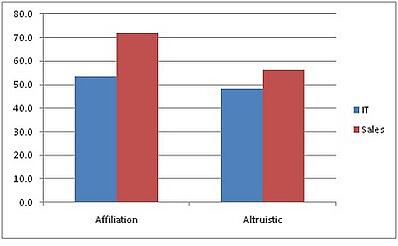
A recent review of IT and Sales professionals in the Hogan archive further supported this need for Affiliation and Altruism for individuals in Sales/Customer Service roles. In particular, it was found that Sales professionals have mean scores of 71.9% and 56.3 % on Affiliation and Altruistic, respectively. In contrast, IT professionals indicate a much lower need for collaboration and building a sense of community with mean percentile scores of 53.6% and 48.3%.

So what does this information tell us about “work spouses” and Valentine’s Day? It tells us that organizational culture matters and feeling as if one’s values and drivers align with the organization is key to a successful and long term working relationship.

With regards to some of those previously mentioned headlines you may be wondering about, the record for the longest kiss is 46 hours. The Obamas keep the romance alive with laughter but the First Lady would not mind a little jewelry on Valentine’s Day either. Should you have gotten a Valentine for your “work spouse?” It depends. If your “work spouse” is your actual significant other, a nice dinner and some chocolate never hurt anyone.

Topics: MVPI

Organizations Are Like Relationships, It’s All About The Fit

Posted by JLowe on Wed, Feb 16, 2011

Have you ever wondered why people fall in love? What drives that spark, the initial attraction, and the eventual relationship? Relationships have been in the news a lot this week. On Valentine’s Day, there were stories of couples trying to obtain the record for the longest kiss, how the Obamas keep romance alive in the White House, and whether employees give their “work spouse” a Valentine. The last of these headlines really caught my eye. An article by Eve Tahmincioglu on msnbc.com describes the work spouse as someone with whom you have camaraderie during the long work days. The article cites a number of examples of what this “spousal relationship” may look like, but in general a “work spouse” is someone you speak to when making a business decision, someone who buys the coffee creamer you both like so you can share, or maybe it’s the person to whom you vent during a difficult day.

After spending time thinking about this and taking a walk around the Hogan office to observe some of this camaraderie in action, I think MSNBC may be on to something. Considering the fact that we spend the majority of our waking hours in the work environment, it is important to find colleagues that we can connect with and an organization that we consider a home away from home. In fact a recent survey by OfficeMax found that approximately 50% of respondents admit to having this type of platonic connection in the workplace.

Although the idea of having these friendships in the workplace is appealing and intuitive, these relationships are probably more of a cultural phenomenon. Research has shown that individuals in certain industries tend to report these relationships more than others. Specifically, individuals in Human Resources, Sales, and Marketing are more likely to establish these workplace friendships than are Finance and IT professionals. What is it about these industries that drives the employees to seek out these connections in the workplace? The culture! For those of you who’ve spent some time in the areas of Human Resources and Marketing you will generally find a group of employees who are motivated by collaboration and establishing alliances with others to get things done. In Sales, developing relationships both internally and with clients is imperative for longevity and growth. In contrast, IT and Finance professionals are likely driven by analytical decision making and the bottom line over that of collaborative decision making and building a community within the organization.

When thinking about the key drivers for these industries in Hogan language, we are referring to the Motives, Values, Preferences Inventory (MVPI). The MVPI is an assessment that provides insight regarding one’s key motives and drivers. This assessment is often used in a selection context to determine if a candidate’s motives and drivers align with an organization. As a result, the MVPI is a powerful tool for predicting cultural fit and ultimately an employee’s satisfaction with an organization. For those individuals in IT and Finance roles, the need for analytical decision making and a focus on the bottom line is related to the MVPI Science and Commerce scales. In contrast, the Human Resources, Customer Service/Sales, and Marketing industries consist of employees who may have a need for collaboration, building a community, or a “work spouse.” These drivers are related to the MVPI Affiliation and Altruistic scales.

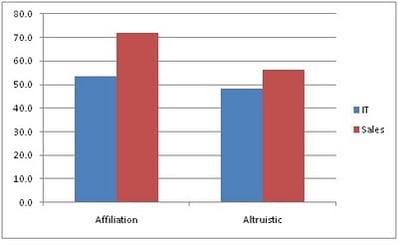
A recent review of IT and Sales professionals in the Hogan archive further supported this need for Affiliation and Altruism for individuals in Sales/Customer Service roles. In particular, it was found that Sales professionals have mean scores of 71.9% and 56.3 % on Affiliation and Altruistic, respectively. In contrast, IT professionals indicate a much lower need for collaboration and building a sense of community with mean percentile scores of 53.6% and 48.3%.

So what does this information tell us about “work spouses” and Valentine’s Day? It tells us that organizational culture matters and feeling as if one’s values and drivers align with the organization is key to a successful and long term working relationship.

With regards to some of those previously mentioned headlines you may be wondering about, the record for the longest kiss is 46 hours. The Obamas keep the romance alive with laughter but the First Lady would not mind a little jewelry on Valentine’s Day either. Should you have gotten a Valentine for your “work spouse?” It depends. If your “work spouse” is your actual significant other, a nice dinner and some chocolate never hurt anyone.

A Blizzard of Bad Judgment

Posted by Jarrett Shalhoop on Fri, Feb 11, 2011

In the past 10 days, much of the country has been blanketed by snow, courtesy of a blizzard that swept through the Midwest and buried the Hogan offices under nearly 30 inches. Stores closed, events were cancelled, businesses sent everyone home, and most of the area hunkered down and braced for the worst. The local meteorologists provided marathon sessions of analysis and updates, warning everyone not to go outside unless absolutely necessary. In the following days, the city cleanup crews described their efforts to clear the streets, noting that the largest obstacle was the number of abandoned cars on the road. This included cars deserted in the middle of the street, on the side of the road, on highway ramps, and just about everywhere.

This made me think about the judgment exercised by the owners of the autos lining the roads. The majority of these vehicles were smaller cars that had virtually no chance of navigating the streets. I assume that most of the owners simply walked home, as they couldn’t have possibly made it far before getting stuck. Was it that they were skeptical and didn’t trust the weather forecast? Did they believe their driving ability was far superior to others? Did they think the warnings and advice didn’t apply to them? Or did they really just not understand that 15 inches of snow was too much for them?

Whatever the case, the same types of characteristics that drive these decisions will influence decision-making and judgment in the workplace. We’ve all encountered the skeptical co-worker that doesn’t trust others and plays political games, the employee who believes that his or her talents are infinitely superior to those around them, the folks that don’t believe the rules apply to them, and the ones that just don’t seem to have the ability to analyze the situation and make good decisions. Often the results won’t be as immediate and obvious as an abandoned car in the middle of the street, but over time the results will become visible and detrimental.

While we can’t dramatically improve other motorists’ skills on the roads, we can identify and target the types of behaviors that lead to these bad decisions in an organization. Many of these characteristics are rooted in our personalities and cognitive abilities. We can screen these characteristics out of candidate pools, or we can raise awareness of these characteristics with current employees and enhance decision-making styles and abilities.

Topics: personality psychology, behavior

A Blizzard of Bad Judgment

Posted by Hogan Assessments on Thu, Feb 10, 2011

In the past 10 days, much of the country has been blanketed by snow, courtesy of a blizzard that swept through the Midwest and buried the Hogan offices under nearly 30 inches. Stores closed, events were cancelled, businesses sent everyone home, and most of the area hunkered down and braced for the worst. The local meteorologists provided marathon sessions of analysis and updates, warning everyone not to go outside unless absolutely necessary. In the following days, the city cleanup crews described their efforts to clear the streets, noting that the largest obstacle was the number of abandoned cars on the road. This included cars deserted in the middle of the street, on the side of the road, on highway ramps, and just about everywhere.

This made me think about the judgment exercised by the owners of the autos lining the roads. The majority of these vehicles were smaller cars that had virtually no chance of navigating the streets. I assume that most of the owners simply walked home, as they couldn’t have possibly made it far before getting stuck. Was it that they were skeptical and didn’t trust the weather forecast? Did they believe their driving ability was far superior to others? Did they think the warnings and advice didn’t apply to them? Or did they really just not understand that 15 inches of snow was too much for them?

Whatever the case, the same types of characteristics that drive these decisions will influence decision-making and judgment in the workplace. We’ve all encountered the skeptical co-worker that doesn’t trust others and plays political games, the employee who believes that his or her talents are infinitely superior to those around them, the folks that don’t believe the rules apply to them, and the ones that just don’t seem to have the ability to analyze the situation and make good decisions. Often the results won’t be as immediate and obvious as an abandoned car in the middle of the street, but over time the results will become visible and detrimental.

While we can’t dramatically improve other motorists’ skills on the roads, we can identify and target the types of behaviors that lead to these bad decisions in an organization. Many of these characteristics are rooted in our personalities and cognitive abilities. We can screen these characteristics out of candidate pools, or we can raise awareness of these characteristics with current employees and enhance decision-making styles and abilities.

Topics: behavior

Losing Jobs: The Problem of Succession Management

Posted by Jackie VanBroekhoven on Fri, Feb 04, 2011

Apple CEO and co-founder Steve Jobs recently announced that he will take yet another medical leave of absence with an unspecified return date. His announcement was followed by much discussion and debate about when and whether he will return. This news re-awakened the debate among worried stockholders and industry analysts who are sweating out the question of whether or not the Sultan of Silicon Valley can be replaced. As reported by the LA Times, Apple’s shares fell 6.45% immediately after markets opened the day following Jobs’ announcement. Consequently, stockholders are putting the pressure on the board to publicize a succession plan. Why the sudden iPanic? Many believe that Jobs’ vision and innovation is integral to the success and brand image of Apple, and that he simply cannot be replaced. Admittedly, Jobs’ uncanny ability to predict, or even create, market demand for consumer technology products has catapulted Apple to undeniable success over the years. So the question remains – can Jobs be replaced?

Jobs’ announcement got me thinking about the problems inherent to succession management, and some recent industry research that has shed some light on the issue. In a December 2010 research report published by Towers Watson, a survey of over 700 global companies indicated that the top two workforce challenges facing businesses today are (1) loss of talent in key positions and (2) lack of succession planning/management. An online survey from the American Management Association of over 1,000 senior managers and executives revealed that only 14% of respondents reported being “well-prepared” for a sudden loss of the organization’s key leaders. In addition, 61% reported being “somewhat prepared”, while one in five admitted to being completely “unprepared.”

After reflecting on the realities of this issue, the public clamoring for Apple to release a succession plan seemed misguided in a few ways. First, what the stockholders seem to actually want in reality is a successor to be named, which is far from establishing a true succession plan. Identifying a successor or even a pool of successors is only a fraction of the battle. What is more important is the need to develop the talent by exposing them to relevant experiences, training activities, or other developmental opportunities. For example, Jobs designated Apple COO Tim Cook to step up to the plate during his first medical leave of absence. Jobs remained involved in major strategic decisions, while Cook oversaw daily operations. Business seemed to go smoothly during Cook’s time in charge. This certainly qualifies as relevant experience, and the truth may be that Jobs and his team are indeed grooming several high-potentials internally at Apple in preparation for Jobs’ eventual retirement. However, a quote from Cook published in Forbes magazine reads, "Come on, replace Steve? No. He's irreplaceable."

Second, succession planning is a long-term, organization-wide initiative. It takes time, considerable planning, and an overall talent management strategy to function properly. For example, the downstream effects of each staffing event must be considered – for every promotion or transition, a well-developed talent pool should be prepared at each subsequent level. If it turns out that Cook is the apple of Job’s eye, a successor must also be prepped and ready to take over Cook’s responsibilities to ensure a smooth transition.

Third, succession planning requires defining what constitutes exceptional performance within each key leadership level, and then finding the talent that will fit the bill. For example, Jobs is celebrated for his creativity, relentless attention to detail, and keen eye for aesthetic appeal. Hogan might measure these characteristics using the Inquisitive, Prudence, and Aesthetic scales. He is also known for his charisma, mischievous business strategies, and ability to convey effective and persuasive messages. Jobs and Cook both share a passion for the Apple brand and a tendency to make extremely bold statements on record. By contrast, Cook is not known as a compelling public speaker, is not seen as a visionary, and does not wear the signature black turtleneck. He is the unflappable operations specialist with a logical mind and an engineering background, and does not spend much time on the creative side of the house. Jobs is an intense, creative mastermind whose vision and aesthetic focus guides all aspects of the product design process. The conundrum of succession planning is that plucking an operations master from his perch and placing him in the chief executive chair often means you lose a great COO and gain a mediocre CEO. Would naming Cook as the successor simply be a case of going after low-hanging fruit? Is comparing Jobs to Cook as useful as comparing apples to oranges?

But seriously folks, all pomological puns aside, the succession planning issue is a relevant one, and personality plays a key role in the ability to effectively fill the holes in the talent pipeline. Cook obviously has talent and a strong track record. However, having the right mix of skills, experiences, and innate personality characteristics provide the necessary foundations for making an effective succession decision. However ambiguous the succession planning issue, one thing is certain: whoever eventually becomes Jobs’ successor will undoubtedly have big New Balance 992’s to fill.

Topics: Steve Jobs, Apple, succession planning, Hogan Assessments, Hogan, succession management

Losing Jobs: The Problem of Succession Management

Posted by JVanBroekhoven on Thu, Feb 03, 2011

Apple CEO and co-founder Steve Jobs recently announced that he will take yet another medical leave of absence with an unspecified return date. His announcement was followed by much discussion and debate about when and whether he will return. This news re-awakened the debate among worried stockholders and industry analysts who are sweating out the question of whether or not the Sultan of Silicon Valley can be replaced. As reported by the LA Times, Apple’s shares fell 6.45% immediately after markets opened the day following Jobs’ announcement. Consequently, stockholders are putting the pressure on the board to publicize a succession plan. Why the sudden iPanic? Many believe that Jobs’ vision and innovation is integral to the success and brand image of Apple, and that he simply cannot be replaced. Admittedly, Jobs’ uncanny ability to predict, or even create, market demand for consumer technology products has catapulted Apple to undeniable success over the years. So the question remains – can Jobs be replaced?

Jobs’ announcement got me thinking about the problems inherent to succession management, and some recent industry research that has shed some light on the issue. In a December 2010 research report published by Towers Watson, a survey of over 700 global companies indicated that the top two workforce challenges facing businesses today are (1) loss of talent in key positions and (2) lack of succession planning/management. An online survey from the American Management Association of over 1,000 senior managers and executives revealed that only 14% of respondents reported being “well-prepared” for a sudden loss of the organization’s key leaders. In addition, 61% reported being “somewhat prepared”, while one in five admitted to being completely “unprepared.”

After reflecting on the realities of this issue, the public clamoring for Apple to release a succession plan seemed misguided in a few ways. First, what the stockholders seem to actually want in reality is a successor to be named, which is far from establishing a true succession plan. Identifying a successor or even a pool of successors is only a fraction of the battle. What is more important is the need to develop the talent by exposing them to relevant experiences, training activities, or other developmental opportunities. For example, Jobs designated Apple COO Tim Cook to step up to the plate during his first medical leave of absence. Jobs remained involved in major strategic decisions, while Cook oversaw daily operations. Business seemed to go smoothly during Cook’s time in charge. This certainly qualifies as relevant experience, and the truth may be that Jobs and his team are indeed grooming several high-potentials internally at Apple in preparation for Jobs’ eventual retirement. However, a quote from Cook published in Forbes magazine reads, “Come on, replace Steve? No. He’s irreplaceable.”

Second, succession planning is a long-term, organization-wide initiative. It takes time, considerable planning, and an overall talent management strategy to function properly. For example, the downstream effects of each staffing event must be considered – for every promotion or transition, a well-developed talent pool should be prepared at each subsequent level. If it turns out that Cook is the apple of Job’s eye, a successor must also be prepped and ready to take over Cook’s responsibilities to ensure a smooth transition.

Third, succession planning requires defining what constitutes exceptional performance within each key leadership level, and then finding the talent that will fit the bill. For example, Jobs is celebrated for his creativity, relentless attention to detail, and keen eye for aesthetic appeal. Hogan might measure these characteristics using the Inquisitive, Prudence, and Aesthetic scales. He is also known for his charisma, mischievous business strategies, and ability to convey effective and persuasive messages. Jobs and Cook both share a passion for the Apple brand and a tendency to make extremely bold statements on record. By contrast, Cook is not known as a compelling public speaker, is not seen as a visionary, and does not wear the signature black turtleneck. He is the unflappable operations specialist with a logical mind and an engineering background, and does not spend much time on the creative side of the house. Jobs is an intense, creative mastermind whose vision and aesthetic focus guides all aspects of the product design process. The conundrum of succession planning is that plucking an operations master from his perch and placing him in the chief executive chair often means you lose a great COO and gain a mediocre CEO. Would naming Cook as the successor simply be a case of going after low-hanging fruit? Is comparing Jobs to Cook as useful as comparing apples to oranges?

But seriously folks, all pomological puns aside, the succession planning issue is a relevant one, and personality plays a key role in the ability to effectively fill the holes in the talent pipeline. Cook obviously has talent and a strong track record. However, having the right mix of skills, experiences, and innate personality characteristics provide the necessary foundations for making an effective succession decision. However ambiguous the succession planning issue, one thing is certain: whoever eventually becomes Jobs’ successor will undoubtedly have big New Balance 992’s to fill.

Topics: Hogan

Competency Mapping & Assessments

Posted by Chris Duffy on Thu, Jan 27, 2011

You don’t have to be in the professional world long before you will likely encounter some form of a competency model in your organization. While the development of an effective competency model is no small task, the end result is simple, easy to understand, and very effective at establishing a framework for success. When developed correctly and with the support of the organization, a competency model can be an effective foundation for strategic staffing, training and development, and performance management. However, that is where the simplicity ends.

At Hogan, we can effectively measure an individual’s performance level against an organization’s pre-determined competency model. Hogan has developed a systematic, scientific approach, leveraging 30+ years of criterion evidence, to map just about any competency to the personality constructs measured in Hogan’s assessment inventories. As a result, our clients have responded positively, and competency mapping has become a routine service provided by our research team. These robust competency mappings can be used to help organizations strategically select new hires and develop incumbents.

It is important to understand that the intersection of competencies, personality traits, and the behaviors described can be very complex. I always suggest that the organization clearly define the role of the competency model and the desired assessments in the context of the selection, succession, and/or development process. The most effective implementations I’ve seen include elements of both tools, not simply one or the other.

Through Hogan’s research process, we can develop a scoring algorithm which will accurately predict someone’s innate ability based on their responses to our core personality inventories. If you don’t have clear understanding of what underlying personality traits and values are influencing an individual’s ability, development efforts will stall. Without these key links of behavioral development, simply knowing how someone compares to your competency model only tells half the story.

Topics: assessments, competency mapping, competencies

Competency Mapping & Assessments

Posted by CDuffy on Wed, Jan 26, 2011

You don’t have to be in the professional world long before you will likely encounter some form of a competency model in your organization. While the development of an effective competency model is no small task, the end result is simple, easy to understand, and very effective at establishing a framework for success. When developed correctly and with the support of the organization, a competency model can be an effective foundation for strategic staffing, training and development, and performance management. However, that is where the simplicity ends.

At Hogan, we can effectively measure an individual’s performance level against an organization’s pre-determined competency model. Hogan has developed a systematic, scientific approach, leveraging 30+ years of criterion evidence, to map just about any competency to the personality constructs measured in Hogan’s assessment inventories. As a result, our clients have responded positively, and competency mapping has become a routine service provided by our research team. These robust competency mappings can be used to help organizations strategically select new hires and develop incumbents.

It is important to understand that the intersection of competencies, personality traits, and the behaviors described can be very complex. I always suggest that the organization clearly define the role of the competency model and the desired assessments in the context of the selection, succession, and/or development process. The most effective implementations I’ve seen include elements of both tools, not simply one or the other.

Through Hogan’s research process, we can develop a scoring algorithm which will accurately predict someone’s innate ability based on their responses to our core personality inventories. If you don’t have clear understanding of what underlying personality traits and values are influencing an individual’s ability, development efforts will stall. Without these key links of behavioral development, simply knowing how someone compares to your competency model only tells half the story.

Topics: assessments, competency mapping, competencies

The Kids Are All Right...Derailers and All

Posted by Adam Vassar on Tue, Jan 18, 2011

I am the proud father of three children: a 4-year-old boy, a 4-year-old girl, and a 7-month-old baby girl. As you might assume, the 4-year-olds are twins. I have observed many things that have amazed me with the twins over the past 4 years. One observation was that a multitude of people, from strangers at the shopping mall to professionals with PhDs, would ask me if the boy and girl were identical. I would, of course, politely respond “no.” I wanted to say that not only did these children not result from the splitting of a single zygote, but there is a very fundamental difference between the anatomy of a boy and a girl that prevent them from being identical!

Another observation that I noticed very early on was how differently they behaved when they were upset. The children share the same family circus environment and around 50% of the same DNA, however their reactions under stress follow very consistent, yet distinctly unique, patterns. Through my work at Hogan as a consultant, I began to see clear parallels between the derailing behavior of leaders as assessed by the Hogan Development Survey (HDS) and the challenges I was facing at home as a father.

A derailer is a counterproductive tendency that, in normal circumstances, likely manifests as a strength. When we are tired, pressured, bored, or otherwise distracted, these behaviors can become overused strengths or risk factors that inhibit our effectiveness. The HDS measures 11 such risk factors. For example, leaders scoring in the high-risk zone on two of these HDS risk factors, Excitable and Diligent, are likely to struggle with a vicious cycle of behavior when under stress. They tend to be perfectionistic and typically impose high performance standards on their employees causing others to view them as demanding and nitpicky (Diligent). When employees do not meet these lofty expectations, the leader may react with emotional outbursts and become overly disappointed in others performance (Excitable). As a result, leaders might demoralize and disempower staff through moody overreactions and a refusal to delegate, which places additional pressure upon the leader to deliver results, and this increased stress level is likely to further trigger the Diligent/Excitable cycle of behaviors.

Now, I obviously cannot administer the HDS to my 4 year-old son. If I could, I would bet dollars to donuts that he would score in the high risk zone on both Excitable and Diligent. Like any leader, child, or human, my son has many wonderful aspects to his personality. He is very hardworking (loves to help his dad shovel snow, pull weeds) and his positive enthusiasm is contagious in our household. However, he has very specific and rigid expectations for his own and others behavior (Diligent) and he becomes overly upset when things don’t play out to his liking (Excitable) such that his negative emotions also set the tone for the house.

Another interesting combination of HDS factors occurs when a leader scores in the high risk zone on both Mischievous and Colorful. These leaders tend to get noticed and succeed early on through their ability to command the spotlight with outgoing and animated behavior (Colorful) and charm others with their impulsivity and excitement seeking (Mischievous). However, these behaviors can cross the line into the realm of derailment when leaders are too dramatic too often such that they manage by crisis in reaction to stress. Performance can also be inhibited when leaders invite negative attention by testing limits, taking risks, and favoring pleasure over commitments. On a smaller scale, Colorful and Mischievous are very accurate labels for my daughter. On the positive side, she is endlessly entertaining with her family room theatrical productions and already demonstrates a capability to use finesse to win others over. However, her dramatic antics are less entertaining when she reacts to a simple splinter extraction as if it were major surgery without proper anesthetic.

The real fun begins when one person’s derailers collide with the derailers of another individual. In my work life as a consultant, these derailers collide among members of work teams. In my personal life, they collide between my twins. What do you think happens when you pair one child who demands that everyone color inside the lines and gets upset when they don’t with another child who truly relishes coloring outside the lines and pushing other peoples’ buttons? Sometimes it resembles a mixed martial arts pay-per-view event. That being said, the twins also function like a little old married couple where neither individual could function without the other. I can’t wait to see what my 7-month-old eventually adds to this behavioral stew!

The Hogan leadership research tells us that most people will struggle with at least one or two derailers. So I guess that makes my children normal. The research also indicates exactly what I’ve observed in that we develop risk factors early in life while learning to deal with parents, peers, and relatives. This behavior that develops while we are young may become habitual and we may be unaware that we behave in certain ways because it’s simply the way we’ve always acted. These derailers can inhibit both individual and team performance both at work and at home. Strategic self-awareness of these potential risk factors is the critical first step for understanding our behavior and beginning to manage ourselves to get the most out of our strengths.

Topics: Hogan Development Survey, leadership, HDS, derailment, leadership performance, derailer

Subscribe to our Blog

Most Popular Posts

Connect