Business Growth in Europe Is Possible and Awair Proves It

Posted by Hogan Assessments on Tue, Mar 10, 2020

Awair-Logo

For the fourth year in a row, the Financial Times compiled with Statista, an independent research company based in Germany, FT 1000 – the annual list of Europe’s fastest-growing companies. This list includes European companies that achieved the highest compound annual growth rate in revenue between 2015 and 2018. The ranking suggests that the most nimble and innovative companies are thriving.

Competition at the top was tougher this year, with companies requiring a minimum growth rate of 38.4% to make the list, compared with 37.7% last year.

The ranking reflects the growing importance of technology, which dominates the list with 189 entrants. Most winners come from Germany, closely followed by Italy, the UK, and France, with these four nations accounting for about 70% of the overall ranking. Although London retains its lead as the city with the greatest number of fast-growing companies, Paris and Milan follow closely, while Warsaw and Vilnius make the top 10 for the first time.

Landing a place halfway through the ranking comes shortly after achieving the 89th place in the Italian 400 fastest-growing companies list, a ranking compiled by Il Sole 24 Ore, the Italian financial newspaper of reference, in collaboration with Statista. This list includes small/medium companies with the highest compound annual growth rate in revenue, led by organic business development supported by robust organizational skills and execution.

In the words of the Co-Founders and Partners of Awair, Gianfranco Gennaro, Francesca Antonini, and Andrea Facchini, “it would be unfair to celebrate this milestone without acknowledging the outstanding support that Hogan Assessments has given our company since day one. When we became a Hogan Authorized Distributor in 2015, Italy was yet uncharted land, but organizations and Independent Consultants have fallen rapidly in love with such a broad range of science-based, data-driven, and highly predictive tools.

The FT 1000 list demonstrates that despite the array of obstacles to growth in recent years in Europe stemming from economic uncertainties in the Western Markets, growth is still possible. Customers reward trusted business partners such as Awair when they recognize clear thought leadership, outstanding quality of services and products, flawless execution, as well as client service.

*This is a guest blog post authored by Giulia Sacchi, marketing & communications coordinator at Awair.

Topics: distributors

8 Personality Types: A Deeper Look at Overachievers

Posted by rtrost@hoganassessments.com on Tue, Mar 03, 2020

personality profile of Overachievers

It has been a month since we revealed the eight most common personality types found via the Hogan suite of assessments. We have already taken an in-depth look at Rebels, Marketers, Proletarians, and Congenials. This week, we continue our dive into these personality types by closely examining the personality profile of Overachievers.

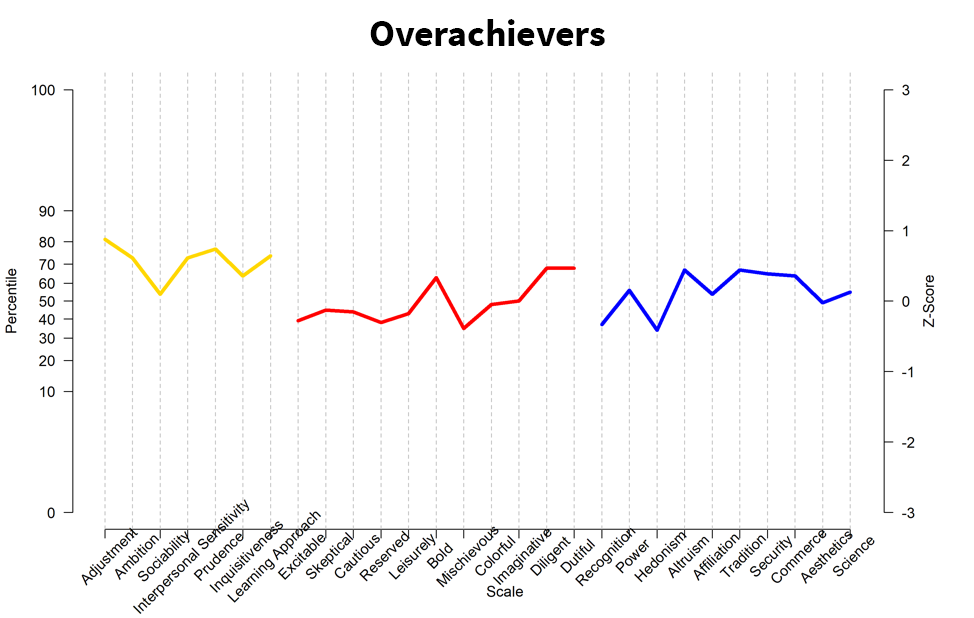
The personality profile of Overachievers make up approximately 17% of the working population. Their Hogan profile is highlighted by slightly above average scores on Altruism, Tradition, and Security on the MVPI but below-average scores on Recognition and Hedonism; very high scores on Adjustment, Ambition, and Prudence on the HPI; low scores on the Moving Against cluster on the HDS, with average scores on Bold and above-average scores on Diligent and Dutiful. See Figure 1 below for the full profile.

Figure 1: Hogan personality profile of Overachievers

personality profile of Overachievers


The Reputation of Overacheivers

We had eight Hogan consultants with a combined 82 years of experience provide independent written interpretations of the Overachievers profile shown in Figure 1. Some of the words our experts most frequently used to describe Overachievers were “willing,” “resilient,” “helping,” “dominant,” “organized,” “perfectionistic,” and most notably “high standards.” Additionally, we examined the workplace reputations of Overachievers by drawing on Hogan 360° data gathered with Hogan distributor Peter Berry Consultancy.

Colleagues, supervisors, and subordinates said Overachievers are calm and even-tempered, treat people with respect, manage emotions maturely, are polite, and are never rude or abrasive. Overachievers’ colleagues also said that Overachievers are not particularly good at coming up with new ideas and may lack industry experience and insight. Overachievers are seen by their coworkers as emotionally stable, disciplined, and respectful of authority.

Lastly, our job performance archive also tells us that Overachievers are seen as skilled at negotiating, focusing on quality and customers, leading others, relationship building, and modeling behavior for others. Overachievers were rated the second highest-performing group overall by their supervisors, just behind Congenials. To summarize, Overachievers are interested in career success, resilient to stress, and focused on results, but insistent on playing fairly and strictly adhering to the rules.

Common Careers for the Personality Profile of Overachievers

Overachievers prefer careers in which they can work hard and demonstrate their value for the company. They like to compete and take pride in their work. They desperately want to be seen as doing a good job, though they do not expect public recognition for it. Our data show Overachievers are overrepresented in customer support and operations and trade jobs.

They are also overrepresented in individual contributor roles (as opposed to leadership roles), suggesting they prefer work that gives them complete control over their performance and outcomes. Despite this, the personality profile of Overachievers rarely shows up as entrepreneurs, preferring the security of more traditional jobs. In popular media, characters such as Captain America (Marvel), Leslie Knope (Parks and Recreation), and Tiana (Disney’s The Princess and the Frog) are prototypical Overachievers — hardworking, dedicated, and eager to please.

Advice for Overachievers

If you are an Overachiever, you should recognize that others might not hold themselves to the same high standards for performance that you expect of yourself. Your manager will see you as a model employee, and you will probably be seen as a high performer. However, some of your coworkers might see you as a teacher’s pet or a brownnoser, always setting the bar higher for everyone else. If your boss is astute, you might also be seen as a threat to his or her job, so you might want to be careful about how you display your ambitions. Finally, be aware that your tendency to play by the rules might result in you being overlooked for promotions by people who play politics better, despite your results.

In leadership roles, you tend to overcontrol projects and micromanage your staff. Employee performance often falls short of your standards. You might find yourself thinking, “I could have done a better job on that project than them.” Be wary of these thoughts because you will not have the time and resources to ensure everything meets your high standards. If you submit to these thoughts, you will subject yourself to extremely long hours and burnout. You will need to trust your employees to get the job done if you want to succeed.

How to Deal with the Personality Profile of Overachievers

If your boss is an Overachiever, recognize that he or she will constantly raise the bar and push you for better results. You might find that, no matter how hard you work, your boss always has some criticism for how you could have done better. Your boss will have no tolerance for shortcuts or efforts to skirt the rules. You will need to prove to your boss that you can be trusted to complete projects without oversight. Otherwise, your boss will insist on reviewing everything you do, holding up progress.

If any of your employees have the personality profile of an Overachiever, realize that these people are likely your most productive employees. They rarely complain, never break the rules, and perform to very high standards. However, Overachievers tend to take on too much and try to do everything perfectly. You should be sure your Overachiever doesn’t spend too much effort on trivial details and burn out. You should also watch how your team reacts to Overachievers who might make them look like poor performers by comparison. Finally, you will need to help your Overachievers develop for leadership roles by teaching them about corporate politics and how to avoid micromanaging.

Want to learn more about personality tests? Check out The Ultimate Guide to Personality Tests

Topics: personality

8 Personality Types: A Deeper Look at Congenials

Posted by rtrost@hoganassessments.com on Mon, Feb 24, 2020

congenial personality

It has been almost a month since we revealed the eight most common personality types found via the Hogan suite of assessments. We have already taken an in-depth look at Rebels, Marketers, and Proletarians. This week, we continue our dive into these personality types by closely examining the personality profile of Congenials.

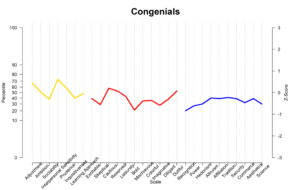
The personality profile of Congenials make up approximately 17% of the working population. Their Hogan profile is highlighted by flat to slightly below average scores on the Motives, Values, Preferences Inventory (MVPI) but with a slight upturn on the getting along dimensions of Altruism, Affiliation, and Tradition; elevated scores on both Adjustment and Interpersonal Sensitivity on the Hogan Personality Inventory (HPI); and above-average scores on Cautious, Reserved, and Dutiful on the Hogan Development Survey (HDS). See Figure 1 below for the full profile.

Figure 1: Congenials Hogan profile

Picture1

The Reputation of Congenials

We had eight Hogan consultants with a combined 82 years of experience provide independent written interpretations of the personality profile of Congenials shown in Figure 1. Some of the words our experts most frequently used to describe Congenials were “nice,” “willing,” “resilient,” “submissive,” “listener,” and “agreeable.” Additionally, we examined the workplace reputations of Congenials by drawing on Hogan 360° data gathered with Hogan distributor Peter Berry Consultancy.

Colleagues, supervisors, and subordinates said Congenials bring a positive attitude to work, manage emotions maturely, are calm and even tempered, are never rude or abrasive, and are positive role models for others. At the same time, Congenials’ work colleagues also said that Congenials are not particularly competitive or driven and that they have difficulty in recognizing and challenging poor performance. In other words, Congenials are seen by their coworkers as friendly, optimistic, and caring, but not particularly driven to produce results.

Lastly, our job performance archive also tells us that the personality profile of Congenials is seen as high performers when it comes to engagement, team building, handling stress, and relationship building. Moreover, Congenials were rated the highest-performing group overall by their supervisors. To summarize, Congenials are friendly, polite, relaxed, and rule abiding at work, but they’re not particularly interested in climbing the corporate ladder.

Common Careers for Congenials

Congenials prefer careers through which they can connect with others. They also prefer cooperation to competition and would rather work with people than work against them. Our data show the personality profile of Congenials is overrepresented in administrative and clerical jobs. Not surprisingly, they are underrepresented in sales jobs, which tend to be more competitive than cooperative in nature.

We also found that Congenials are underrepresented in entry-level supervisory and managerial roles. Additionally, Congenials are rarely entrepreneurs. In popular media, characters such as Groot (Marvel), Ann Perkins (Parks and Recreation), and Olaf (Disney’s Frozen) are prototypical Congenials — optimistic, friendly, and cooperative.

Advice for Congenials

If you are a Congenial, you should recognize your talent for bringing people together and improving team morale. Your manager likely sees you as a model employee and a high performer. However, some of your coworkers might see you as someone who is more concerned with keeping everyone happy than getting results. You will have to prove to them that you care about results as much as you do about the people you work with.

In leadership roles, you tend to emphasize the three Cs: collaboration, cohesion, and consensus. You prefer projects and tasks that require group cooperation. You prioritize the importance of getting along, sometimes at the expense of productivity, and you may insist that everyone agree on a matter before moving forward. Team members who prioritize productivity over pleasantness will struggle with your management style.

How to Deal with Congenials

If your boss is a Congenial, recognize that he or she will be sensitive to emotional discomfort and make extra effort to ensure everyone is happy. Your Congenial boss is also likely to present situations as more positive and optimistic than they really are. This leader will be uncomfortable delivering bad news; a Congenial boss once fired an employee in such a kind and gentle way that the employee didn’t even realize he was fired! You will need to actively request feedback from others if you want to get an honest assessment of your performance.

If any of your employees have the personality profile of Congenials, realize that you will naturally find them likeable and easy to get along with. They will rarely complain about anything, and if they do complain, you can bet it is a serious problem. Because the personality profile of Congenials cause so few problems and are so friendly, you will naturally tend to see them as model employees and high performers. However, you should keep in mind that Congenials are excellent at building interpersonal relationships, sometimes at the expense of productivity. Pay careful attention to their actual results when it comes time for performance evaluations.

Want to learn more about personality tests? Check out The Ultimate Guide to Personality Tests

Topics: personality

Using Hogan Assessments to Explore Team Culture and Unconscious Bias

Posted by Hogan Assessments on Mon, Feb 24, 2020

Team Culture*This is a guest post authored by David Biggs, PhD, of Advanced People Strategies.

I have always been fascinated with teams and their impact on organizations. My most recent work in this area has been using the Hogan Personality Inventory (HPI), Hogan Development Survey (HDS), and Motives, Values, Preferences Inventory (MVPI) from Hogan Assessments.

  • HPI – Measures everyday personality and can be used to predict job performance.
  • HDS – Identifies potential personality-based performance and derailment behaviors.
  • MVPI – Reveals a person’s core values, goals, and interests.

One of the advantages of using psychometrics is the ability to quickly discover a team’s underlying motivations and personality factors.

Schein (1990) warns that misalignment of team values and underlying assumptions can lead to serious organizational conflicts. I have certainly seen that in my career, with project managers falling out and physically coming to blows over resources.

The first step in the process of creating a better-functioning team is improving trust. This involves encouraging people to feel OK with being vulnerable, open, and honest in front of their coworkers. Improving trust is easier said than done. Putting ourselves at risk of failure or ridicule can be difficult to achieve. Individual differences are also a factor. For example, individuals who are more skeptical can be less trusting, especially under pressure.

Lencioni (2005) suggests that behavioral profiling might be key to improving trust within teams by giving team members an objective, reliable measure for understanding one another. This aids the team in admitting weaknesses and strengths to one another, which is part of building an effective team. It also provides the team with a common vocabulary for describing their differences and similarities.

We often use the Hogan assessments (HPI, HDS, and MVPI) for both individual and team development. At the 2020 Division of Occupational Psychology conference, a case study was presented that demonstrates the process of using the assessments for development in a team among whom skepticism made trust difficult to foster.

Topics: teams

Dr. Robert Hogan Receives RHR International Award for Excellence in Consulting Psychology

Posted by Blake Loepp on Tue, Feb 18, 2020

RHR International Award

We’re excited to announce that our very own Dr. Robert Hogan was given the 2020 RHR International Award for Excellence in Consulting Psychology at the Society of Consulting Psychology (SCP) annual conference on February 8 in Philadelphia, Pennsylvania.

The award is granted to individuals who epitomize the standards of excellence that RHR and the SCP seek to perpetuate. Dr. Hogan received the award in recognition of his distinguished career and his significant contributions to the practice of consulting psychology.

“Bob Hogan has made an extraordinary contribution to the understanding of how leaders can leverage strengths and avoid derailing behaviors as they lead organizations,” said Dr. Paul Winum, senior partner and co-head of Board & CEO Services for RHR International. “He is a well-deserving recipient of the RHR Award for Excellence in Consultation and embodies the professionalism and impact our firm seeks to deliver and recognize through this award.”

Deemed by his peers as one of the world’s greatest living psychologists, Hogan is known for his ground-breaking research on personality and how it translates to organizational and leadership effectiveness. The same study also ranked Hogan among the top five greatest personality psychologists of all time. In addition to Hogan, the group consisted of famous psychologists, such as Sigmund Freud, Hans Eysenck, Gordon Allport, and Raymond Cattell.

“I can’t think of a person more deserving of this award than our founder and friend, Dr. Robert Hogan,” said Hogan Assessments now-former CEO Scott Gregory, PhD. “His work disrupted and advanced the use of personality assessment to improve workplace performance and organizational success, and his work continues to drive valid and fair employment decisions for millions of people around the globe each year. He’s a legend in personality psychology, and he continues to be a tireless advocate for the science of personality.”

Topics: Hogan

8 Personality Types: A Deeper Look at Proletarians

Posted by rtrost@hoganassessments.com on Mon, Feb 17, 2020

Untitled-1

Three weeks ago we revealed the eight most common personality types found via the Hogan suite of assessments. We have already taken an in-depth look at Rebels and Marketers. This week, we continue our dive into these personality types by closely examining the personality profile of Proletarians.

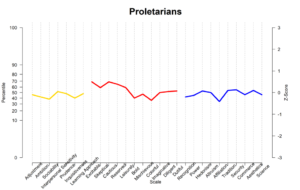
The personality profile of Proletarians makes up approximately 14% of the working population. Their Hogan profile is highlighted by mostly average scores on the MVPI with a slightly lower than average score on Affiliation; a flat and normative set of scores on the HPI with slightly lower than average scores on Sociability and Inquisitiveness; and high scores on the so-called moving away cluster of the HDS, which includes the Excitable, Skeptical, Cautious, Reserved, and Leisurely scales. See Figure 1 below for the full profile.

Figure 1. Proletarians Hogan Profile

Picture1

The Reputation of Proletarians Personality Profile

We had eight Hogan consultants with a combined 82 years of experience provide independent, written interpretations of the Proletarians profile shown above. Some of the words our experts most frequently used to describe Proletarians were “flexible,” “adaptable,” “consistency,” “safe,” “grey,” “steady,” and “balanced.” Additionally, we examined the workplace reputation of Proletarians by drawing on Hogan 360 data gathered with Hogan distributor Peter Berry Consultancy.

Colleagues, supervisors, and subordinates said individuals with the personality profile of Proletarians “treat people with respect,” “behave to very high ethical standards,” “are positive role models,” and “are polite and considerate, never rude or abrasive.” At the same time, Proletarians’ work colleagues also said that Proletarians do not “have strong influencing and negotiation skills and are “not assertive and energetic” or “competitive and driven.” In other words, Proletarians are seen by their coworkers as respectful and trustworthy but not particularly motivated or ambitious.

Lastly, our job performance archive also tells us that the personality profile of Proletarians scores high on managing conflict, attracting talent, caring about people, team building, and driving performance, but low on handling stress. Overall, Proletarians are interested in stability and a simplistic lifestyle. They are hardworking, reserved, and careful, making them solid employees who want to work without being bothered.

Common Careers for Proletarians

Proletarians prefer careers involving clear objectives and can work without much oversight or supervision. They are not looking to climb the corporate ladder, preferring roles that offer stability. They tend to see work as a necessary part of life and rarely complain. Our data show the personality profile of Proletarians are overrepresented in administrative and clerical jobs as well as in the military, both careers that offer stability and predictability.

We also found that Proletarians are slightly overrepresented in entry-level supervisory roles and underrepresented among executives. Their supervisors see them as above-average performers at work. In popular media, characters such as the Scarlett Witch (Marvel), Ron Swanson (Parks and Recreation), and Mrs. Potts (Disney’s Beauty and the Beast) are prototypical Proletarians – hardworking and preferring the simple things in life.

Advice for Proletarians

If you are a Proletarian, you should be aware of your tendency to fade into the background of most work situations. Although your manager will likely see you as a competent and steady worker, you are unlikely to be recognized as a high performer. If you aspire to move up in the company, you will need to do more to stand out and get your ideas noticed.

In leadership roles, you may tend to manage your reports rather than lead them. That is, although you will direct your reports as to what they should do, they are unlikely to find you particularly influential and will view you as more tactical than strategic. In meetings, you will tend to keep to yourself and not speak up. It will be important for you to find ways to make sure your opinion is heard, especially when you have expertise on the topic.

How to Deal with the Personality Profile of Proletarians

If your boss is a Proletarian, recognize that he or she is more likely to provide hands-on support but not much in the way of long-term vision or future direction. You will be viewed as productive if you meet deadlines and accomplish specific tasks that are assigned to you. Be aware that your business unit may not receive wider recognition in the company because of your manager’s tendency to stay out of the company’s strategic direction.

If any of your employees are Proletarians, the good news is that performance management is unlikely to be a big issue. With clear tasks and assignments in front of them, Proletarians tend to work hard and do not need much guidance. Furthermore, your Proletarian employees will likely have little interest in developmental discussions, perhaps even finding them to be a waste of time. They are typically quite happy in their roles and not looking to move up. Still, you will likely need to address the personality profile of Proletarians tendencies to be uncommunicative and withdraw from conflict. You won’t know when Proletarians have something to say, so you will have to draw it out of them.

Want to learn more about personality tests? Check out The Ultimate Guide to Personality Tests

Topics: personality

Natural Language Processing at Hogan

Posted by Hogan Assessments on Tue, Feb 11, 2020

Natural Language ProcessingThe amount of text data we send out in the world is staggering. On average, there are 500 million tweets sent per day, 23 billion text messages, and 306.4 billion emails. Everything we say, every email we send, and every word on our resumes can be used to not only understand the world around us, but as clues about the individual speaking, typing, and writing.

Unfortunately, text data does not fit into the traditional structured format of rows and columns. Text data is messy, unstructured, and not easily analyzed using classical statistical methods. Enter natural language processing, or NLP. NLP is a type of artificial intelligence that uses machine learning to break down, process, and quantify human language. NLP helps us understand the hidden stories within text-based data.

There is no singular method associated with NLP. NLP consists of multiple techniques ranging from using keywords to interpret text or speech to understanding the underlying meaning and context of communication. Because of the varying techniques associated with NLP, in the IO literature, NLP has been used to aid with several business initiatives, such as job analysis and selection, to name just two.

Up to 95% of usable organizational data is unstructured, resulting in an increased drive for using this data to remain competitive. The competition and consistent advancements in computational power, data access, and open-source research initiatives have led to the field of NLP to evolve and grow constantly. At Hogan, we are leveraging this continual growth by using NLP to improve our products and talent analytics solutions.

Hogan and Natural Language Processing

One way we are using NLP is by streamlining the coding process of focus-group notes for personality scale relevance, thereby injecting NLP into our job-analysis strategy to increase the efficiency of the approach and improve the quality of our results. Manually reading and coding focus-group notes is a time-intensive and cognitively draining process. Using NLP, on average, we can decrease the overall time it takes by approximately 6,000% while maintaining predictions that are both consistent and accurate.

Many text-based, data-analytic tasks require similar knowledge about language, such as semantics, structural similarities, and syntax. This knowledge can be shared from one model to another through transfer learning. Transfer learning allows us to quickly take advantage of cutting-edge NLP research without having to spend months and years gathering unneeded data and training similar models from scratch. Transfer learning involves taking a model trained on another dataset for a different task and fine-tuning it on a second dataset for a different task. In other words, we take what the model learned already and adapt it for our purposes. The base model for focus-group note prediction was trained on over 3 billion words. The base model was fine-tuned on a large collection of focus group notes collected across hundreds of organizations where researchers identified which personality scales were relevant based on their expert judgment.

This approach has already shown promising results for correctly identifying the relevance of personality characteristics from focus-group notes. When compared against human-raters (subject matter experts; SMEs), our model was consistent and had an average accuracy score approximately 10% higher than the average accuracy of the SMEs. This indicates that Natural Language Processing is an accurate and efficient method for identifying the critical personality characteristics of job roles from focus groups.

Topics: Hogan, Big Data

8 Personality Types: A Deeper Look at Marketers

Posted by rtrost@hoganassessments.com on Mon, Feb 10, 2020

personality profile of marketers

Two weeks ago, we revealed the eight most common personality types found in the Hogan suite of assessments. Last week we took an in-depth look at the first personality type, Rebels. This week we continue our dive into these personality types by closely examining the personality profile of Marketers.

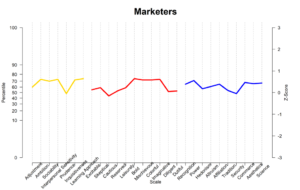
Marketers make up approximately 18% of the working population. Their Hogan profile is highlighted by high scores on Recognition, Power, Commerce, Aesthetics, and Science on the MVPI; high scores on Ambition, Interpersonal Sensitivity, Inquisitive, and Learning Approach, with only moderate Prudence on the HPI; and high scores on the so-called moving against cluster of the HDS; Bold, Mischievous, Colorful, and Imaginative. See Figure 1 below for the full profile.

Figure 1. Hogan Personality Profile of Marketers

personality profile of marketers

The Reputation of Marketers

We had eight Hogan consultants with a combined 82 years of experience provide independent, written interpretations of the personality profile of Marketers shown above. Some of the words our experts most frequently used to describe Marketers were “individual,” “idea,” “assertive,” “convince,” “charming,” “leadership,” “speak,” and most prominently “confident.” Additionally, we examined the workplace reputation of Marketers by drawing on Hogan 360 data gathered with Hogan distributor Peter Berry Consultancy. Colleagues, supervisors, and even their subordinates said Marketers are “very competitive and driven,” “think long-term about opportunities,” “have the passion to make a difference,” and “promote a long-term vision for the organization.” At the same time, their work colleagues also said Marketers do a poor job of being “open, straightforward, and communicating honestly.” In other words, Marketers are seen by their co-workers as motivated, passionate, and strategic, but somewhat untrustworthy.

Lastly, our job performance archive also tells us that Marketers score high on “competing with others,” “presenting to others,” “displaying confidence,” “self-management,” and “overcoming obstacles.” Overall, Marketers appear highly motivated to compete, win, push for results, and to make money. They are bright, sociable, and ambitious at work, but also likely to take big chances and fall prey to overconfidence.

Common Careers for Marketers

Marketers will prefer careers where they can compete with others and be measured on their performance. They have confidence in their ability to outperform the competition and will generally prefer pay-for-performance programs.

Not surprisingly, our data show that the personality profile of Marketers is heavily overrepresented in sales jobs. While only 18% of the population fits the personality profile of a Marketer, 28% of people working in sales jobs fit this profile. We also found the Marketers are slightly overrepresented in both entry-level supervisor and executive job roles. They are above-average performers at work, and it is likely that this is the main contributor – along with their charm and persuasion skills – that leads to their overrepresentation in some leadership roles. In popular media, characters such as Pepper Potts (Ironman), Chris Treager (Parks and Recreation), and Mulan (Disney’s Mulan) are prototypical Marketers – ambitious and full of confidence.

Advice for Marketers

If you are a Marketer, you need to be aware that your self-confidence will come across to many as overconfident and arrogant. In individual contributor roles, you may over-promise what can actually be delivered and ultimately take on more than you can handle. As a leader, you will have the tendency to focus on large, strategic, and long-term issues without attending to the day-to-day details that are critical to any plan’s success.

In meetings, you will tend to take over and run the show without letting other people have their say. It will be important for you to step off the pulpit and listen to others. Nonetheless, many will find your confidence inspiring and motivating, so long as you do not promise more than your team can deliver. Successful Marketers use their social skills to their advantage, motivate others to perform, and are able to limit their own ambition to projects and tasks that can actually be completed.

How to Deal with the Personality Profile of Marketers

If your boss is a Marketer, be prepared to deliver on promises that you didn’t make. A Marketer boss is bound to have more faith in what the team can accomplish than might actually be possible and it will ultimately fall on you to deliver. You should also realize that your Marketer boss is not going to want to talk about the details of getting a project done, but how that project fits in with the bigger picture. If possible, you will want to talk through strategic initiatives with your Marketer boss before s/he goes off to corporate strategy meetings. This will give you an opportunity to remind your boss of the critical details and time necessary to deliver on the objectives s/he might have in mind before big promises are made. In meetings, you will need to be assertive to get your point across as your Marketer boss will otherwise dominate the speaking time.

If any of your employees have the personality profile of a Marketer, the good news is that you will have few performance management issues. The bad news is that it will be your task to reign in their confidence and to keep them from taking on too much. You should also be prepared to have discussions about processes and reporting. Many individuals with the personality profile of Marketers will see things like logging calls and completing expense reports as needless details, preferring to focus on big-picture issues like their sales figures. It will be your job to ensure that they are spending the appropriate amount of time doing the necessary paperwork.

Want to learn more about personality tests? Check out The Ultimate Guide to Personality Tests

Topics: personality

8 Personality Types: A Deeper Look at Rebels

Posted by rtrost@hoganassessments.com on Mon, Feb 03, 2020

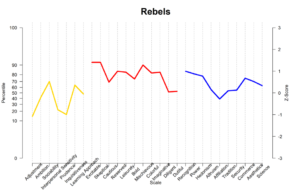
personality profile of Rebels

Last week we revealed the eight most common personality types found in the Hogan suite of assessments. Starting this week, and in the following weeks, we will take a deeper look at these eight profiles. This week we take a deep look at the personality profile of Rebels.

Rebels makeup approximately 8% of the working population. Their Hogan profile is highlighted by high scores on Recognition, Power, Hedonism, and Commerce on the MVPI; low scores on Adjustment, Interpersonal Sensitivity, and Prudence as well as high scores on Sociability and Inquisitive on the HPI; and high scores on most of the HDS scales except for Diligent and Dutiful, with especially high scores on Excitable and Skeptical. See Figure 1 below for the full profile.

Figure 1. Rebels Hogan Profile

personality profile of Rebels

The Reputation of Rebels

We had eight Hogan consultants with a combined 82 years of experience provide independent, written interpretations of the Rebels profile shown above. Some of the words our experts most frequently used to describe rebels were “emotional,” “strong,” “passionate,” “direct,” “volatile,” “reactive,” “energetic,” and “status.” Additionally, we examined the workplace reputation of Rebels by drawing on Hogan 360 data gathered with Hogan distributor Peter Berry Consultancy. Colleagues, supervisors, and even subordinates of Rebels described them as “very competitive and driven,” but also as having difficulty “managing emotions maturely and intelligently” and staying “calm and even tempered.” In other words, Rebels are seen by their co-workers as enthusiastic and energetic but struggling with emotional control. Lastly, our job performance archive also tells us that Rebels score low on “political savvy,” “modeling behavior for others,” and “overcoming obstacles.”

Common Careers for Rebels

Rebels will prefer careers where they can be creative and disruptive, where they can push the boundaries and limits of what most people consider possible. Rebels dislike the status quo and will struggle to fit with many traditional jobs. As a result, Rebels are substantially more likely to end up working for themselves as entrepreneurs.

In fact, we find that every sample of entrepreneurs that we work with is overrepresented by people with the Rebels personality profile. These samples have 18-28% entrepreneurs, which is 2-3 times more than the 8% we see in the global working population. On the darker side of things, we have also found Rebels to make up nearly half of our sample of organized crime members. Whether as entrepreneurs or as criminals, Rebels make a habit out of breaking the rules. The strictness of society’s rules then largely decides whether Rebels are considered sinners or saints. In popular media, characters such as Tony Stark (Ironman), Donna Meagle (Parks and Recreation), and Aladdin (Disney’s Aladdin) are prototypical Rebels – creative, disruptive, and pushing the limits.

Advice for Rebels

If you are a Rebel, you need to be aware of your tendency to try to skirt around the rules. On the one hand, disruption leads to innovation, change, and progress. On the other hand, many people resist change and will see your disruptive behavior as a threat to their stability. You are more comfortable with change than most people and need to realize that other people will not be as enthusiastic about your transformative ideas. Most critically, you need to be aware that some of your plans and ideas might be considered outside the bounds of fair play by society, which could lead to serious legal trouble.

Regardless, you should be prepared to cut your own path and to start your own business. You will likely be resistant to working for anyone else and working for yourself gives you the freedom and flexibility you desire. Keep in mind that, as your business grows, your employees will be looking for stability. Many of the changes and “improvements” you might like to implement will be silly and a waste of time in the minds of your employees. Frequent changes in direction will drive your best employees away. The key to success will be in your ability to temper your impulse to constantly reinvent.

How to Deal with Rebels

If your boss has the personality profile of a Rebel, be prepared to deal with frequent change. A Rebel boss might demand one thing on Monday and the complete opposite thing on Tuesday. You will need to be adaptable, flexible, and comfortable with instability. In the mind of a Rebel, nothing is ever quite good enough so the call for improvements will be constant. If any of your employees are Rebels, then be prepared to spend a fair amount of time doing performance management. They will likely listen to your coaching and feedback, but ultimately resist changing their behavior.

Your Rebel employees will often see your point of view as outdated and not future-oriented enough. To keep your Rebels productive, it is best to provide them with tasks and opportunities to create, change, or disrupt current processes. Provide ample opportunities for Rebels to share their innovative ideas. Ultimately, Rebels will probably leave your company to strike out on their own, so you should maximize their strengths while they’re there.

Want to learn more about personality tests? Check out The Ultimate Guide to Personality Tests

Topics: personality

Engaging a Multi-Generational Workforce

Posted by Hogan Assessments on Thu, Jan 30, 2020

PBCPic*This is a guest post authored by Lynne Cruickshank, senior consultant at Peter Berry Consultancy (PBC). 

A clear link has been established between how leadership drives engagement, which in turn drives performance. However, one of the challenges that leaders face is how to engage a multi-generational workforce that consists of people who differ in their perceptions and approach to work. Through developing an understanding of the unique motivators, drivers, and values of their workforce, leaders can identify the kind of approaches and work environments that are most likely to engage and motivate their employees from all generations.

So, what motivates different generations?

Research conducted by PBC revealed that people from younger generations in the Australian workforce (i.e. Generation Y [born 1978-1992] and Generation Z [born 1993-present]) tend to have distinctly different values and motivators compared to those from older generations (i.e. Generation X [born 1965-1977] and Baby Boomers [born 1946-1964]).

Specifically, younger generations (i.e. Generation Y and Generation Z) were more likely to value work where they can:

  • Influence others, challenge themselves, and focus on achievement and success
  • Stand out and be acknowledged for their achievements
  • Find enjoyment, variety, and fun
  • Socialize, network, and collaborate with others
  • Have a sense of certainty and predictability

Those from Generation Z were also found to be more strongly motivated by opportunities to engage in meaningful work that contributes to society and helps others compared to older generations (i.e. Generation X and Baby Boomers).

On the other hand, those from older generations (i.e. Generation X and Baby Boomers) were more likely to:

  • Have stronger values toward upholding traditional ways of working, respecting a sense of hierarchy, and being good organizational citizens
  • Present with a preference for a professional approach to work
  • Be less concerned about the need for teamwork and socializing
  • Not as concerned with wanting status and praise or being in environments that are fun and provide variety

What does this mean for those in leadership roles?

When seeking to engage and motivate employees from Generations Y and Z, leaders should consider providing these individuals with opportunities to engage in work that they will find meaningful, that will challenge and stretch them, and also provide them with the opportunities to engage and collaborate with others. Leaders should identify opportunities to celebrate successes and ‘wins’ with these individuals and acknowledge and recognize their contributions and achievements as this is likely to help further engage and motivate employees from younger generations. Additionally, these employees are likely to appreciate having factors that enable work-life balance and flexibility. Finally, as younger generations were found to more strongly value having a sense of certainty and predictability, they are likely to appreciate clarity around their current role as well as open discussions about their future career within the organization.

It is important to note that what engages and motivates employees from younger generations is not necessarily going to be the same for those from Generation Y or Baby Boomers due to the differences in values found across different generations.

For employees from Generation Y and Baby Boomers, they are less likely to find public acknowledgement and recognition of their contributions and achievements motivating and are likely to prefer focusing on deliverables rather than spending time focusing on socializing and injecting fun into the workplace. They are more likely to value tradition and conventions within the organization and appreciate those who demonstrate a strong work ethic and help foster a professional and business-like environment. As people from these generations are more likely to be in leadership roles within an organization, it will also be important for these leaders to keep in mind that what they tend to find rewarding and their preferred working style may differ from people they are responsible for leading and managing who are from younger generations.

At the end of the day, it is important for leaders to think about the type of culture and work environment that they want to foster based on the organization’s values and strategic focus.

They can then ensure that key practices, processes, and systems are in place to help drive this desired culture and work environment that will help achieve the organization’s key goals and performance outcomes. To ensure employees are engaged and motivated and contributing to the successful performance of the organization, it is also important for leaders to understand the values, motivators, and drivers of their employees and how this is likely to impact how they will respond to the current culture and work environment within the organization. While the generational differences outlined above are useful to consider when managing multi-generational teams, it is important to remember and respect each team member as an individual and to seek to understand their personal motivators at work.

Topics: personality

Subscribe to our Blog

Most Popular Posts

Connect