Stressed Much? A Closer Look At What's Killing You

Posted by Hogan News on Thu, Jul 10, 2014

StressFew would expect to hear the death knoll at work, but 80% of people name their job as the main source of stress - an emotional state of tension that can have long-term negative effects on health.

Studies show that chronic stress can increase people’s chances of experiencing a diagnosable mental or emotional disorder, suffering from depression and anxiety, and having panic attacks.

And it’s not just psychological. Chronic stress is also linked to increases in metabolic syndrome, a collection of signs and symptoms – obesity, high blood pressure, and a larger waist size – that increase the risk of heart disease. Three out of four doctor’s visits are for stress-related ailments or complaints!

Work-related stress can also have an effect on family life. Men and women with greater amounts of stress were more reactive to the normal ups and downs of relationships. Alcohol consumption also has a positive correlation with amount of stress an adult takes home.

All of this could easily be avoided – at least 75% of people said the most stressful aspect of their job is their immediate boss. Find out how your leadership and employees could benefit from a closer examination of work-related stressors in our ebook Stress is Killing You.

Stressed Much? A Closer Look At What’s Killing You

Posted by HNews on Wed, Jul 09, 2014


StressFew would expect to hear the death knoll at work, but 80% of people name their job as the main source of stress – an emotional state of tension that can have long-term negative effects on health.

Studies show that chronic stress can increase people’s chances of experiencing a diagnosable mental or emotional disorder, suffering from depression and anxiety, and having panic attacks.

And it’s not just psychological. Chronic stress is also linked to increases in metabolic syndrome, a collection of signs and symptoms – obesity, high blood pressure, and a larger waist size – that increase the risk of heart disease. Three out of four doctor’s visits are for stress-related ailments or complaints!

Work-related stress can also have an effect on family life. Men and women with greater amounts of stress were more reactive to the normal ups and downs of relationships. Alcohol consumption also has a positive correlation with amount of stress an adult takes home.

All of this could easily be avoided – at least 75% of people said the most stressful aspect of their job is their immediate boss. Find out how your leadership and employees could benefit from a closer examination of work-related stressors in our ebook Stress is Killing You.


EQ in the Healthcare Industry

Posted by Hogan News on Tue, Jul 08, 2014

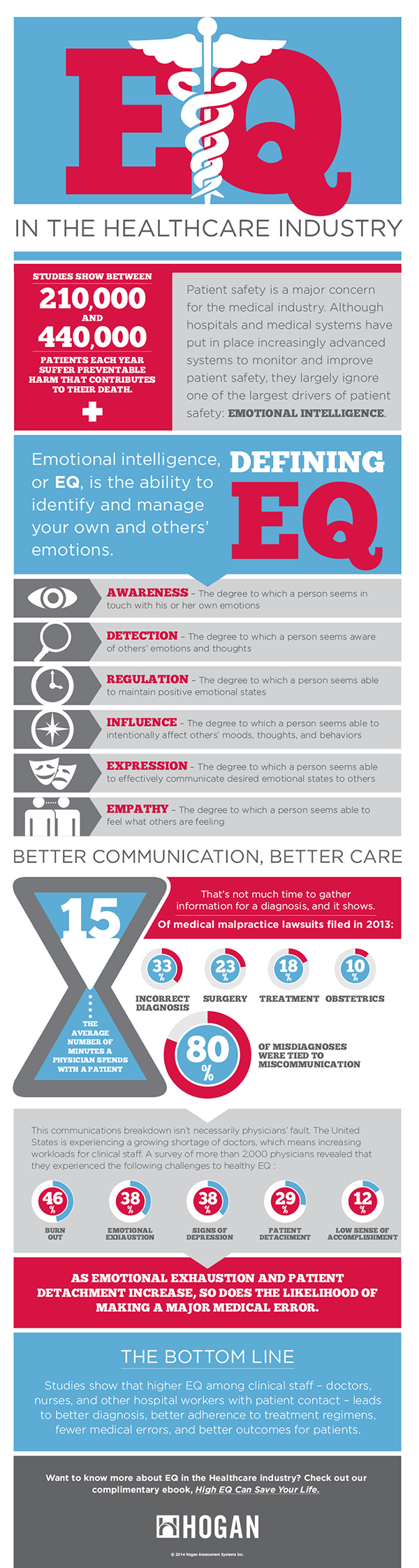
Patient safety is a major concern for the medical industry. Although hospitals have advanced systems to monitor and improve patient safety, they largely ignore one of the largest drivers of patient safety: emotional intelligence.

EQ Healthcare Infographic resized 600

Topics: EQ, emotional intelligence

EQ in the Healthcare Industry

Posted by HNews on Mon, Jul 07, 2014

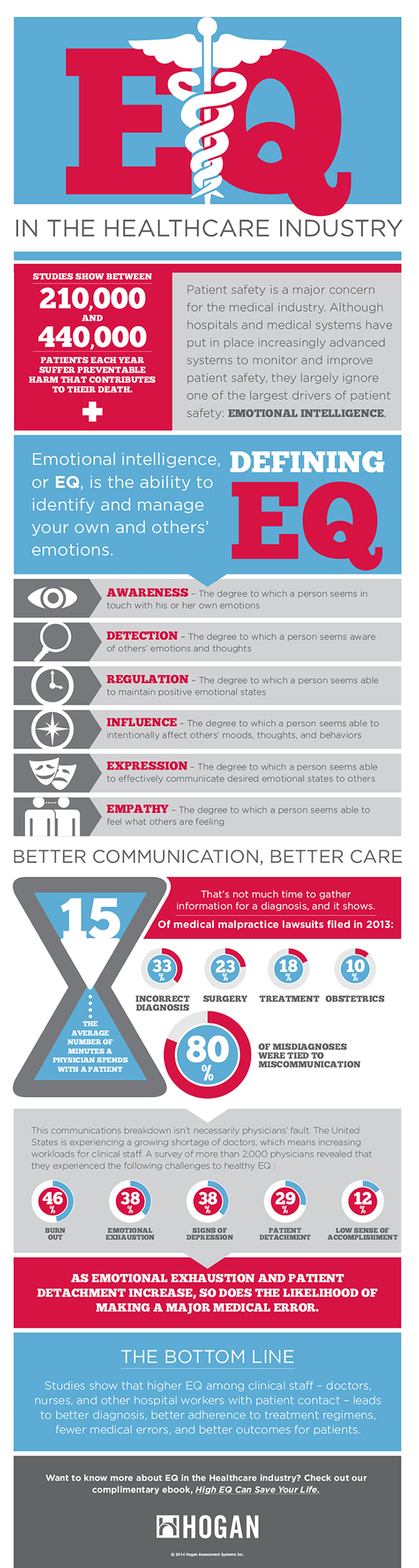
Patient safety is a major concern for the medical industry. Although hospitals have advanced systems to monitor and improve patient safety, they largely ignore one of the largest drivers of patient safety: emotional intelligence.

EQ Healthcare Infographic resized 600

Topics: EQ, emotional intelligence

Myth Busting Innovation

Posted by Natalie O'Neal on Thu, Jul 03, 2014

MythAre you being taken in by innovation myths? Tomas Chamorro-Premuzic debunks three falsehoods about being innovative within an organization in a recent Fast Company article.

1. The Personality Cult: While it’s true that some individuals are more innovative than others, it’s the side-kick and/or creative team that turn the vision into a concrete product. The qualities that make an individual innovative are more likely related to certain personality traits like “a hungry mind, openness to new experiences, and problems with authority,” says Chamorro-Premuzic. But we should remember that “innovation is always the product of teams, rather than the heroic effort of isolated individuals,” he continues.

2. The Glorification of Risk: “It is popular opinion that risk and innovation go hand in hand…The fact is that innovation requires a very small dose of risk,” says Chamorro-Premuzic. “Of course,” he continues, “there are risks associated with any innovation--as Jeff Bezos noted, if you know it’s going to work, then it’s not an experiment. But that’s precisely why a cautionary approach to innovation is more likely to pay off.”

3. The Confidence Delusion: “Most people overestimate how creative they really are,” says Chamorro-Premuzic. “This positive self-delusion creates three major problems,” he continues. First, self-deluded individuals are less likely to continually better themselves since they think they’re already creative enough. Second, it is easy to mistake confidence for competence. Third, when the confidence outshines competence, individuals are likely to be seen as entitled and narcissistic by their peers – not a healthy way to inspire creativity.

“Crucially, innovation requires a series of coordinated management efforts and effective leadership. People will always differ in their creative potential, but with the right culture in place every employee will feel compelled to unleash their creative potential,” concludes Chamorro-Premuzic.

Myth Busting Innovation

Posted by Hogan Assessments on Wed, Jul 02, 2014

MythAre you being taken in by innovation myths? Tomas Chamorro-Premuzic debunks three falsehoods about being innovative within an organization in a recent Fast Company article.

1. The Personality Cult: While it’s true that some individuals are more innovative than others, it’s the side-kick and/or creative team that turn the vision into a concrete product. The qualities that make an individual innovative are more likely related to certain personality traits like “a hungry mind, openness to new experiences, and problems with authority,” says Chamorro-Premuzic. But we should remember that “innovation is always the product of teams, rather than the heroic effort of isolated individuals,” he continues.

2. The Glorification of Risk: “It is popular opinion that risk and innovation go hand in hand…The fact is that innovation requires a very small dose of risk,” says Chamorro-Premuzic. “Of course,” he continues, “there are risks associated with any innovation–as Jeff Bezos noted, if you know it’s going to work, then it’s not an experiment. But that’s precisely why a cautionary approach to innovation is more likely to pay off.”

3. The Confidence Delusion: “Most people overestimate how creative they really are,” says Chamorro-Premuzic. “This positive self-delusion creates three major problems,” he continues. First, self-deluded individuals are less likely to continually better themselves since they think they’re already creative enough. Second, it is easy to mistake confidence for competence. Third, when the confidence outshines competence, individuals are likely to be seen as entitled and narcissistic by their peers – not a healthy way to inspire creativity.

“Crucially, innovation requires a series of coordinated management efforts and effective leadership. People will always differ in their creative potential, but with the right culture in place every employee will feel compelled to unleash their creative potential,” concludes Chamorro-Premuzic.

Is Stress Killing You?

Posted by Natalie O'Neal on Tue, Jul 01, 2014

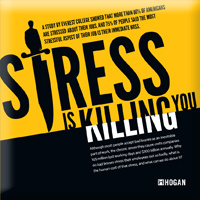
StressOr, more accurately, is your boss killing you? A study by Everest College showed that more than 80% of Americans are stressed about their jobs, and 75% of people said the most stressful aspect of their job is their immediate boss.

Although most people accept bad bosses as an inevitable part of work, the chronic stress they cause costs companies 105 million lost working days and $300 billion annually. Why do bad bosses stress their employees out so badly, what is the human cost of that stress, and what can we do about it?

Find out in our ebook Stress is Killing You.

Is Stress Killing You?

Posted by Hogan Assessments on Mon, Jun 30, 2014


StressOr, more accurately, is your boss killing you? A study by Everest College showed that more than 80% of Americans are stressed about their jobs, and 75% of people said the most stressful aspect of their job is their immediate boss.

Although most people accept bad bosses as an inevitable part of work, the chronic stress they cause costs companies 105 million lost working days and $300 billion annually. Why do bad bosses stress their employees out so badly, what is the human cost of that stress, and what can we do about it?

Find out in our ebook Stress is Killing You.


Go Global or Go Home

Posted by Renee Yang on Thu, Jun 26, 2014

PuzzleAs the World Cup kicks off the summer, it also brings out patriotism across the globe. After all, victory at the international level defines the competitiveness of a national sports team. The same rule applies to organizations. In an increasingly globalized business environment, a company’s capacity for global expansion and its performance in local markets define its competitive advantage.

Speaking of entrance into a foreign country, cultural immersion is always the top concern. As an international professional who has spent five years in the U.S., I learned from personal experience what it takes to overcome the cultural barriers.

Growing up in the most globalized city in China where English was taught at the earliest age across the nation, I did not anticipate much challenge living abroad. After all, if I had been a big fan of McDonald’s growing up, had been up-to-date with American TV shows, songs and movies, and most importantly, had proved my 'language skills' through the toughest language test in my world – TOEFL (Test of English as a Foreign Language), what obstacles should I expect?

With that naïve mindset, my first reality shock occurred right after boarding my first international flight, when I could barely understand the safety instructions in English and realized I would be doomed in case of emergency. The anxiety continued after I landed, when I was starved at the airport because I could hardly make myself understood or understand the cashier at McDonald’s (which is also why I still feel proud now every time I order at McDonald’s). To date, I can still remember my first summer class, where I had problem following any group discussions. What about my impeccable TOEFL score? If only my classmates talked like the recorded conversations in TOEFL tests. Besides language barriers, it turned out that the TV shows, songs, and movies imported into China were tailored to the interests of the local audience, whereas there were tons of American culture icons I was unaware of. Life in the U.S. was nothing like I expected.

Now that I have overcome the initial frustrations and have managed to live a life and start a career abroad, the number one lesson I learned is that when it comes to cultural immersion, it is wiser to learn than unlearn. Coming into a new culture with pre-existing biases always costs additional time and efforts because we need to un-bias the false impressions before getting to know the truth. To me, there are still a lot of things I do not know about American culture. But once I learned not to view my overseas experience through colored lenses, I started to appreciate the novelties and challenges I encountered each and every day.

Likewise, the key to an organization’s sustainable global presence is true cultural awareness through humble learning. Having a history of partnership with global distributors in over 56 countries, Hogan demonstrates true cultural awareness by adopting a learner’s mindset. Not only do we build trusting relationships with local distributors who are familiar with our assessment tools and experienced with the local business environment, but also we invite translators who are fluent in English and the target language, have a psychological background (e.g., experience working with personality characteristics and measurement), and are well acquainted with both American culture and the target culture to translate our assessments and reports based on both literal meanings and cultural adaptations. Most importantly, Hogan develops global and local norms and regularly updates those based on industry standards to ensure accurate interpretation of our assessment results in each cultural context. Through these evidence-based solutions, we are able to learn the cultural nuances and be mindful of those differences when working with international or multi-national clients.

With the emergence of a borderless economic world, organizations face the new challenge of going global or going home. Those that are willing to invest in continuous learning will be better prepared to truly understand the local market and win the global competition.

Topics: distributors

Go Global or Go Home

Posted by Hogan Assessments on Wed, Jun 25, 2014

PuzzleAs the World Cup kicks off the summer, it also brings out patriotism across the globe. After all, victory at the international level defines the competitiveness of a national sports team. The same rule applies to organizations. In an increasingly globalized business environment, a company’s capacity for global expansion and its performance in local markets define its competitive advantage.

Speaking of entrance into a foreign country, cultural immersion is always the top concern. As an international professional who has spent five years in the U.S., I learned from personal experience what it takes to overcome the cultural barriers.

Growing up in the most globalized city in China where English was taught at the earliest age across the nation, I did not anticipate much challenge living abroad. After all, if I had been a big fan of McDonald’s growing up, had been up-to-date with American TV shows, songs and movies, and most importantly, had proved my ‘language skills’ through the toughest language test in my world – TOEFL (Test of English as a Foreign Language), what obstacles should I expect?

With that naïve mindset, my first reality shock occurred right after boarding my first international flight, when I could barely understand the safety instructions in English and realized I would be doomed in case of emergency. The anxiety continued after I landed, when I was starved at the airport because I could hardly make myself understood or understand the cashier at McDonald’s (which is also why I still feel proud now every time I order at McDonald’s). To date, I can still remember my first summer class, where I had problem following any group discussions. What about my impeccable TOEFL score? If only my classmates talked like the recorded conversations in TOEFL tests. Besides language barriers, it turned out that the TV shows, songs, and movies imported into China were tailored to the interests of the local audience, whereas there were tons of American culture icons I was unaware of. Life in the U.S. was nothing like I expected.

Now that I have overcome the initial frustrations and have managed to live a life and start a career abroad, the number one lesson I learned is that when it comes to cultural immersion, it is wiser to learn than unlearn. Coming into a new culture with pre-existing biases always costs additional time and efforts because we need to un-bias the false impressions before getting to know the truth. To me, there are still a lot of things I do not know about American culture. But once I learned not to view my overseas experience through colored lenses, I started to appreciate the novelties and challenges I encountered each and every day.

Likewise, the key to an organization’s sustainable global presence is true cultural awareness through humble learning. Having a history of partnership with global distributors in over 56 countries, Hogan demonstrates true cultural awareness by adopting a learner’s mindset. Not only do we build trusting relationships with local distributors who are familiar with our assessment tools and experienced with the local business environment, but also we invite translators who are fluent in English and the target language, have a psychological background (e.g., experience working with personality characteristics and measurement), and are well acquainted with both American culture and the target culture to translate our assessments and reports based on both literal meanings and cultural adaptations. Most importantly, Hogan develops global and local norms and regularly updates those based on industry standards to ensure accurate interpretation of our assessment results in each cultural context. Through these evidence-based solutions, we are able to learn the cultural nuances and be mindful of those differences when working with international or multi-national clients.

With the emergence of a borderless economic world, organizations face the new challenge of going global or going home. Those that are willing to invest in continuous learning will be better prepared to truly understand the local market and win the global competition.

Topics: distributors

Subscribe to our Blog

Most Popular Posts

Connect