In the first installment of our Drinks with Hogan video series, Global Alliances Consultant Rebecca Miller discusses identity, reputation, and the importance of strategic self-awareness to an individual’s ability to lead.
+1.918.749.0632




In the first installment of our Drinks with Hogan video series, Global Alliances Consultant Rebecca Miller discusses identity, reputation, and the importance of strategic self-awareness to an individual’s ability to lead.
Topics: Drinks with Hogan

It is alarmingly easy to come up with a list of narcissistic CEOs – Donald Trump, the late Steve Jobs, and Mark Zuckerberg are the first three that pop into my head, as do an endless number of banking and finance industry executives (full disclosure: I just saw the excellent The Wolf of Wall Street, so my feeling here may be a little skewed).
What about coming up with a list of the least narcissistic CEOs? That, it turns out, is a little more difficult. Fortunately, someone did it for me.
Alex Frino, the Dean of Macquarie Graduate School of Management in Sydney, content analyzed quarterly earnings call transcripts for the 100 largest companies in America and calculated the ratio of how frequently CEOs used the pronouns 'I', 'me', or 'mine' versus 'we', 'our', or 'ours'. According to this metric, the three most humble CEOs in America are Pat Gelsinger (CEO of VMware), Gregg Steinhafel (CEO of Target), and Omar Ishrak (CEO of Medtronic).
You can check out a more complete list here.
As the article points out, the link between CEO humility and performance is possible, although uncertain – VMware and others are high performers in their categories, while Target and Medtronic are struggling. And, the story points out, there is a conspicuous absence of leaders from the tech or financial industries – hotbeds of high-performing companies lead by word-class narcissists.
“Many leaders dominating the workforce today possess narcissistic leadership traits, and in this era of constant change and innovation, it seems natural that charismatic, risk takers would take charge,” Frino said. “Is narcissism, generally viewed as a personality defect, actually a good thing? Does the world in fact need more narcissistic CEOs? Or is this a trait we should be actively teaching future leaders to avoid?”
Topics: narcissism

It is alarmingly easy to come up with a list of narcissistic CEOs – Donald Trump, the late Steve Jobs, and Mark Zuckerberg are the first three that pop into my head, as do an endless number of banking and finance industry executives (full disclosure: I just saw the excellent The Wolf of Wall Street, so my feeling here may be a little skewed).
What about coming up with a list of the least narcissistic CEOs? That, it turns out, is a little more difficult. Fortunately, someone did it for me.
Alex Frino, the Dean of Macquarie Graduate School of Management in Sydney, content analyzed quarterly earnings call transcripts for the 100 largest companies in America and calculated the ratio of how frequently CEOs used the pronouns ‘I’, ‘me’, or ‘mine’ versus ‘we’, ‘our’, or ‘ours’. According to this metric, the three most humble CEOs in America are Pat Gelsinger (CEO of VMware), Gregg Steinhafel (CEO of Target), and Omar Ishrak (CEO of Medtronic).
You can check out a more complete list here.
As the article points out, the link between CEO humility and performance is possible, although uncertain – VMware and others are high performers in their categories, while Target and Medtronic are struggling. And, the story points out, there is a conspicuous absence of leaders from the tech or financial industries – hotbeds of high-performing companies lead by word-class narcissists.
“Many leaders dominating the workforce today possess narcissistic leadership traits, and in this era of constant change and innovation, it seems natural that charismatic, risk takers would take charge,” Frino said. “Is narcissism, generally viewed as a personality defect, actually a good thing? Does the world in fact need more narcissistic CEOs? Or is this a trait we should be actively teaching future leaders to avoid?”
 As Big Data and technology swoop in to change the face of HR forever, it’s no wonder HR practitioners are having a few nightmares about their future. We’ve identified 5 problem children for the HR industry this year:
1) Recruiting – Every time a new employee fails (which is, according to our research, half of them), the cost to the employer is more than 150% of the candidate’s salary.
2) Retaining Talent – Voluntary turnover is on the rise. A survey by Future Workplace showed that 91% of Millennials expected to stay at a job for fewer than three years.
3) Millennials – A survey of more than 37,000 college students showed that narcissistic personality traits rose as fast as obesity rates from the 1980s to the present. That’s a lot of ego for one entry-level employee.
4) Succession Planning – According to a SilkRoad survey, only 38 percent of companies are prepared for the sudden retirement of a top executive.
5) HR Business Function – Fifty-three percent of SilkRoad’s survey respondents were most concerned about developing an HR organization that acts strategically rather than tactically.
But wait, there’s hope! Find out how to keep HR nightmares at bay in our ebook, How to Conquer the 5 Things Keeping HR up at Night.
Topics: talent management
 As Big Data and technology swoop in to change the face of HR forever, it’s no wonder HR practitioners are having a few nightmares about their future. We’ve identified 5 problem children for the HR industry this year:
1) Recruiting – Every time a new employee fails (which is, according to our research, half of them), the cost to the employer is more than 150% of the candidate’s salary.
2) Retaining Talent – Voluntary turnover is on the rise. A survey by Future Workplace showed that 91% of Millennials expected to stay at a job for fewer than three years.
3) Millennials – A survey of more than 37,000 college students showed that narcissistic personality traits rose as fast as obesity rates from the 1980s to the present. That’s a lot of ego for one entry-level employee.
4) Succession Planning – According to a SilkRoad survey, only 38 percent of companies are prepared for the sudden retirement of a top executive.
5) HR Business Function – Fifty-three percent of SilkRoad’s survey respondents were most concerned about developing an HR organization that acts strategically rather than tactically.
But wait, there’s hope! Find out how to keep HR nightmares at bay in our ebook, How to Conquer the 5 Things Keeping HR up at Night.
 President Obama received a notorious honor at the end of 2013 — numerous Pinocchio votes for Lie of the Year: “If you like your health care plan, you can keep it . . . PERIOD." It was uttered numerous times, but it was a promise impossible to keep.
His statement was truthful . . . but, it was not accurate. His declarative, ‘period,’ made it definitive and unconditional, even though he attempted to point out an implicit ‘if’ factor that should be considered.
Truth is most often used to mean in accord with fact or reality. Accuracy is the quality of being true, but includes the element of being correct, precise or exact. So, one can be truthful, but the power of words and semantics can be used very cleverly to intimate, insinuate, and imply things that may not be accurate.
President Reagan used a beautiful rhetorical device called an apophasis during the 1984 debates. When asked if, at 73, he was too old to be President, he quipped, "I will not make age an issue of this campaign. I am not going to exploit, for political purposes, my opponent's youth and inexperience." The device involves mentioning a subject by stating that it will not be mentioned!
In President Obama’s case, the ‘period’ remark conveyed something naturally to be inferred or understood — when that logical deduction was further qualified, it seemed he was being deliberately dishonest. And this impacts trust when one feels ‘caught on a technicality.’
There once were two English mariners, Nigel and Toby, who worked side-by-side on a fishing schooner. One of their daily duties as deckhand was to record "personnel" remarks in the captain's log for further action or discipline.
Now it happened one night, after an extremely common drinking party aboard the vessel, these two long-time buddies got into a fight with one another. The next morning, Nigel was hung-over and unable to perform his duty on deck. His equally hung-over partner, Toby, had logging duty for the day and recorded, "Nigel totally consumed by spirits--not able to report for duty--recommend the brig." Nigel pleaded with his companion not to record his transgression, but Toby was steadfast and said "it was the truth."
After a fitful night of sleep and boiling anger, it was now Nigel's morning watch and duty to make entries in the ship's log. When Toby arrived on deck, Nigel recorded, "Let it be noted, to the astonishment of all, that Toby showed up for duty this morning and he was NOT drunk!"
Truthful? Yes. Accurate? Certainly not.
 President Obama received a notorious honor at the end of 2013 — numerous Pinocchio votes for Lie of the Year: “If you like your health care plan, you can keep it . . . PERIOD.” It was uttered numerous times, but it was a promise impossible to keep.
His statement was truthful . . . but, it was not accurate. His declarative, ‘period,’ made it definitive and unconditional, even though he attempted to point out an implicit ‘if’ factor that should be considered.
Truth is most often used to mean in accord with fact or reality. Accuracy is the quality of being true, but includes the element of being correct, precise or exact. So, one can be truthful, but the power of words and semantics can be used very cleverly to intimate, insinuate, and imply things that may not be accurate.
President Reagan used a beautiful rhetorical device called an apophasis during the 1984 debates. When asked if, at 73, he was too old to be President, he quipped, “I will not make age an issue of this campaign. I am not going to exploit, for political purposes, my opponent’s youth and inexperience.” The device involves mentioning a subject by stating that it will not be mentioned!
In President Obama’s case, the ‘period’ remark conveyed something naturally to be inferred or understood — when that logical deduction was further qualified, it seemed he was being deliberately dishonest. And this impacts trust when one feels ‘caught on a technicality.’
There once were two English mariners, Nigel and Toby, who worked side-by-side on a fishing schooner. One of their daily duties as deckhand was to record “personnel” remarks in the captain’s log for further action or discipline.
Now it happened one night, after an extremely common drinking party aboard the vessel, these two long-time buddies got into a fight with one another. The next morning, Nigel was hung-over and unable to perform his duty on deck. His equally hung-over partner, Toby, had logging duty for the day and recorded, “Nigel totally consumed by spirits–not able to report for duty–recommend the brig.” Nigel pleaded with his companion not to record his transgression, but Toby was steadfast and said “it was the truth.”
After a fitful night of sleep and boiling anger, it was now Nigel’s morning watch and duty to make entries in the ship’s log. When Toby arrived on deck, Nigel recorded, “Let it be noted, to the astonishment of all, that Toby showed up for duty this morning and he was NOT drunk!”
Truthful? Yes. Accurate? Certainly not.
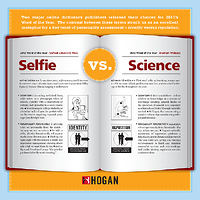
Two major online dictionary publishers released their choices for 2013's Word of the Year. The contrast between these terms struck us as an excellent metaphor for a key tenet of personality assessment - identity versus reputation.
self-ie /sel-fee/ n. In use since 2002, selfie saw a 17,000% increase in use over 2012 - thanks in no small part to everyone from Miley Cyrus to Barack Obama keeping it in the news.
Definition - According to Oxford press, selfie refers to a photograph taken of oneself, typically with a smartphone or webcam and uploaded to a social media site. Most teenagers, college students, or celebritites will tell you the perfect selfie can be elusive, requiring repeated poses to get just the right look.
Personality Perspective - Identity relies on personality from the inside - the way we see ourselves. As with a selfie, identity doesn't tell anyone much about the real you. Finding the right angle with the camera is really just impression management, showing others only what we want them to see. And as Sigmund Freud used to say, "the you that you know is hardly worth knowing."
sci-ence /'si-en(t)s/ n. First used in the 14th century, science saw a 176% increase in lookups this year over last, and remained at the top of the list throughout the year.
Definition - Merriam-Webster defines science as knowledge or a system of knowledge covering general truths or the operation of general laws especially as obtained and tested through scientific method. At Hogan, that means using a massive volume of proven data to predict job performance.
Personality Perspective - Reputation refers to personality from the outside - the way others see you. Hogan's scientific assessment of reputation produces a data-based, multi-dimensional picture of who you really are, giving you strategic self-awareness to build and maintain successful careers and relationships. And unlike identity, reputation remains stable over time.
Topics: reputation, identity
Two major online dictionary publishers released their choices for 2013’s Word of the Year. The contrast between these terms struck us as an excellent metaphor for a key tenet of personality assessment – identity versus reputation.
self-ie /sel-fee/ n. In use since 2002, selfie saw a 17,000% increase in use over 2012 – thanks in no small part to everyone from Miley Cyrus to Barack Obama keeping it in the news.
Definition – According to Oxford press, selfie refers to a photograph taken of oneself, typically with a smartphone or webcam and uploaded to a social media site. Most teenagers, college students, or celebritites will tell you the perfect selfie can be elusive, requiring repeated poses to get just the right look.
Personality Perspective – Identity relies on personality from the inside – the way we see ourselves. As with a selfie, identity doesn’t tell anyone much about the real you. Finding the right angle with the camera is really just impression management, showing others only what we want them to see. And as Sigmund Freud used to say, “the you that you know is hardly worth knowing.”
sci-ence /’si-en(t)s/ n. First used in the 14th century, science saw a 176% increase in lookups this year over last, and remained at the top of the list throughout the year.
Definition – Merriam-Webster defines science as knowledge or a system of knowledge covering general truths or the operation of general laws especially as obtained and tested through scientific method. At Hogan, that means using a massive volume of proven data to predict job performance.
Personality Perspective – Reputation refers to personality from the outside – the way others see you. Hogan’s scientific assessment of reputation produces a data-based, multi-dimensional picture of who you really are, giving you strategic self-awareness to build and maintain successful careers and relationships. And unlike identity, reputation remains stable over time.
 “You don’t have to be a total narcissist to be a successful executive – but a solid dash of ego can help,” Rachel Feintzeig, a management reporter for the Wall Street Journal, writes in WSJ’s At Work blog. And she’s right. Citing sources from the University of Illinois at Urbana-Champaign, the University of Nebraska at Lincoln and Hogan Assessments, she delves into the controversial topic of narcissism in the workplace. Hogan’s managing partner Rodney Warrenfeltz discusses the implications of Bold scores in the 70-90 range and above on the Hogan Development Survey. Despite its stigma, narcissism and “being able to influence people is a crucial part of effective leadership” writes Feintzeig.
Topics: Hogan Development Survey, HDS, HDS scales

 Download a PDF
 Download a PDF