
Assessment + Interview = Hiring Success

Posted by DNei on Sun, Sep 29, 2013

using assessments in interviews

I was browsing the internet one night a few weeks ago, and I came across a story that caught my attention. The story is one of a Los Angeles County traffic cop that, through 20 years on the job and 25,000 traffic stops, has never received a single complaint. Zip. Zero. Zilch. Nada. This is an amazing statistic, especially when you consider that most interactions with traffic police will leave you with a citation and a bad mood. However, this officer has a flawless record and it is all due to one factor – personality. Instead of chastising and embarrassing commuters for speeding, failure to wear a safety belt, and the like, he puts his interpersonal skills to good use and leaves commuters with a ticket and a smile. It’s the perfect combination of charm without being too charming, being personable without being walked-on.

Organizations and individuals looking to hire or promote the right person for a job need to consider factors like an individual’s personality or values. In fact, these factors are the difference between having a good set of employees and a great set of employees. Someone can have all the intelligence, experience, and educational degrees needed to do the job, but if they don’t have the right blend of personality and values needed for the job or the organization, they will likely end up underperforming and may even leave or be fired. What I would rather have is someone with the right personality and values at day one, because skills are trainable and experience will come with time. Personality on the other hand is difficult to train.

Using Assessments in Interviews

You may be saying to yourself right now, “None of this is news to me. That’s exactly why I rely on interviews when hiring people.” Interviews are great for several reasons. They allow you the opportunity to ask follow-up questions and to dig further into interesting items on a résumé. However, there are several drawbacks associated with interviews. First, asking follow-up questions reduces the structure of an interview, which is a bad thing. Second, people are able to fake during interviews, making it difficult to know what the person will look like 6 months on the job. Third, interviews are expensive. Interviewers need to be trained on the concepts they are assessing, as well as how to rate the interviewee on those concepts. Then, there are the costs associated with paying someone to conduct the interview. Not to mention, the costs associated with bringing a candidate in to interview (Sure, there are ways of conducting virtual interviews, but if successful, most are followed up with in-person meetings).

Interviews are an inevitable and expensive part of the candidate selection process, but that doesn’t mean that we can’t do things beforehand to make interviews more cost effective and efficient. This is where personality assessment comes in. First, personality assessments provide a standard set of items that each candidate responds to, therefore adding structure to the talent acquisition process. Second, well-constructed personality assessments cannot be faked. Third, personality assessments are a cost effective way of gathering standardized information on a batch of candidates to trim down the amount of interviews.

To find the right employee to fit your organization (like the zero-complaint traffic cop), assess your candidates then interview. You’ll have success every time.

Want to learn more about hiring the right way? Check out our guide to crafting next-level talent identification, interviewing, and selection processes

Hogan U Wrap-Up

Posted by Kristin Switzer on Thu, Sep 26, 2013

HoganUEarlier this month, Hogan’s Global Alliances team was proud to host nearly two dozen individuals from around the world for the first edition of Hogan University, later coined Hogan U. Held in Tulsa, Oklahoma, where the Hogan headquarters reside, the event featured three days of presentations, training sessions, and interactions with the Tulsa staff. As always, there were several opportunities for great food, drinks, and conversation to please all of us with high Hedonism and Affiliation scores.
Hogan U was created to accelerate the Hogan-related learning and orientation of our international distributors’ high-potential employees. The curriculum focuses on several primary interests from our distributor network, including direct selling techniques, marketing and social media tactics, competency-based solutions, and new Hogan products.

Further, the event provided significant takeaways for the Hogan team itself. For me, time with our global network always confirms an important perspective: each of our international distributors faces unique challenges in their respective territories; however, every market has an appetite for the use of personality assessments to predict performance. Our team is tasked with the challenge, albeit exciting, to understand each market intimately and address various challenges, all the while knowing that the need for valid, predictable personality assessments is everywhere.

We are thrilled that our international guests embraced the event whole-heartedly and received some great pieces of information to take back to their home countries and organizations. Personally, I’m also delighted our guests enjoyed Tulsa’s southern charm, honky-tonk and all.

For pictures of the Hogan U Welcome Reception and conference, please see our Facebook page.

Topics: personality

Q2 I/O Breakdown

Posted by Hogan News on Thu, Sep 26, 2013

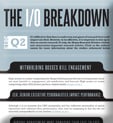
I/O BreakdownIt's difficult to find time to read every new piece of rersearch that could impact the I/O field. However, to be effective, it is important to stay up to date on current research. To help, the Hogan Research Division collects and summarizes important articles every quarter. Click on the authors' names for more information about the studies.

Withholding Bosses Kill Engagement
High scores on scales comprising the Hogan Development Survey’s moving-away factor are most harmful to engagement, job satisfaction, and burnout. High scores on scales comprising other HDS factors produce mixed results (Leary et al.).

CEO, Senior Executive Personalities Impact Performance
Although it is no surprise that CEO personality and the collective personality of senior executives both influence firm performance, what may be surprising is that the two act relatively independently of one another (Colbert et al.).

Virtual Harassment More Damaging Than Face-To-Face
Virtual workplace harassment (i.e., harassment via computer-based communications) can be just as psychologically damaging as face-to-face harassment, but even more so when the person doing the harassing is anonymous or from outside of the organization (Ford).

Is Too Much Creativity a Bad Thing?
All organizations need creative people, but overall levels of creativity might be less beneficial or even detrimental to large or risk-prone organizations (Gong et al.).

Values Predict Self-Starters in Ambiguous Jobs
Individual values predict how proactive employees will be on the job, but only in weak employment situations where ambiguity is high (Grant and Rothbard).

For Extraversion, Moderation is Key
When it comes to the relationship between extraversion and call center performance, individuals with moderate extraversion scores tend to do better than individuals with either low or high scores (Grant).

Shared Leadership Drives Innovation
Shared leadership within teams helps drive innovation (Hoch).

Neurotic People May Also Be Smarter
Both neuroticism and openness to experience are significantly related to certain aspects of higher level cognitive functioning (Murdock et al.).

Workplace Bullying Impacts Mental Health
Workplace bullying not only impacts performance, but also the overall mental health of employees (Nielsen et al.).

Conscientiousness More Important in Low-Level Jobs
Although generally predictive across jobs, conscientiousness may be particularly important for lower level jobs that are highly structured and less cognitively demanding (Shaffer & Postlewaite).

Topics: psychology, research, I/O Psychology

Hogan U Wrap-Up

Posted by Hogan Assessments on Wed, Sep 25, 2013

HoganUEarlier this month, Hogan’s Global Alliances team was proud to host nearly two dozen individuals from around the world for the first edition of Hogan University, later coined Hogan U. Held in Tulsa, Oklahoma, where the Hogan headquarters reside, the event featured three days of presentations, training sessions, and interactions with the Tulsa staff. As always, there were several opportunities for great food, drinks, and conversation to please all of us with high Hedonism and Affiliation scores.

Hogan U was created to accelerate the Hogan-related learning and orientation of our international distributors’ high-potential employees. The curriculum focuses on several primary interests from our distributor network, including direct selling techniques, marketing and social media tactics, competency-based solutions, and new Hogan products.

Further, the event provided significant takeaways for the Hogan team itself. For me, time with our global network always confirms an important perspective: each of our international distributors faces unique challenges in their respective territories; however, every market has an appetite for the use of personality assessments to predict performance. Our team is tasked with the challenge, albeit exciting, to understand each market intimately and address various challenges, all the while knowing that the need for valid, predictable personality assessments is everywhere.

We are thrilled that our international guests embraced the event whole-heartedly and received some great pieces of information to take back to their home countries and organizations. Personally, I’m also delighted our guests enjoyed Tulsa’s southern charm, honky-tonk and all.

For pictures of the Hogan U Welcome Reception and conference, please see our Facebook page.

Q2 I/O Breakdown

Posted by HNews on Wed, Sep 25, 2013

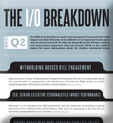
I/O BreakdownIt’s difficult to find time to read every new piece of rersearch that could impact the I/O field. However, to be effective, it is important to stay up to date on current research. To help, the Hogan Research Division collects and summarizes important articles every quarter. Click on the authors’ names for more information about the studies.

Withholding Bosses Kill Engagement
High scores on scales comprising the Hogan Development Survey’s moving-away factor are most harmful to engagement, job satisfaction, and burnout. High scores on scales comprising other HDS factors produce mixed results (Leary et al.).

CEO, Senior Executive Personalities Impact Performance
Although it is no surprise that CEO personality and the collective personality of senior executives both influence firm performance, what may be surprising is that the two act relatively independently of one another (Colbert et al.).

Virtual Harassment More Damaging Than Face-To-Face
Virtual workplace harassment (i.e., harassment via computer-based communications) can be just as psychologically damaging as face-to-face harassment, but even more so when the person doing the harassing is anonymous or from outside of the organization (Ford).

Is Too Much Creativity a Bad Thing?
All organizations need creative people, but overall levels of creativity might be less beneficial or even detrimental to large or risk-prone organizations (Gong et al.).

Values Predict Self-Starters in Ambiguous Jobs
Individual values predict how proactive employees will be on the job, but only in weak employment situations where ambiguity is high (Grant and Rothbard).

For Extraversion, Moderation is Key
When it comes to the relationship between extraversion and call center performance, individuals with moderate extraversion scores tend to do better than individuals with either low or high scores (Grant).

Shared Leadership Drives Innovation
Shared leadership within teams helps drive innovation (Hoch).

Neurotic People May Also Be Smarter
Both neuroticism and openness to experience are significantly related to certain aspects of higher level cognitive functioning (Murdock et al.).

Workplace Bullying Impacts Mental Health
Workplace bullying not only impacts performance, but also the overall mental health of employees (Nielsen et al.).

Conscientiousness More Important in Low-Level Jobs
Although generally predictive across jobs, conscientiousness may be particularly important for lower level jobs that are highly structured and less cognitively demanding (Shaffer & Postlewaite).

Branson Nailed It on LinkedIn Today

Posted by Ryan Daly on Wed, Sep 25, 2013

culturefitIt’s safe to say that Sir Richard Branson, the billionaire founder of the Virgin Group, which operates more than 400 companies, knows how to run a company.

Even so, it is rare to hear even the most successful of business leaders state something so perfectly as Branson did when he declared in a recent LinkedIn blog post: “The first thing to look for when searching for a great employee is somebody with a personality that fits with your company culture. Most skills can be learned, but it is difficult to train people on their personality.”

We’ve been preaching the gospel of fit – the extent to which a person’s personality aligns with a particular job, position, or organization – for a while, but there’s nothing like hearing it straight from the horse’s mouth.

For more of Branson’s tips for managing his people and running an empire, check out Inc’s video series here.

Topics: culture, job fit

Branson Nailed It on LinkedIn Today

Posted by Hogan Assessments on Tue, Sep 24, 2013

culturefitIt’s safe to say that Sir Richard Branson, the billionaire founder of the Virgin Group, which operates more than 400 companies, knows how to run a company.
Even so, it is rare to hear even the most successful of business leaders state something so perfectly as Branson did when he declared in a recent LinkedIn blog post: “The first thing to look for when searching for a great employee is somebody with a personality that fits with your company culture. Most skills can be learned, but it is difficult to train people on their personality.”

We’ve been preaching the gospel of fit – the extent to which a person’s personality aligns with a particular job, position, or organization – for a while, but there’s nothing like hearing it straight from the horse’s mouth.

For more of Branson’s tips for managing his people and running an empire, check out Inc’s video series here.

Topics: culture

Dr. Hogan on Hogan

Posted by Hogan News on Tue, Sep 24, 2013

Dr. Robert Hogan dedicated his career to uncovering how personality factors influence leadership effectiveness and predict job performance. In this video, he discusses personality theory and assessment, identity vs. reputation, and faking.

Dr. Hogan on Hogan

Posted by HNews on Mon, Sep 23, 2013

Dr. Robert Hogan dedicated his career to uncovering how personality factors influence leadership effectiveness and predict job performance. In this video, he discusses personality theory and assessment, identity vs. reputation, and faking.

Pro-tip: The answer is always good leadership.

Posted by Natalie O'Neal on Mon, Sep 23, 2013

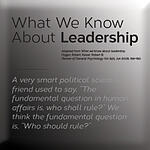
What We KnowDid you know that trust in one’s superior predicts the entire range of desirable organizational outcomes: productivity, job satisfaction, and organizational commitment? Good leaders can build trust by embodying four essential qualities: integrity, judgment, competence, and vision.

Personality predicts leadership style, which in turn, directly impacts employee engagement. Companies whose employees are engaged show higher returns on assets, are more profitable, and yield nearly twice the value to their shareholders compared to companies characterized by low employee engagement. Disengagement, on the other hand, results in an estimated $300 billion in lost productivity in the U.S. each year!

Because leadership can make or break an organization, it’s imperative we find out all we can about what it means to be a good leader. So, let us share with you What We Know About Leadership and discover the answer to organizational success.

Topics: leadership, personality

Subscribe to our Blog

Most Popular Posts

Connect