

Reflect by GMAC

Posted by HNews on Wed, Mar 13, 2013

ReflectHogan and the Graduate Management Admission Council (GMAC) partnered to launch Reflect by GMAC, the first self-directed, personality-based development tool designed to bring the power of self-awareness to B-school students.

Reflect evaluates personal and professional qualities deemed imperative in today’s workplace by 800 corporate recruiters. It provides concrete action items to help individuals learn more about themselves, improve their strengths, and address their weaknesses. The Reflect tool is the only interactive platform that goes beyond results to provide a personalized action plan, library, and benchmarking data from 14 job functions.

The assessment measures 10 key competencies:

  • Innovation – generates new and unique ideas
  • Operational Thinking – works efficiently and effectively
  • Decision Making – selects best course of action
  • Strategic Vision – combines own ideas with others
  • Strategic Self-Awareness – recognizes own strengths and weaknesses
  • Resilience – performs well under pressure
  • Drive – holds high standards for self and others
  • Interpersonal Intuition – adjusts communications to audience
  • Valuing Others – builds trust-based relationships
  • Collaboration – promotes team accomplishments

More on Reflect by GMAC, powered by Hogan

Topics: assessment, GMAC

The Mask of Integrity

Posted by Hogan News on Tue, Mar 12, 2013

TrustIn their book chapter “The Mask of Integrity,” published in Citizen Espionage: Studies in Trust and Betrayal, Drs. Joyce and Robert Hogan, outlined four characteristics that typified the ideal betrayer:

Charisma – According to Dr. Tomas Chamorro-Premuzic, vice president of research and innovation at Hogan, there are three ways to influence others: force, reason, or charm. Force and reason are rational – even when people are forced to do something, they obey for a good reason. Charm, on the other hand, is based on emotional manipulation and has the ability to trump rational assessments.

Self-absorption – The second characteristic of an ideal betrayer is an unusual degree of self-absorption, or, more to the point, a relentless drive for self-advancement. Betrayers possess a ruthless dedication to self-advancement to the extent that other people lose their value as humans and become objects to be manipulated.

Self-Deception – The third characteristic that typifies the ideal betrayer is self-deception. A major tenet of psychoanalysis and existentialism is that people are prone to deceive themselves about the reasons for their actions.

Hollow Core Syndrome – The final characteristic of the ideal betrayer is a pattern of personality characteristics called the hollow core syndrome. The hollow core syndrome refers to people who are overtly self-confident, who meet the public well, who are charming and socially poised, and who expect others to like them, but who are privately self-doubting and unhappy.

Unfortunately, this charm, confidence, and talent for ingratiation provides betrayers the tools they need to find employment at and quickly ascend the ranks of large, hierarchical organizations, and the private self-doubt associated with the hollow core fuels their pursuit of the money, power, and prestige offered by senior management positions. Trust and Betrayal, a new eBook from Hogan, examines what companies can do to identify and mitigate the effects of betrayers in their ranks.


Topics: leadership, judgment, integrity, trust

The Mask of Integrity

Posted by HNews on Mon, Mar 11, 2013


TrustIn their book chapter “The Mask of Integrity,” published in Citizen Espionage: Studies in Trust and Betrayal, Drs. Joyce and Robert Hogan, outlined four characteristics that typified the ideal betrayer:

Charisma – According to Dr. Tomas Chamorro-Premuzic, vice president of research and innovation at Hogan, there are three ways to influence others: force, reason, or charm. Force and reason are rational – even when people are forced to do something, they obey for a good reason. Charm, on the other hand, is based on emotional manipulation and has the ability to trump rational assessments.

Self-absorption – The second characteristic of an ideal betrayer is an unusual degree of self-absorption, or, more to the point, a relentless drive for self-advancement. Betrayers possess a ruthless dedication to self-advancement to the extent that other people lose their value as humans and become objects to be manipulated.

Self-Deception – The third characteristic that typifies the ideal betrayer is self-deception. A major tenet of psychoanalysis and existentialism is that people are prone to deceive themselves about the reasons for their actions.

Hollow Core Syndrome – The final characteristic of the ideal betrayer is a pattern of personality characteristics called the hollow core syndrome. The hollow core syndrome refers to people who are overtly self-confident, who meet the public well, who are charming and socially poised, and who expect others to like them, but who are privately self-doubting and unhappy.

Unfortunately, this charm, confidence, and talent for ingratiation provides betrayers the tools they need to find employment at and quickly ascend the ranks of large, hierarchical organizations, and the private self-doubt associated with the hollow core fuels their pursuit of the money, power, and prestige offered by senior management positions. Trust and Betrayal, a new eBook from Hogan, examines what companies can do to identify and mitigate the effects of betrayers in their ranks.


Developing Leaders for the Future

Posted by Ashley Palmer on Mon, Mar 11, 2013

bschoolHarvard Business Review blogger, Jack Zenger, recently wrote “we wait too long to train our leaders.” In his post Zenger points out the discrepancy between when individuals first take on leadership roles and when they first receive leadership training. When looking at data from over 17,000 leaders across the globe, the average age an individual became a leader was 30, yet the average age for entering leadership training was 42. Why does this gap exist?

Some critics have pointed the finger at business schools, claiming they focus on developing “hard” business skills while doing little to develop their graduates’ “soft” leadership skills. These critics assert that new managers use their MBA skills marginally or not at all in their first management assignments. As such, MBA program administrators and faculty can no longer assume that graduates will successfully motivate and lead people in the business world without first developing these skills. In fact, companies prefer to recruit graduates who have been exposed to soft skill leadership development while still in school.

The Graduate Management Admissions Council (GMAC) concluded that business schools could enhance their relevancy by devoting more attention to soft skill competencies and recently developed Reflect, an online development tool aimed at addressing this gap. Also, MBA programs have started implementing leadership development courses into their curriculums. Several of U.S. News’s top ranked MBA programs describe their leadership development courses on their websites to attract prospective students. Business schools appear to be working to close the gap by providing their students with leadership training early in their careers.

Interestingly, a similar trend may be happening in the leadership ranks within universities themselves. A recent Wall Street Journal article quoted Lucy Apthorp Leske, co-director of the education and not-for-profit practice at Witt/Kieffer, as saying, “There has been a real shift to the professionalization of higher education administration.” She explained that universities are putting more weight on factors like business sense and creative problem-solving rather than just research prowess for their leaders.

So while Zenger has a point, universities seem to be addressing this gap in more ways than one, working to equip leaders with the skills they need to be successful in the future.

Topics: leadership, Reflect

Developing Leaders for the Future

Posted by Hogan Assessments on Sun, Mar 10, 2013

bschoolHarvard Business Review blogger, Jack Zenger, recently wrote “we wait too long to train our leaders.” In his post Zenger points out the discrepancy between when individuals first take on leadership roles and when they first receive leadership training. When looking at data from over 17,000 leaders across the globe, the average age an individual became a leader was 30, yet the average age for entering leadership training was 42. Why does this gap exist?

Some critics have pointed the finger at business schools, claiming they focus on developing “hard” business skills while doing little to develop their graduates’ “soft” leadership skills. These critics assert that new managers use their MBA skills marginally or not at all in their first management assignments. As such, MBA program administrators and faculty can no longer assume that graduates will successfully motivate and lead people in the business world without first developing these skills. In fact, companies prefer to recruit graduates who have been exposed to soft skill leadership development while still in school.

The Graduate Management Admissions Council (GMAC) concluded that business schools could enhance their relevancy by devoting more attention to soft skill competencies and recently developed Reflect, an online development tool aimed at addressing this gap. Also, MBA programs have started implementing leadership development courses into their curriculums. Several of U.S. News’s top ranked MBA programs describe their leadership development courses on their websites to attract prospective students. Business schools appear to be working to close the gap by providing their students with leadership training early in their careers.

Interestingly, a similar trend may be happening in the leadership ranks within universities themselves. A recent Wall Street Journal article quoted Lucy Apthorp Leske, co-director of the education and not-for-profit practice at Witt/Kieffer, as saying, “There has been a real shift to the professionalization of higher education administration.” She explained that universities are putting more weight on factors like business sense and creative problem-solving rather than just research prowess for their leaders.

So while Zenger has a point, universities seem to be addressing this gap in more ways than one, working to equip leaders with the skills they need to be successful in the future.

Leading the Global Economy

Posted by Hogan News on Tue, Mar 05, 2013

Global EconomyAs businesses continue to expand into China, and Chinese companies establish operations around the world, employers find themselves having to integrate both Chinese and Western perspectives into their organizational leadership roles. Understanding the inherent differences between Chinese and Western leadership styles is essential for successful talent management programs.

To pinpoint the differences between Chinese and Western leadership styles, Hogan consultants Jarrett Shalhoop and Michael Sanger collected personality data from 992 Chinese business leaders who met three criteria:
1. They were born and educated in Mainland China.
2. They were working in Mainland China at the time of assessment.
3. They had direct reports at the time of assessment.

They compared this sample to business leaders in the U.S. (4,184), Germany (1,779), and Australia (4,864), regions selected because of their large trade interests with China.

Shalhoop and Sanger examined three kinds of data: bright-side personality, also called normal personality, dark-side personality, and values. Together, these three dimensions accurately predict individuals’ strengths, weaknesses, and leadership style.

Read the results of the study to understand the differences between Chinese and Western leadership styles.

Leading the Global Economy

Posted by HNews on Mon, Mar 04, 2013

Global EconomyAs businesses continue to expand into China, and Chinese companies establish operations around the world, employers find themselves having to integrate both Chinese and Western perspectives into their organizational leadership roles. Understanding the inherent differences between Chinese and Western leadership styles is essential for successful talent management programs.

To pinpoint the differences between Chinese and Western leadership styles, Hogan consultants Jarrett Shalhoop and Michael Sanger collected personality data from 992 Chinese business leaders who met three criteria:
1. They were born and educated in Mainland China.
2. They were working in Mainland China at the time of assessment.
3. They had direct reports at the time of assessment.

They compared this sample to business leaders in the U.S. (4,184), Germany (1,779), and Australia (4,864), regions selected because of their large trade interests with China.

Shalhoop and Sanger examined three kinds of data: bright-side personality, also called normal personality, dark-side personality, and values. Together, these three dimensions accurately predict individuals’ strengths, weaknesses, and leadership style.

Read the results of the study to understand the differences between Chinese and Western leadership styles.

New eBook: Coaching Strategies

Posted by Hogan News on Thu, Feb 28, 2013

Coaching StrategiesProviding candidates with accurate feedback about the behaviors they should keep doing, stop doing, and start doing is the first step to improving their interpersonal effectiveness. The Hogan Personality Inventory, Hogan Development Survey, and the Motives, Values, Preferences Inventory provide useful feedback about what individuals need to do to improve their performance at work. This interpretation guide uses a simple, but focused, series of steps to help affect behavioral and repetitional change for the coaching candidate. Visit our bookstore to purchase Coaching Strategies.

Bookstore

Topics: coaching, assessment

New eBook: Coaching Strategies

Posted by HNews on Wed, Feb 27, 2013

Coaching StrategiesProviding candidates with accurate feedback about the behaviors they should keep doing, stop doing, and start doing is the first step to improving their interpersonal effectiveness. The Hogan Personality Inventory, Hogan Development Survey, and the Motives, Values, Preferences Inventory provide useful feedback about what individuals need to do to improve their performance at work. This interpretation guide uses a simple, but focused, series of steps to help affect behavioral and repetitional change for the coaching candidate. Visit our bookstore to purchase Coaching Strategies.



Bookstore

Topics: coaching, assessment

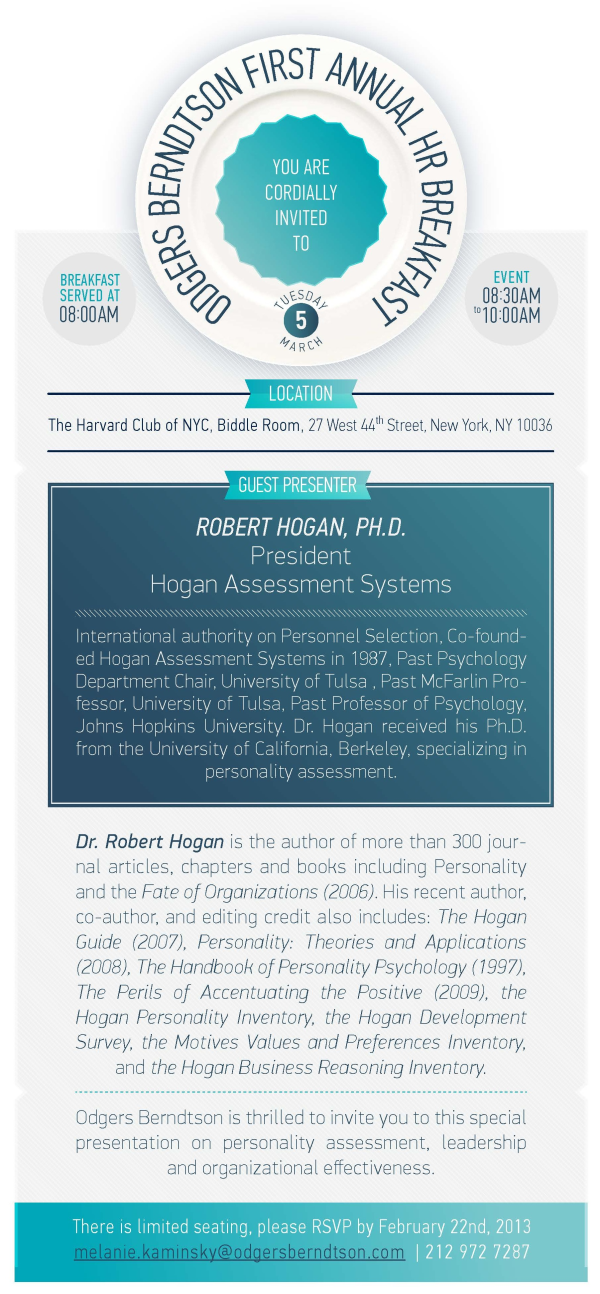
Dr. Hogan to give a breakfast talk with Odgers Berndtson

Posted by Hogan News on Mon, Feb 25, 2013

OB Event

Dr. Hogan to speak on personality assessment, leadership, and organizational effectiveness.

Topics: leadership, Dr. Hogan

Subscribe to our Blog

Most Popular Posts

Connect