MVPI Item Themes

Posted by HNews on Wed, Mar 27, 2013


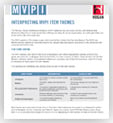
MVPI ThumbThe Motives, Values, Preferences Inventory identifies the core goals, drivers, and interests that determine what gets people to the office each day. The MVPI consists of 10 primary scales, which are further divided into five item themes. The MVPI item themes provide additional interpretive power by categorizing participants’ responses to the questions that compose each MVPI scale.


MVPI Item Themes:

  • Lifestyles – The manner in which a person would like to live
  • Beliefs – “Shoulds”, ideals, and ultimate life goals
  • Occupational Preferences – The work an individual would like to do, what constitutes a good job, and preferred work materials
  • Aversions – Reflects attitudes and behaviors that are either disliked or distressing
  • Preferred Associates – The kind of people desired as coworkers and friends

Read more about interpreting the MVPI Item Themes


Corporate Culture and the Impact on Employee Engagement

Posted by Cheryl Oxley on Mon, Mar 25, 2013

In the past few weeks, I’ve noticed a focus around corporate culture in many of my typical news sources – Fast Company, Fortune, Talent Management Magazine, and Harvard Business Review’s Blog. I’m sure the recent changes in Yahoo’s and Best Buy’s corporate work-from-home policies sparked the heated debates around corporate culture. Many of the discussions center around the impact these culture changes may have on the employees’ engagement, satisfaction, and overall commitment to the company. As covered in the New York Times, Yahoo explained the workplace policy change was made in an effort to boost employee morale. I’m not here to discuss whether this type of culture change was right or wrong, as I believe an argument for both is easily found in the media already.

However, it does have me thinking about how corporate culture affects employee engagement in general. A Gallup poll showed that more than 71% of Americans aren’t engaged in their jobs. We at Hogan believe this is more often a result of failed leadership or a bad boss, which Ryan Ross explains in an article by Adrienne Hedger and Dr. Robert Hogan discusses in “Why Engagement Matters.” I would argue that employee engagement is connected to organizational culture as well.

Perhaps the high rate of employee disengagement is a result of shifting views of how work environments should be structured. Companies are attempting to mitigate low employee engagement by creating a unique environment. We’re seeing examples of how top performing companies, especially those on the Fortune's “Best Places To Work” list, create a culture where employees want to be at work. Casual dress codes, free food, on-site gyms, ping-pong tables, pet-friendly policies, and many other non-traditional benefits are found in these types of cultures. Not surprisingly, Google is ranked as the #1 Best Place to Work by Forbes.

Of course, not all companies can provide what Google does in terms of free benefits. Fortunately, people want to work at places like Google for reasons besides the free food and rooms full of Legos. Fast Company’s recent article highlights how Google deliberately designs workplace satisfaction, not just around incredible perks, but also by creating a corporate culture that provides freedom, mutual respect, and transparency for all employees. According to the article, Google empowers its employees to have a say in topics ranging from how the company is run to the new design of its company-provided bicycles. This underlying philosophy of empowerment and transparency is the most attractive aspect of corporate culture, and the easiest to emulate.

As more companies begin to make the shift to a flat organizational structure, I bet employee engagement rates will also increase. Only time will tell.

Topics: leadership, engagement, culture

Corporate Culture and the Impact on Employee Engagement

Posted by Hogan Assessments on Sun, Mar 24, 2013


In the past few weeks, I’ve noticed a focus around corporate culture in many of my typical news sources – Fast Company, Fortune, Talent Management Magazine, and Harvard Business Review’s Blog. I’m sure the recent changes in Yahoo’s and Best Buy’s corporate work-from-home policies sparked the heated debates around corporate culture. Many of the discussions center around the impact these culture changes may have on the employees’ engagement, satisfaction, and overall commitment to the company. As covered in the New York Times, Yahoo explained the workplace policy change was made in an effort to boost employee morale. I’m not here to discuss whether this type of culture change was right or wrong, as I believe an argument for both is easily found in the media already.

However, it does have me thinking about how corporate culture affects employee engagement in general. A Gallup poll showed that more than 71% of Americans aren’t engaged in their jobs. We at Hogan believe this is more often a result of failed leadership or a bad boss, which Ryan Ross explains in an article by Adrienne Hedger and Dr. Robert Hogan discusses in “Why Engagement Matters.” I would argue that employee engagement is connected to organizational culture as well.

Perhaps the high rate of employee disengagement is a result of shifting views of how work environments should be structured. Companies are attempting to mitigate low employee engagement by creating a unique environment. We’re seeing examples of how top performing companies, especially those on the Fortune’s “Best Places To Work” list, create a culture where employees want to be at work. Casual dress codes, free food, on-site gyms, ping-pong tables, pet-friendly policies, and many other non-traditional benefits are found in these types of cultures. Not surprisingly, Google is ranked as the #1 Best Place to Work by Forbes.

Of course, not all companies can provide what Google does in terms of free benefits. Fortunately, people want to work at places like Google for reasons besides the free food and rooms full of Legos. Fast Company’s recent article highlights how Google deliberately designs workplace satisfaction, not just around incredible perks, but also by creating a corporate culture that provides freedom, mutual respect, and transparency for all employees. According to the article, Google empowers its employees to have a say in topics ranging from how the company is run to the new design of its company-provided bicycles. This underlying philosophy of empowerment and transparency is the most attractive aspect of corporate culture, and the easiest to emulate.

As more companies begin to make the shift to a flat organizational structure, I bet employee engagement rates will also increase. Only time will tell.


Topics: engagement, culture

I'm too skeptical? Where's the proof?

Posted by Hogan News on Thu, Mar 21, 2013

High SkepticalMost people have experienced some form of office politics, and it's wise to view other’s motives with a healthy amount of skepticism. But where is the line between skepticism and paranoia, and at what point does that paranoia interfere with a person’s career?

Our latest ebook, I'm too skeptical? Where's the proof?, evaluates potential performance implications and describes how to manage the highly skeptical.

Topics: Hogan Development Survey, HDS, skeptical scale

I’m too skeptical? Where’s the proof?

Posted by HNews on Wed, Mar 20, 2013


High SkepticalMost people have experienced some form of office politics, and it’s wise to view other’s motives with a healthy amount of skepticism. But where is the line between skepticism and paranoia, and at what point does that paranoia interfere with a person’s career?

Our latest ebook, I’m too skeptical? Where’s the proof?, evaluates potential performance implications and describes how to manage the highly skeptical.


The Importance of Trust

Posted by Hogan News on Mon, Mar 18, 2013

TrustAn individual’s ability to exercise leadership is hinged on his or her ability to persuade others to follow. According to the Hogan Leadership Model, followers look for four essential qualities in a leader: integrity, judgment, competence, and vision. Of these, integrity is most essential.

In a recent survey, Hogan asked more than 1,000 individuals about the qualities of their all-time best boss. Eighty-one percent of respondents said trustworthiness was their most important personality characteristic. Conversely, 50% described their worst boss as deceitful.

“People need to know that the person in charge won’t take advantage of his or her position,” said Dr. Robert Hogan, founder of Hogan Assessments. “That they won’t lie, steal, play favorites, and betray subordinates.”

In a separate study, Dr. Hogan and Hogan co-founder and former vice president Dr. Joyce Hogan gathered personality data and performance ratings from the immediate supervisor and subordinates of 55 managers at a large transportation company. Statistical analysis revealed that subordinates ratings of their managers’ overall effectiveness was directly tied to the degree to which a manager was trusted.

Unfortunately, as the as the past decade of scandal, corruption, and Congressional hearings proved, there are an alarming number of dishonest people in leadership roles. Our latest complimentary eBook, Trust and Betrayal, examines who these people are, and how companies can prevent them from damaging their workforce.

Topics: leadership, judgment, integrity, trust

The Importance of Trust

Posted by HNews on Sun, Mar 17, 2013


TrustAn individual’s ability to exercise leadership is hinged on his or her ability to persuade others to follow. According to the Hogan Leadership Model, followers look for four essential qualities in a leader: integrity, judgment, competence, and vision. Of these, integrity is most essential.

In a recent survey, Hogan asked more than 1,000 individuals about the qualities of their all-time best boss. Eighty-one percent of respondents said trustworthiness was their most important personality characteristic. Conversely, 50% described their worst boss as deceitful.

“People need to know that the person in charge won’t take advantage of his or her position,” said Dr. Robert Hogan, founder of Hogan Assessments. “That they won’t lie, steal, play favorites, and betray subordinates.”

In a separate study, Dr. Hogan and Hogan co-founder and former vice president Dr. Joyce Hogan gathered personality data and performance ratings from the immediate supervisor and subordinates of 55 managers at a large transportation company. Statistical analysis revealed that subordinates ratings of their managers’ overall effectiveness was directly tied to the degree to which a manager was trusted.

Unfortunately, as the as the past decade of scandal, corruption, and Congressional hearings proved, there are an alarming number of dishonest people in leadership roles. Our latest complimentary eBook, Trust and Betrayal, examines who these people are, and how companies can prevent them from damaging their workforce.


Kids These Days

Posted by Miranda Hanes on Fri, Mar 15, 2013

kids technologyThe year I was born, personal computers didn’t exist and Apple wasn’t a household name. In fact, the World Wide Web hadn’t been invented. Google wasn’t a verb, noun or adjective. My first on-the-job experience with a desktop computer was in DOS and printed on green bar.

The year my daughter was born, Twitter opened its site. iTunes sold it billionth download just days before her birth. Just after her first birthday, Apple introduced the iPhone.  

Now, two out of every three people on the planet have a mobile phone subscription. There are more people with mobile phones than running water or toothbrushes. One in 10 people on the planet have a Facebook account and revolutions in the Middle East are gaining momentum through social media.

The difference between what I knew as a kid and what my daughter knows is mind-boggling at best. She is growing up with a pill for everything, food-like substances, ‘reality’ TV, and laws to try to prevent people from texting/Facebooking/Googling while driving. Her generation has a rapidly growing desire for the best, newest and fastest. For her and her peers, it’s a race to gain information, but maybe not always knowledge.

Discussing the differences between parents and our kids with a friend, he might have hit the nail on the head when he stated “the future of voting in America will be via text messages and on a platform similar to ‘American Idol.’”  Although I find this thought completely humiliating for the human race, he probably isn’t that far off.

We will soon have five generations in the workforce, and the landscape is in a constant flux. Not only will individuals need to be agile and open to new ideas and processes, but organizations are being forced to look at the definition of work. The tools we use to do our jobs are going to change, but more importantly the application will need to be more fluid. Organizations will need to adapt to a growing market of customers and employees who are overly-connected through technology, and push to getting what they want, when they want it.

As you prepare for your next strategy meeting, a discussion with your child might prove useful to begin the process of moving in the new direction. If we take a look at the habits of our children and how they communicate amongst their peers and adults, we could gain a glimpse of the future in workplace communication. Additionally, she is learning in a technology-based atmosphere and is required to pass a reading test not only through a paperback book, but also on a computer. This makes me wonder what else has changed in twenty-five years.

Topics: organizational development

Kids These Days

Posted by Hogan Assessments on Thu, Mar 14, 2013

kids technologyThe year I was born, personal computers didn’t exist and Apple wasn’t a household name. In fact, the World Wide Web hadn’t been invented. Google wasn’t a verb, noun or adjective. My first on-the-job experience with a desktop computer was in DOS and printed on green bar.

The year my daughter was born, Twitter opened its site. iTunes sold it billionth download just days before her birth. Just after her first birthday, Apple introduced the iPhone.  

Now, two out of every three people on the planet have a mobile phone subscription. There are more people with mobile phones than running water or toothbrushes. One in 10 people on the planet have a Facebook account and revolutions in the Middle East are gaining momentum through social media.

The difference between what I knew as a kid and what my daughter knows is mind-boggling at best. She is growing up with a pill for everything, food-like substances, ‘reality’ TV, and laws to try to prevent people from texting/Facebooking/Googling while driving. Her generation has a rapidly growing desire for the best, newest and fastest. For her and her peers, it’s a race to gain information, but maybe not always knowledge.

Discussing the differences between parents and our kids with a friend, he might have hit the nail on the head when he stated “the future of voting in America will be via text messages and on a platform similar to ‘American Idol.’”  Although I find this thought completely humiliating for the human race, he probably isn’t that far off.

We will soon have five generations in the workforce, and the landscape is in a constant flux. Not only will individuals need to be agile and open to new ideas and processes, but organizations are being forced to look at the definition of work. The tools we use to do our jobs are going to change, but more importantly the application will need to be more fluid. Organizations will need to adapt to a growing market of customers and employees who are overly-connected through technology, and push to getting what they want, when they want it.

As you prepare for your next strategy meeting, a discussion with your child might prove useful to begin the process of moving in the new direction. If we take a look at the habits of our children and how they communicate amongst their peers and adults, we could gain a glimpse of the future in workplace communication. Additionally, she is learning in a technology-based atmosphere and is required to pass a reading test not only through a paperback book, but also on a computer. This makes me wonder what else has changed in twenty-five years.

Reflect by GMAC

Posted by Hogan News on Thu, Mar 14, 2013

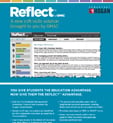
ReflectHogan and the Graduate Management Admission Council (GMAC) partnered to launch Reflect by GMAC, the first self-directed, personality-based development tool designed to bring the power of self-awareness to B-school students.

Reflect evaluates personal and professional qualities deemed imperative in today’s workplace by 800 corporate recruiters. It provides concrete action items to help individuals learn more about themselves, improve their strengths, and address their weaknesses. The Reflect tool is the only interactive platform that goes beyond results to provide a personalized action plan, library, and benchmarking data from 14 job functions.

The assessment measures 10 key competencies:

  • Innovation - generates new and unique ideas
  • Operational Thinking - works efficiently and effectively
  • Decision Making - selects best course of action
  • Strategic Vision - combines own ideas with others
  • Strategic Self-Awareness - recognizes own strengths and weaknesses
  • Resilience - performs well under pressure
  • Drive - holds high standards for self and others
  • Interpersonal Intuition - adjusts communications to audience
  • Valuing Others - builds trust-based relationships
  • Collaboration - promotes team accomplishments

More on Reflect by GMAC, powered by Hogan

Topics: Reflect, assessment, self awareness, GMAC

Subscribe to our Blog

Most Popular Posts

Connect