Your Middle Managers are Getting a Bum Rap

Posted by Hogan Assessments on Sun, Aug 11, 2013

Middle managers are perhaps the most maligned individuals in the corporate world. Most view them as roadblocks whose sole purpose is to prevent efficiency or innovation. And when business consultants come in, middle managers are the first to go.


At Hogan, we think middle managers get a bum rap. Rather than the useless bureaucrats they are made out to be, middle managers can be the key to an effective organization.

A recent article on Slate illustrates my point.

If there was ever an easy example of how layers of ineffective middle managers can break down organizational effectiveness, it’s the U.S. government and its public-facing agencies (think the IRS, the passport office, etc.). Five minutes in the DMV is all it takes to send the most levelheaded among us into a white-hot rage.

But a recent article titled “The Most Efficient Office in the World” describes a Manhattan passport office that not only received rave reviews from the authors’ friend, a management consultant, but from the general public as well (the site has a startling 4.5 stars on Yelp).

What is the secret to this lowly agency’s runaway customer satisfaction? Its manager, Michael Hoffman:

[Hoffman] faces the same combination of constraints that many middle managers in the corporate world do. He has to deal with some amount of standardization… [and] he receives visits from his supervisors at the State Department and the regional passport headquarters, who evaluate him based on performance metrics like cost savings and the rate at which passport applications are processed.

But Hoffman also has a great deal of discretion in how the place is run: the layout of the various waiting rooms, the particular queues that move people through the application process (Hoffman has chosen four: one for appointments, one for walk-ins, a special-requests line, and one for applicants with complicated cases), and the color of the walls (they’re currently a dull institutional blue; he’s planning on painting them a cheerier yellow). And it’s his job to motivate and manage his workforce. He promotes high-performing agents and disciplines—or in extreme instances even fires—lower-performing ones. He’s been given enough autonomy within the context of a federal bureaucracy to make the passport experience in New York terrible or fantastic, and… Hoffman, a modest and unassuming mid-level bureaucrat with a fondness for baseball, has just done a great job of using his power to make the office run really well.

If Hoffman can take a model of inefficiency and turn it into a place of which people are at least tolerant, imagine what a manger of his caliber could do with the resources of a private corporation.

Want more information on mid-level managers? Check out our latest ebook, Four ways you’re failing you’re middle managers, and why it’s killing innovation.

New Certification Workshop Location: Times Square

Posted by Hogan News on Tue, Aug 06, 2013

Hogan Cert ThumbThe Hogan Certification workshop will be held in a new location this October. The Westin New York at Times Square will host the two-day workshop where participants will leave with an in-depth understanding of how to use and interpret the Hogan suite of assessments. Register for this popular workshop location before it fills up.


More info and register

Topics: certification, workshop

New Certification Workshop Location: Times Square

Posted by HNews on Mon, Aug 05, 2013

Hogan Cert Thumb

The Hogan Certification workshop will be held in a new location this October. The Westin New York at Times Square will host the two-day workshop where participants will leave with an in-depth understanding of how to use and interpret the Hogan suite of assessments. Register for this popular workshop location before it fills up.

Topics: certification

New from the Hogan Bookstore: Don't Hire the Best

Posted by Hogan News on Thu, Aug 01, 2013

Dont Hire ThumbEveryone has made a bad hire, and considering they typically cost 150% of their annual salary, chances are you don't want it to happen again. This new book by Abhijit Bhaduri outlines how employers should weigh education, experience, competence, and personality to hire the right people and drive success at their companies.

 For more info and to purchase

New from the Hogan Bookstore: Don’t Hire the Best

Posted by HNews on Wed, Jul 31, 2013


Dont Hire ThumbEveryone has made a bad hire, and considering they typically cost 150% of their annual salary, chances are you don’t want it to happen again. This new book by Abhijit Bhaduri outlines how employers should weigh education, experience, competence, and personality to hire the right people and drive success at their companies.
For more info and to purchase


The Johnson Treatment

Posted by Hogan News on Mon, Jul 29, 2013

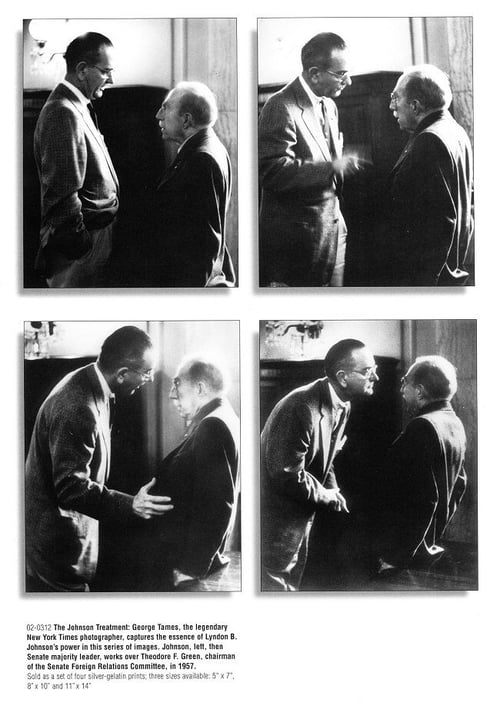
Workplace bullies are skilled manipulators and politicians who harass others not out of social frustration but to fulfill their professional ambitions. Take Lyndon B. Johnson, the 36th President of the United States, for example. His bullying and coercive tactics were so legendary that they were termed “the Johnson Treatment.” Below you can see Johnson effectively giving Senator Theodore Green of Rhode Island the Treatment.

nytjohnson

On his somewhat irreverent Dead Presidents Tumblr, self-proclaimed presidential historian Anthony Bergen describes Johnson’s bullying tactics beyond physical intimidation: “Lyndon Johnson had an innate, often stunning ability to read the personalities of others and immediately understand exactly how to ingratiate himself with them...Johnson would tailor his strategy differently for everybody he approached, and his success rate was astonishing.” Johnson sought out those who would propel his career forward, often stating “Power is where power goes.”

While a president is a rather extreme example, according to the Workplace Bullying Institute, more than 50% of workers have witnessed workplace bullying. Read more about the characteristics and effects of a potential workplace bully in our ebook Bullying Their Way to the Top and avoid hiring employees who might dole out their own version of the Johnson Treatment.

Topics: leadership, bullying

The Johnson Treatment

Posted by HNews on Sun, Jul 28, 2013

Workplace bullies are skilled manipulators and politicians who harass others not out of social frustration but to fulfill their professional ambitions. Take Lyndon B. Johnson, the 36th President of the United States, for example. His bullying and coercive tactics were so legendary that they were termed “the Johnson Treatment.” Below you can see Johnson effectively giving Senator Theodore Green of Rhode Island the Treatment.

nytjohnson

On his somewhat irreverent Dead Presidents Tumblr, self-proclaimed presidential historian Anthony Bergen describes Johnson’s bullying tactics beyond physical intimidation: “Lyndon Johnson had an innate, often stunning ability to read the personalities of others and immediately understand exactly how to ingratiate himself with them…Johnson would tailor his strategy differently for everybody he approached, and his success rate was astonishing.” Johnson sought out those who would propel his career forward, often stating “Power is where power goes.”

While a president is a rather extreme example, according to the Workplace Bullying Institute, more than 50% of workers have witnessed workplace bullying. Read more about the characteristics and effects of a potential workplace bully in our ebook Bullying Their Way to the Top and avoid hiring employees who might dole out their own version of the Johnson Treatment.

Topics: bullying

High Potentials: What works and what doesn't?

Posted by Hogan News on Thu, Jul 25, 2013

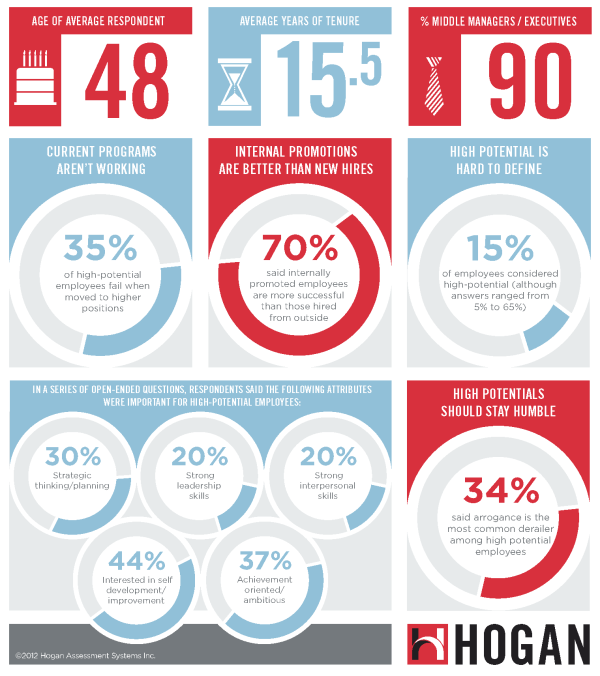
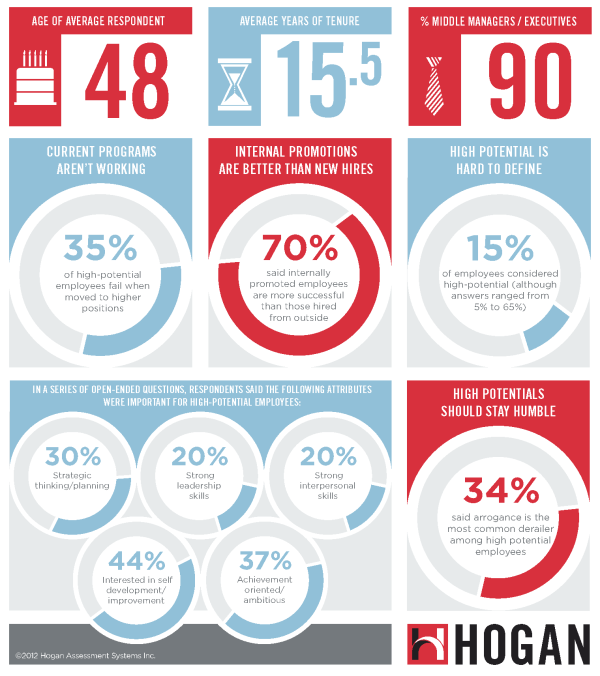
Focusing on employee potential maximizes organizational performance. So why do so many companies lack a comprehensive plan to identify, retain, and develop their high potential employees? Current processes for identifying high-potentials produce mixed results. We surveyed more than 200 middle managers and executives to find out what works and what doesn’t.

High Potentials

Topics: high potentials

High Potentials: What works and what doesn’t?

Posted by HNews on Wed, Jul 24, 2013

Focusing on employee potential maximizes organizational performance. So why do so many companies lack a comprehensive plan to identify, retain, and develop their high potential employees? Current processes for identifying high-potentials produce mixed results. We surveyed more than 200 middle managers and executives to find out what works and what doesn’t.

High Potentials

Topics: high potentials

Coaching the Coach

Posted by Hogan News on Tue, Jul 23, 2013

Coaching ThumbCEOs and executives helm the ship by encouraging their crew to work together and use resources at hand. Although some guide their teams safely to their destination, others end up lost at sea. Organizational and executive coaches can help leaders keep their teams on track when they begin to flounder.

5 Suggestions from the Hogan Coaching Network for Building an Effective Development Framework
1. Provide education and training. Formal programs, classes, or workshops; coaching; mentoring; webinars; or on-the-job training are all valuable resources to build and reinforce an employee’s skills and improve performance.
2. Leverage strengths. If a leader lacks creative and innovative ability but excels in effective teambuilding, he or she can leverage his or her ability to create an environment that facilitates and nurtures the team’s new and different ideas.
3. Compensate with alternative behaviors. Use positive behaviors to rebuild a reputation marked by counterproductive behaviors. As positive behaviors are demonstrated multiple times, the manager’s reputation will begin to change, and often new behaviors become the person’s natural behaviors.
4. Support weakness with resources. When someone has a clear weakness, such as micromanaging, sometimes the most effective development strategy is to compensate by supporting the employee with additional resources, such as a direct report who excels at dotting the I’s and crossing the T’s.
5. Redesign the job or assignment. More effective than allowing an individual’s performance to flag, it is sometimes possible to alter an individual’s job requirements to remove key roles or responsibilities and assign him or her elsewhere in the organization.

Read the full paper.

Topics: coaching, Hogan Coaching Network

Subscribe to our Blog

Most Popular Posts

Connect