Coaching the Coach

Posted by HNews on Mon, Jul 22, 2013

Coaching ThumbCEOs and executives helm the ship by encouraging their crew to work together and use resources at hand. Although some guide their teams safely to their destination, others end up lost at sea. Organizational and executive coaches can help leaders keep their teams on track when they begin to flounder.

5 Suggestions from the Hogan Coaching Network for Building an Effective Development Framework
1. Provide education and training. Formal programs, classes, or workshops; coaching; mentoring; webinars; or on-the-job training are all valuable resources to build and reinforce an employee’s skills and improve performance.
2. Leverage strengths. If a leader lacks creative and innovative ability but excels in effective teambuilding, he or she can leverage his or her ability to create an environment that facilitates and nurtures the team’s new and different ideas.
3. Compensate with alternative behaviors. Use positive behaviors to rebuild a reputation marked by counterproductive behaviors. As positive behaviors are demonstrated multiple times, the manager’s reputation will begin to change, and often new behaviors become the person’s natural behaviors.
4. Support weakness with resources. When someone has a clear weakness, such as micromanaging, sometimes the most effective development strategy is to compensate by supporting the employee with additional resources, such as a direct report who excels at dotting the I’s and crossing the T’s.
5. Redesign the job or assignment. More effective than allowing an individual’s performance to flag, it is sometimes possible to alter an individual’s job requirements to remove key roles or responsibilities and assign him or her elsewhere in the organization.

Read the full paper.

Topics: coaching, Hogan Coaching Network

The Art of Asking Good Questions

Posted by Dan Paulk on Mon, Jul 22, 2013

Blue questionThere’s an old sales adage: the person who asks the questions controls the agenda

How well do you ask questions? Even though salespeople are very deliberate and strategic in their question-asking, most managers and leaders don't think about this issue. After all, you don't usually find "the ability to ask good questions" on any list of managerial competencies, but asking questions effectively is a major underlying part of a manager's job, which suggests that it might be worth giving this skill a little more focus.

Dan Black, in On Leadership , states that “Having and maintaining relationships is essential when it comes to leadership. One essential aspect to learning about, connecting with, and relating to the people in your life comes through the art of asking good questions.” This is an essential ingredient to becoming a relational leader.  

Two basic question-asking principles can be valuable tools for a leader: open-ended questions and clarifying questions.

1. Open-ended questions can lead to a better discussion and a deeper level of conversation. This is because they require more than a yes or no response. One example is: “What is your most pressing business challenge in taking on this project?” This question type keeps a conversation alive and flowing.

2. Clarifying questions show engagement and bring clarification to what the other person is saying. Some examples: “Can you be more specific?” or “Can you share an example?” An interesting consequence to asking a clarification question is that it spawns successive questions.

Socrates observed that you can tell how clever a person is by their answers, but you can tell how wise a person is by their questions. Most of us never think about how to frame our questions, but doing so not only improves a one’s inquiry skills, it can, as our sales adage reminds, help us gain something strategically. 

There once were two monks who lived an uncomplicated life of peace and devotion at the monastery. Both were exemplary individuals, but each also had one vice, that of cigarette-smoking. Smoking was a privilege rarely granted by the Monsignor, and permission had to be granted.

One day, both monks had an insatiable desire to smoke, so they each separately approached the monsignor to ask permission to smoke. One monk returned shortly with an anger he could barely control, saying the monsignor had denied him the opportunity to light up. The other monk returned to their dorm and immediately lit a cigarette.

The denied monk was furious. "How did you get to smoke and I didn't?" he queried. "I asked if I could smoke while I prayed in the chapel--I was flatly denied; what in providence did you ask?" The other monk smugly answered, "I merely asked the Monsignor if it would be all right if I continued to pray while I smoked!"

The art of asking good questions is essential in learning about, connecting with, and relating to the people in your life where relationships matter.

Topics: leadership

The Art of Asking Good Questions

Posted by DPaulk on Sun, Jul 21, 2013

Blue questionThere’s an old sales adage: the person who asks the questions controls the agenda

How well do you ask questions? Even though salespeople are very deliberate and strategic in their question-asking, most managers and leaders don’t think about this issue. After all, you don’t usually find “the ability to ask good questions” on any list of managerial competencies, but asking questions effectively is a major underlying part of a manager’s job, which suggests that it might be worth giving this skill a little more focus.

Dan Black, in On Leadership , states that “Having and maintaining relationships is essential when it comes to leadership. One essential aspect to learning about, connecting with, and relating to the people in your life comes through the art of asking good questions.” This is an essential ingredient to becoming a relational leader.  

Two basic question-asking principles can be valuable tools for a leader: open-ended questions and clarifying questions.

1. Open-ended questions can lead to a better discussion and a deeper level of conversation. This is because they require more than a yes or no response. One example is: “What is your most pressing business challenge in taking on this project?” This question type keeps a conversation alive and flowing.

2. Clarifying questions show engagement and bring clarification to what the other person is saying. Some examples: “Can you be more specific?” or “Can you share an example?” An interesting consequence to asking a clarification question is that it spawns successive questions.

Socrates observed that you can tell how clever a person is by their answers, but you can tell how wise a person is by their questions. Most of us never think about how to frame our questions, but doing so not only improves a one’s inquiry skills, it can, as our sales adage reminds, help us gain something strategically. 

There once were two monks who lived an uncomplicated life of peace and devotion at the monastery. Both were exemplary individuals, but each also had one vice, that of cigarette-smoking. Smoking was a privilege rarely granted by the Monsignor, and permission had to be granted.

One day, both monks had an insatiable desire to smoke, so they each separately approached the monsignor to ask permission to smoke. One monk returned shortly with an anger he could barely control, saying the monsignor had denied him the opportunity to light up. The other monk returned to their dorm and immediately lit a cigarette.

The denied monk was furious. “How did you get to smoke and I didn’t?” he queried. “I asked if I could smoke while I prayed in the chapel–I was flatly denied; what in providence did you ask?” The other monk smugly answered, “I merely asked the Monsignor if it would be all right if I continued to pray while I smoked!”

The art of asking good questions is essential in learning about, connecting with, and relating to the people in your life where relationships matter.

Why Validity Matters

Posted by Hogan News on Thu, Jul 18, 2013

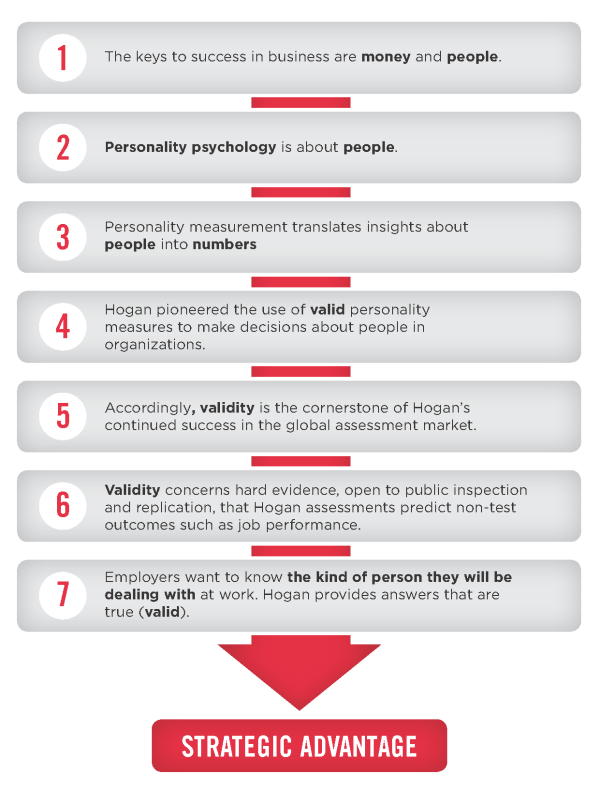
A quick-reference guide to understanding how validity relates to Hogan’s business model and marketing content.

Validity Matters

Topics: assessment, personality psychology, validity

Why Validity Matters Graphic

Posted by HNews on Wed, Jul 17, 2013


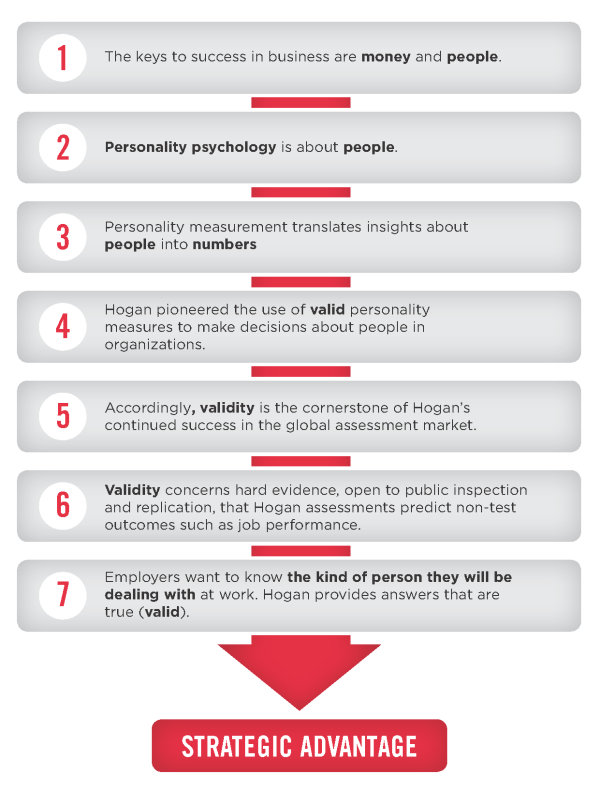
A quick-reference guide to understanding how validity relates to Hogan’s business model and marketing content.

Validity Matters

Topics: assessment

Keep Calm and Carry On

Posted by Hogan News on Tue, Jul 16, 2013

Keep calmEveryone has worked with someone they could describe as a pistol, a live wire, or a short fuse. These excitable individuals’ energy and enthusiasm can energize their peers and employees, but their mood can turn on a dime, and when it does, they will have their employees walking on eggshells to avoid setting them off.

What makes these time-bomb personalities tick, and how can you keep excitable individuals from unleashing their dark side?

Find out in our complimentary ebook, Keep Calm and Carry On.

Topics: Hogan Development Survey, HDS, derailment

Keep Calm and Carry On

Posted by HNews on Mon, Jul 15, 2013

Keep calmEveryone has worked with someone they could describe as a pistol, a live wire, or a short fuse. These excitable individuals’ energy and enthusiasm can energize their peers and employees, but their mood can turn on a dime, and when it does, they will have their employees walking on eggshells to avoid setting them off.



 

What makes these time-bomb personalities tick, and how can you keep excitable individuals from unleashing their dark side?


Find out in our complimentary ebook, Keep Calm and Carry On.

Topics: derailment

Workplace Nightmares

Posted by Hogan News on Mon, Jul 15, 2013

Gordon Ramsay, one of the most explosive personalities in the culinary industry, is widely known for his entrepreneurial genius as well as his bullying tactics and creative insults on TV shows Hell’s Kitchen and Ramsay’s Kitchen Nightmares. His verbally abusive outbursts have brought tears to many aspiring chefs’ eyes as he decimates their confidence with scathing derision. Back to your Easy-Bake Oven!

gordonramsay

Studies show that, while Gordon Ramsay may be sensationalized by reality TV, boss bullies are quite real. According to the Workplace Bullying Institute, 35% of workers have experienced workplace bullying and that, alarmingly, the vast majority are managers, supervisors, and executives.

Many workplace bullies suffered from a turbulent childhood, not excluding Ramsay, and overcompensate later in life with a ruthless drive for power. Unfortunately, studies show that bullied employees have higher rates of turnover and lowered engagement.

Learn how to understand the bullies in your office and never hire another bully again in our complimentary ebook, Bullying Their Way to the Top.


Topics: leadership, bullying

Workplace Nightmares

Posted by HNews on Sun, Jul 14, 2013

Gordon Ramsay, one of the most explosive personalities in the culinary industry, is widely known for his entrepreneurial genius as well as his bullying tactics and creative insults on TV shows Hell’s Kitchen and Ramsay’s Kitchen Nightmares. His verbally abusive outbursts have brought tears to many aspiring chefs’ eyes as he decimates their confidence with scathing derision. Back to your Easy-Bake Oven!

gordonramsay

Studies show that, while Gordon Ramsay may be sensationalized by reality TV, boss bullies are quite real. According to the Workplace Bullying Institute, 35% of workers have experienced workplace bullying and that, alarmingly, the vast majority are managers, supervisors, and executives.

Many workplace bullies suffered from a turbulent childhood, not excluding Ramsay, and overcompensate later in life with a ruthless drive for power. Unfortunately, studies show that bullied employees have higher rates of turnover and lowered engagement.

Learn how to understand the bullies in your office and never hire another bully again in our complimentary ebook, Bullying Their Way to the Top.

Topics: bullying

Risky Business

Posted by Hogan News on Thu, Jul 11, 2013

HDS Scale ThumbCareer success depends more on an individual’s ability to get along with his or her supervisor, peers, and employees than it does on intellect or technical skill. Perhaps that is why some people seem to succeed with little more than a wink and a smile. Most of the time, these individuals are friendly, spontaneous, and fun loving. At their worst, however, they can be flighty, impulsive, or outright Machiavellian. How can you be sure your employees are using their powers of persuasion for good, not evil?

Risky Business, the latest in our HDS scale ebook series, looks at how the mischievous side of people can impact their careers.

Topics: Hogan Development Survey, HDS, HDS scales, #riskybusiness

Subscribe to our Blog

Most Popular Posts

Connect