You manage things; you lead people.
+1.918.749.0632




You manage things; you lead people.
Say you apply for a job. You take an assessment to see if you’re the right fit for the company and the role. After you join the company, you take another assessment to gauge your managerial skills. Later you may be part of a team-building exercise, which requires an entirely different assessment. Pretty soon, you’re feeling like this:

According to senior consultant Dr. Kevin Meyer, a lot of companies are dealing with assessment overkill.
“Over time, they’ve adopted specific assessment tools for specific needs,” he said. “In theory, it’s a good approach, but when you use different tools there’s no common framework for a company to use to understand and evaluate its employees.”
Our comprehensive approach to personality assessment provides the depth and detail companies need to hire the right people, identify and develop talented individuals, build better leaders, and improve their bottom line. And because personality is stable over time, our assessments are a useful tool throughout the employee lifecycle.
To learn more, check out this video interview, or read our new eBook, Why Personality?
Topics: personality, assessment
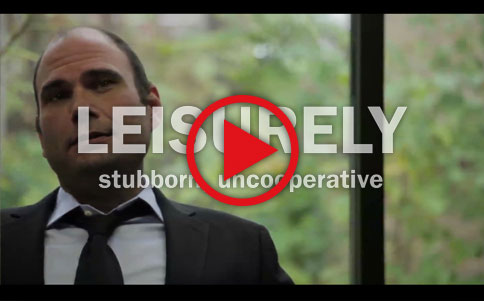
He’s the passive aggressor, the one with the tight-jawed smile. Sure, he’s a great guy when he gets his way, but give him an unpleasant task and he’ll drag his feet. Need him to fill out that insurance paperwork? Yeah. He’ll get right on that.
On the climb up the corporate ladder, the line between strength and weakness isn’t always clear. Although the procrastinator is outwardly pleasant and sociable, team members may be putt off by his stubbornness.
Watch this video to see the Procrastinator at work, or visit www.howdoyouderail.com to view the entire HDS video series. Follow on Twitter @ImHiLeisurely #howdoyouderail
Topics: Hogan Development Survey, HDS, How Do You Derail, HDS video, HDS scale
Say you apply for a job. You take an assessment to see if you’re the right fit for the company and the role. After you join the company, you take another assessment to gauge your managerial skills. Later you may be part of a team-building exercise, which requires an entirely different assessment. Pretty soon, you’re feeling like this:

According to senior consultant Dr. Kevin Meyer, a lot of companies are dealing with assessment overkill.
“Over time, they’ve adopted specific assessment tools for specific needs,” he said. “In theory, it’s a good approach, but when you use different tools there’s no common framework for a company to use to understand and evaluate its employees.”
Our comprehensive approach to personality assessment provides the depth and detail companies need to hire the right people, identify and develop talented individuals, build better leaders, and improve their bottom line. And because personality is stable over time, our assessments are a useful tool throughout the employee lifecycle.
To learn more, check out this video interview, or read our new eBook, Why Personality?
Topics: assessment
He’s the passive aggressor, the one with the tight-jawed smile. Sure, he’s a great guy when he gets his way, but give him an unpleasant task and he’ll drag his feet. Need him to fill out that insurance paperwork? Yeah. He’ll get right on that.
On the climb up the corporate ladder, the line between strength and weakness isn’t always clear. Although the procrastinator is outwardly pleasant and sociable, team members may be putt off by his stubbornness.
Watch this video to see the Procrastinator at work, or visit www.howdoyouderail.com to view the entire HDS video series. Follow on Twitter @ImHiLeisurely #howdoyouderail
 High-Performance Strategies for Business Teams
Society tends to idolize the individual – from the star quarterback to the charismatic leaders of the modern business arena. In business, high-performing teams can achieve superior results to individuals. Yet, when the psychological roles within a team are unbalanced, even teams composed of talented individuals rarely perform to their maximum potential.
Download The Office Playbook and learn about team culture and the personalities that influence performance.
Topics: teams, team-building, team culture
High-Performance Strategies for Business Teams
Society tends to idolize the individual – from the star quarterback to the charismatic leaders of the modern business arena. In business, high-performing teams can achieve superior results to individuals. Yet, when the psychological roles within a team are unbalanced, even teams composed of talented individuals rarely perform to their maximum potential.
Download The Office Playbook and learn about team culture and the personalities that influence performance.
 When it comes to understanding your employees, it boils down to three basic questions:
What do people want? What are the core motives, values, and interests that get them out of bed and into the office every morning?
How will they get what they want? What strengths and weaknesses do they display when they are at their best?
What will get in their way? What are their derailers, the characteristics that emerge during stress or pressure to erode relationships and derail their chances of success?
Armed with this powerful information, you can make better hires, identify and develop talented individuals, build better leaders, and impact your bottom line. To find out more, check out our recent eBook, Why Personality?
 When it comes to understanding your employees, it boils down to three basic questions:
What do people want? What are the core motives, values, and interests that get them out of bed and into the office every morning?
How will they get what they want? What strengths and weaknesses do they display when they are at their best?
What will get in their way? What are their derailers, the characteristics that emerge during stress or pressure to erode relationships and derail their chances of success?
Armed with this powerful information, you can make better hires, identify and develop talented individuals, build better leaders, and impact your bottom line. To find out more, check out our recent eBook, Why Personality?
Assessments are powerful, business-critical tools that predict and monitor employee performance and multiple assessments are administered based on the different needs within the organization. Over the course of a typical year, some employees might be assessed and reassessed over and over again, causing frustration and assessment burnout for already busy employees. When organizations use multiple assessments that have no or limited correlation to each other, it also creates a glut of data that forms its very own black hole, sucking in all the information – full of redundancies – including the vital insights.
Since the variance between these assessment tools is often slight, organizations risk capturing virtually the same data in different systems that are further limiting because they are unable to talk to each other. Organization-wide, collected data filters into this black hole ensuring it is nearly impossible to compare results or pull broad-spectrum reports. As more assessments are ordered to suit emerging needs, employees and human resources professionals become frustrated. To avoid burnout and black hole syndrome, finding an alternative is imperative.
Research indicates that the solution may be easier than you realize: employ a comprehensive suite of assessment tools. Here’s how:
One Suite, Multiple Options Having a comprehensive suite allows the organization to assess employees once, using the same questions for everyone. With this concise data in hand, the organization can run multiple reports on everything from detecting leadership potential to recognizing levels of accident proneness.
Creating Consistency Collecting the same information about all employees provides a broad, deep understanding of the entire workforce.
Implementing Strategy This starts by identifying the organization’s needs (PDF) including the biggest pain point; once needs are determined a comprehensive assessment suite can be rolled out. We recommend holding a “conversion” training to help employees understand the new approach and its associated value for improving the HR lifecycle and employee experience.
With a comprehensive assessments suite in place, organizations will see burnout diminish while the black hole gives way to a viable bank of employee data. To find out more about using a comprehensive suite of assessments, download our latest eBook, Why Personality?
Topics: personality, assessment, ebook, Why Personality
