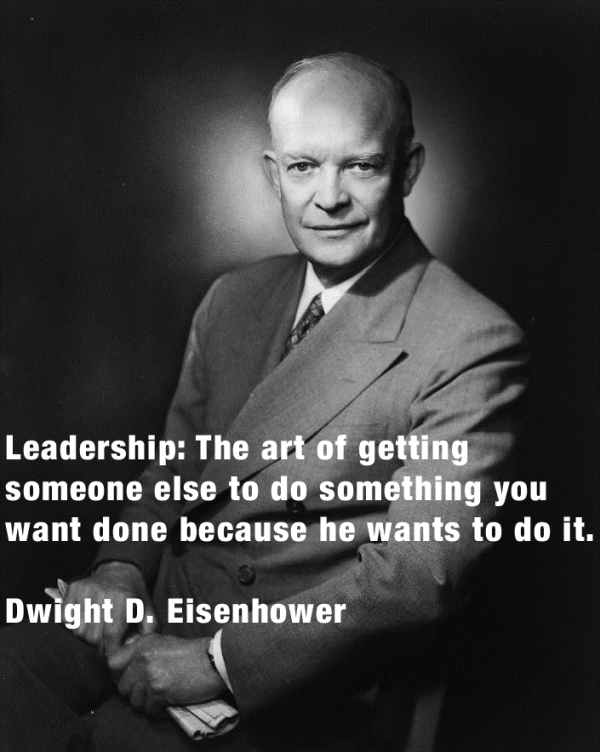
President Eisenhower on leadership:
+1.918.749.0632




President Eisenhower on leadership:

Ever heard the phrase, “employees leave their bosses, not their jobs”? Bad managers are easy to spot, but good managers are more difficult to identify. Because staff engagement is most strongly linked to the behavior of leaders, it is paramount that we recognize what makes a good manager good and a bad manager bad.
Download Good Managers and learn the tipping point that distinguishes a good leader from a bad leader.
Topics: leadership, employee engagement
 Ever heard the phrase, “employees leave their bosses, not their jobs”? Bad managers are easy to spot, but good managers are more difficult to identify. Because staff engagement is most strongly linked to the behavior of leaders, it is paramount that we recognize what makes a good manager good and a bad manager bad.
Download Good Managers and learn the tipping point that distinguishes a good leader from a bad leader.
Topics: employee engagement
 Socioanalytic theory draws on key ideas of Charles Darwin, Sigmund Freud, and George Herbert Mead to explain why people act as they do. All three writers noted that humans evolved as group living animals; this suggests that the big problems in life concern:
In modern life, individual differences in the ability to solve these three problems translate into individual differences in career success. Successful people live longer and healthier lives and are better able to care for their dependents - and that is the definition of fitness in biology. Thus, Socioanalytic theory is about career success.
Socioanalytic theory defines personality from two perspectives: Identity and Reputation. Identity concerns who you think you are; reputation concerns who we think you are. Research on identity has produced few useful generalizations; in contrast, research on reputation has been highly productive; e.g., the Five-Factor Model - a taxonomy of reputation - is a useful way to organize personality research findings. Past behavior predicts future behavior; reputation is a summary of past behavior; thus reputation is the best possible data source for predicting future behavior.
Socioanalytic theory focuses research in four broad areas:
Occupational performance, leadership effectiveness, and managerial incompetence can be predicted with valid personality measures. Team effectiveness depends on putting the right people (defined by personality) in the right positions (defined by team role).
Socioanalytic theory argues that social skill is the key to career success - because social skill translates identity into reputation. Socioanalytic theory also maintains that feedback from valid personality assessment can create strategic self-awareness which allows ambitious people to maximize their career potential and minimize their issues.
Topics: reputation, identity, identity vs reputation, socioanalytic theory, leadership effectiveness, occupational performance
 Socioanalytic theory draws on key ideas of Charles Darwin, Sigmund Freud, and George Herbert Mead to explain why people act as they do. All three writers noted that humans evolved as group living animals; this suggests that the big problems in life concern:
In modern life, individual differences in the ability to solve these three problems translate into individual differences in career success. Successful people live longer and healthier lives and are better able to care for their dependents – and that is the definition of fitness in biology. Thus, Socioanalytic theory is about career success.
Socioanalytic theory defines personality from two perspectives: Identity and Reputation. Identity concerns who you think you are; reputation concerns who we think you are. Research on identity has produced few useful generalizations; in contrast, research on reputation has been highly productive; e.g., the Five-Factor Model – a taxonomy of reputation – is a useful way to organize personality research findings. Past behavior predicts future behavior; reputation is a summary of past behavior; thus reputation is the best possible data source for predicting future behavior.
Socioanalytic theory focuses research in four broad areas:
Occupational performance, leadership effectiveness, and managerial incompetence can be predicted with valid personality measures. Team effectiveness depends on putting the right people (defined by personality) in the right positions (defined by team role).
Socioanalytic theory argues that social skill is the key to career success – because social skill translates identity into reputation. Socioanalytic theory also maintains that feedback from valid personality assessment can create strategic self-awareness which allows ambitious people to maximize their career potential and minimize their issues.
 Results are the what of teamwork, whereas the seven components of the Rocket Model© are the how of teamwork. The relationship between Results and the components of the Rocket Model© is not perfect—some teams do well when they shouldn’t and vice versa. For example, a team may be dysfunctional but have great products or face weak competitors. Such teams, however, will fail when faced with strong competition. Other teams may lose even though they do everything right. Still others may achieve poor Results due to a single, underperforming component of the Rocket Model© (e.g. a team killer, the lack of resources, or poor accountability may prevent a team from winning). We believe that teams need to have at least moderate scores on all seven components of the Rocket Model© if they are to compete successfully.
Effective and ineffective leaders differ in their ability to obtain superior Results. Most organizations are staffed with managers who don’t achieve Results; poor leaders are the biggest obstacles to team or group performance. A critical but often overlooked role of a leader is to teach the team how to win. Athletic team coaches and heads of military combat units tend to do this well – they evaluate the competition and devise strategies and tactics to defeat them. They define team member roles and responsibilities, make members practice, provide feedback and coaching, upgrade talent, and hold members accountable for performance.
Leaders can use three mechanisms to teach their teams how to win. First, set clear metrics and goals that are benchmarked against the competition. These goals might include market share, survey results, analysts’ recommendations, and customer complaints. Given the amount of data available to modern organizations, it is usually easy to find benchmarking information that teams can use to set winning goals.
Second, review team performance regularly. Periodic team scorecard reviews will help members understand where they are succeeding and where they are falling short. These reviews should include discussions about how to improve performance; leaders can also use this time to provide feedback and coaching on proposed solutions.
Third, teach members how to win by creating action plans. These action plans need to state the steps members must take to implement solutions, steps that eventually become roadmaps for winning. The best leaders capitalize on all three techniques to drive team performance.
Topics: leadership, teams, employee engagement, The Rocket Model, team performance, Groups, Team Facilitation, Curphy Consulting Corporation, Followership
 Results are the what of teamwork, whereas the seven components of the Rocket Model© are the how of teamwork. The relationship between Results and the components of the Rocket Model© is not perfect—some teams do well when they shouldn’t and vice versa. For example, a team may be dysfunctional but have great products or face weak competitors. Such teams, however, will fail when faced with strong competition. Other teams may lose even though they do everything right. Still others may achieve poor Results due to a single, underperforming component of the Rocket Model© (e.g. a team killer, the lack of resources, or poor accountability may prevent a team from winning). We believe that teams need to have at least moderate scores on all seven components of the Rocket Model© if they are to compete successfully.
Effective and ineffective leaders differ in their ability to obtain superior Results. Most organizations are staffed with managers who don’t achieve Results; poor leaders are the biggest obstacles to team or group performance. A critical but often overlooked role of a leader is to teach the team how to win. Athletic team coaches and heads of military combat units tend to do this well – they evaluate the competition and devise strategies and tactics to defeat them. They define team member roles and responsibilities, make members practice, provide feedback and coaching, upgrade talent, and hold members accountable for performance.
Leaders can use three mechanisms to teach their teams how to win. First, set clear metrics and goals that are benchmarked against the competition. These goals might include market share, survey results, analysts’ recommendations, and customer complaints. Given the amount of data available to modern organizations, it is usually easy to find benchmarking information that teams can use to set winning goals.
Second, review team performance regularly. Periodic team scorecard reviews will help members understand where they are succeeding and where they are falling short. These reviews should include discussions about how to improve performance; leaders can also use this time to provide feedback and coaching on proposed solutions.
Third, teach members how to win by creating action plans. These action plans need to state the steps members must take to implement solutions, steps that eventually become roadmaps for winning. The best leaders capitalize on all three techniques to drive team performance.
 “What is your greatest weakness?”
A Google search using that common interview question yields more than 2 million articles, most of which outline ways to artfully dodge the answer. The most common trick is to list a weakness in the form of an exaggerated strength. However, the line between strength and weakness isn’t always clear. The personality characteristics that help launch promising careers can turn into crippling derailers down the line. But they don’t have to.
Download How Your Greatest Strength Can Become Your Greatest Weakness and learn how to identify and mitigate potentially destructive behaviors.
Topics: Hogan Development Survey, HDS, strategic self awareness, derailers
 “What is your greatest weakness?”
A Google search using that common interview question yields more than 2 million articles, most of which outline ways to artfully dodge the answer. The most common trick is to list a weakness in the form of an exaggerated strength. However, the line between strength and weakness isn’t always clear. The personality characteristics that help launch promising careers can turn into crippling derailers down the line. But they don’t have to.
Download How Your Greatest Strength Can Become Your Greatest Weakness and learn how to identify and mitigate potentially destructive behaviors.
Topics: derailers
This past weekend, I made an impromptu trip to Kansas City to be with my grandmother in the hospital after a heart attack. Thankfully, the doctors are confident that the damage can be treated quickly and she may be able to return home soon.
During the time I spent with grandmother before returning back to Tulsa, we got to know the nurses and nursing assistants quite well and I couldn’t help but pay close attention to their every move. This is my grandmother, after all, and given the circumstances, my high Skeptical tendencies were out in full force. While we were very pleased with the majority of the staff, there were two nursing assistants that left a more lasting impression.
First, there was nursing assistant A, let’s call her Nancy. During her 12-hour shift, Nancy performed all tasks very well (i.e., administering medication, assisting the patient with bathing, assessing the patient’s vitals and documenting them with the nurse). However, the positive impression Nancy left with us was not due to her technical skills alone. Nancy was upbeat, attentive, friendly, and understanding. She checked in on my grandmother frequently, brought her extra ice cream after room service was closed, and cracked jokes to lighten the mood. Without a doubt, Nancy made the hospital stay easier on my grandmother (and us).
Then, there was nursing assistant B, let’s call her Anita. Anita was from the hospital’s radiology department and transported my grandmother from her room to the lab for testing. Although Anita performed her primary task, she caused us all to be concerned with her interest and capabilities for doing so. As an example, Anita first approached my grandmother’s bed, asking her “Are you going down for X-rays now? I think that’s where you’re going”, while grabbing a piece of paper from her pocket to check the order. She failed to make any attempt to make my grandmother comfortable as she moved from her hospital bed to the gurney and when the R.N. asked Anita if there was an oxygen tank attached to the gurney, Anita glanced at the bed from several feet away and responded “Yeah, it looks like there is a tank.” It was apparent that Anita lacked the confidence, interpersonal skills, and motivators necessary for the role.
This is another example of the importance of personality fit within a role. My colleagues Ryan Daly and Cheryl Dunlap shared stories of a rewarding and disappointing experience with organizations and our observations all share one common, albeit basic, theme: employing the right or wrong people for the job will leave a lasting impression on your customers.
Topics: personality, customer service, job fit
