
A Tale of Two Nurses

Posted by Hogan Assessments on Wed, Sep 12, 2012

This past weekend, I made an impromptu trip to Kansas City to be with my grandmother in the hospital after a heart attack. Thankfully, the doctors are confident that the damage can be treated quickly and she may be able to return home soon.

During the time I spent with grandmother before returning back to Tulsa, we got to know the nurses and nursing assistants quite well and I couldn’t help but pay close attention to their every move. This is my grandmother, after all, and given the circumstances, my high Skeptical tendencies were out in full force. While we were very pleased with the majority of the staff, there were two nursing assistants that left a more lasting impression.

First, there was nursing assistant A, let’s call her Nancy. During her 12-hour shift, Nancy performed all tasks very well (i.e., administering medication, assisting the patient with bathing, assessing the patient’s vitals and documenting them with the nurse). However, the positive impression Nancy left with us was not due to her technical skills alone. Nancy was upbeat, attentive, friendly, and understanding. She checked in on my grandmother frequently, brought her extra ice cream after room service was closed, and cracked jokes to lighten the mood. Without a doubt, Nancy made the hospital stay easier on my grandmother (and us).

Then, there was nursing assistant B, let’s call her Anita. Anita was from the hospital’s radiology department and transported my grandmother from her room to the lab for testing. Although Anita performed her primary task, she caused us all to be concerned with her interest and capabilities for doing so. As an example, Anita first approached my grandmother’s bed, asking her “Are you going down for X-rays now? I think that’s where you’re going”, while grabbing a piece of paper from her pocket to check the order. She failed to make any attempt to make my grandmother comfortable as she moved from her hospital bed to the gurney and when the R.N. asked Anita if there was an oxygen tank attached to the gurney, Anita glanced at the bed from several feet away and responded “Yeah, it looks like there is a tank.” It was apparent that Anita lacked the confidence, interpersonal skills, and motivators necessary for the role.

This is another example of the importance of personality fit within a role. My colleagues Ryan Daly and Cheryl Dunlap shared stories of a rewarding and disappointing experience with organizations and our observations all share one common, albeit basic, theme: employing the right or wrong people for the job will leave a lasting impression on your customers.


Topics: customer service

Bill Gates on Leadership

Posted by Hogan Assessments on Tue, Sep 11, 2012

Here's Bill Gates on leadership.

describe the image

Topics: leadership, Bill Gates, quote

Bill Gates on Leadership

Posted by Hogan Assessments on Mon, Sep 10, 2012


Here’s Bill Gates on leadership.

describe the image


Topics: Bill Gates

The Rocket Model: Team Morale and Conflict

Posted by Hogan Assessments on Mon, Sep 10, 2012

Rocket ModelMorale can be defined as a group or team’s cohesiveness or esprit de corps. Strong emotional ties, close relationships, and high levels of trust between members are the mark of high Morale. Members of high Morale teams often say they would do anything for their teammates; in some cases (combat teams or firefighting crews), members are willing to die for their units. Conversely, low Morale groups and teams contain members who will easily sabotage others if doing so furthers their own careers.

Morale is the component of the Rocket Model© that is most easily observed by outsiders; it is also the primary reason consultants are asked to do team building. However, team leaders are often unable to assess Morale because teams may appear cohesive, but have high levels of covert conflict. This covert conflict is due to norms that require employees to be team players even though they despise one another. The members of these teams smile, nod their heads, and endorse team decisions but secretly resent the process. Leaders need to recognize and deal with this mismatch between members’ private thoughts and public actions if they want functional teams.  

It is important to distinguish between engagement, cohesiveness, and conflict. Engagement concerns members’ willingness to put effort towards team and group tasks.  Members with high levels of engagement take their roles seriously and go above and beyond the call of duty when it comes to getting things done. Engagement is quite different than cohesiveness. Members can all get along but not exert any effort towards team tasks, and highly engaged employees may not particularly like each other. Conflict is related to, but somewhat distinct from, cohesiveness. Teams with low or high levels of conflict may not be particularly cohesive. Often the most cohesive teams are those that experience modest amounts of conflict and have developed ways to get issues successfully resolved.

Unfortunately, many leaders are unable to resolve intra-team conflict. Some hear what they want to hear and ignore the rest. Others know that their teams are riddled with conflict but hope it will just go away. Still others may ask team members to go through team building activities such as sharing personality test results, golf outings, ropes courses, white-water rafting excursions, etc. We know a CEO who asked his dysfunctional team to go on a one-day sailboat cruise and bring ten objects with personal significance. During the cruise, they were to talk about the objects. However, many of these personal stories were leaked back to the larger organization and became sources of mockery for certain team members. This story is fairly typical—most team-building events fail to identify and resolve the sources of intra-team conflict, and have little if any impact on team cohesiveness.  

Topics: leadership, teams, employee engagement, The Rocket Model, team performance, Groups, Team Facilitation, Curphy Consulting Corporation, Followership

The Rocket Model: Team Morale and Conflict

Posted by Hogan Assessments on Sun, Sep 09, 2012

Rocket ModelMorale can be defined as a group or team’s cohesiveness or esprit de corps. Strong emotional ties, close relationships, and high levels of trust between members are the mark of high Morale. Members of high Morale teams often say they would do anything for their teammates; in some cases (combat teams or firefighting crews), members are willing to die for their units. Conversely, low Morale groups and teams contain members who will easily sabotage others if doing so furthers their own careers.

Morale is the component of the Rocket Model© that is most easily observed by outsiders; it is also the primary reason consultants are asked to do team building. However, team leaders are often unable to assess Morale because teams may appear cohesive, but have high levels of covert conflict. This covert conflict is due to norms that require employees to be team players even though they despise one another. The members of these teams smile, nod their heads, and endorse team decisions but secretly resent the process. Leaders need to recognize and deal with this mismatch between members’ private thoughts and public actions if they want functional teams.  

It is important to distinguish between engagement, cohesiveness, and conflict. Engagement concerns members’ willingness to put effort towards team and group tasks.  Members with high levels of engagement take their roles seriously and go above and beyond the call of duty when it comes to getting things done. Engagement is quite different than cohesiveness. Members can all get along but not exert any effort towards team tasks, and highly engaged employees may not particularly like each other. Conflict is related to, but somewhat distinct from, cohesiveness. Teams with low or high levels of conflict may not be particularly cohesive. Often the most cohesive teams are those that experience modest amounts of conflict and have developed ways to get issues successfully resolved.

Unfortunately, many leaders are unable to resolve intra-team conflict. Some hear what they want to hear and ignore the rest. Others know that their teams are riddled with conflict but hope it will just go away. Still others may ask team members to go through team building activities such as sharing personality test results, golf outings, ropes courses, white-water rafting excursions, etc. We know a CEO who asked his dysfunctional team to go on a one-day sailboat cruise and bring ten objects with personal significance. During the cruise, they were to talk about the objects. However, many of these personal stories were leaked back to the larger organization and became sources of mockery for certain team members. This story is fairly typical—most team-building events fail to identify and resolve the sources of intra-team conflict, and have little if any impact on team cohesiveness.  

The Email Black Hole

Posted by Hogan News on Fri, Sep 07, 2012

Email Black HoleAre you convinced you are too busy to keep up with your inbox?

Do you regularly apologize to people after failing to return correspondence?

Does your staff send you multiple follow-up emails covering the same topic?

Technology helps teams connect instantly to members across the globe. Yet, there are many among us who routinely take more than 72 hours to return emails, if they return them at all. These “email black holes” cause serious bottlenecks in workflow and decision-making. Are you part of the problem?

Download our white paper for five reasons you may be creating an email black hole.

Topics: strategic self awareness

The Email Black Hole

Posted by HNews on Thu, Sep 06, 2012

Email Black Hole

Are you convinced you are too busy to keep up with your inbox?

Do you regularly apologize to people after failing to return correspondence?

Does your staff send you multiple follow-up emails covering the same topic?

Technology helps teams connect instantly to members across the globe. Yet, there are many among us who routinely take more than 72 hours to return emails, if they return them at all. These “email black holes” cause serious bottlenecks in workflow and decision-making. Are you part of the problem?

Download our white paper for five reasons you may be creating an email black hole.

Rethinking Leadership Training

Posted by Robert Hogan on Wed, Sep 05, 2012

leadershipLeadership training is a big industry. It is estimated that businesses spent approximately $60 billion on such training in 2011. This raises two questions.

1. Why is so much money spent on leadership training?
2. Is the money well spent?

Leadership training is more about showing respect to certain employees than it is about improving their leadership performance. Being sent to a leadership training course seems to be more of a perk than a response to a perceived need. As to whether the money is well spent, the answer is, “Who knows?” The literature regarding the evaluation of leadership training is sparse, and that is no accident. 

In the absence of empirical data, the issue of leadership trainability can be analyzed logically. Leadership is typically defined in terms of the people in charge. This is the place holder theory of leadership. Because, in most organizations, people are promoted into leadership positions primarily based on politics and only sometimes based on demonstrated leadership, the lessons learned from a study of leadership concern how to climb a hierarchy, not how to run an organization. Moreover, defining leadership in terms of place holder theories is the reason there is so much variability in leadership training curricula. 

Drawing on the study of human origins, Van Vugt, Hogan, and Kaiser propose that leadership is a resource for a group, not a source of privilege for incumbents; in this view, leadership concerns building and maintaining a team that can outperform the competition. Leadership should be defined and evaluated in terms of the performance of the followers; in business this performance is usually specified in terms of profitability. A person can rapidly climb the hierarchy of an organization while ruining the teams he/she leads—and still be called a leader—but a person who leads a team to victory is, in fact, a leader. 

Leadership is a skilled performance. Leadership performance involves building a team by creating team member engagement. A person must behave so as to be perceived by the team members as having:

  • Integrity
  • Good judgment
  • Competence in the activity in which the team is engaged
  • An attractive vision for the future of the team

How do potential leaders persuade their teams that they have integrity, good judgment, competence, and an attractive vision? They do this by putting on a consistent and credible performance that displays probity and astute decision making, demonstrates competence, and explains the vision. However, team members will watch closely for signs that potential leaders lack these characteristics and every lie, bad decision, operational oopsie, and sign of self-serving behavior will undermine their claim to legitimate leadership and alienate the team.

A major factor in the development of any talent concerns coachability - it is the one thing that all professional athletes and good leaders have in common. Coachability can be conceptualized in terms of two components: (1) a desire to improve one’s performance; and (2) being responsive to critical feedback.

Leadership training should follow from one’s theory of leadership. The place holder theory of leadership suggests that we should train people to lie and steal ideas, to bully and humiliate subordinates, or to plunder and bankrupt organizations. In contrast, the team builder theory of leadership suggests we should train people to act with integrity, exercise good judgment, become experts in the business, and be able to persuade the team that their goals are worthy. This analysis also suggests that training money is best spent on people who have talent for leadership and are coachable.

Topics: leadership, employee engagement, leadership performance, leadership training, building a team, executive coaching

Rethinking Leadership Training

Posted by RHogan on Tue, Sep 04, 2012

leadershipLeadership training is a big industry. It is estimated that businesses spent approximately $60 billion on such training in 2011. This raises two questions.
1. Why is so much money spent on leadership training?
2. Is the money well spent?

Leadership training is more about showing respect to certain employees than it is about improving their leadership performance. Being sent to a leadership training course seems to be more of a perk than a response to a perceived need. As to whether the money is well spent, the answer is, “Who knows?” The literature regarding the evaluation of leadership training is sparse, and that is no accident. 

In the absence of empirical data, the issue of leadership trainability can be analyzed logically. Leadership is typically defined in terms of the people in charge. This is the place holder theory of leadership. Because, in most organizations, people are promoted into leadership positions primarily based on politics and only sometimes based on demonstrated leadership, the lessons learned from a study of leadership concern how to climb a hierarchy, not how to run an organization. Moreover, defining leadership in terms of place holder theories is the reason there is so much variability in leadership training curricula. 

Drawing on the study of human origins, Van Vugt, Hogan, and Kaiser propose that leadership is a resource for a group, not a source of privilege for incumbents; in this view, leadership concerns building and maintaining a team that can outperform the competition. Leadership should be defined and evaluated in terms of the performance of the followers; in business this performance is usually specified in terms of profitability. A person can rapidly climb the hierarchy of an organization while ruining the teams he/she leads—and still be called a leader—but a person who leads a team to victory is, in fact, a leader. 

Leadership is a skilled performance. Leadership performance involves building a team by creating team member engagement. A person must behave so as to be perceived by the team members as having:

  • Integrity
  • Good judgment
  • Competence in the activity in which the team is engaged
  • An attractive vision for the future of the team

How do potential leaders persuade their teams that they have integrity, good judgment, competence, and an attractive vision? They do this by putting on a consistent and credible performance that displays probity and astute decision making, demonstrates competence, and explains the vision. However, team members will watch closely for signs that potential leaders lack these characteristics and every lie, bad decision, operational oopsie, and sign of self-serving behavior will undermine their claim to legitimate leadership and alienate the team.

A major factor in the development of any talent concerns coachability – it is the one thing that all professional athletes and good leaders have in common. Coachability can be conceptualized in terms of two components: (1) a desire to improve one’s performance; and (2) being responsive to critical feedback.

Leadership training should follow from one’s theory of leadership. The place holder theory of leadership suggests that we should train people to lie and steal ideas, to bully and humiliate subordinates, or to plunder and bankrupt organizations. In contrast, the team builder theory of leadership suggests we should train people to act with integrity, exercise good judgment, become experts in the business, and be able to persuade the team that their goals are worthy. This analysis also suggests that training money is best spent on people who have talent for leadership and are coachable.

Topics: employee engagement, building a team

Meet ‘That Guy’

Posted by Hogan Assessments on Tue, Sep 04, 2012

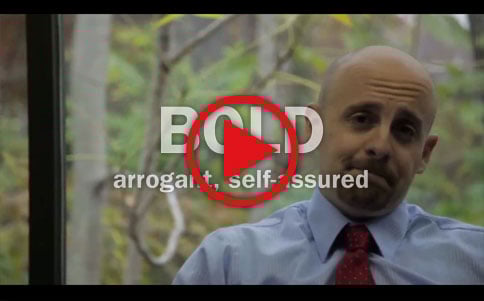
You've seen him around the office, he's made sure of it. He’s the boaster, the big timer, the guy who never seems to mind tooting his own horn. Some call it hubris, but are you really going to question God’s gift to business?

On the climb up the corporate ladder, the line between strength and weakness isn’t always clear. The same confidence and willingness to take credit that helped 'that guy' early in his career can turn into a sense of entitlement under the pressure of the corner office.

Watch this video to see 'that guy' at work, or visit www.howdoyouderail.com to view the entire HDS video series. Follow on Twitter @ImHiBold #howdoyouderail

1084 bold vid

Topics: Hogan Development Survey, HDS, derailment, HDS scales, How Do You Derail

Subscribe to our Blog

Most Popular Posts

Connect